
Density functional theory calculations on Ruthenium polypyridyl complexes
- Slides: 1
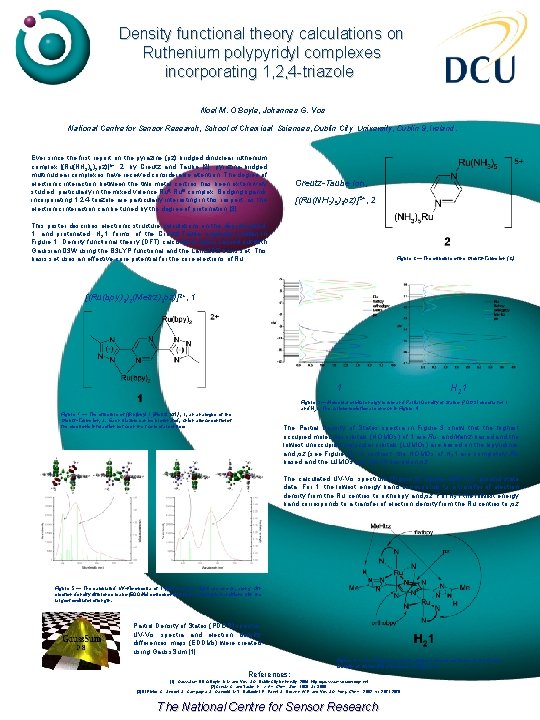
Density functional theory calculations on Ruthenium polypyridyl complexes incorporating 1, 2, 4 -triazole Noel M. O’Boyle, Johannes G. Vos National Centre for Sensor Research, School of Chemical Sciences, Dublin City University, Dublin 9, Ireland. Ever since the first report on the pyrazine (pz) bridged dinuclear ruthenium complex [(Ru(NH 3)5)2 pz)]5+, 2, by Creutz and Taube [2], pyrazine-bridged multinuclear complexes have received considerable attention. The degree of electronic interaction between the two metal centres has been extensively studied, particularly in the mixed valence Ru. II-Ru. III complex. Bridging ligands incorporating 1, 2, 4 -triazole are particularly interesting in this respect, as the electronic interaction can be tuned by the degree of protonation [3]. Creutz-Taube ion, [(Ru(NH 3)5)2 pz)]5+, 2 This poster describes electronic structure calculations on the deprotonated, 1, and protonated, H 21, forms of the Creutz-Taube analogue shown in Figure 1. Density functional theory (DFT) calculations were carried out with Gaussian 03 W using the B 3 LYP functional and the Lan. L 2 DZ basis set. This basis set uses an effective core potential for the core electrons of Ru. Figure 2 — The structure of the Creutz-Taube ion [2]. [(Ru(bpy)2)2(Metrz)2 pz)]2+, 1 1 H 21 Figure 3 — Molecular orbital energy levels and Partial Density of States (PDOS) spectra for 1 and H 21. The various moieties are shown in Figure 4. Figure 1 — The structure of [(Ru(bpy)2)2(Metrz)2 pz)]+, 1, an analogue of the Creutz-Taube ion, 2. Each triazole can be protonated, which allows control of the electronic interaction between the two metal centres. The Partial Density of States spectra in Figure 3 show that the highest occupied molecular orbitals (HOMOs) of 1 are Ru- and Metrz-based and the lowest unoccupied molecular orbitals (LUMOs) are based on the bipyridines and pz (see Figure 4). In contrast, the HOMOs of H 21 are completely Rubased and the LUMOs are mainly based on pz. The calculated UV-Vis spectrum (Figure 5) agrees with this ground state data. For 1, the lowest energy band corresponds to a transfer of electron density from the Ru centres to orthobpy and pz. For H 21 the lowest energy band corresponds to a transfer of electron density from the Ru centres to pz. Figure 5 — The calculated UV-Vis spectra of 1 (left) and H 21 (right) are shown, along with electron density difference maps (EDDMs) corresponding to the electronic transitions with the largest oscillator strength. Partial Density of States (PDOS) spectra, UV-Vis spectra and electron density differences maps (EDDMs) were created using Gauss. Sum [1]. Figure 4 — The diagram shows the group names used to create the Partial Density of States (PDOS) spectra in Figure 3. References: [1] Gauss. Sum 0. 8, O’Boyle, N. M. and Vos, J. G. , Dublin City University, 2004. http: //gausssum. sourceforge. net [2] Creutz, C. and Taube, H. , J. Am. Chem. Soc. , 1969, 91, 3988. [3] Di Pietro, C. , Serroni, S. , Campagna, S. , Gandolfi, M. T. , Ballardini, R. , Fanni, S. , Browne, W. R. and Vos, J. G. , Inorg. Chem. , 2002, 41, 2871 -2878. The National Centre for Sensor Research