
Density cooling Density as a function of depth
- Slides: 28
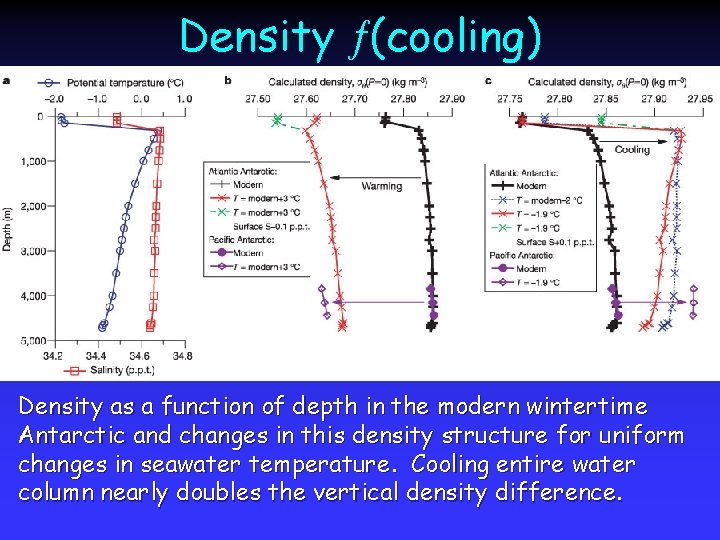
Density (cooling) Density as a function of depth in the modern wintertime Antarctic and changes in this density structure for uniform changes in seawater temperature. Cooling entire water column nearly doubles the vertical density difference.
Effect of Stratification on PCO 2 n n Global cooling an important factor promoting highlatitude stratification Polar ocean stratification prevents deep ocean ventilation u Traps more carbon in the deep sea During Quaternary climatic cycles u Interglacial periods sufficiently warm to allow deep water convection in Antarctic u Not the North Pacific During glacial periods u Stratification in Antarctica and North Pacific u Contribute to lower atmospheric CO 2
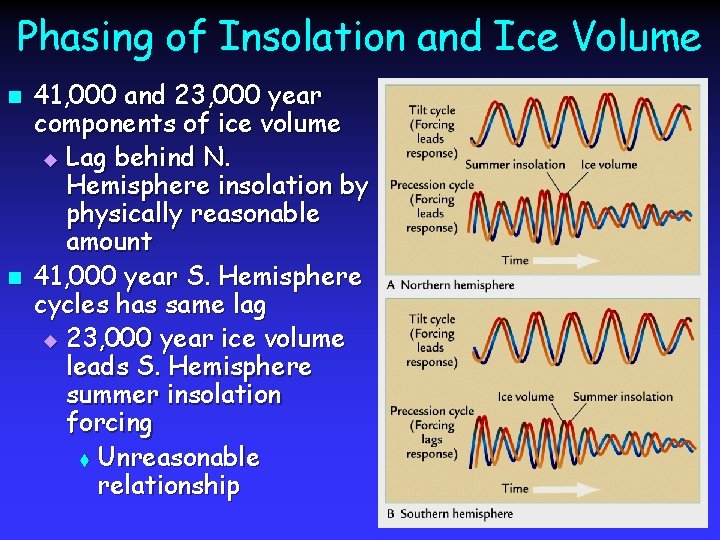
Phasing of Insolation and Ice Volume n n 41, 000 and 23, 000 year components of ice volume u Lag behind N. Hemisphere insolation by physically reasonable amount 41, 000 year S. Hemisphere cycles has same lag u 23, 000 year ice volume leads S. Hemisphere summer insolation forcing t Unreasonable relationship
Questions? If northern hemisphere glaciation drives the benthic d 18 O record and u Northern hemisphere summer insolation leads the ice volume signal and u The precessional cycle is out of phase in the hemispheres u How can polar ocean stratification affect atmospheric CO 2? n When precessional insolation forces ice growth in the northern hemisphere, will it not keep the southern hemisphere warm? n
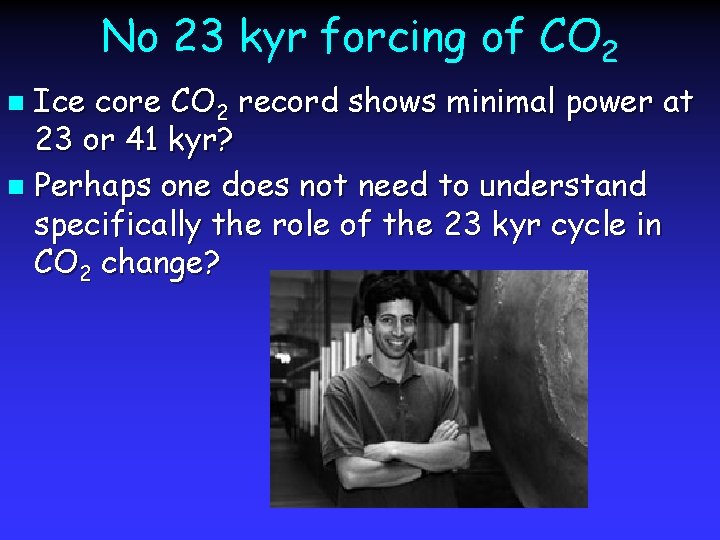
No 23 kyr forcing of CO 2 Ice core CO 2 record shows minimal power at 23 or 41 kyr? n Perhaps one does not need to understand specifically the role of the 23 kyr cycle in CO 2 change? n
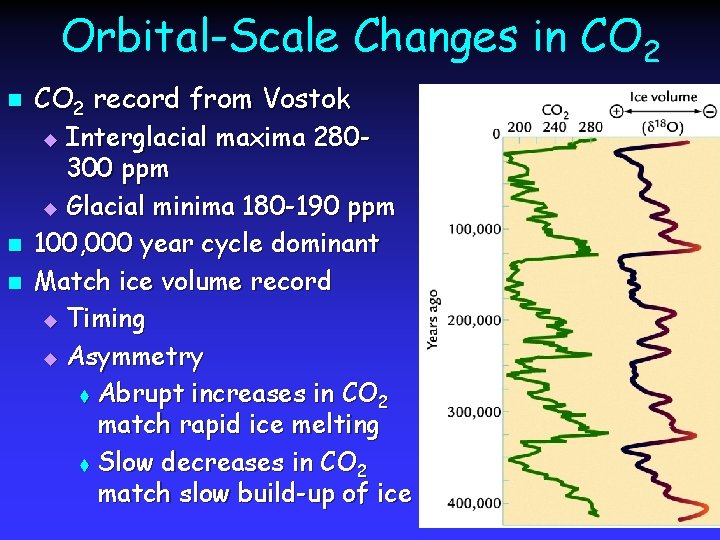
Orbital-Scale Changes in CO 2 record from Vostok Interglacial maxima 280300 ppm u Glacial minima 180 -190 ppm 100, 000 year cycle dominant Match ice volume record u Timing u Asymmetry t Abrupt increases in CO 2 match rapid ice melting t Slow decreases in CO 2 match slow build-up of ice u n n
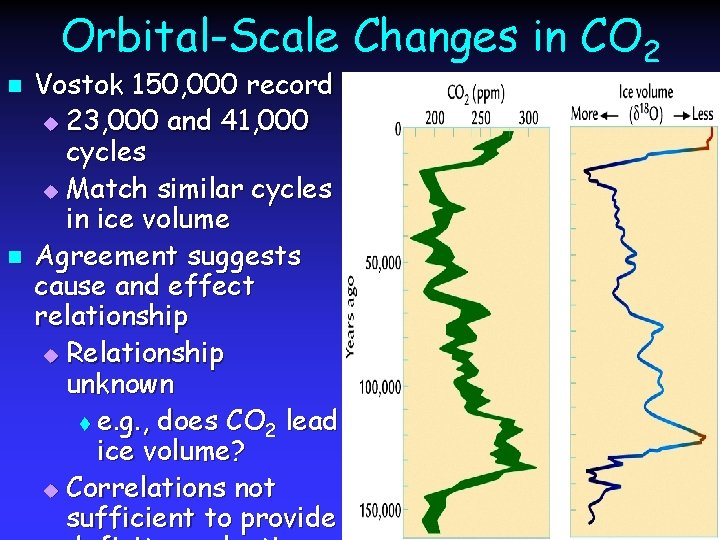
Orbital-Scale Changes in CO 2 n n Vostok 150, 000 record u 23, 000 and 41, 000 cycles u Match similar cycles in ice volume Agreement suggests cause and effect relationship u Relationship unknown t e. g. , does CO 2 lead ice volume? u Correlations not sufficient to provide
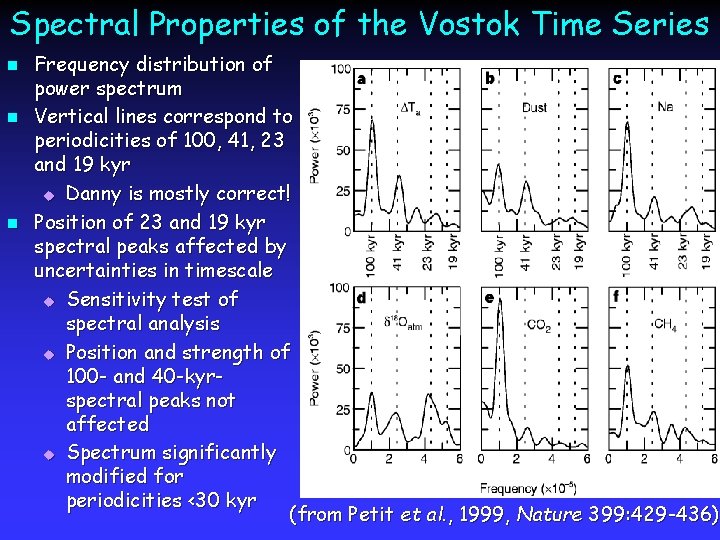
Spectral Properties of the Vostok Time Series n n n Frequency distribution of power spectrum Vertical lines correspond to periodicities of 100, 41, 23 and 19 kyr u Danny is mostly correct! Position of 23 and 19 kyr spectral peaks affected by uncertainties in timescale u Sensitivity test of spectral analysis u Position and strength of 100 - and 40 -kyrspectral peaks not affected u Spectrum significantly modified for periodicities <30 kyr (from Petit et al. , 1999, Nature 399: 429 -436)
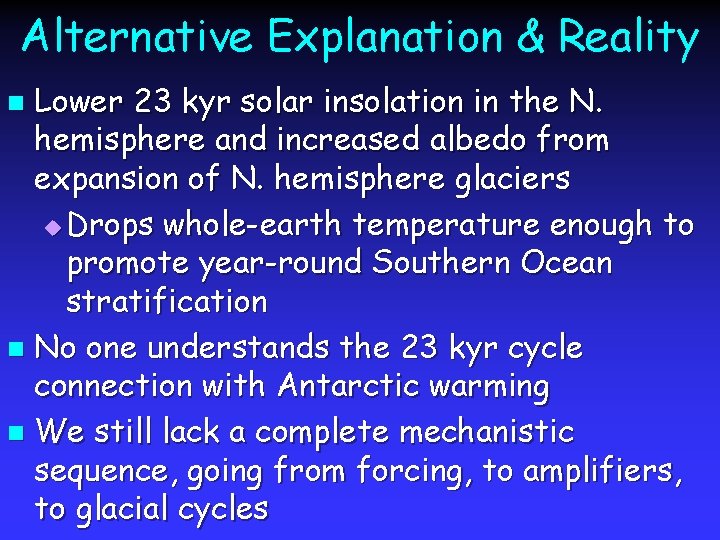
Alternative Explanation & Reality Lower 23 kyr solar insolation in the N. hemisphere and increased albedo from expansion of N. hemisphere glaciers u Drops whole-earth temperature enough to promote year-round Southern Ocean stratification n No one understands the 23 kyr cycle connection with Antarctic warming n We still lack a complete mechanistic sequence, going from forcing, to amplifiers, to glacial cycles n
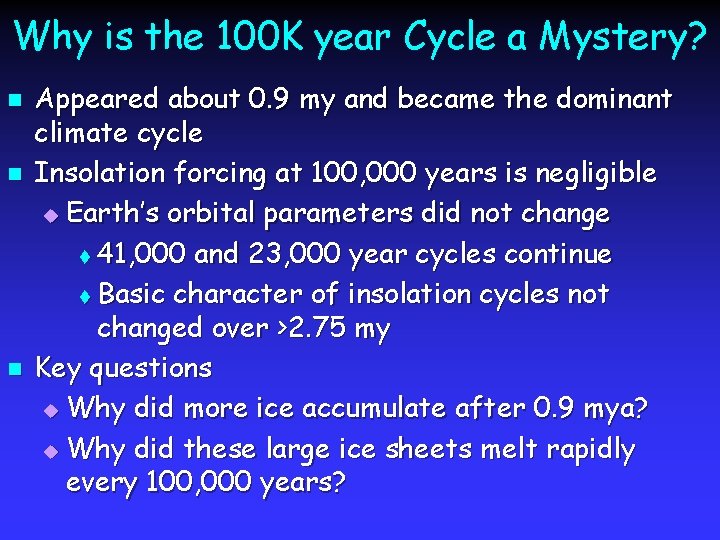
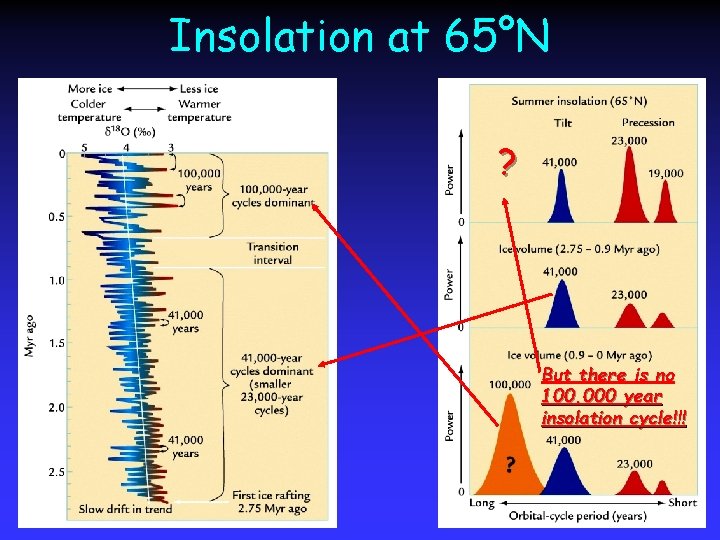
Why is the 100 K year Cycle a Mystery? n n n Appeared about 0. 9 my and became the dominant climate cycle Insolation forcing at 100, 000 years is negligible u Earth’s orbital parameters did not change t 41, 000 and 23, 000 year cycles continue t Basic character of insolation cycles not changed over >2. 75 my Key questions u Why did more ice accumulate after 0. 9 mya? u Why did these large ice sheets melt rapidly every 100, 000 years?
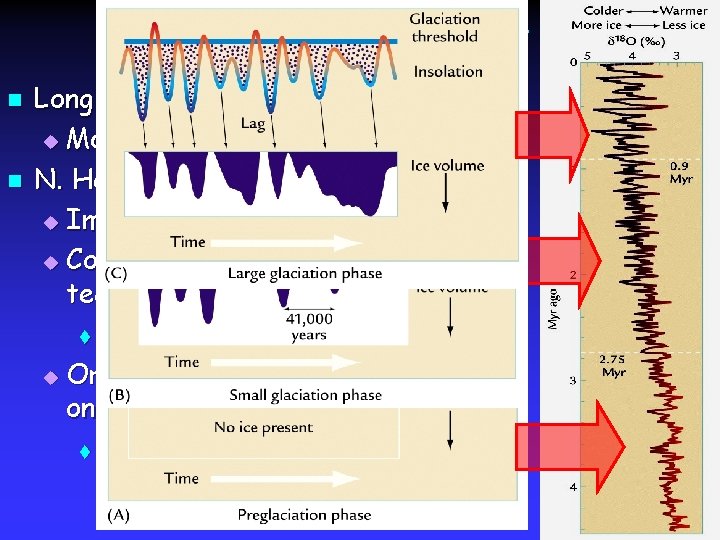
Larger Ice Sheets n n Long cores show gradual cooling u Marine d 18 O record N. Hemisphere ice accumulation u Important only after 2. 75 my u Cooling trend results from tectonic-scale change t CO 2 – weathering/volcanism u Orbital scale cycles superimposed on long term change t Fits the small-glacial to large glacial phase model
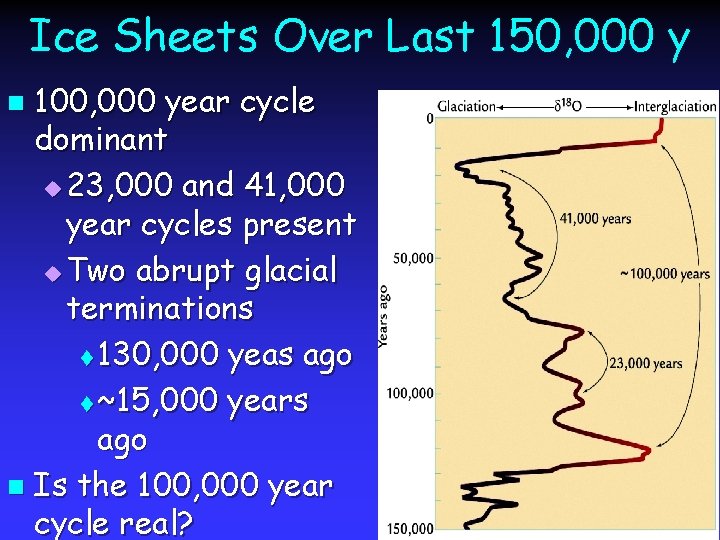
Ice Sheets Over Last 150, 000 y 100, 000 year cycle dominant u 23, 000 and 41, 000 year cycles present u Two abrupt glacial terminations t 130, 000 yeas ago t ~15, 000 years ago n Is the 100, 000 year cycle real? n
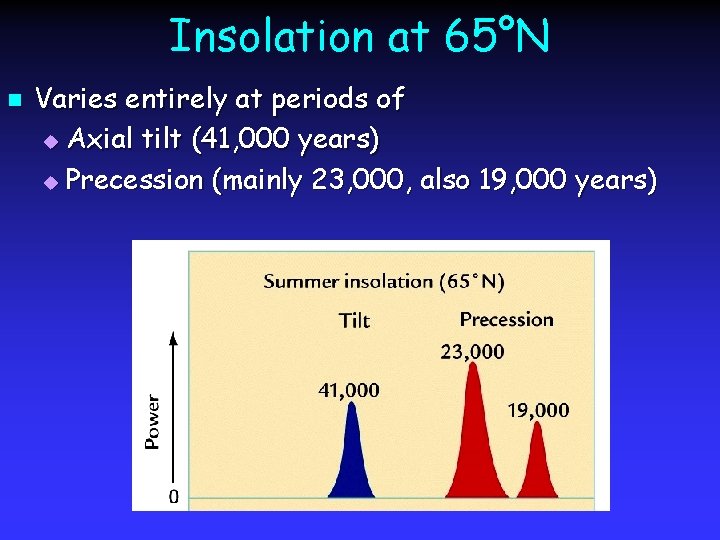
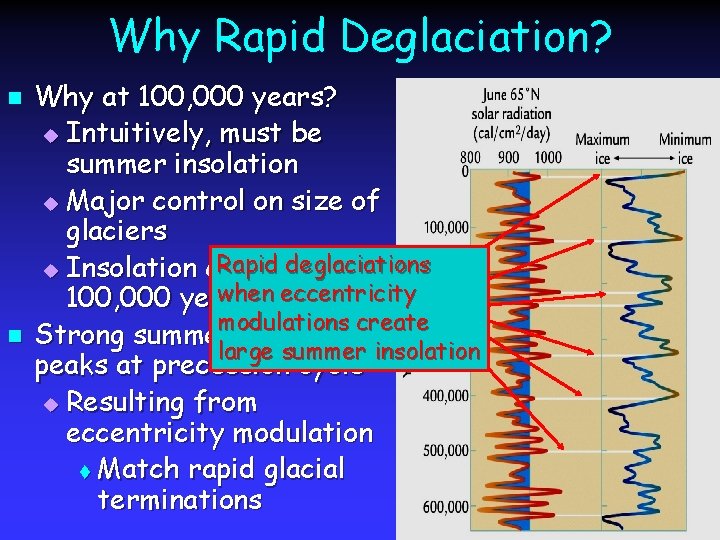
Insolation at 65°N n Varies entirely at periods of u Axial tilt (41, 000 years) u Precession (mainly 23, 000, also 19, 000 years)
Insolation at 65°N ? But there is no 100, 000 year insolation cycle!!!
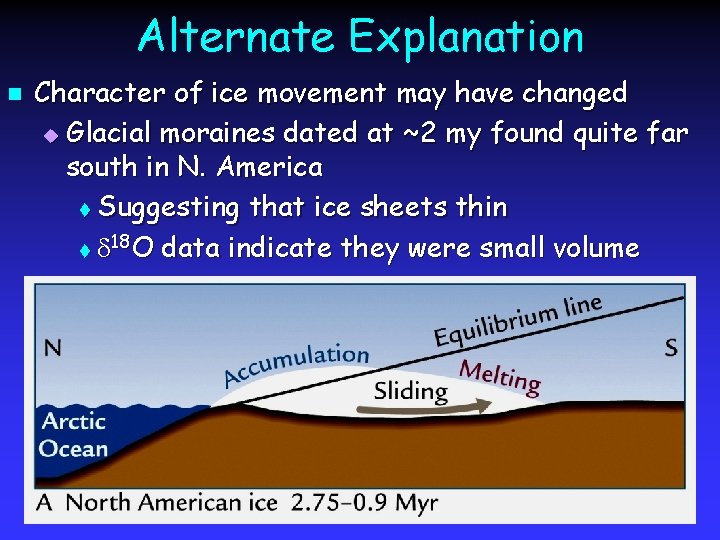
Alternate Explanation n Character of ice movement may have changed u Glacial moraines dated at ~2 my found quite far south in N. America t Suggesting that ice sheets thin t d 18 O data indicate they were small volume
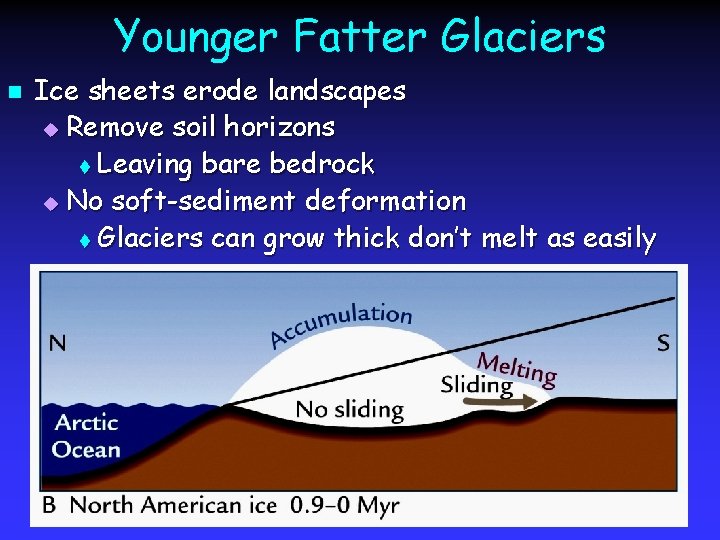
Slip-Sliding Glaciers n Ground on which ice accumulated may have been different u If no ice before 2. 75 my t Thick accumulations of soil t Soils saturated with water and ice began slip-sliding under heavy weight • Deformation at base of glacier fast • Faster than internal deformation t If they slid towards southern latitudes • Ablation rates would keep volume low
Younger Fatter Glaciers n Ice sheets erode landscapes u Remove soil horizons t Leaving bare bedrock u No soft-sediment deformation t Glaciers can grow thick don’t melt as easily
Why Rapid Deglaciation? n n Why at 100, 000 years? u Intuitively, must be summer insolation u Major control on size of glaciers Rapid deglaciations u Insolation control at when eccentricity 100, 000 years miniscule modulations create Strong summer insolation large summer insolation peaks at precession cycle u Resulting from eccentricity modulation t Match rapid glacial terminations
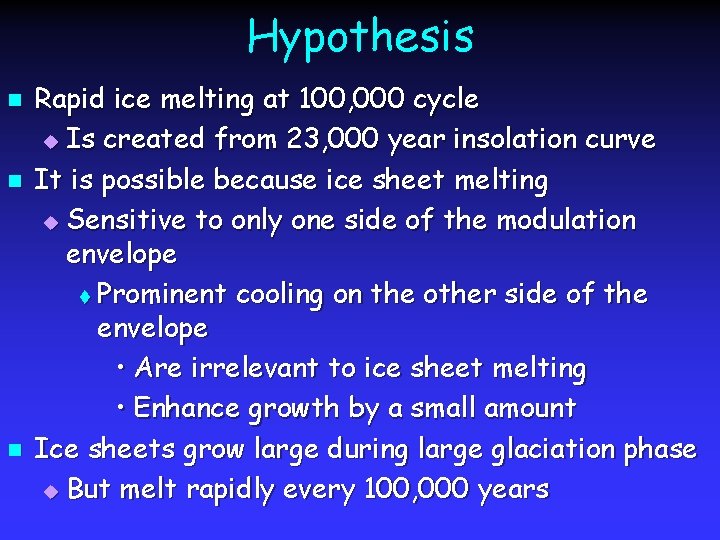
Hypothesis n n n Rapid ice melting at 100, 000 cycle u Is created from 23, 000 year insolation curve It is possible because ice sheet melting u Sensitive to only one side of the modulation envelope t Prominent cooling on the other side of the envelope • Are irrelevant to ice sheet melting • Enhance growth by a small amount Ice sheets grow large during large glaciation phase u But melt rapidly every 100, 000 years
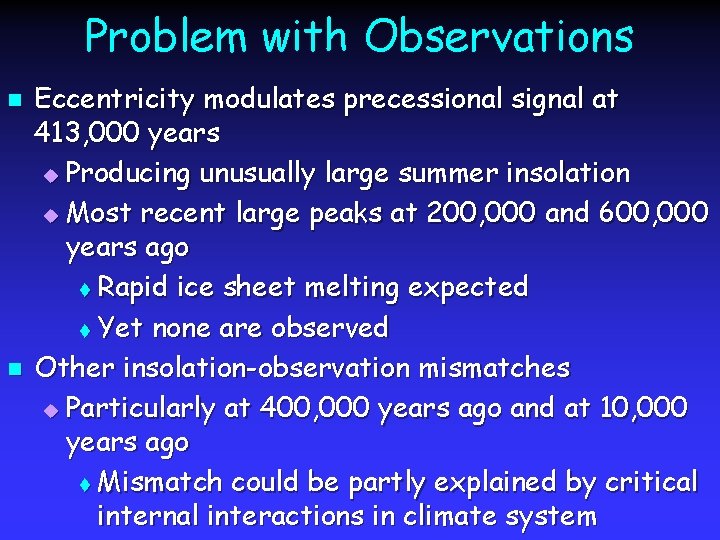
Problem with Observations n n Eccentricity modulates precessional signal at 413, 000 years u Producing unusually large summer insolation u Most recent large peaks at 200, 000 and 600, 000 years ago t Rapid ice sheet melting expected t Yet none are observed Other insolation-observation mismatches u Particularly at 400, 000 years ago and at 10, 000 years ago t Mismatch could be partly explained by critical internal interactions in climate system
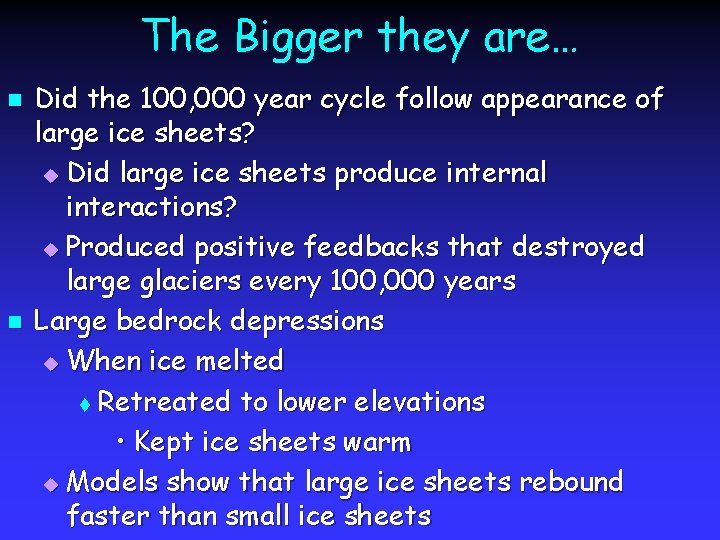
The Bigger they are… n n Did the 100, 000 year cycle follow appearance of large ice sheets? u Did large ice sheets produce internal interactions? u Produced positive feedbacks that destroyed large glaciers every 100, 000 years Large bedrock depressions u When ice melted t Retreated to lower elevations • Kept ice sheets warm u Models show that large ice sheets rebound faster than small ice sheets
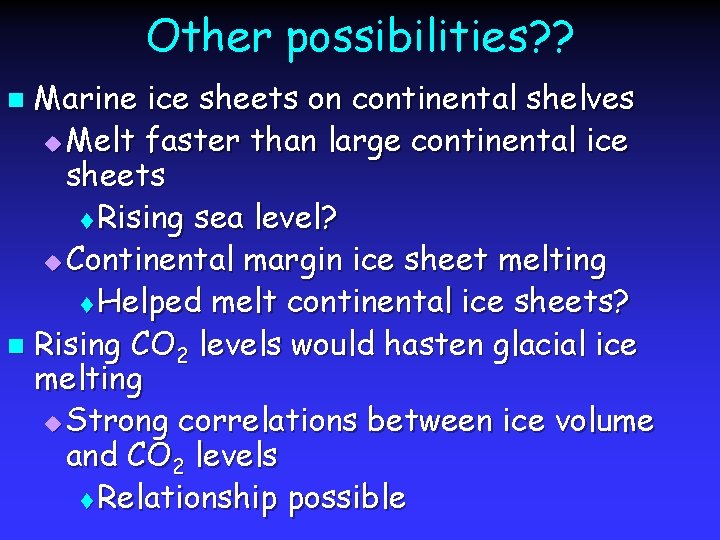
Other possibilities? ? Marine ice sheets on continental shelves u Melt faster than large continental ice sheets t Rising sea level? u Continental margin ice sheet melting t Helped melt continental ice sheets? n Rising CO 2 levels would hasten glacial ice melting u Strong correlations between ice volume and CO 2 levels t Relationship possible n
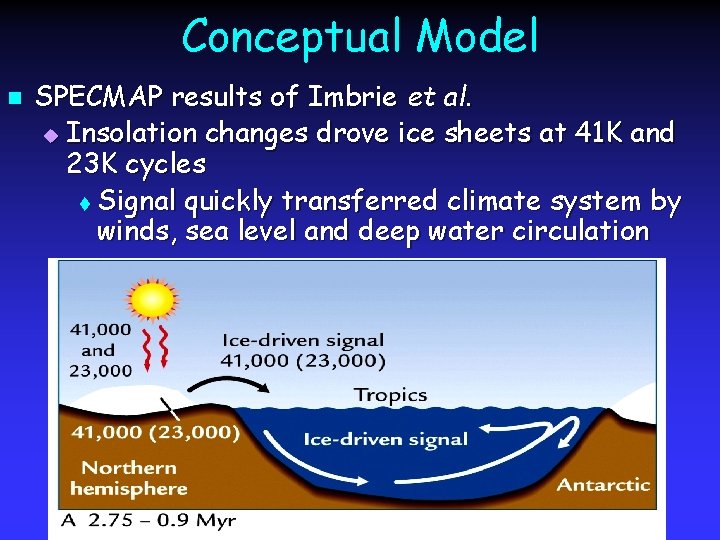
Conceptual Model n SPECMAP results of Imbrie et al. u Insolation changes drove ice sheets at 41 K and 23 K cycles t Signal quickly transferred climate system by winds, sea level and deep water circulation
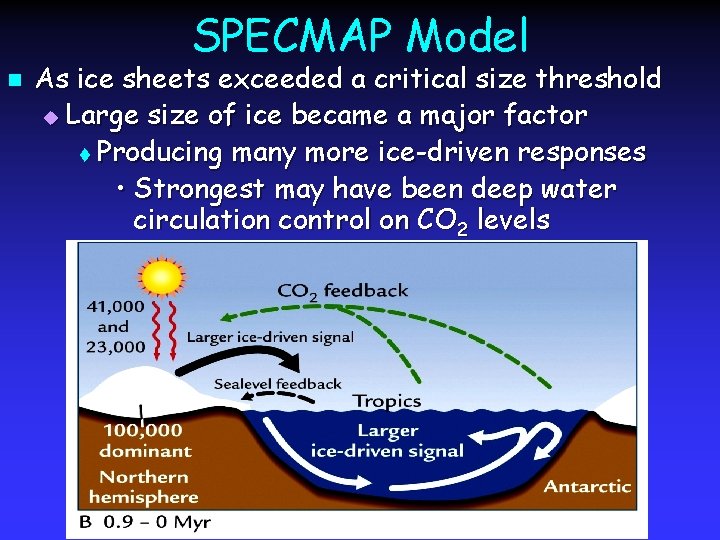
SPECMAP Model n As ice sheets exceeded a critical size threshold u Large size of ice became a major factor t Producing many more ice-driven responses • Strongest may have been deep water circulation control on CO 2 levels
Deep Water Circulation n Large N. Hemisphere ice sheets u Altered low-level winds in regions u N. Atlantic deep water formation t Altering the timing of CO 2 cycle • Providing positive feedbacks to ice sheet growth u N. Hemisphere ice sheets control N. Atlantic deep water formation t N. Atlantic deep water formation exerts controls on CO 2
N. Ice Drives S. Climate n n Since response of deep water circulation faster than ice sheet response u Ocean responses in the S. Hemisphere lead changes in N. Hemisphere ice sheet volume t Even though both are responding to an initial change in N. Hemisphere climate Critics of SPECMAP hypothesis u Point to mismatch between CO 2 and ice volume or S. Hemisphere temperature t At 115, 000 and 75, 000 years ago t Correlations with Southern Hemisphere temperature now shown to be excellent
Other Explanations Southern Ocean carbon cycle reacted to orbital forcing u Earlier and independently of N. Hemisphere ice sheets t Problems with timing • Linked to orbital forcing independently of ice sheets – Yet with a similar overall timing n Resonant response – a characteristic response timing regardless of the forcing u Why did it begin suddenly at 0. 9 mya? n
Summary n Really quite close to understanding ice sheet variations u 2. 75 – 0. 9 mya t Ice sheets controlled by summer insolation • At rhythms of 41 K and 23 K years – Just as Milankovitch predicted u 0. 9 mya global cooling allowed growth of large ice sheets t Dominant 100 K rhythm paced by summer insolation • Governed by internal feedbacks produced by ice sheets