
Density and SI Units Scientific Measurements SI Units


- Slides: 11
Density and SI Units
Scientific Measurements SI Units Significant Figures
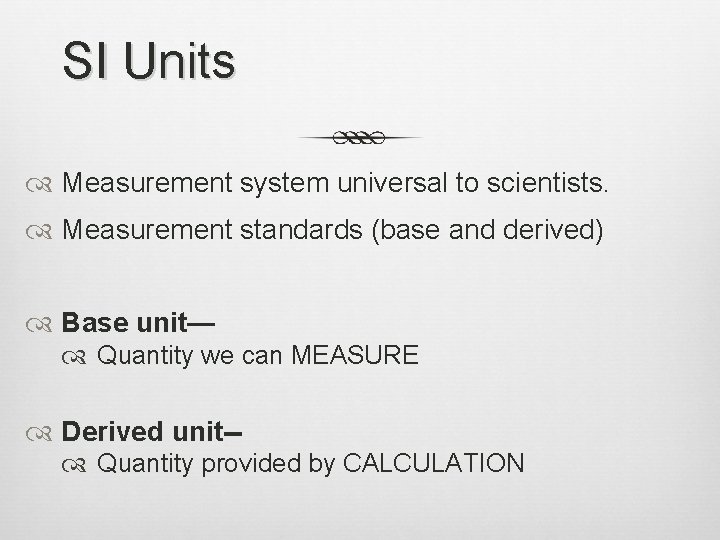
SI Units Measurement system universal to scientists. Measurement standards (base and derived) Base unit— Quantity we can MEASURE Derived unit- Quantity provided by CALCULATION
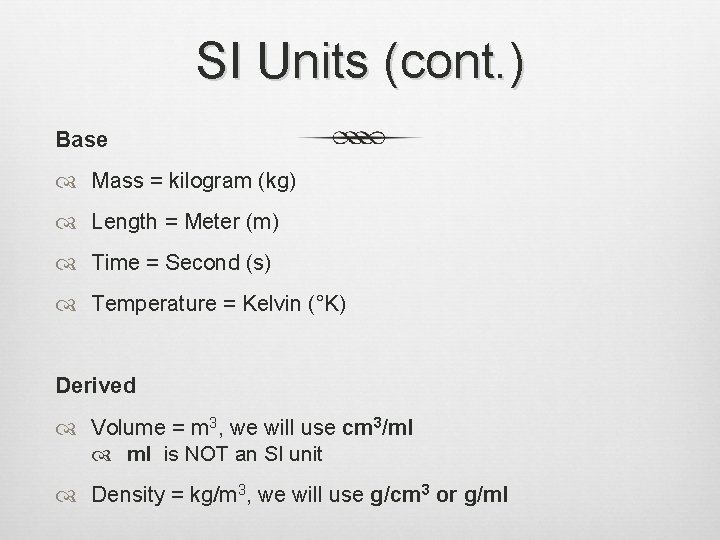
SI Units (cont. ) Base Mass = kilogram (kg) Length = Meter (m) Time = Second (s) Temperature = Kelvin (°K) Derived Volume = m 3, we will use cm 3/ml ml is NOT an SI unit Density = kg/m 3, we will use g/cm 3 or g/ml
Mass vs. Weight What is the difference? How do we measure mass?
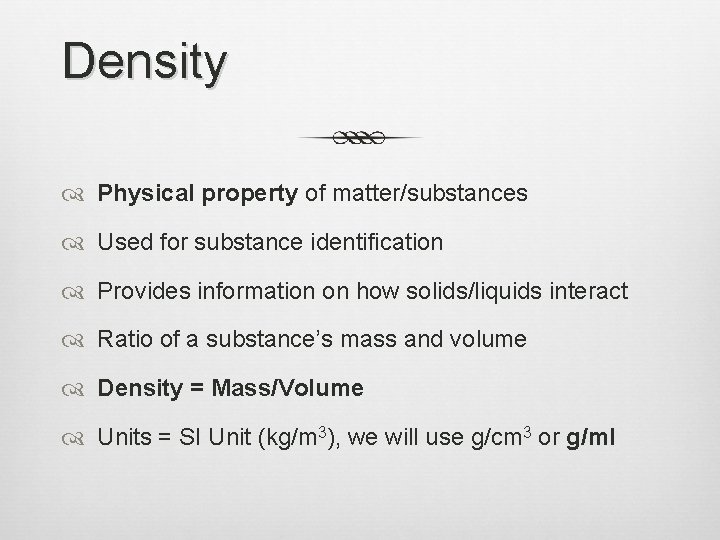
Density Physical property of matter/substances Used for substance identification Provides information on how solids/liquids interact Ratio of a substance’s mass and volume Density = Mass/Volume Units = SI Unit (kg/m 3), we will use g/cm 3 or g/ml
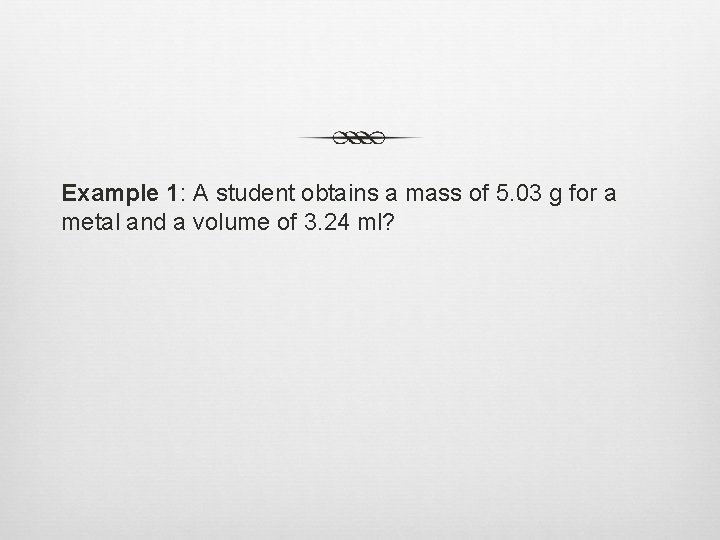
Example 1: A student obtains a mass of 5. 03 g for a metal and a volume of 3. 24 ml?
Example 2: What is the volume of a substance with a density of 0. 824 g/ml and a mass of 0. 451 g?
Example 3: A student records V 1= 2. 7 ml and V 2= 3. 4 ml after placing an object in a graduated cylinder. The mass of an empty beaker is 1. 13 g and the mass of both the beaker and substance is 4. 13 g. What is the object’s density?
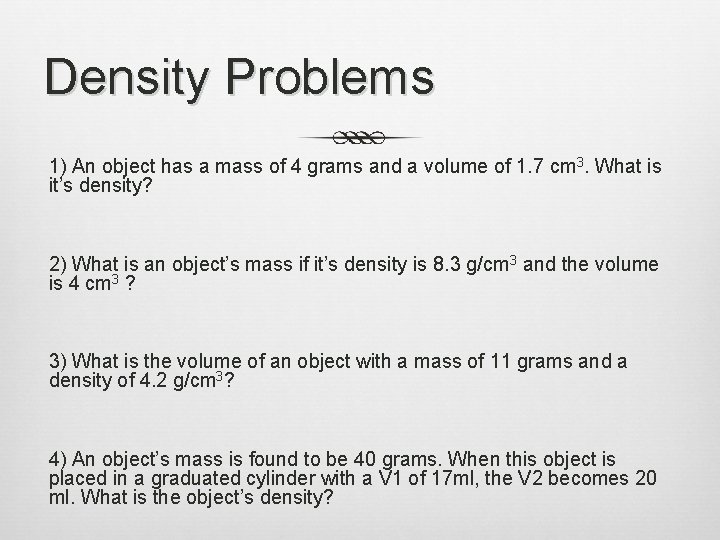
Density Problems 1) An object has a mass of 4 grams and a volume of 1. 7 cm 3. What is it’s density? 2) What is an object’s mass if it’s density is 8. 3 g/cm 3 and the volume is 4 cm 3 ? 3) What is the volume of an object with a mass of 11 grams and a density of 4. 2 g/cm 3? 4) An object’s mass is found to be 40 grams. When this object is placed in a graduated cylinder with a V 1 of 17 ml, the V 2 becomes 20 ml. What is the object’s density?
Homework Density Problems