
Dense Ge V ElectronPositron Pairs Production via Super

- Slides: 25
Dense Ge. V Electron-Positron Pairs Production via Super -intense Laser Interaction with Plasmas Yan Yin National University of Defense Technology SAP 2017, Aug. 28 -30, Ji Shou, Hunan, China
Collaborators T. P. Yu (余同普), X. L. Zhu (朱兴龙), J. J. Liu (刘津津), H. Z. Li (李汉臻). Z. M. Sheng I. C. E. Turcu A. Pukhov SAP 2017, Aug. 28 -30, Ji Shou, Hunan, China
OUTLINE l QED-Plasma Regime l Copious e-e+ pairs production Ø laser – NCD plasma interaction Ø laser – solid interaction l Discussion SAP 2017, Aug. 28 -30, Ji Shou, Hunan, China
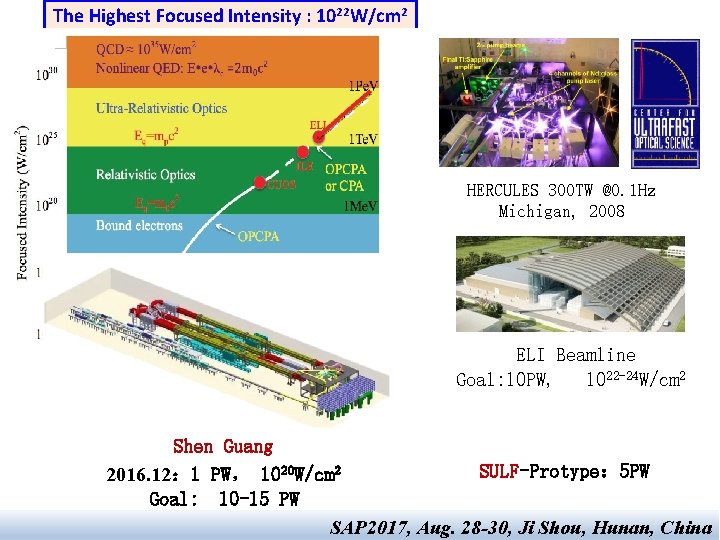
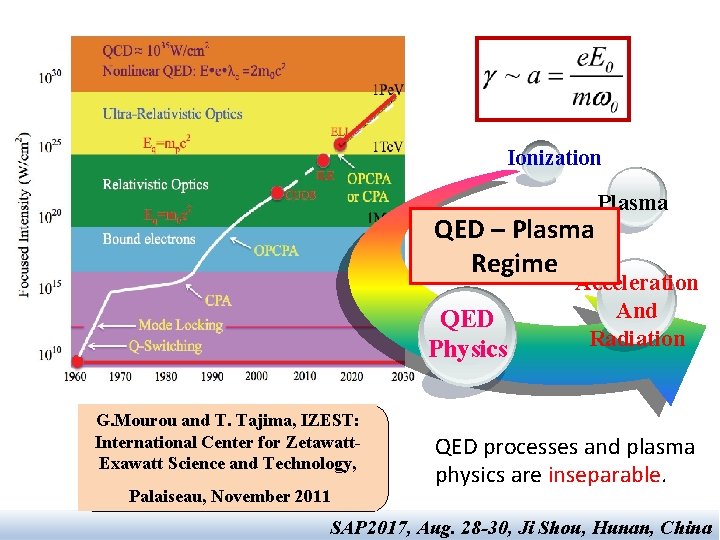
The Highest Focused Intensity : 1022 W/cm 2 HERCULES 300 TW @0. 1 Hz Michigan, 2008 ELI Beamline Goal: 10 PW, 1022 -24 W/cm 2 G. Mourou and T. Tajima, IZEST: International Center for Zetawatt. Shen Guang Exawatt Science and Technology, SULF-Protype: 5 PW 2016. 12: 1 PW, 1020 W/cm 2 Palaiseau, Goal: November 10 -15 2011 PW SAP 2017, Aug. 28 -30, Ji Shou, Hunan, China
Ionization QED – Plasma Regime QED Physics G. Mourou and T. Tajima, IZEST: International Center for Zetawatt. Exawatt Science and Technology, Palaiseau, November 2011 Plasma Acceleration And Radiation QED processes and plasma physics are inseparable. SAP 2017, Aug. 28 -30, Ji Shou, Hunan, China
Conference on Extremely High Intensity Laser Physics • Heidelberg, Germany, 21 – 24 July 2015 • Lisbon, Portugal, 5 – 8 Sep 2017 Scientific Topics: • New High-Intensity Laser Facilities • Ionization and Relativistic Atomic Physics • Thomson and Compton Scattering • Radiation Reaction • Electron-Positron Pair Production • Electromagnetic Cascades. . . SAP 2017, Aug. 28 -30, Ji Shou, Hunan, China
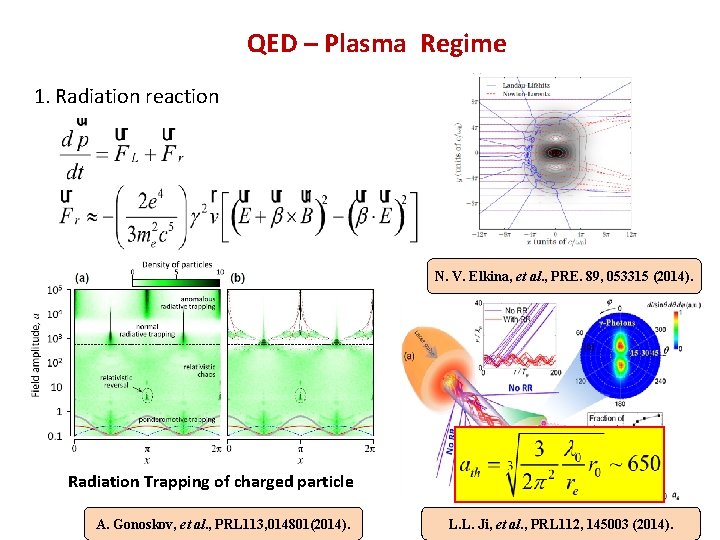
QED – Plasma Regime 1. Radiation reaction N. V. Elkina, et al. , PRE. 89, 053315 (2014). Radiation Trapping of charged particle A. Gonoskov, et al. , PRL 113, 014801(2014). L. L. Ji, et al. , PRL 112, 145003 (2014).
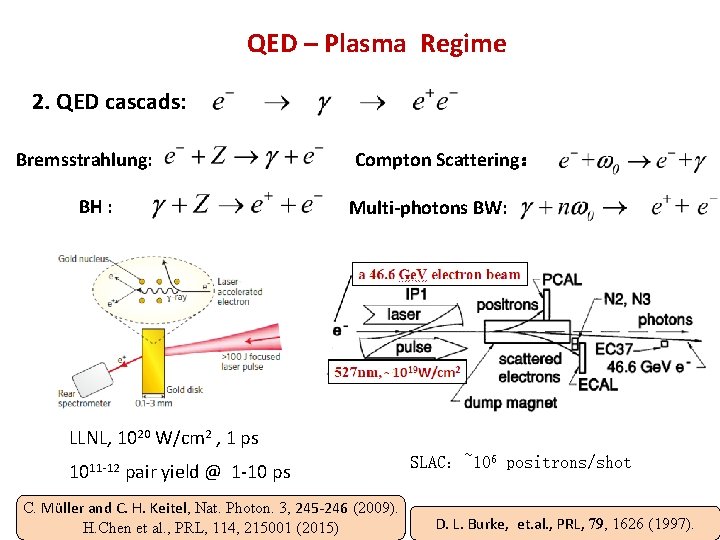
QED – Plasma Regime 2. QED cascads: Bremsstrahlung: BH : Compton Scattering: Multi-photons BW: LLNL, 1020 W/cm 2 , 1 ps 1011 -12 pair yield @ 1 -10 ps C. Müller and C. H. Keitel, Nat. Photon. 3, 245 -246 (2009). H. Chen et al. , PRL, 114, 215001 (2015) SLAC:~106 positrons/shot D. L. Burke, et. al. , PRL, 79, 1626 (1997).
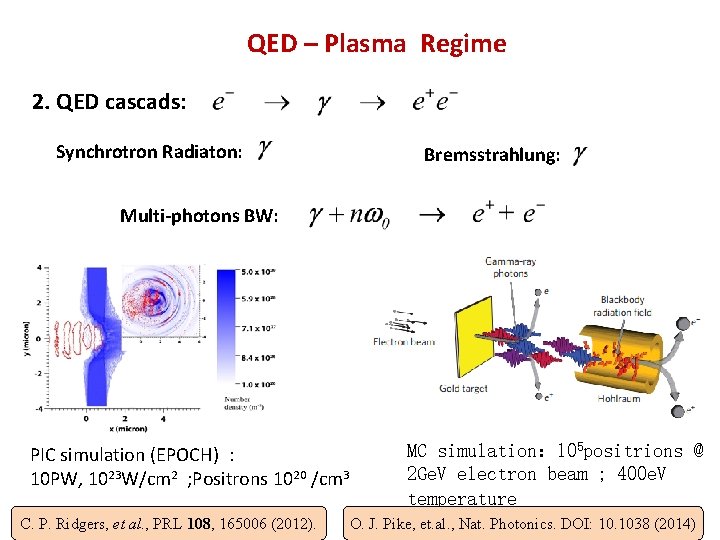
QED – Plasma Regime 2. QED cascads: Synchrotron Radiaton: Bremsstrahlung: Multi-photons BW: PIC simulation (EPOCH) : 10 PW, 1023 W/cm 2 ; Positrons 1020 /cm 3 C. P. Ridgers, et al. , PRL 108, 165006 (2012). MC simulation: 105 positrions @ 2 Ge. V electron beam ; 400 e. V temperature O. J. Pike, et. al. , Nat. Photonics. DOI: 10. 1038 (2014)
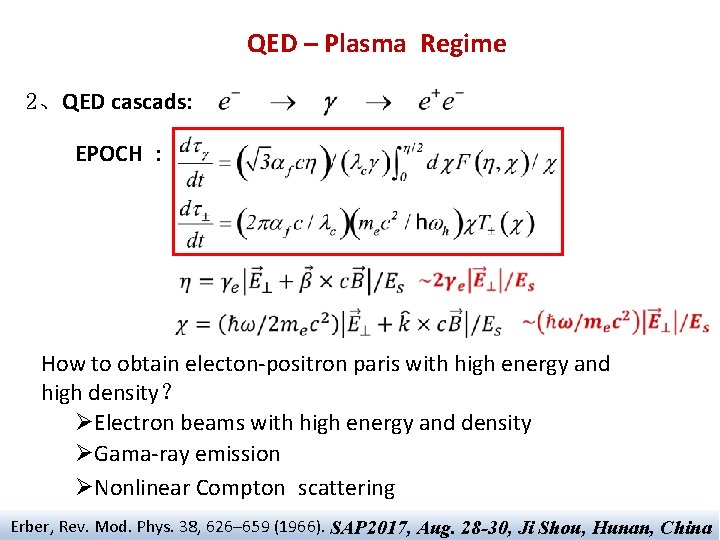
QED – Plasma Regime 2、QED cascads: EPOCH : How to obtain electon-positron paris with high energy and high density? ØElectron beams with high energy and density ØGama-ray emission ØNonlinear Compton scattering Erber, Rev. Mod. Phys. 38, 626– 659 (1966). SAP 2017, Aug. 28 -30, Ji Shou, Hunan, China
OUTLINE l QED-Plasma Regime l Copious e-e+ pairs production Ø laser – NCD plasma interaction Ø laser – solid interaction l Discussion SAP 2017, Aug. 28 -30, Ji Shou, Hunan, China
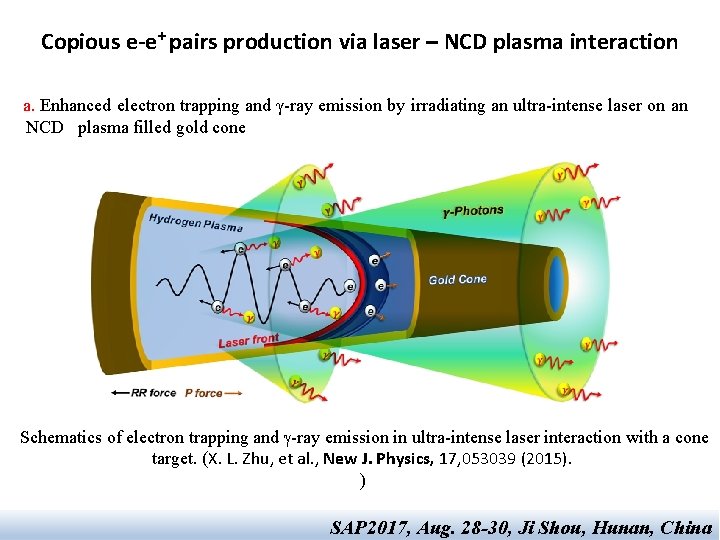
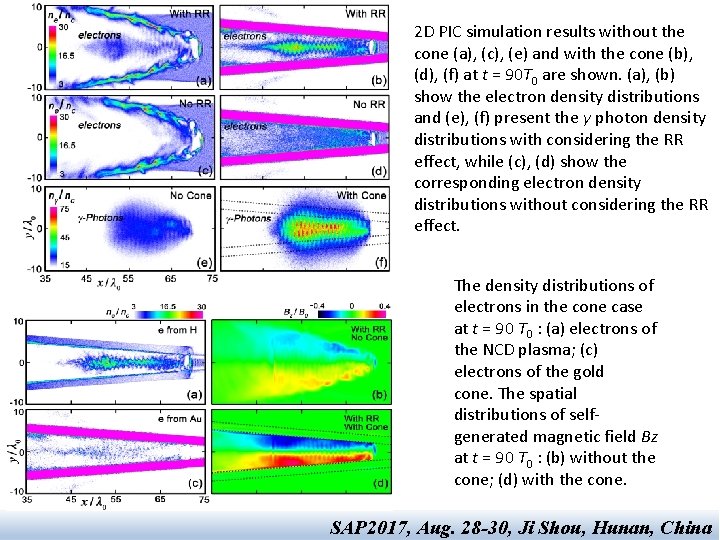
Copious e-e+ pairs production via laser – NCD plasma interaction a. Enhanced electron trapping and γ-ray emission by irradiating an ultra-intense laser on an NCD plasma filled gold cone Schematics of electron trapping and g-ray emission in ultra-intense laser interaction with a cone target. (X. L. Zhu, et al. , New J. Physics, 17, 053039 (2015). ) SAP 2017, Aug. 28 -30, Ji Shou, Hunan, China
2 D PIC simulation results without the cone (a), (c), (e) and with the cone (b), (d), (f) at t = 90 T 0 are shown. (a), (b) show the electron density distributions and (e), (f) present the γ photon density distributions with considering the RR effect, while (c), (d) show the corresponding electron density distributions without considering the RR effect. The density distributions of electrons in the cone case at t = 90 T 0 : (a) electrons of the NCD plasma; (c) electrons of the gold cone. The spatial distributions of selfgenerated magnetic field Bz at t = 90 T 0 : (b) without the cone; (d) with the cone. SAP 2017, Aug. 28 -30, Ji Shou, Hunan, China
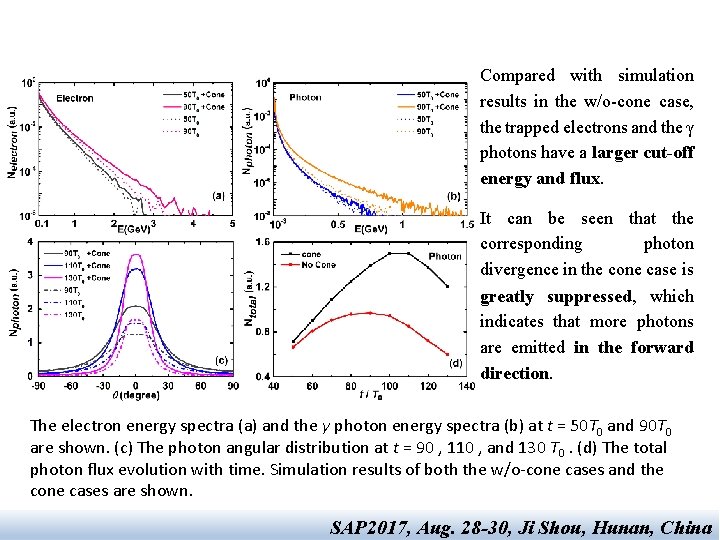
Compared with simulation results in the w/o-cone case, the trapped electrons and the γ photons have a larger cut-off energy and flux. It can be seen that the corresponding photon divergence in the cone case is greatly suppressed, which indicates that more photons are emitted in the forward direction. The electron energy spectra (a) and the γ photon energy spectra (b) at t = 50 T 0 and 90 T 0 are shown. (c) The photon angular distribution at t = 90 , 110 , and 130 T 0. (d) The total photon flux evolution with time. Simulation results of both the w/o-cone cases and the cone cases are shown. SAP 2017, Aug. 28 -30, Ji Shou, Hunan, China
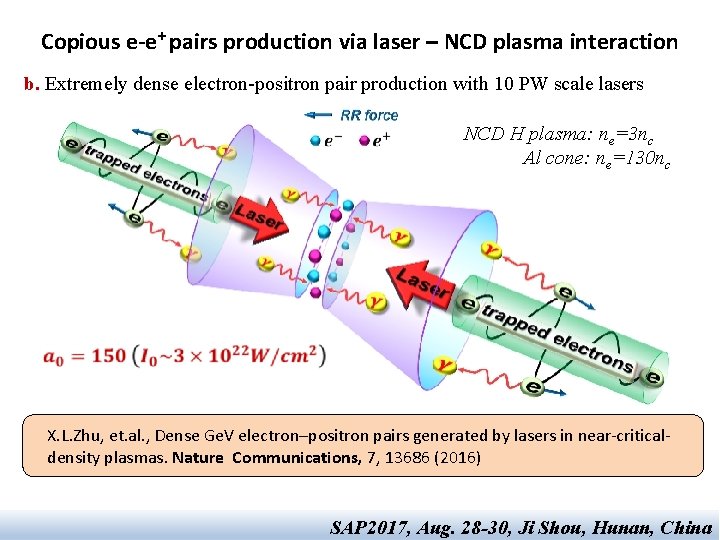
Copious e-e+ pairs production via laser – NCD plasma interaction b. Extremely dense electron-positron pair production with 10 PW scale lasers NCD H plasma: ne=3 nc Al cone: ne=130 nc X. L. Zhu, et. al. , Dense Ge. V electron–positron pairs generated by lasers in near-criticaldensity plasmas. Nature Communications, 7, 13686 (2016) SAP 2017, Aug. 28 -30, Ji Shou, Hunan, China
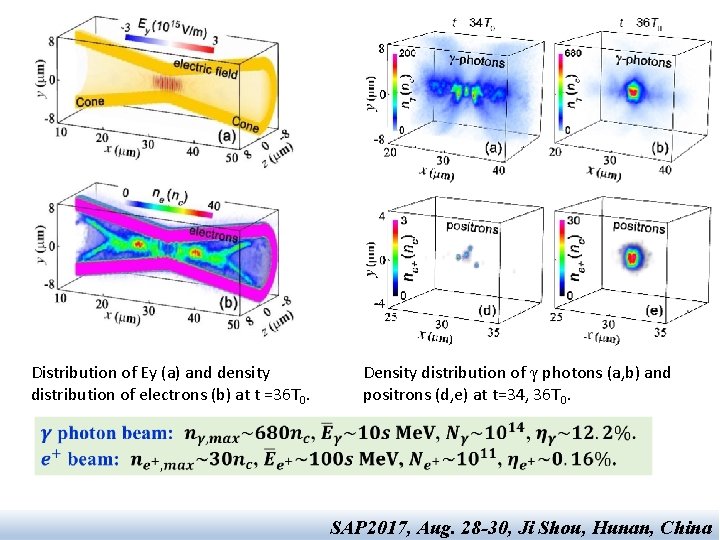
Distribution of Ey (a) and density distribution of electrons (b) at t =36 T 0. Density distribution of γ photons (a, b) and positrons (d, e) at t=34, 36 T 0. SAP 2017, Aug. 28 -30, Ji Shou, Hunan, China
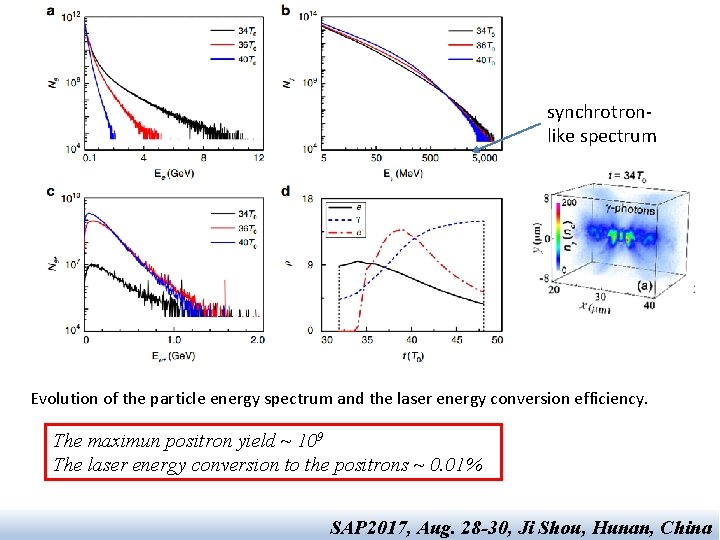
synchrotronlike spectrum Evolution of the particle energy spectrum and the laser energy conversion efficiency. The maximun positron yield ~ 109 The laser energy conversion to the positrons ~ 0. 01% SAP 2017, Aug. 28 -30, Ji Shou, Hunan, China
SAP 2017, Aug. 28 -30, Ji Shou, Hunan, China
OUTLINE l QED-Plasma Regime l Copious e-e+ pairs production Ø laser – NCD plasma interaction Ø laser – solid interaction l Discussion SAP 2017, Aug. 28 -30, Ji Shou, Hunan, China
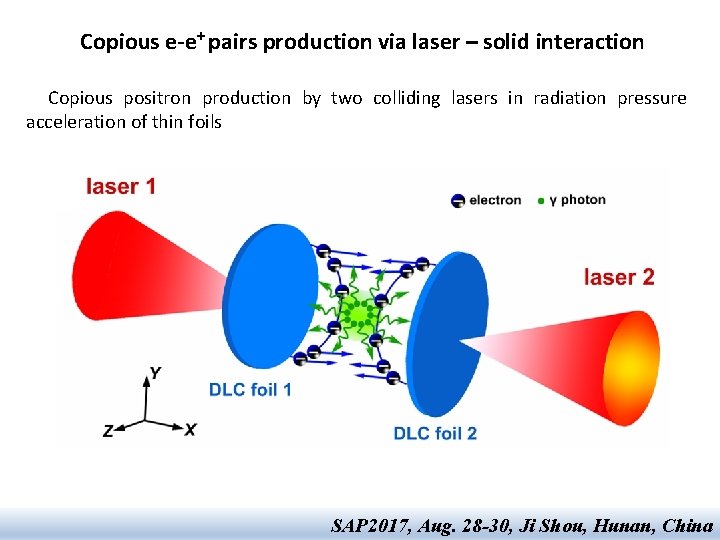
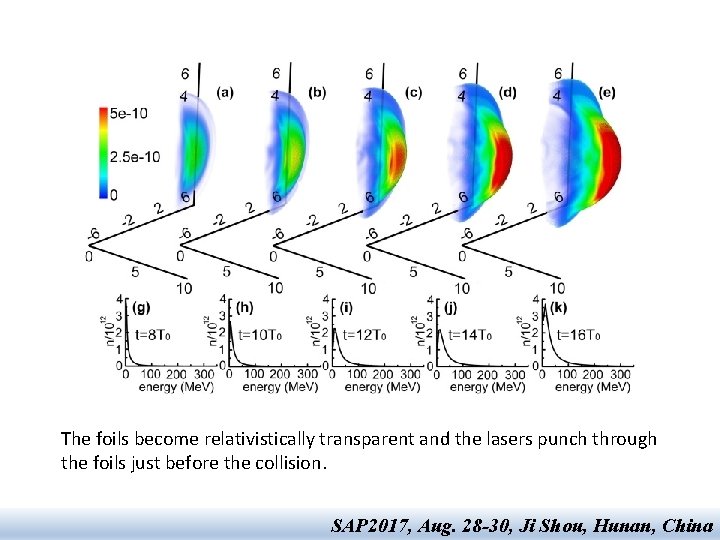
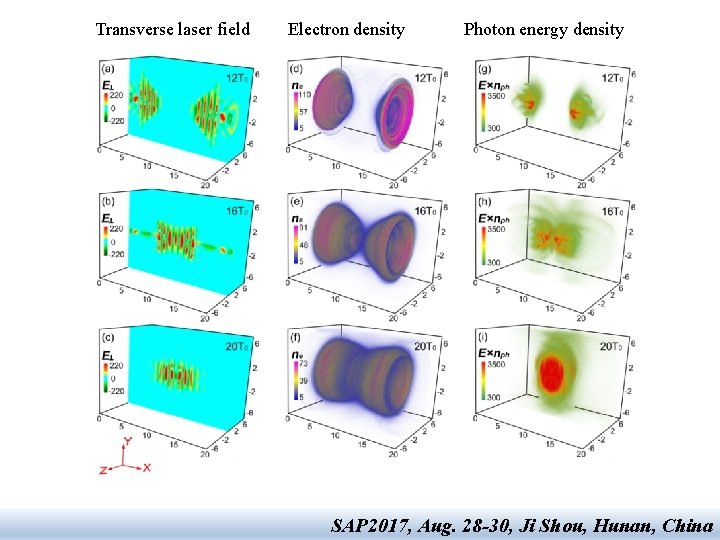
Copious e-e+ pairs production via laser – solid interaction Copious positron production by two colliding lasers in radiation pressure acceleration of thin foils SAP 2017, Aug. 28 -30, Ji Shou, Hunan, China
The foils become relativistically transparent and the lasers punch through the foils just before the collision. SAP 2017, Aug. 28 -30, Ji Shou, Hunan, China
Transverse laser field Electron density Photon energy density SAP 2017, Aug. 28 -30, Ji Shou, Hunan, China
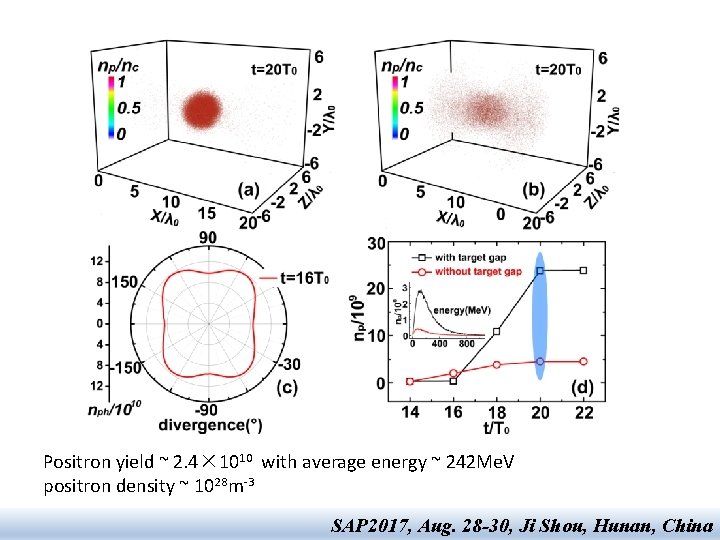
Positron yield ~ 2. 4× 10¹⁰ with average energy ~ 242 Me. V positron density ~ 1028 m-3 SAP 2017, Aug. 28 -30, Ji Shou, Hunan, China
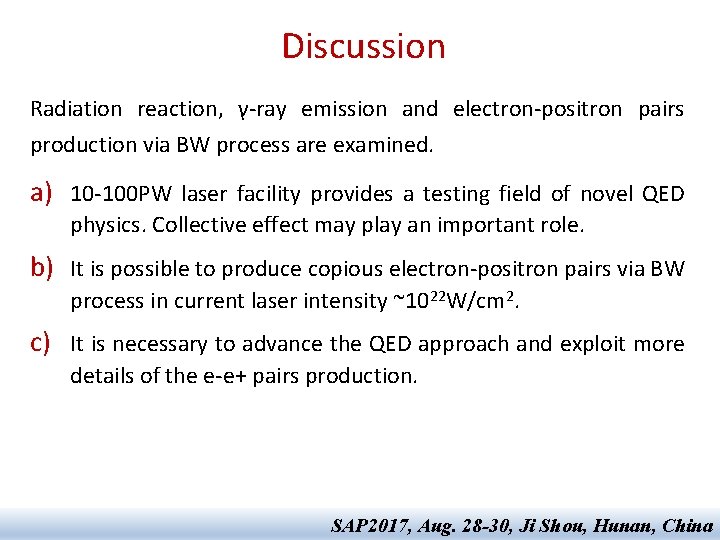
Discussion Radiation reaction, γ-ray emission and electron-positron pairs production via BW process are examined. a) 10 -100 PW laser facility provides a testing field of novel QED physics. Collective effect may play an important role. b) It is possible to produce copious electron-positron pairs via BW process in current laser intensity ~1022 W/cm 2. c) It is necessary to advance the QED approach and exploit more details of the e-e+ pairs production. SAP 2017, Aug. 28 -30, Ji Shou, Hunan, China