
Denotational Semantics Based on a lecture by Martin
Denotational Semantics Based on a lecture by Martin Abadi
Introduction • Denotational semantics is supposed to be mathematical: – The meaning of an expression is a mathematical object – A fair amount of mathematics is involved • Denotational semantics is compositional • Denotational semantics is more abstract and canonical than operational semantics – No small step vs. big step • Denotational semantics is also called – Fixed point semantics – Mathematical semantics – Scott-Strachey semantics
Plan • Definition of the denotational semantics of While (first attempt) • Complete partial orders and related properties – Montonicity – Continuity • Definition of denotational semantics of While
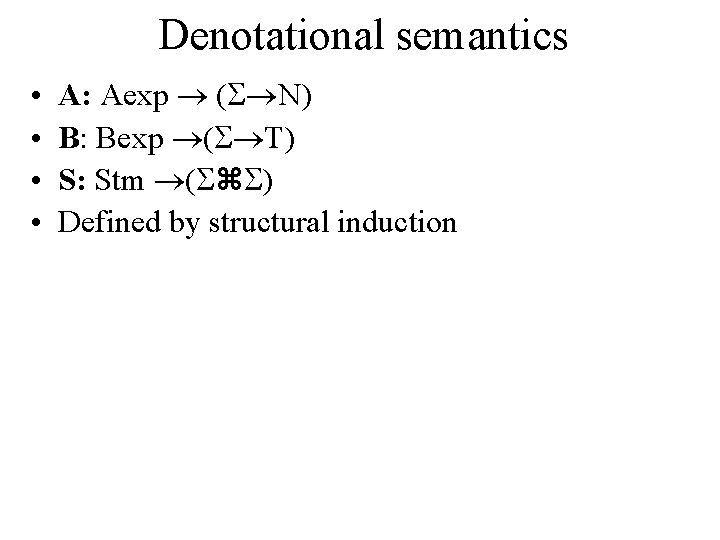
Denotational semantics • • A: Aexp ( N) B: Bexp ( T) S: Stm ( ) Defined by structural induction
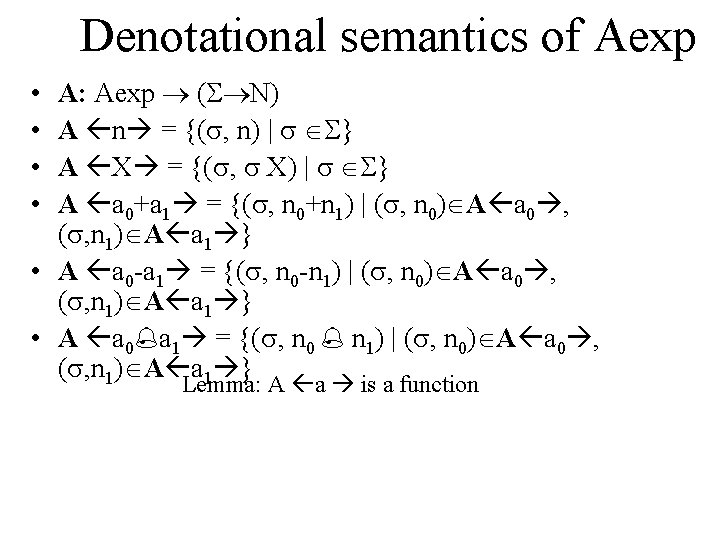
Denotational semantics of Aexp A: Aexp ( N) A n = {( , n) | } A X = {( , X) | } A a 0+a 1 = {( , n 0+n 1) | ( , n 0) A a 0 , ( , n 1) A a 1 } • A a 0 -a 1 = {( , n 0 -n 1) | ( , n 0) A a 0 , ( , n 1) A a 1 } • A a 0 a 1 = {( , n 0 n 1) | ( , n 0) A a 0 , ( , n 1) A a 1 } • • Lemma: A a is a function
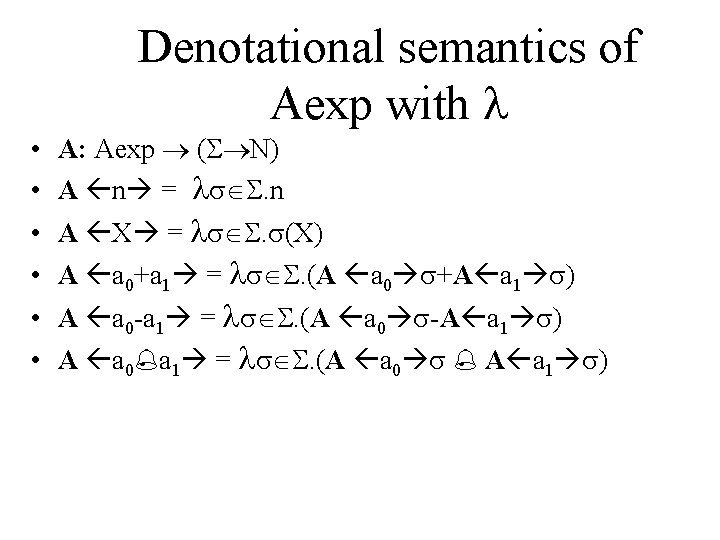
Denotational semantics of Aexp with • A: Aexp ( N) • A n = . n • • A X = . (X) A a 0+a 1 = . (A a 0 +A a 1 ) A a 0 -a 1 = . (A a 0 -A a 1 ) A a 0 a 1 = . (A a 0 A a 1 )
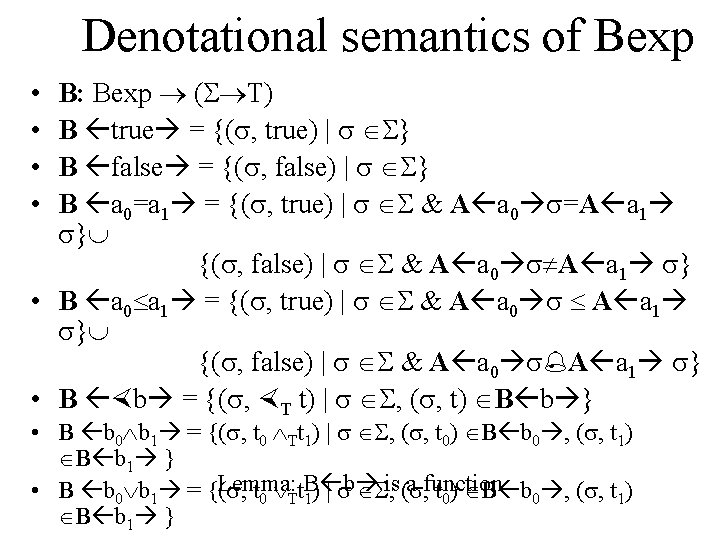
Denotational semantics of Bexp B: Bexp ( T) B true = {( , true) | } B false = {( , false) | } B a 0=a 1 = {( , true) | & A a 0 =A a 1 } {( , false) | & A a 0 A a 1 } • B a 0 a 1 = {( , true) | & A a 0 A a 1 } {( , false) | & A a 0 A a 1 } • B b = {( , T t) | , ( , t) B b } • • • B b 0 b 1 = {( , t 0 Tt 1) | , ( , t 0) B b 0 , ( , t 1) B b 1 } Lemma: is a function • B b 0 b 1 = {( , t 0 Tt. B b 1) | , ( , t 0) B b 0 , ( , t 1) B b 1 }
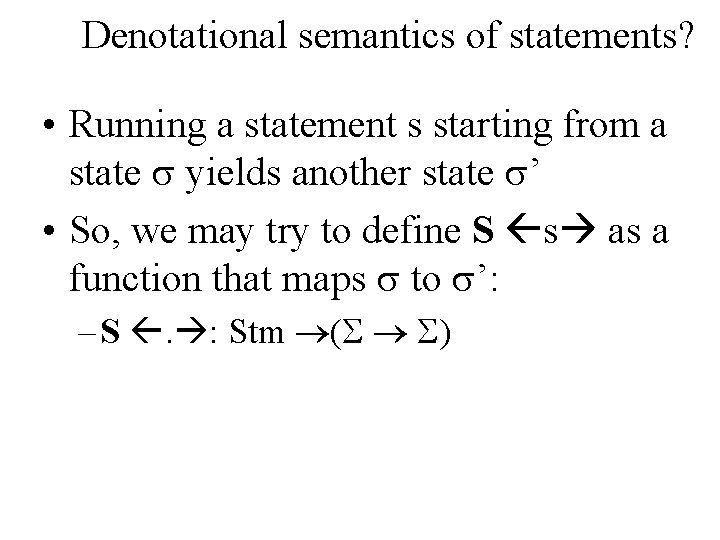
Denotational semantics of statements? • Running a statement s starting from a state yields another state ’ • So, we may try to define S s as a function that maps to ’: – S . : Stm ( )
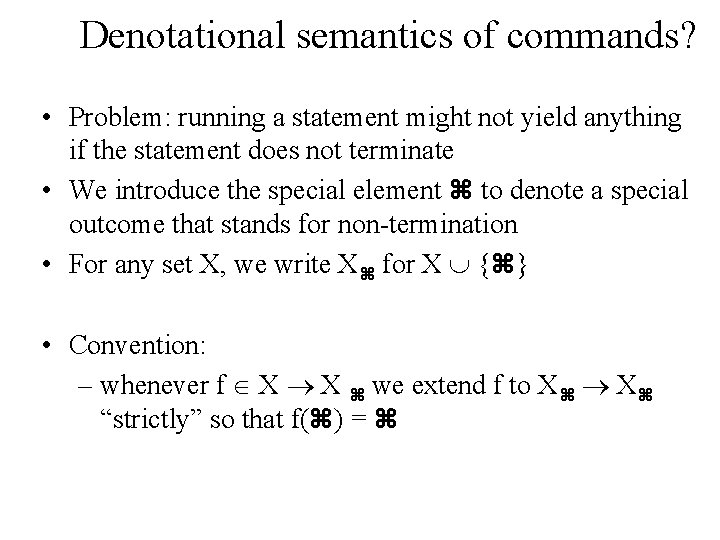
Denotational semantics of commands? • Problem: running a statement might not yield anything if the statement does not terminate • We introduce the special element to denote a special outcome that stands for non-termination • For any set X, we write X for X { } • Convention: – whenever f X X we extend f to X X “strictly” so that f( ) =
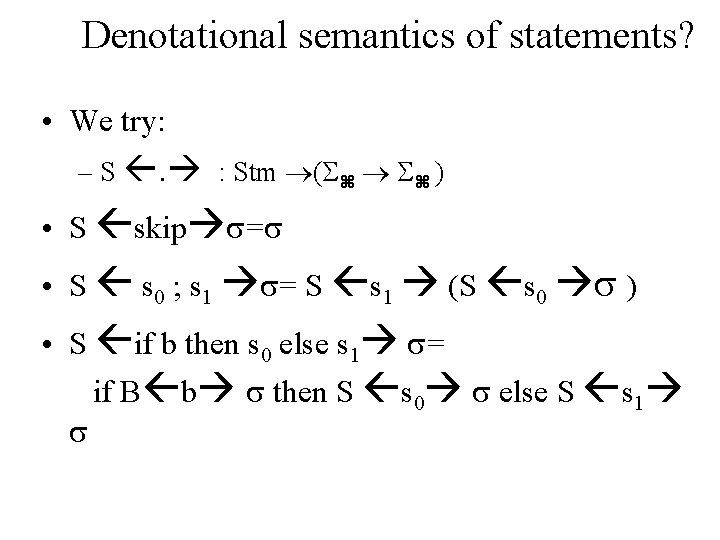
Denotational semantics of statements? • We try: – S . : Stm ( ) • S skip = • S s 0 ; s 1 = S s 1 (S s 0 ) • S if b then s 0 else s 1 = if B b then S s 0 else S s 1
![Examples • S X: = 2; X: =1 = [X 1] • S if](http://slidetodoc.com/presentation_image_h2/0ac357bcd56446d6e58379e12646e927/image-11.jpg "Examples • S X: = 2; X: =1 = [X 1] • S if")
Examples • S X: = 2; X: =1 = [X 1] • S if true then X: =2; X: =1 else … = [X 1] • The semantics does not care about intermediate states • So far, we did not explicitly need
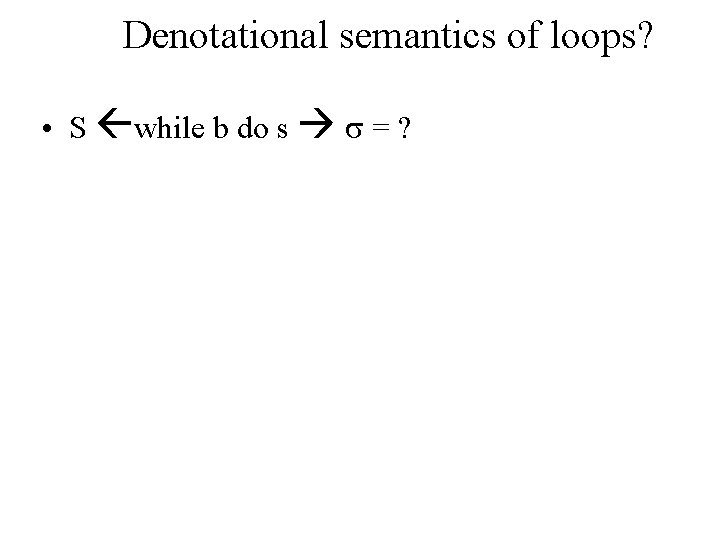
Denotational semantics of loops? • S while b do s = ?
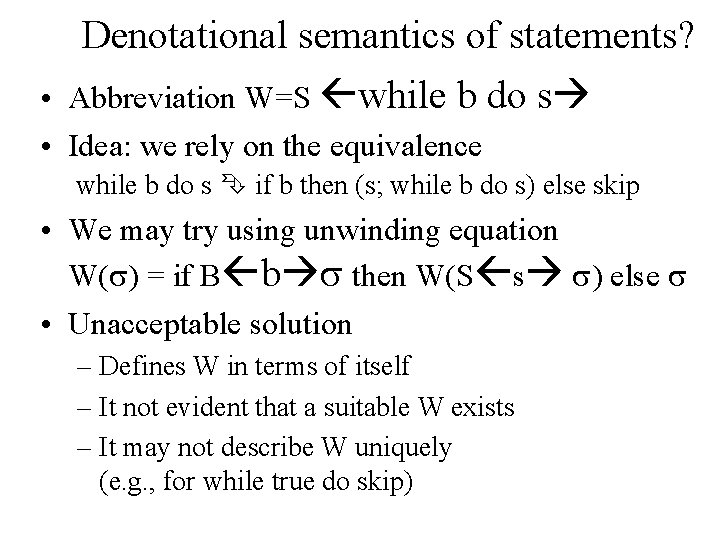
Denotational semantics of statements? • Abbreviation W=S while b do s • Idea: we rely on the equivalence while b do s if b then (s; while b do s) else skip • We may try using unwinding equation W( ) = if B b then W(S s ) else • Unacceptable solution – Defines W in terms of itself – It not evident that a suitable W exists – It may not describe W uniquely (e. g. , for while true do skip)
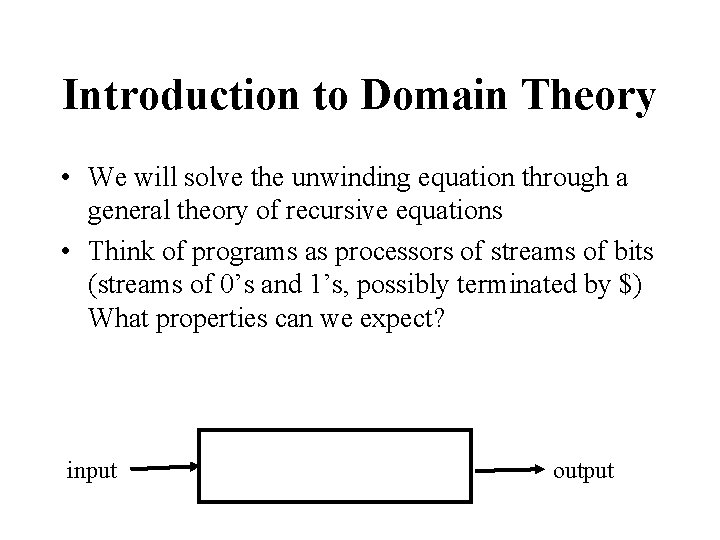
Introduction to Domain Theory • We will solve the unwinding equation through a general theory of recursive equations • Think of programs as processors of streams of bits (streams of 0’s and 1’s, possibly terminated by $) What properties can we expect? input output
Motivation • Let “isone” be a function that must return “ 1$” when the input string has at least a 1 and “ 0$” otherwise – isone(00… 0$) = 0$ – isone(xx… 1…$) =1$ – isone(0… 0) =? • Monotonicity : Output is never retracted – More information about the input is reflected in more information about the output • How do we express monotonicity precisely?
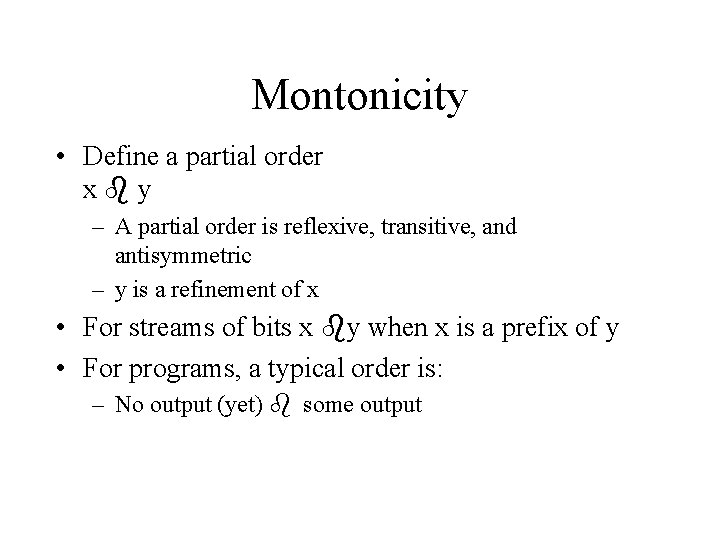
Montonicity • Define a partial order x y – A partial order is reflexive, transitive, and antisymmetric – y is a refinement of x • For streams of bits x y when x is a prefix of y • For programs, a typical order is: – No output (yet) some output
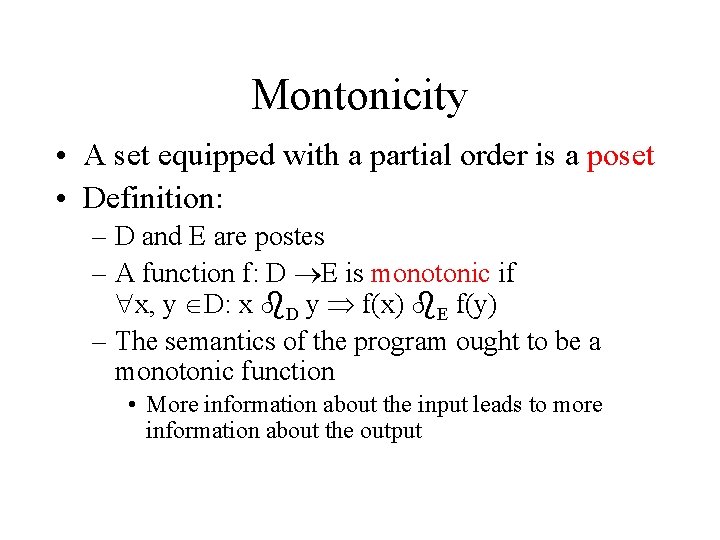
Montonicity • A set equipped with a partial order is a poset • Definition: – D and E are postes – A function f: D E is monotonic if x, y D: x D y f(x) E f(y) – The semantics of the program ought to be a monotonic function • More information about the input leads to more information about the output
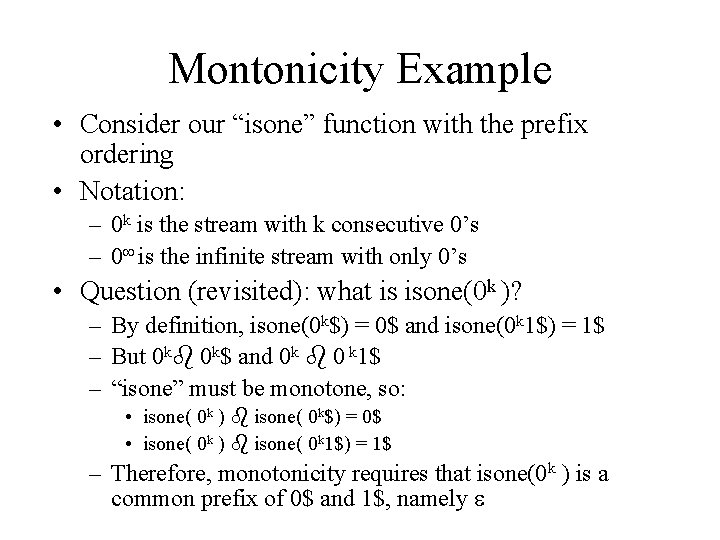
Montonicity Example • Consider our “isone” function with the prefix ordering • Notation: – 0 k is the stream with k consecutive 0’s – 0 is the infinite stream with only 0’s • Question (revisited): what is isone(0 k )? – By definition, isone(0 k$) = 0$ and isone(0 k 1$) = 1$ – But 0 k 0 k$ and 0 k 0 k 1$ – “isone” must be monotone, so: • isone( 0 k ) isone( 0 k$) = 0$ • isone( 0 k ) isone( 0 k 1$) = 1$ – Therefore, monotonicity requires that isone(0 k ) is a common prefix of 0$ and 1$, namely
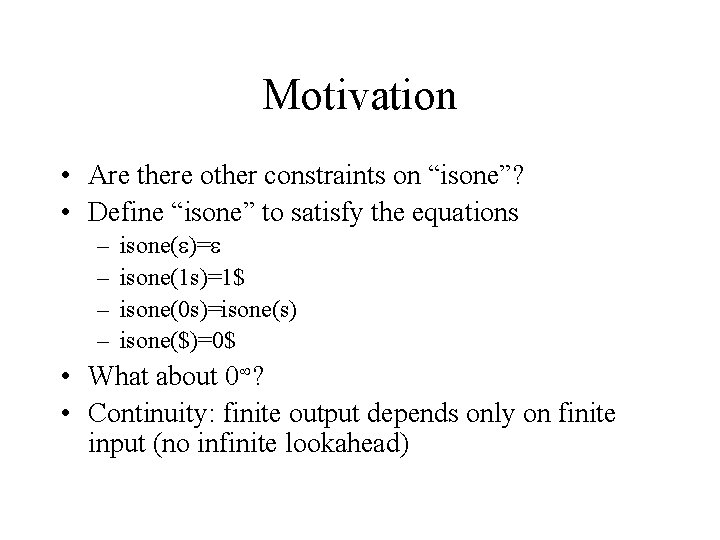
Motivation • Are there other constraints on “isone”? • Define “isone” to satisfy the equations – – isone( )= isone(1 s)=1$ isone(0 s)=isone(s) isone($)=0$ • What about 0 ? • Continuity: finite output depends only on finite input (no infinite lookahead)
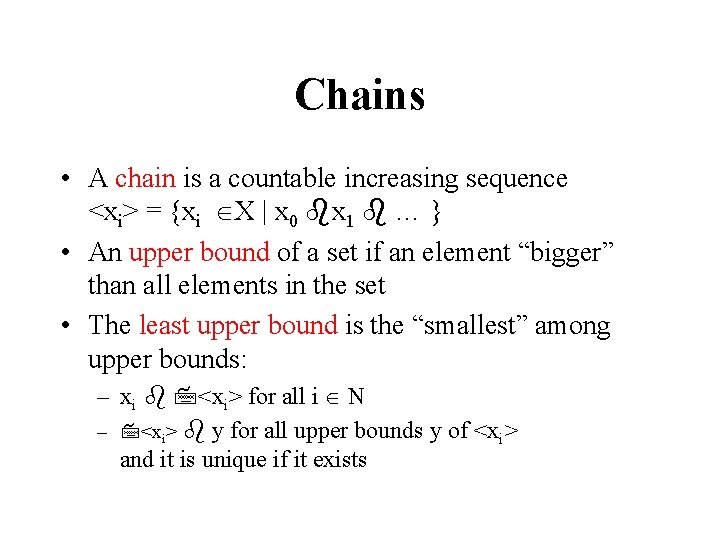
Chains • A chain is a countable increasing sequence <xi> = {xi X | x 0 x 1 … } • An upper bound of a set if an element “bigger” than all elements in the set • The least upper bound is the “smallest” among upper bounds: – xi <xi> for all i N – <xi> y for all upper bounds y of <xi> and it is unique if it exists
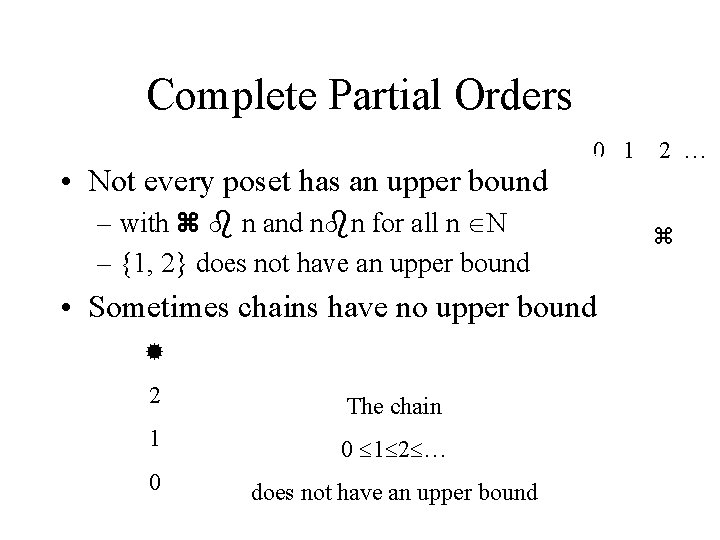
Complete Partial Orders • Not every poset has an upper bound 0 1 – with n and n n for all n N – {1, 2} does not have an upper bound • Sometimes chains have no upper bound 2 The chain 1 0 1 2 … 0 does not have an upper bound 2 …
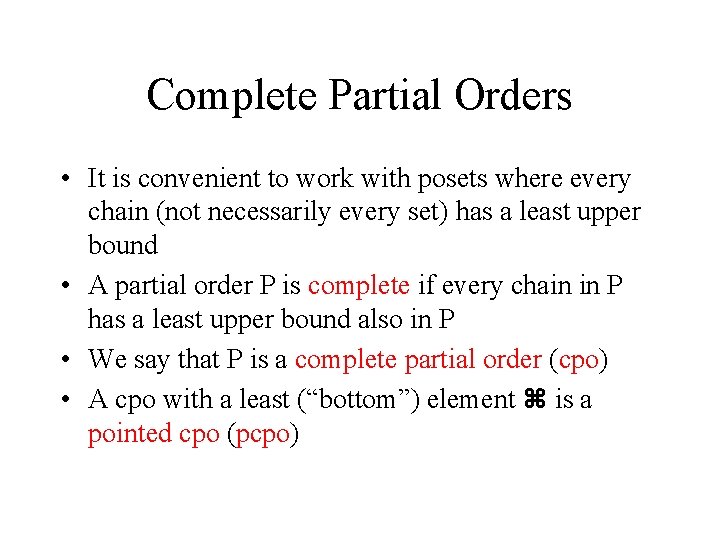
Complete Partial Orders • It is convenient to work with posets where every chain (not necessarily every set) has a least upper bound • A partial order P is complete if every chain in P has a least upper bound also in P • We say that P is a complete partial order (cpo) • A cpo with a least (“bottom”) element is a pointed cpo (pcpo)
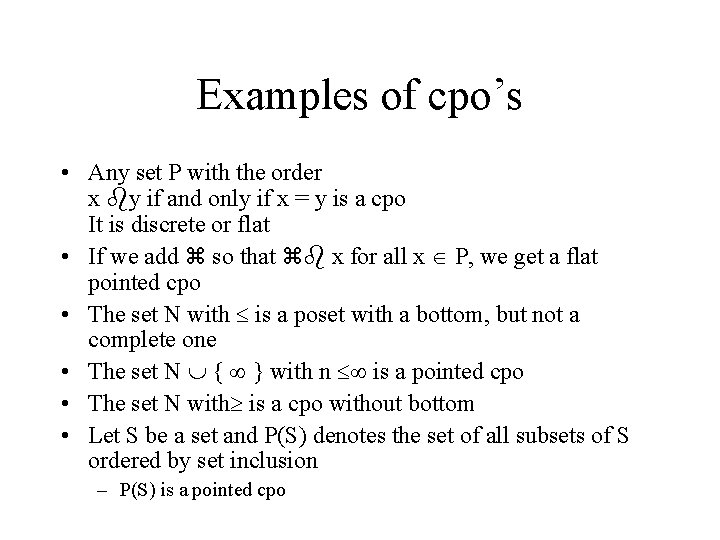
Examples of cpo’s • Any set P with the order x y if and only if x = y is a cpo It is discrete or flat • If we add so that x for all x P, we get a flat pointed cpo • The set N with is a poset with a bottom, but not a complete one • The set N { } with n is a pointed cpo • The set N with is a cpo without bottom • Let S be a set and P(S) denotes the set of all subsets of S ordered by set inclusion – P(S) is a pointed cpo
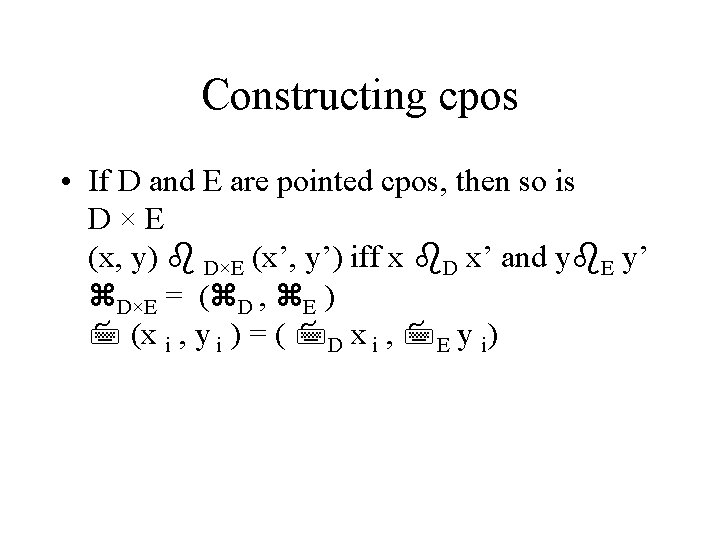
Constructing cpos • If D and E are pointed cpos, then so is D×E (x, y) D×E (x’, y’) iff x D x’ and y E y’ D×E = ( D , E ) (x i , y i ) = ( D x i , E y i)
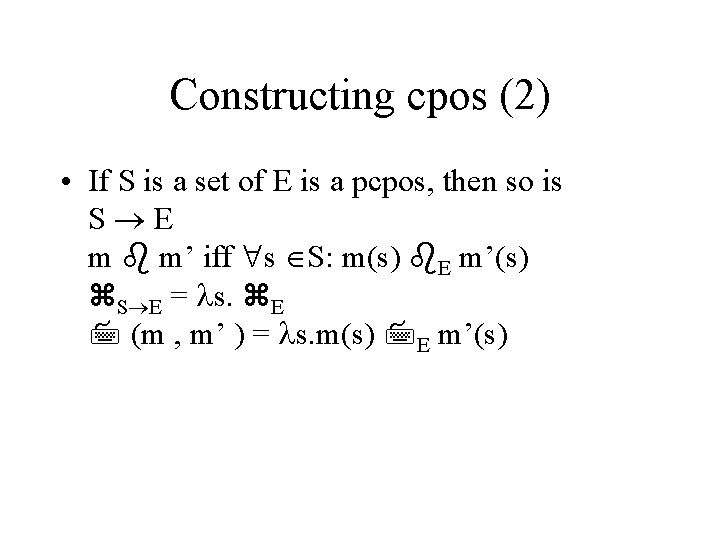
Constructing cpos (2) • If S is a set of E is a pcpos, then so is S E m m’ iff s S: m(s) E m’(s) S E = s. E (m , m’ ) = s. m(s) E m’(s)
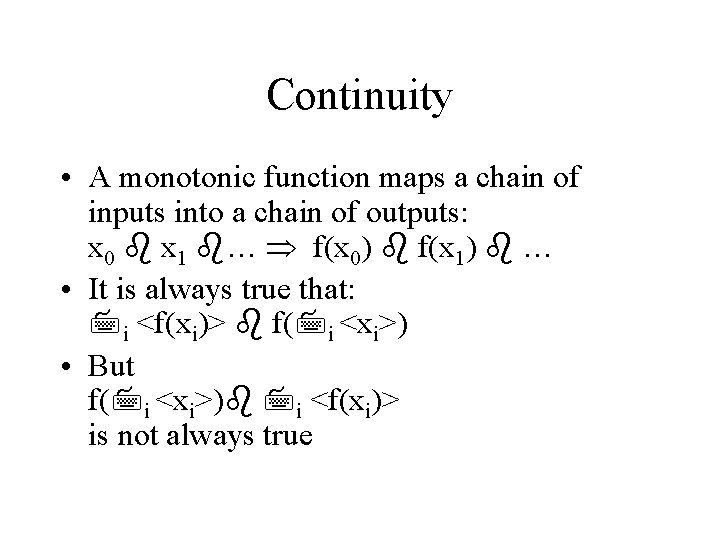
Continuity • A monotonic function maps a chain of inputs into a chain of outputs: x 0 x 1 … f(x 0) f(x 1) … • It is always true that: i <f(xi)> f( i <xi>) • But f( i <xi>) i <f(xi)> is not always true
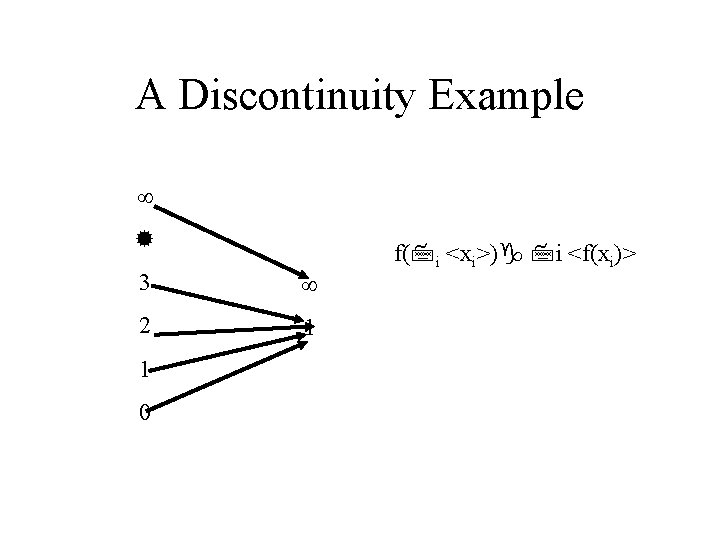
A Discontinuity Example 3 2 1 1 0 f( i <xi>) i <f(xi)>
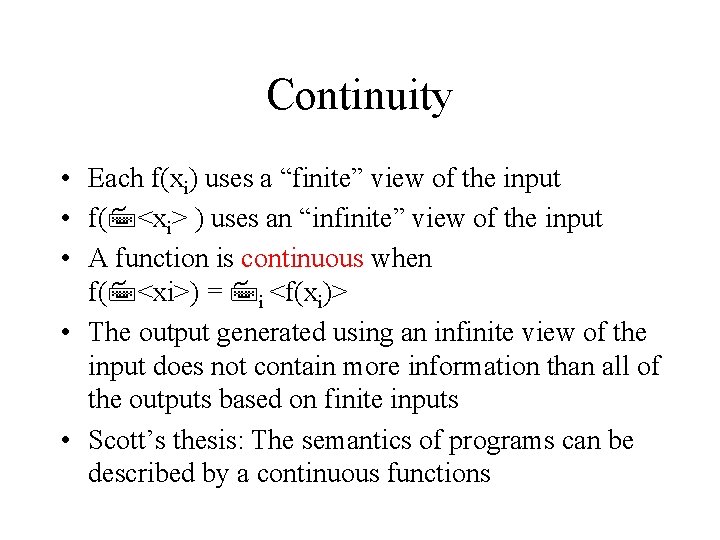
Continuity • Each f(xi) uses a “finite” view of the input • f( <xi> ) uses an “infinite” view of the input • A function is continuous when f( <xi>) = i <f(xi)> • The output generated using an infinite view of the input does not contain more information than all of the outputs based on finite inputs • Scott’s thesis: The semantics of programs can be described by a continuous functions
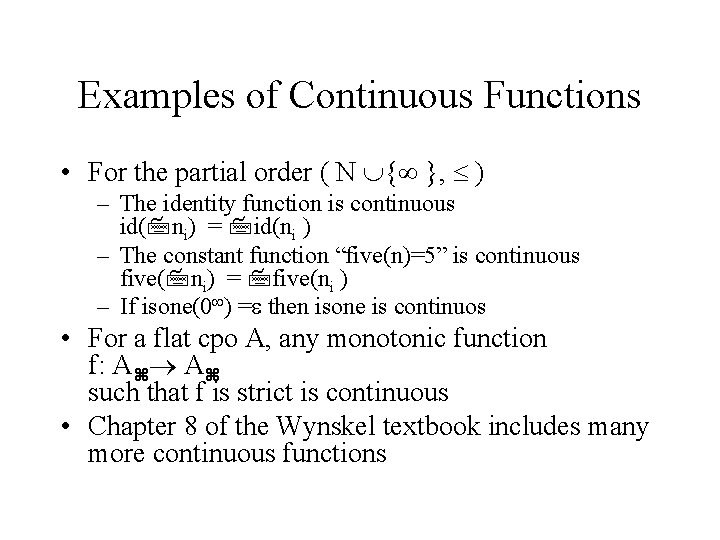
Examples of Continuous Functions • For the partial order ( N { }, ) – The identity function is continuous id( ni) = id(ni ) – The constant function “five(n)=5” is continuous five( ni) = five(ni ) – If isone(0 ) = then isone is continuos • For a flat cpo A, any monotonic function f: A A such that f is strict is continuous • Chapter 8 of the Wynskel textbook includes many more continuous functions
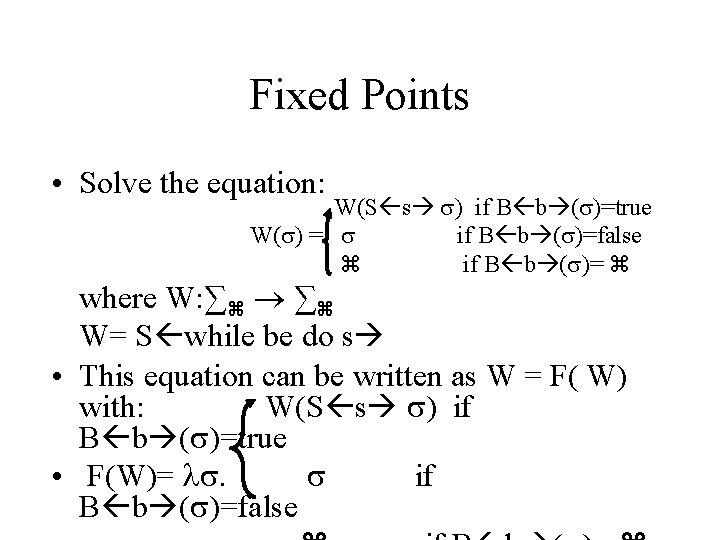
Fixed Points • Solve the equation: W(S s ) if B b ( )=true W( ) = if B b ( )=false if B b ( )= where W: ∑ ∑ W= S while be do s • This equation can be written as W = F( W) with: W(S s ) if B b ( )=true • F(W)= . if B b ( )=false
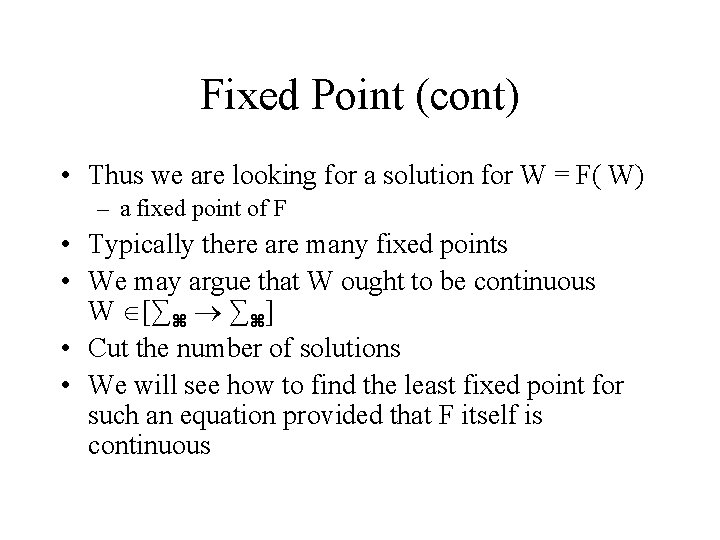
Fixed Point (cont) • Thus we are looking for a solution for W = F( W) – a fixed point of F • Typically there are many fixed points • We may argue that W ought to be continuous W [∑ ∑ ] • Cut the number of solutions • We will see how to find the least fixed point for such an equation provided that F itself is continuous
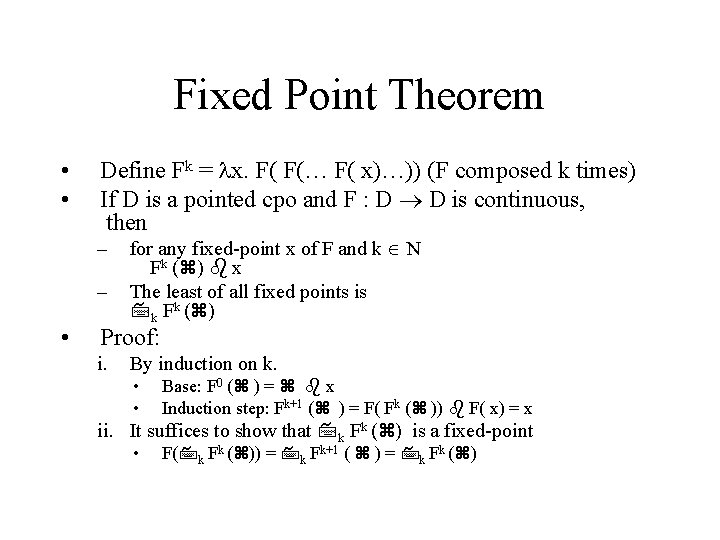
Fixed Point Theorem • • Define Fk = x. F( F(… F( x)…)) (F composed k times) If D is a pointed cpo and F : D D is continuous, then – – • for any fixed-point x of F and k N Fk ( ) x The least of all fixed points is k Fk ( ) Proof: i. By induction on k. • • Base: F 0 ( ) = x Induction step: Fk+1 ( ) = F( Fk ( )) F( x) = x ii. It suffices to show that k Fk ( ) is a fixed-point • F( k Fk ( )) = k Fk+1 ( ) = k Fk ( )
Fixed-Points (notes) • If F is continuous on a pointed cpo, we know how to find the least fixed point • All other fixed points can be regarded as refinements of the least one • They contain more information, they are more precise • In general, they are also more arbitrary • They also make less sense for our purposes
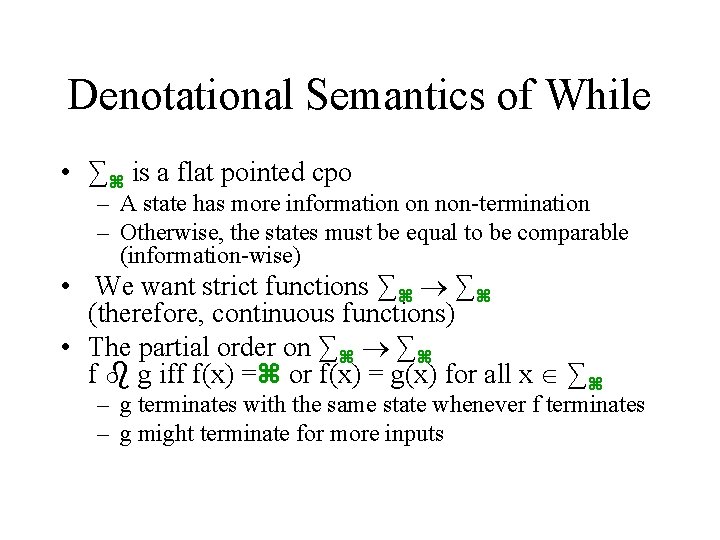
Denotational Semantics of While • ∑ is a flat pointed cpo – A state has more information on non-termination – Otherwise, the states must be equal to be comparable (information-wise) • We want strict functions ∑ ∑ (therefore, continuous functions) • The partial order on ∑ ∑ f g iff f(x) = or f(x) = g(x) for all x ∑ – g terminates with the same state whenever f terminates – g might terminate for more inputs
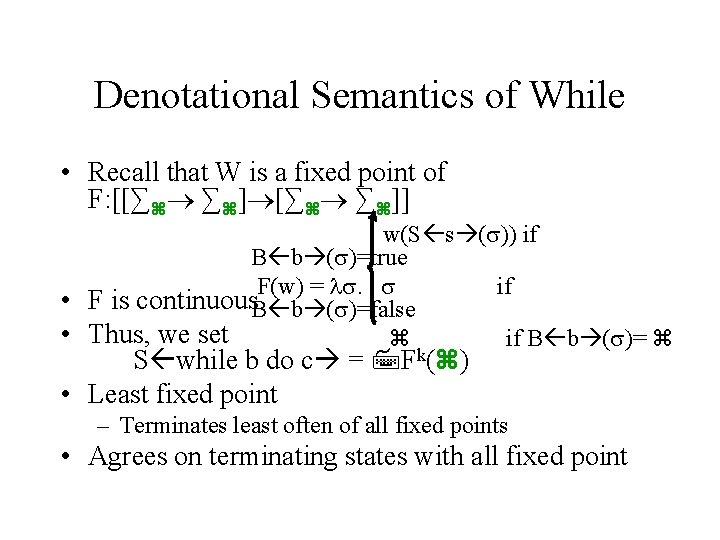
Denotational Semantics of While • Recall that W is a fixed point of F: [[∑ ∑ ]] w(S s ( )) if B b ( )=true F(w) = . if • F is continuous. B b ( )=false • Thus, we set if B b ( )= S while b do c = Fk( ) • Least fixed point – Terminates least often of all fixed points • Agrees on terminating states with all fixed point
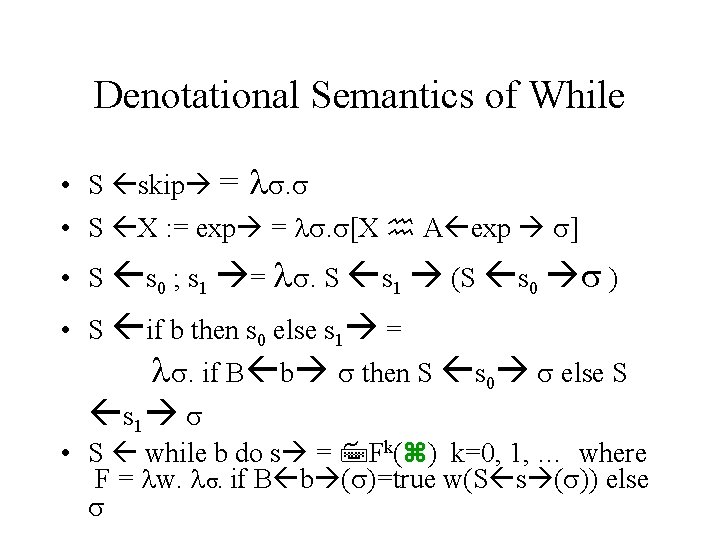
Denotational Semantics of While • S skip = . • S X : = exp = . [X A exp ] • S s 0 ; s 1 = . S s 1 (S s 0 ) • S if b then s 0 else s 1 = . if B b then S s 0 else S s 1 • S while b do s = Fk( ) k=0, 1, … where F = w. . if B b ( )=true w(S s ( )) else
![Example(1) • while true do skip • F: [[∑ ∑ ]] w(S s (](http://slidetodoc.com/presentation_image_h2/0ac357bcd56446d6e58379e12646e927/image-37.jpg "Example(1) • while true do skip • F: [[∑ ∑ ]] w(S s (")
Example(1) • while true do skip • F: [[∑ ∑ ]] w(S s ( )) if B b ( )=true F = w. . if B b ( )=false B true = . true if B b ( )= S skip = . F = w. . w( ) F 0( )= F 1( ) = F 2( ) =
![Example(2) • while false do s • F: [[∑ ∑ ]] w(S s (](http://slidetodoc.com/presentation_image_h2/0ac357bcd56446d6e58379e12646e927/image-38.jpg "Example(2) • while false do s • F: [[∑ ∑ ]] w(S s (")
Example(2) • while false do s • F: [[∑ ∑ ]] w(S s ( )) if B b ( )=true F = w. . if B b ( )=false B false = . false if B b ( )= F = w. . F 0( )= F 1( ) = . F 2( ) = . .
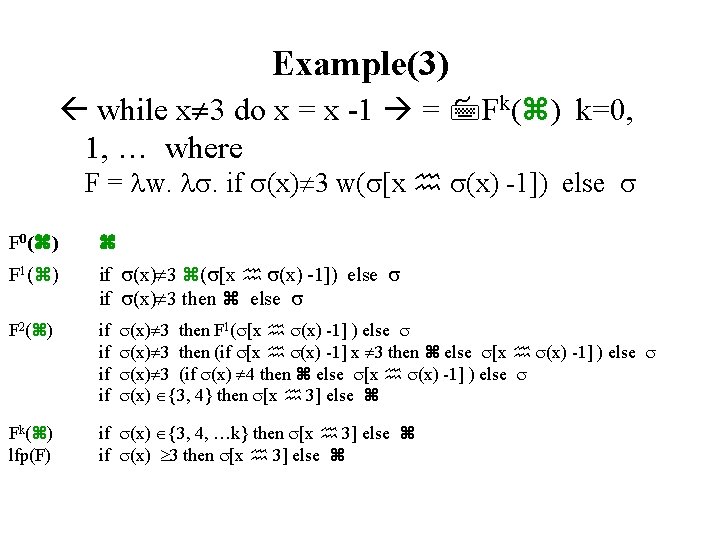
Example(3) while x 3 do x = x -1 = Fk( ) k=0, 1, … where F = w. . if (x) 3 w( [x (x) -1]) else F 0( ) F 1( ) if (x) 3 ( [x (x) -1]) else if (x) 3 then else F 2( ) if if Fk( ) lfp(F) if (x) {3, 4, …k} then [x 3] else if (x) 3 then [x 3] else (x) 3 then F 1( [x (x) -1] ) else (x) 3 then (if [x (x) -1] x 3 then else [x (x) -1] ) else (x) 3 (if (x) 4 then else [x (x) -1] ) else (x) {3, 4} then [x 3] else
![Example 4 Nested Loops s inner-loop = [Y 0][Z (Z)+ (Y) * ( (Y)+1)/2]](http://slidetodoc.com/presentation_image_h2/0ac357bcd56446d6e58379e12646e927/image-40.jpg "Example 4 Nested Loops s inner-loop = [Y 0][Z (Z)+ (Y) * ( (Y)+1)/2]")
Example 4 Nested Loops s inner-loop = [Y 0][Z (Z)+ (Y) * ( (Y)+1)/2] S == Z : = 0 ; if (Y) 0 if (Y)<0 s outer-loop = while X > 0 do ( Y : = X; while (Y>0) do if (X) 0 [Y 0] [X 0] [Z (Z)+ (X) ( (X) + 1) (1 + (2 (X) + 1)/3)/4 ] Z : = Z + Y ; Y: = Y- 1; ) X=X– 1 ) s S = if (X)<0 if (X) 0 [Y 0] [X 0] [Z (X) ( (X) + 1) (1 + (2 (X) + 1)/3)/4 ] if (X)<0
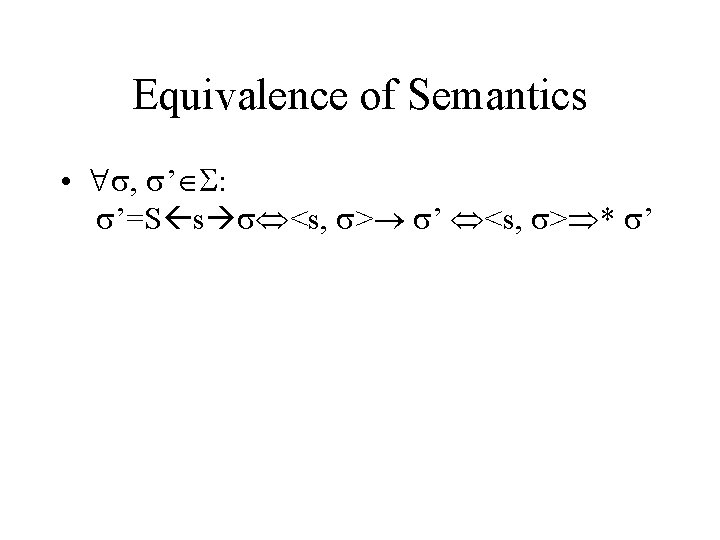
Equivalence of Semantics • , ’ : ’=S s <s, > ’ <s, > * ’
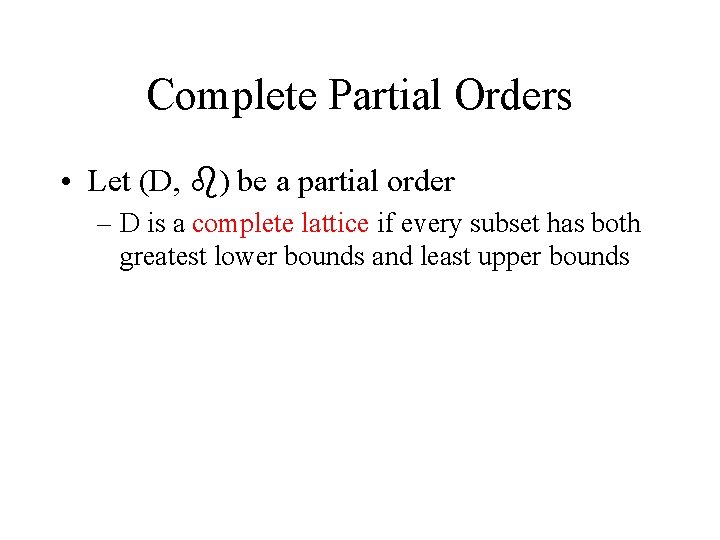
Complete Partial Orders • Let (D, ) be a partial order – D is a complete lattice if every subset has both greatest lower bounds and least upper bounds
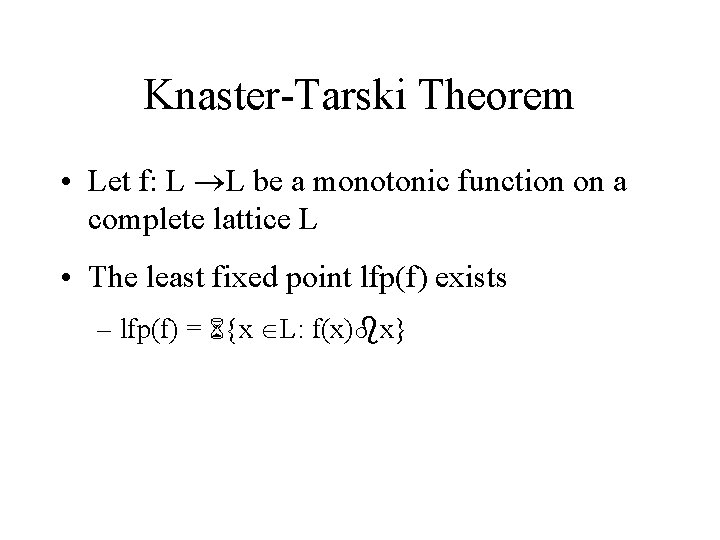
Knaster-Tarski Theorem • Let f: L L be a monotonic function on a complete lattice L • The least fixed point lfp(f) exists – lfp(f) = {x L: f(x) x}
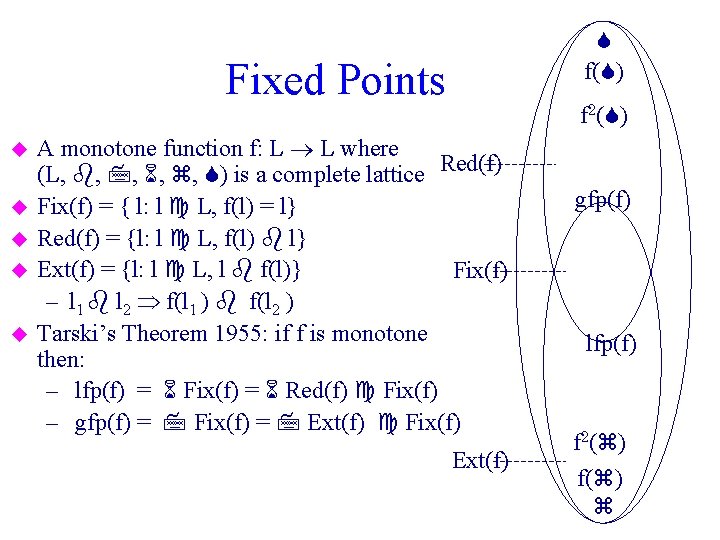
f( ) Fixed Points u u u f 2( ) A monotone function f: L L where (L, , , ) is a complete lattice Red(f) Fix(f) = { l: l L, f(l) = l} Red(f) = {l: l L, f(l) l} Ext(f) = {l: l L, l f(l)} Fix(f) – l 1 l 2 f(l 1 ) f(l 2 ) Tarski’s Theorem 1955: if f is monotone then: – lfp(f) = Fix(f) = Red(f) Fix(f) – gfp(f) = Fix(f) = Ext(f) Fix(f) Ext(f) gfp(f) lfp(f) f 2( ) f( )
Summary • Denotational definitions are not necessarily better than operational semantics, and they usually require more mathematical work • The mathematics may be done once and for all • The mathematics may pay off: • Some of its techniques are being transferred to operational semantics. • It is trivial to prove that “If B b 1 = B b 2 and C c 1 = C c 2 then C while b 1 do c 1 = C while b 2 do c 2 ” (compare with the operational semantics)
Summary • Denotational semantics provides a way to declare the meaning of programs in an abstract way – Can handle • side-effects • loops • Recursion • Gotos • non-determinism – But not low level concurrency • Fixed point theory provides a declarative way to specify computations – Many usages
- Slides: 46