
Denial of Service Firewalls and Intrusion Detection Denial
- Slides: 44
Denial of Service, Firewalls, and Intrusion Detection
Denial of Service �denial of service (Do. S) an action that prevents or impairs the authorized use of networks, systems, or applications by exhausting resources such as central processing units (CPU), memory, bandwidth, and disk space �attacks ◦ network bandwidth ◦ system resources ◦ application resources �have been an issue for some time
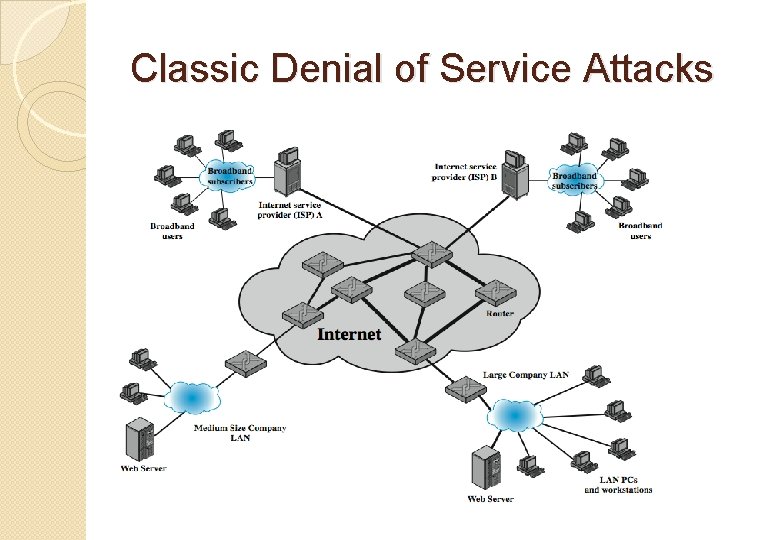
Classic Denial of Service Attacks �can use simple flooding ping �from higher capacity link to lower �causing loss of traffic �source of flood traffic easily identified
Classic Denial of Service Attacks
Source Address Spoofing �use forged source addresses ◦ given sufficient privilege to “raw sockets” ◦ easy to create �generate large volumes of packets �directed at target �with different, random, source addresses �cause same congestion �responses are scattered across Internet �real source is much harder to identify
SYN Spoofing �other common attack �attacks ability of a server to respond to future connection requests �overflowing tables used to manage them �hence an attack on system resource
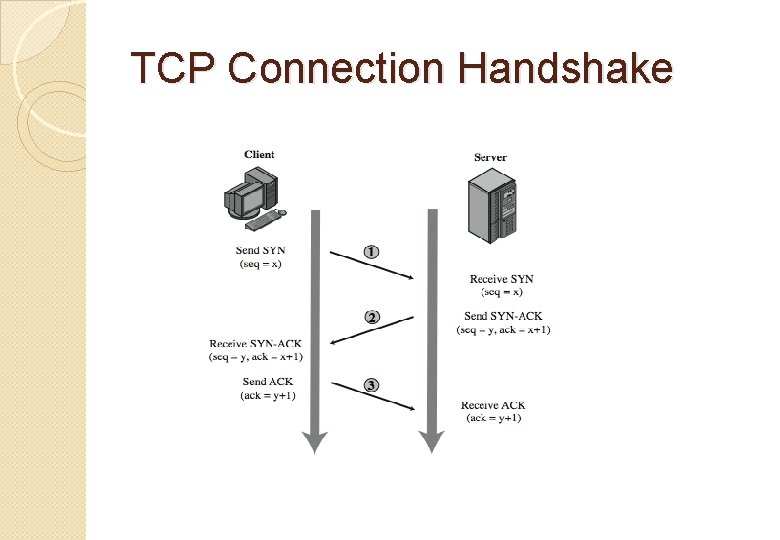
TCP Connection Handshake
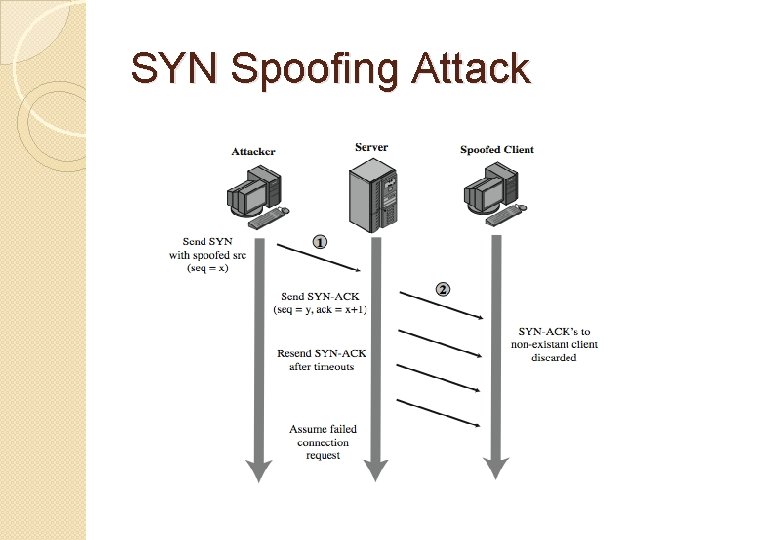
SYN Spoofing Attack
SYN Spoofing Attack �attacker often uses either ◦ random source addresses ◦ or that of an overloaded server ◦ to block return of (most) reset packets �has much lower traffic volume ◦ attacker can be on a much lower capacity link
Types of Flooding Attacks �classified based on network protocol used �ICMP Flood ◦ uses ICMP packets, eg echo request ◦ typically allowed through, some required �UDP Flood ◦ alternative uses UDP packets to some port �TCP SYN Flood ◦ use TCP SYN (connection request) packets ◦ but for volume attack
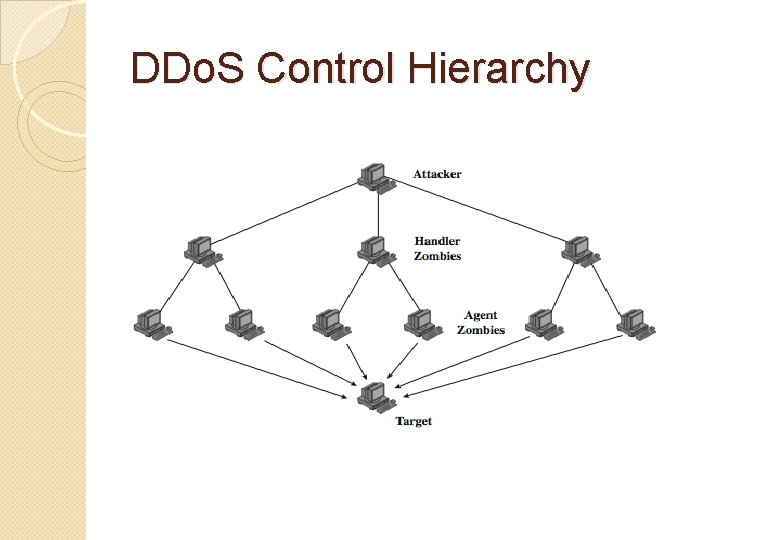
Distributed Denial of Service Attacks �have limited volume if single source used �multiple systems allow much higher traffic volumes to form a Distributed Denial of Service (DDo. S) Attack �often compromised PC’s / workstations ◦ zombies with backdoor programs installed ◦ forming a botnet �e. g. Tribe Flood Network (TFN), TFN 2 K
DDo. S Control Hierarchy
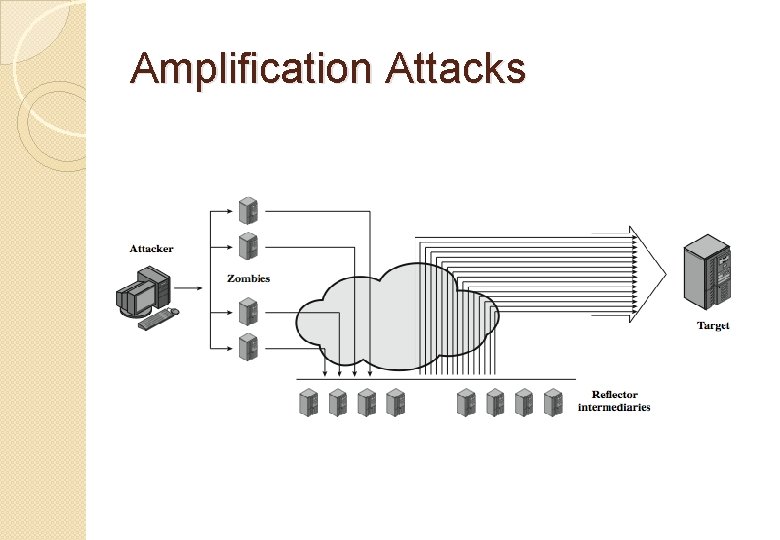
Reflection Attacks �use normal behavior of network �attacker sends packet with spoofed source address being that of target to a server �server response is directed at target �if send many requests to multiple servers, response can flood target �various protocols e. g. UDP or TCP/SYN �ideally want response larger than request �prevent if block source spoofed packets
Amplification Attacks
DNS Amplification Attacks �use DNS requests with spoofed source address being the target �exploit DNS behavior to convert a small request to a much larger response ◦ 60 byte request to 512 - 4000 byte response �attacker sends requests to multiple well connected servers, which flood target ◦ need only moderate flow of request packets ◦ DNS servers will also be loaded
Do. S Attack Defenses �high traffic volumes may be legitimate ◦ result of high publicity, e. g. “slash-dotted” ◦ or to a very popular site, e. g. Olympics etc �or legitimate traffic created by an attacker �three lines of defense against (D)Do. S: ◦ attack prevention and preemption ◦ attack detection and filtering ◦ attack source traceback and identification
Attack Prevention �block spoofed source addresses ◦ on routers as close to source as possible ◦ still far too rarely implemented �rate controls in upstream distribution nets ◦ on specific packets types ◦ e. g. some ICMP, some UDP, TCP/SYN �use modified TCP connection handling ◦ or selective or random drop when table full
Attack Prevention �block IP directed broadcasts �block suspicious services & combinations �manage application attacks with “puzzles” to distinguish legitimate human requests �good general system security practices �use mirrored and replicated servers when high -performance and reliability required
Responding to Attacks �need good incident response plan ◦ with contacts for ISP ◦ needed to impose traffic filtering upstream ◦ details of response process �have standard filters �ideally have network monitors and IDS ◦ to detect and notify abnormal traffic patterns
Responding to Attacks �identify type of attack ◦ capture and analyze packets ◦ design filters to block attack traffic upstream ◦ or identify and correct system/application bug �have ISP trace packet flow back to source ◦ may be difficult and time consuming ◦ necessary if legal action desired �implement contingency plan �update incident response plan
Summary �introduced denial of service (Do. S) attacks �classic flooding and SYN spoofing attacks �ICMP, UDP, TCP SYN floods �distributed denial of service (DDo. S) attacks �reflection and amplification attacks �defenses against Do. S attacks �responding to Do. S attacks
Firewalls and Intrusion Prevention Systems �effective means of protecting LANs �internet connectivity essential ◦ for organization and individuals ◦ but creates a threat �could secure workstations and servers �also use firewall as perimeter defence ◦ single choke point to impose security
Firewall Capabilities & Limits �capabilities: ◦ defines a single choke point ◦ provides a location for monitoring security events ◦ convenient platform for some Internet functions such as NAT, usage monitoring, IPSEC VPNs �limitations: ◦ cannot protect against attacks bypassing firewall ◦ may not protect fully against internal threats ◦ improperly secure wireless LAN ◦ laptop, PDA, portable storage device infected outside then used inside
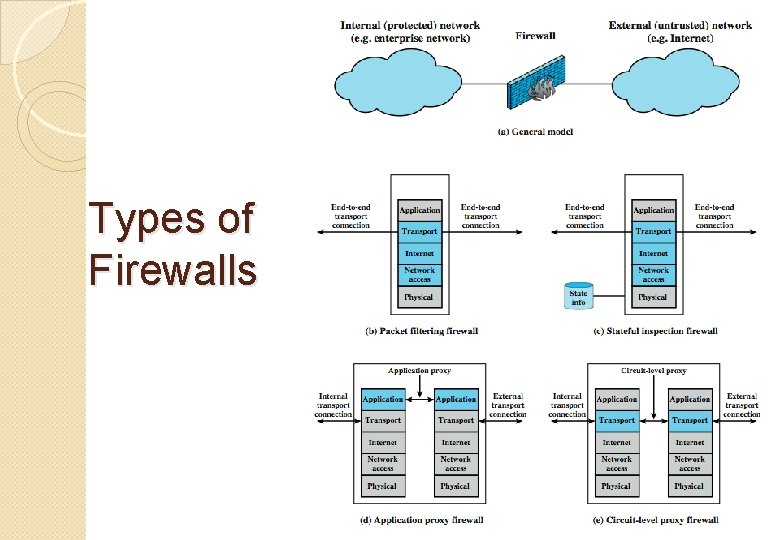
Types of Firewalls
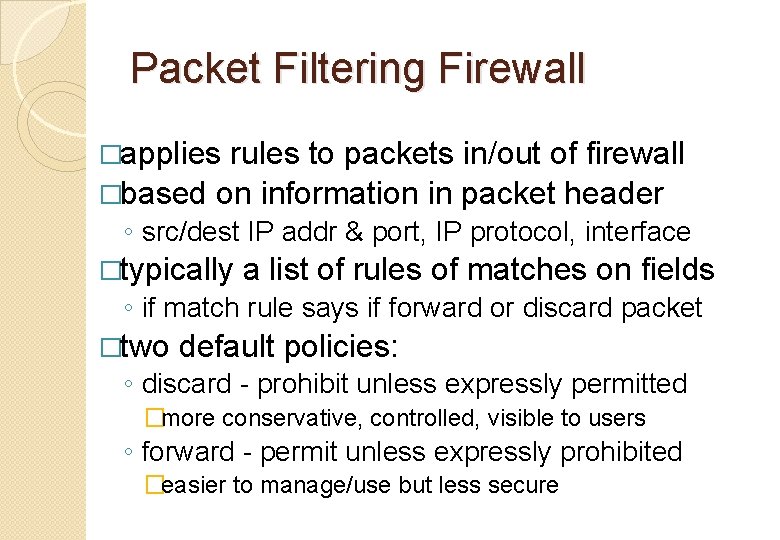
Packet Filtering Firewall �applies rules to packets in/out of firewall �based on information in packet header ◦ src/dest IP addr & port, IP protocol, interface �typically a list of rules of matches on fields ◦ if match rule says if forward or discard packet �two default policies: ◦ discard - prohibit unless expressly permitted �more conservative, controlled, visible to users ◦ forward - permit unless expressly prohibited �easier to manage/use but less secure
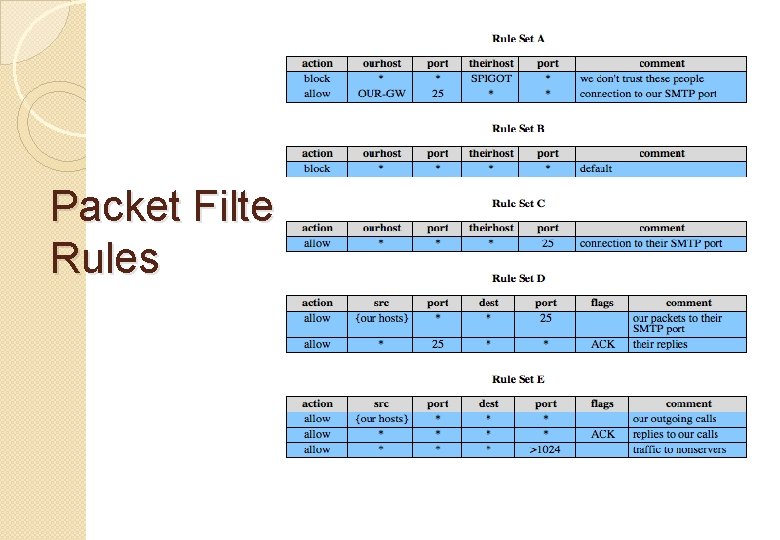
Packet Filter Rules
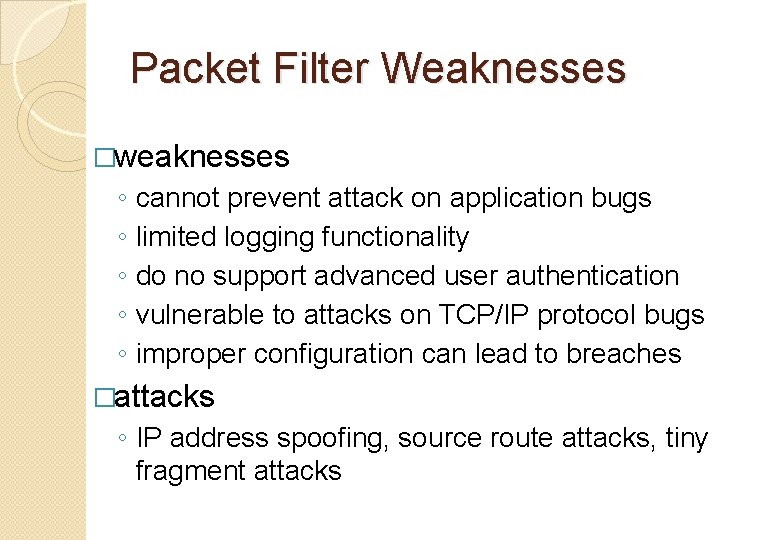
Packet Filter Weaknesses �weaknesses ◦ ◦ ◦ cannot prevent attack on application bugs limited logging functionality do no support advanced user authentication vulnerable to attacks on TCP/IP protocol bugs improper configuration can lead to breaches �attacks ◦ IP address spoofing, source route attacks, tiny fragment attacks
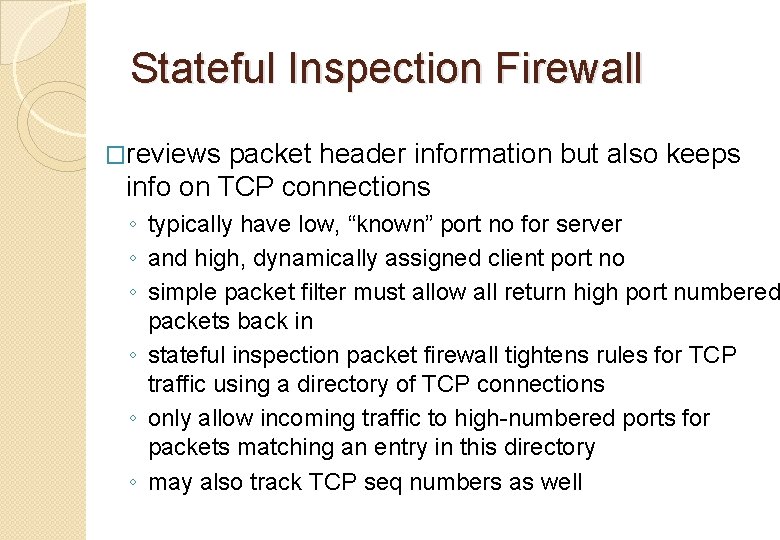
Stateful Inspection Firewall �reviews packet header information but also keeps info on TCP connections ◦ typically have low, “known” port no for server ◦ and high, dynamically assigned client port no ◦ simple packet filter must allow all return high port numbered packets back in ◦ stateful inspection packet firewall tightens rules for TCP traffic using a directory of TCP connections ◦ only allow incoming traffic to high-numbered ports for packets matching an entry in this directory ◦ may also track TCP seq numbers as well
Application-Level Gateway �acts as a relay of application-level traffic ◦ user contacts gateway with remote host name ◦ authenticates themselves ◦ gateway contacts application on remote host and relays TCP segments between server and user �must have proxy code for each application ◦ may restrict application features supported �more secure than packet filters �but have higher overheads
Circuit-Level Gateway �sets up two TCP connections, to an inside user and to an outside host �relays TCP segments from one connection to the other without examining contents ◦ hence independent of application logic ◦ just determines whether relay is permitted �typically used when inside users trusted ◦ may use application-level gateway inbound and circuit-level gateway outbound ◦ hence lower overheads
SOCKS Circuit-Level Gateway �SOCKS v 5 defined as RFC 1928 to allow TCP/UDP applications to use firewall �components: ◦ SOCKS server on firewall ◦ SOCKS client library on all internal hosts ◦ SOCKS-ified client applications �client app contacts SOCKS server, authenticates, sends relay request �server evaluates & establishes relay connection �UDP handled with parallel TCP control channel
Firewall Basing �several options for locating firewall: �bastion host �individual host-based firewall �personal firewall
Bastion Hosts �critical strongpoint in network �hosts application/circuit-level gateways �common characteristics: ◦ ◦ ◦ runs secure O/S, only essential services may require user auth to access proxy or host each proxy can restrict features, hosts accessed each proxy small, simple, checked for security each proxy is independent, non-privileged limited disk use, hence read-only code
Host-Based Firewalls �used to secure individual host �available in/add-on for many O/S �filter packet flows �often used on servers �advantages: ◦ taylored filter rules for specific host needs ◦ protection from both internal / external attacks ◦ additional layer of protection to org firewall
Personal Firewall �controls traffic flow to/from PC/workstation �for both home or corporate use �may be software module on PC �or in home cable/DSL router/gateway �typically much less complex �primary role to deny unauthorized access �may also monitor outgoing traffic to detect/block worm/malware activity
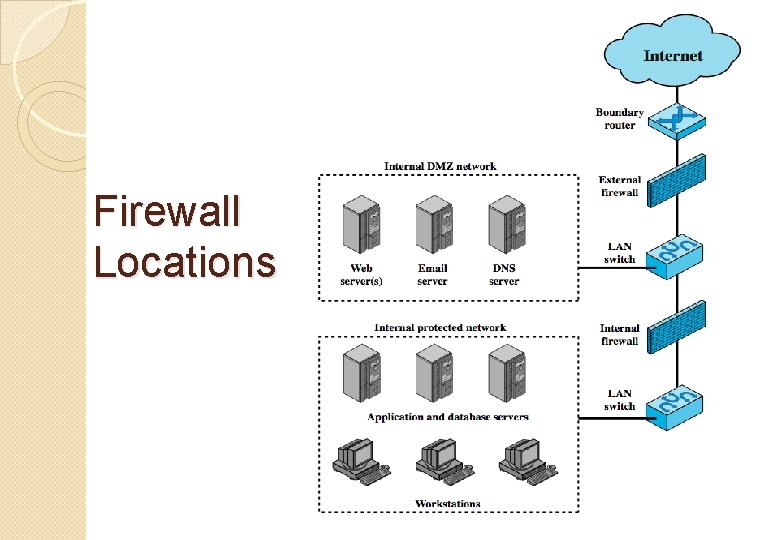
Firewall Locations
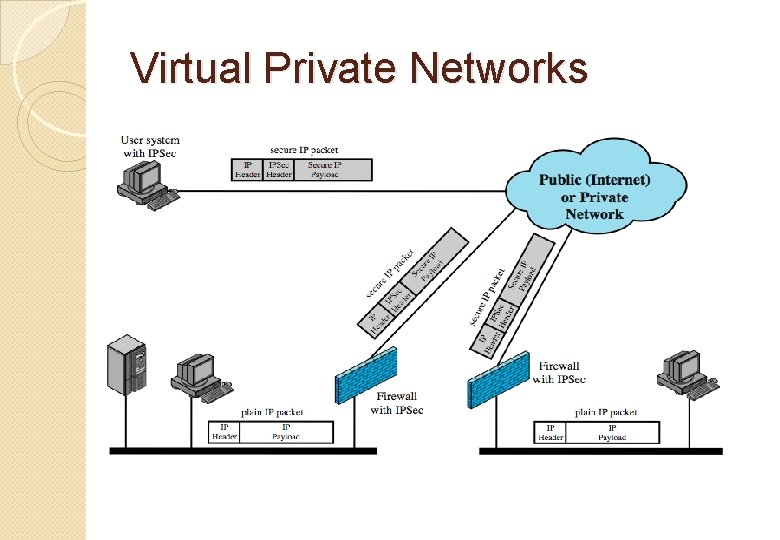
Virtual Private Networks
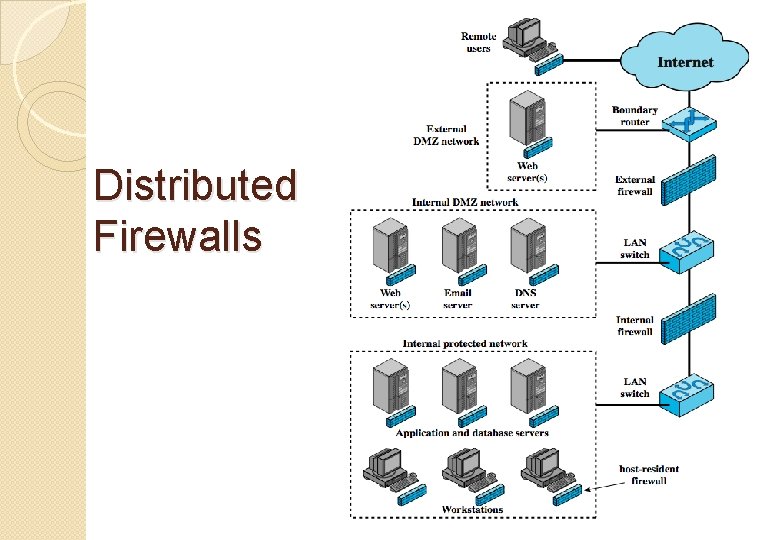
Distributed Firewalls
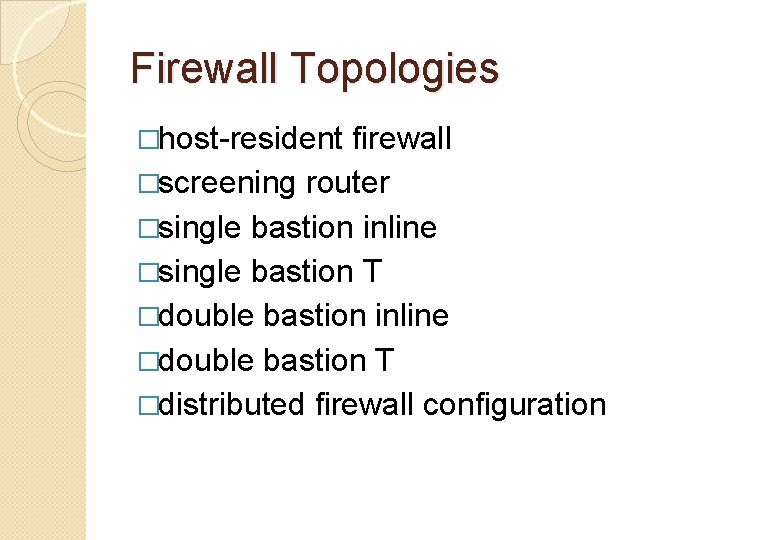
Firewall Topologies �host-resident firewall �screening router �single bastion inline �single bastion T �double bastion inline �double bastion T �distributed firewall configuration
Intrusion Prevention Systems (IPS) �recent addition to security products which ◦ inline net/host-based IDS that can block traffic ◦ functional addition to firewall that adds IDS capabilities �can block traffic like a firewall �using IDS algorithms �may be network or host based
Host-Based IPS �identifies attacks using both: ◦ signature techniques �malicious application packets ◦ anomaly detection techniques �behavior patterns that indicate malware �can be tailored to the specific platform ◦ e. g. general purpose, web/database server specific �can also sandbox applets to monitor behavior �may give desktop file, registry, I/O protection
Network-Based IPS �inline NIDS that can discard packets or terminate TCP connections �uses signature and anomaly detection �may provide flow data protection ◦ monitoring full application flow content �can identify malicious packets using: ◦ pattern matching, stateful matching, protocol anomaly, traffic anomaly, statistical anomaly �cf. SNORT inline can drop/modify packets
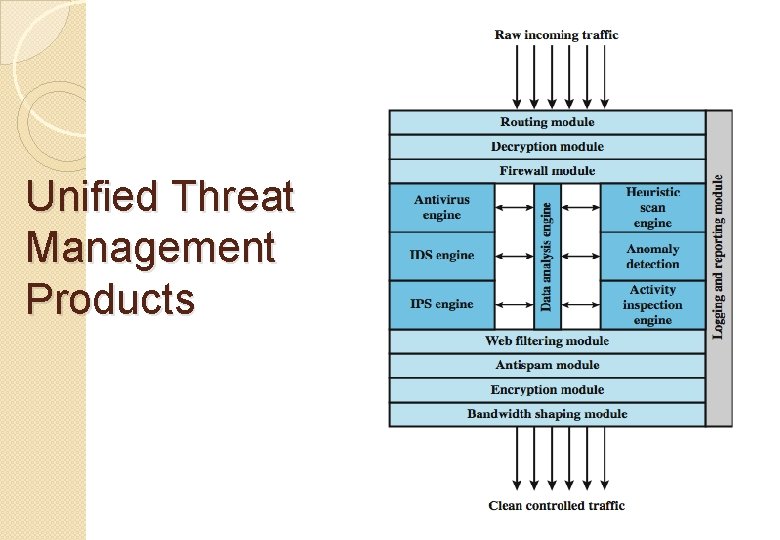
Unified Threat Management Products
Summary �introduced need for & purpose of firewalls �types of firewalls ◦ packet filter, stateful inspection, application and circuit gateways �firewall hosting, locations, topologies �intrusion prevention systems