
Dendritic Solidification in Undercooled Metallic Melts Processed by
Dendritic Solidification in Undercooled Metallic Melts Processed by Electromagnetic Levitation Sven Reutzel 1, 2, Dieter M. Herlach 2 1 Ruhr-University, Bochum Institute of Experimental Physics IV 06. 2021 2 German Aerospace Center, Cologne Institute of Space Simulation 2 nd Sino German Workshop on Institute of Space Simulation Electromagnetic Processing of Materials 1 Dresden, 17 Oct. 2005
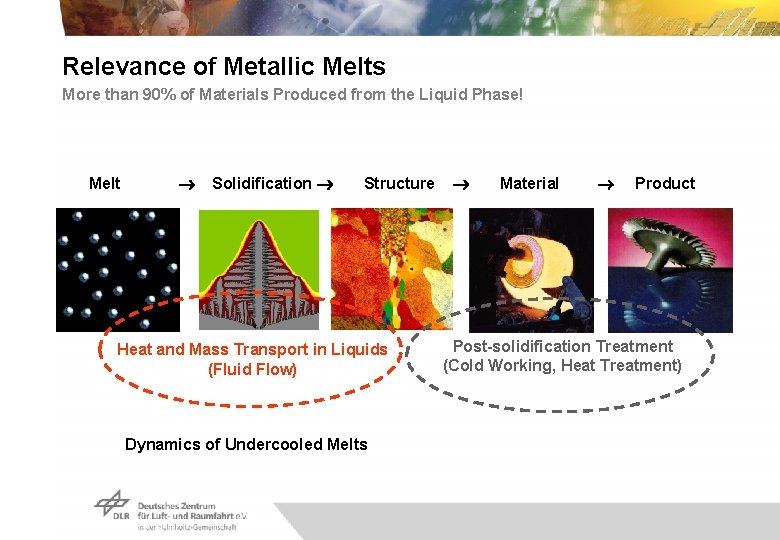
Relevance of Metallic Melts More than 90% of Materials Produced from the Liquid Phase! Melt Solidification Structure Heat and Mass Transport in Liquids (Fluid Flow) Dynamics of Undercooled Melts Institute of Space Simulation Material Product Post-solidification Treatment (Cold Working, Heat Treatment)
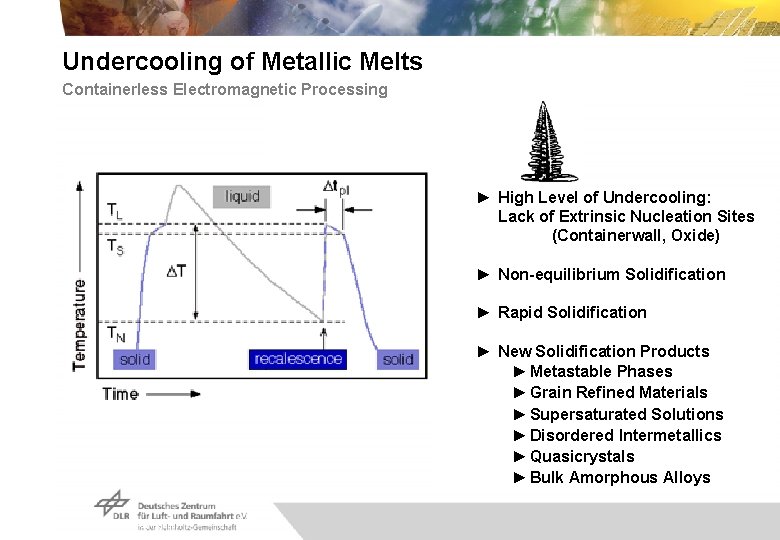
Undercooling of Metallic Melts Containerless Electromagnetic Processing ► High Level of Undercooling: Lack of Extrinsic Nucleation Sites (Containerwall, Oxide) ► Non-equilibrium Solidification ► Rapid Solidification ► New Solidification Products ► Metastable Phases ► Grain Refined Materials ► Supersaturated Solutions ► Disordered Intermetallics ► Quasicrystals ► Bulk Amorphous Alloys Institute of Space Simulation
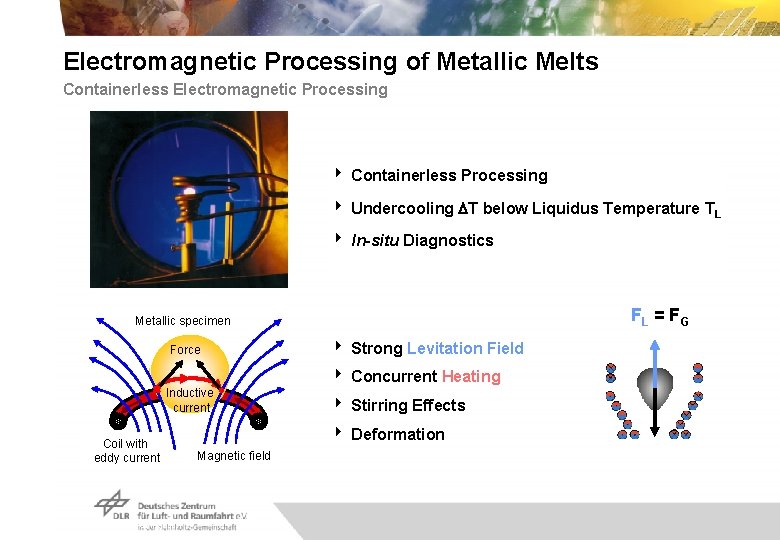
Electromagnetic Processing of Metallic Melts Containerless Electromagnetic Processing 4 Containerless Processing 4 Undercooling T below Liquidus Temperature TL 4 In-situ Diagnostics FL = F G Metallic specimen Force Inductive current Coil with eddy current Institute of Space Simulation 4 Strong Levitation Field 4 Concurrent Heating 4 Stirring Effects 4 Deformation Magnetic field
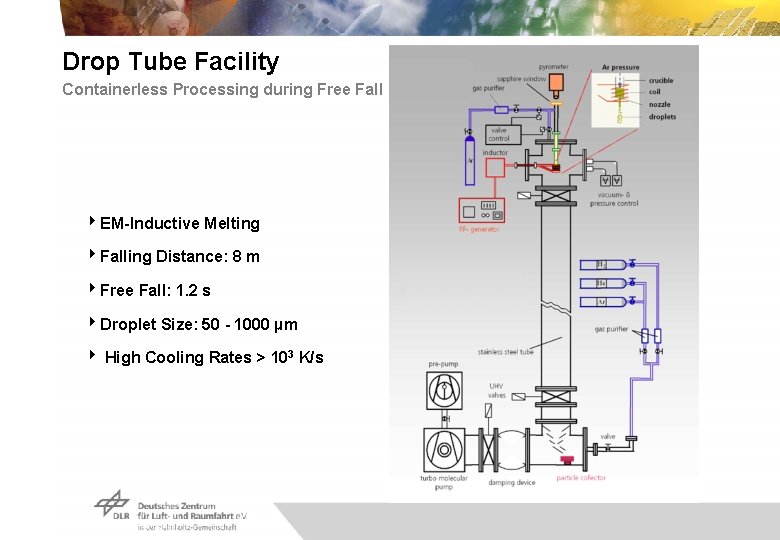
Drop Tube Facility Containerless Processing during Free Fall 4 EM-Inductive Melting 4 Falling Distance: 8 m 4 Free Fall: 1. 2 s 4 Droplet Size: 50 - 1000 µm 4 High Cooling Rates > 103 K/s Institute of Space Simulation
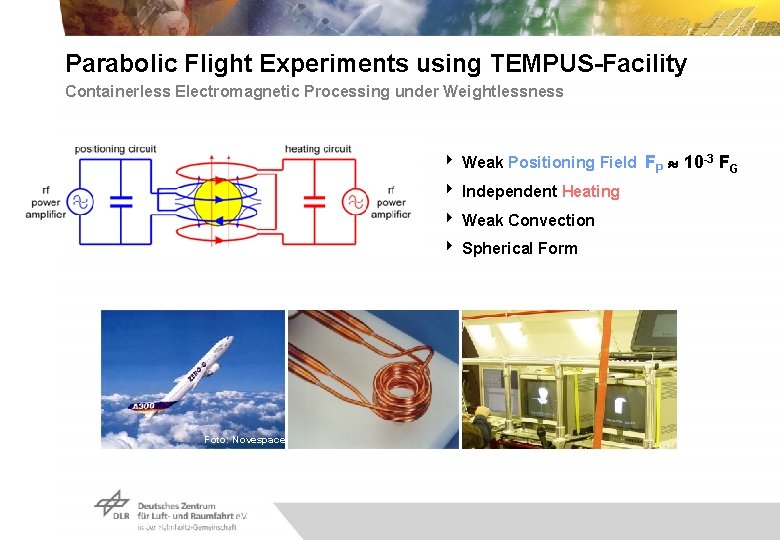
Parabolic Flight Experiments using TEMPUS-Facility Containerless Electromagnetic Processing under Weightlessness 4 Weak Positioning Field FP 10 -3 FG 4 Independent Heating 4 Weak Convection 4 Spherical Form Foto: Novespace Institute of Space Simulation
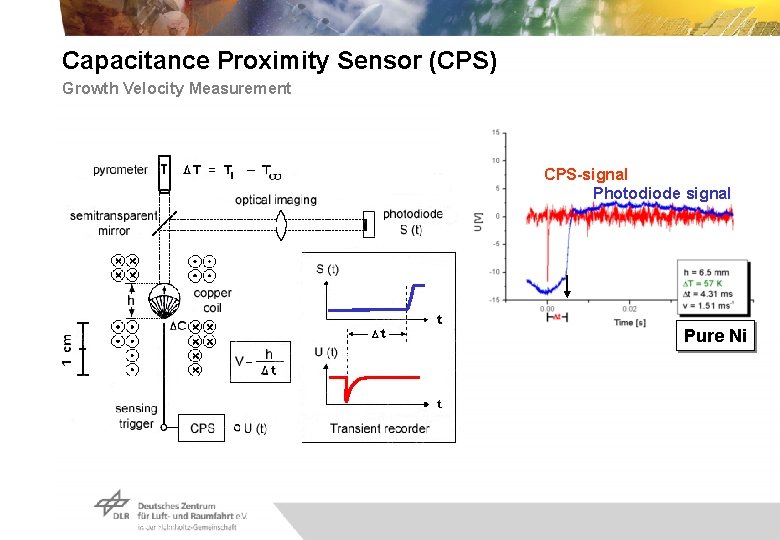
Capacitance Proximity Sensor (CPS) Growth Velocity Measurement CPS-signal Photodiode signal Pure Ni Institute of Space Simulation
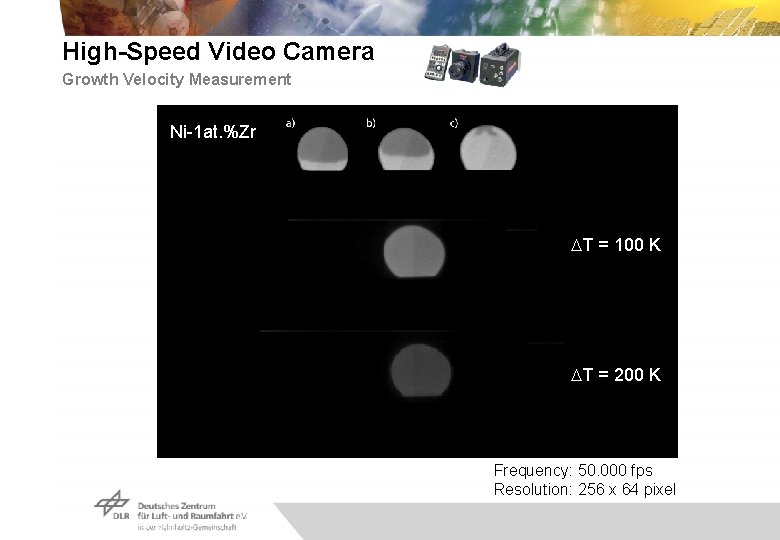
High-Speed Video Camera Growth Velocity Measurement Ni-1 at. %Zr T = 100 K T = 200 K Frequency: 50. 000 fps Resolution: 256 x 64 pixel Institute of Space Simulation
![Dendrite Growth of pure Ni [1] Growth Velocity Measurements ► Forced Convection · -](http://slidetodoc.com/presentation_image_h2/5896ba0044c1986b103884a13e23879d/image-9.jpg "Dendrite Growth of pure Ni [1] Growth Velocity Measurements ► Forced Convection · -")
Dendrite Growth of pure Ni [1] Growth Velocity Measurements ► Forced Convection · - experimental data 1 - Brener theory 2 - model with convection, µk 0 = 1. 2 (m/s/K) 3 - model with convection, µk 0 = 0. 45 (m/s/K) ► Convection Roles ► Anisotropic Growth Conditions Discrepancy of Experimental Results to Dendrite Growth Model without Fluid Flow Effects [2] Institute of Space Simulation [1] O. Funke et al. , Europ. Phys. Journal B, submitted [2] E. Brener, J. Cryst. Growth 99 (1990) 165
![Extension of Sharp Interface Model including Forced Convection [3] Total Undercooling: ∆T = ∆TT](http://slidetodoc.com/presentation_image_h2/5896ba0044c1986b103884a13e23879d/image-10.jpg "Extension of Sharp Interface Model including Forced Convection [3] Total Undercooling: ∆T = ∆TT")
Extension of Sharp Interface Model including Forced Convection [3] Total Undercooling: ∆T = ∆TT + ∆TR + ∆Tk + ∆TC + ∆TN Thermal Undercooling: Curvature Undercooling: (Gibbs-Thomson Effect) Kinetic Undercooling: , with Constitutional Undercooling: due to Shift of Equilibrium Liquidus from Equilibrium Position in Kinetic Phase Diagram of Steady-state Solidification Solvability Theory: Institute of Space Simulation [3] P. K. Galenko, D. A. Danilov, Phys. Lett. A 235 (1997) 271
![Dendrite Growth of Ni-Zr Alloys [4] Growth Velocity Measurement Sharp-interface Modeling Fluid Flow U](http://slidetodoc.com/presentation_image_h2/5896ba0044c1986b103884a13e23879d/image-11.jpg "Dendrite Growth of Ni-Zr Alloys [4] Growth Velocity Measurement Sharp-interface Modeling Fluid Flow U")
Dendrite Growth of Ni-Zr Alloys [4] Growth Velocity Measurement Sharp-interface Modeling Fluid Flow U 0 = 0. 85 m/s Institute of Space Simulation [4] P. Galenko et al. , Mater. Sci. Eng. A, accepted
![Dendritic Solidification in Ni-Zr Alloys [4] Dendritic Pattern Formation in Ni-1 at. %Zr tbu](http://slidetodoc.com/presentation_image_h2/5896ba0044c1986b103884a13e23879d/image-12.jpg "Dendritic Solidification in Ni-Zr Alloys [4] Dendritic Pattern Formation in Ni-1 at. %Zr tbu")
Dendritic Solidification in Ni-Zr Alloys [4] Dendritic Pattern Formation in Ni-1 at. %Zr tbu < tpl Nucleation Undercooled Melt T = 37 K: Coarse Grained Institute of Space Simulation T = 80 K: Grain Refined Structure Coarse Grained Structure tbu > tpl T = 155 K: Coarse Grained [4] P. Galenko et al. , Mater. Sci. Eng. A, accepted
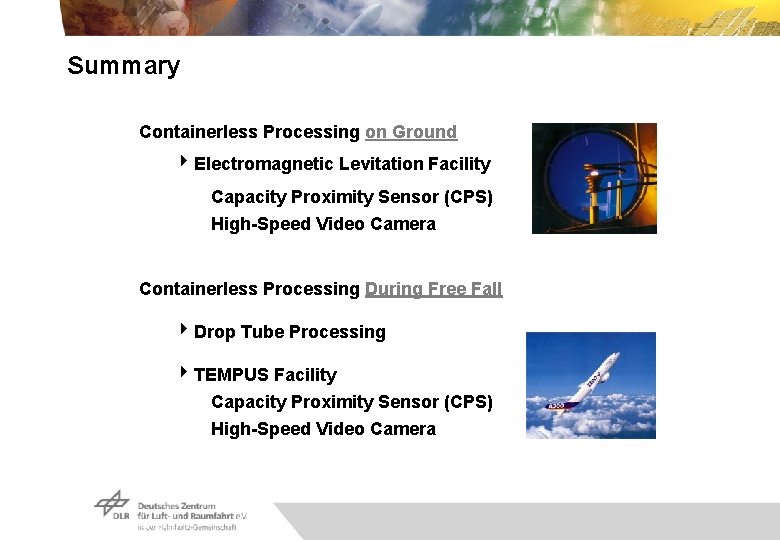
Summary Containerless Processing on Ground 4 Electromagnetic Levitation Facility Capacity Proximity Sensor (CPS) High-Speed Video Camera Containerless Processing During Free Fall 4 Drop Tube Processing 4 TEMPUS Facility Capacity Proximity Sensor (CPS) High-Speed Video Camera Institute of Space Simulation
Acknowledgments Contributors to the presented work: Dr. Hamid Assadi Mrs. Liudmilla Chernova Dr. Oliver Funke Dr. Peter Galenko Dr. Phanikumar Gandham PD Dr. Dirk Holland-Moritz Dr. Matthias Kolbe Financial support of the European Space Agency within the Microgravity Application Programme project ‚Non-equilibrium Solidification, Modeling for Microstructure Engineering of Industrial Alloys‘ is gratefully acknowledged! Institute of Space Simulation
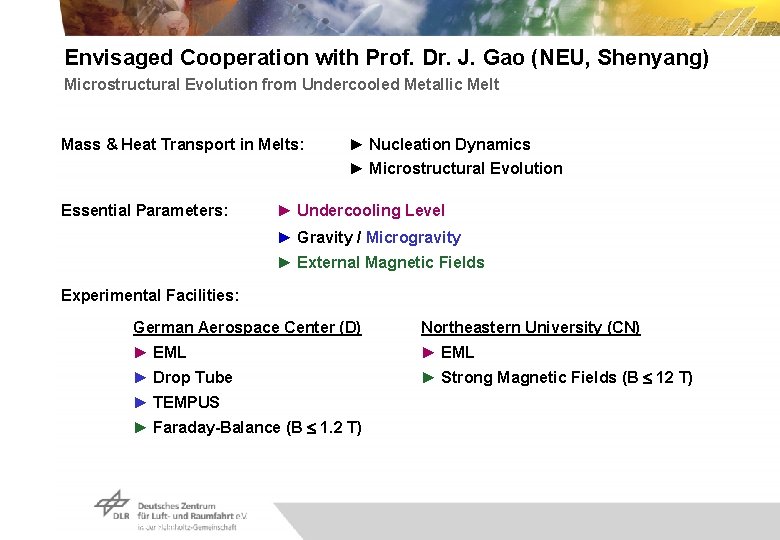
Envisaged Cooperation with Prof. Dr. J. Gao (NEU, Shenyang) Microstructural Evolution from Undercooled Metallic Melt Mass & Heat Transport in Melts: Essential Parameters: ► Nucleation Dynamics ► Microstructural Evolution ► Undercooling Level ► Gravity / Microgravity ► External Magnetic Fields Experimental Facilities: German Aerospace Center (D) Northeastern University (CN) ► EML ► Drop Tube ► Strong Magnetic Fields (B 12 T) ► TEMPUS ► Faraday-Balance (B 1. 2 T) Institute of Space Simulation
- Slides: 15