
Demystifying the Public Mental Health System Mark Botts
Demystifying the Public Mental Health System Mark Botts, JD Associate Professor of Public Law and Government School of Government UNC Chapel Hill botts@sog. unc. edu 919 -962 -8204 919 -923 -3229
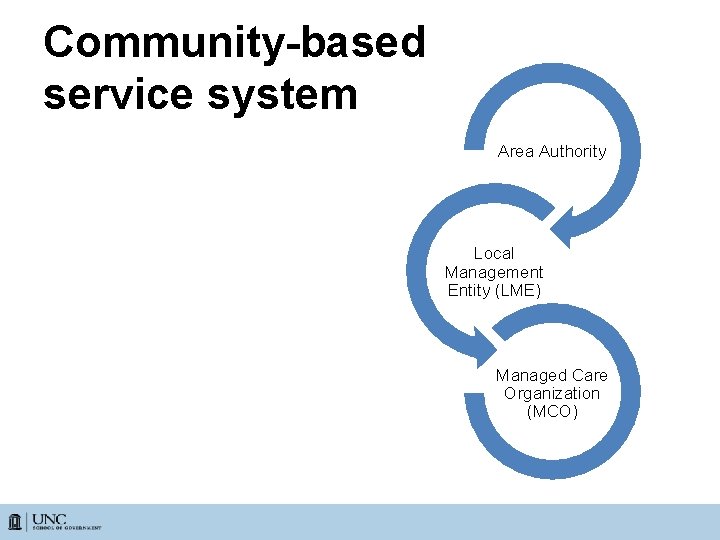
Community-based service system Area Authority Local Management Entity (LME) Managed Care Organization (MCO)
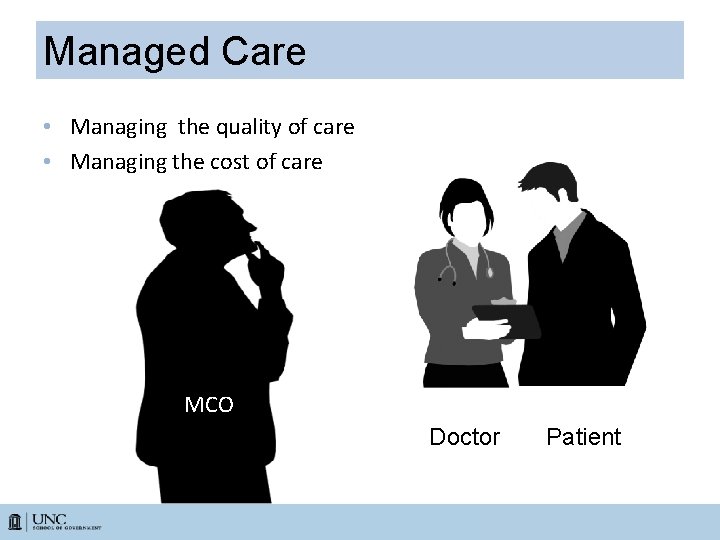
Managed Care • Managing the quality of care • Managing the cost of care MCO Doctor Patient
State Government Role § General Assembly—policymaker § Organization and Structure § Funding § Eligibility § DHHS § Services— 14 state-operated facilities (2, 800) § Funds for community-based services § DMA—Medicaid money (insured) § DMH/DD/SAS—Non-Medicaid funds (uninsured) § Oversight of community-based system 4
WHAT IS AN AREA AUTHORITY AND WHAT DOES IT DO? 5
What is an area authority? § An area authority is a local political subdivision of the state § Within the public system of mental health, developmental disabilities, and substance abuse services (MH/DD/SAS) an area authority is the locus of coordination among public services for clients of its catchment area G. S. 122 C-101, -116. 6
How are they established? § Two or more counties together must establish an area authority § A county must provide MH/DD/SA services through an area authority § With DHHS Secretary approval: § A county may “disengage” from one LME and “realign” with another § Two area authorities may consolidate (merge) to create one larger area authority G. S. 122 C-115. 7
Who Governs the LME? q Boards of county commissioners within the area authority’s catchment area appoint “area board” board members according to a plan § jointly adopted by the counties and § that describes the board composition, appointment, and selection process q Area board statute requires § At least 11 and no more than 21 voting members § 11 prescribed categories of professional and constituent representation G. S. 122 C-118. 1, 122 C-115. 2 8
What does an area authority do? q. Responsible for the management and oversight of the public system of MH/DD/SA services at the community level. q. Must plan, develop, implement, and monitor services within a specified geographic area to ensure expected outcomes for consumers within available resources. G. S. 122 C-115. 4

LME-MCO Regions Map courtesy of Sandhills Center Area Nine Counties 4, 876 Square Miles 1, 101, 687 People 188, 000 Medicaid Covered Lives 124, 871 Uninsured Lives Governed by 21 Member Board of Directors
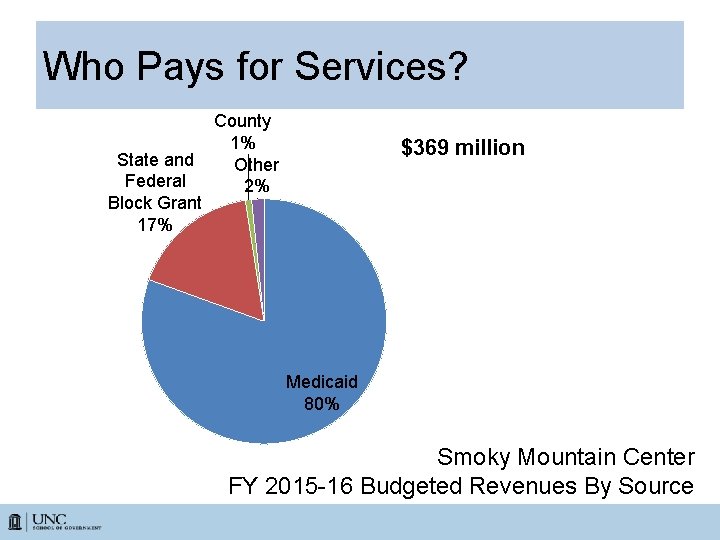
Who Pays for Services? State and Federal Block Grant 17% County 1% Other 2% $369 million Medicaid 80% Smoky Mountain Center FY 2015 -16 Budgeted Revenues By Source
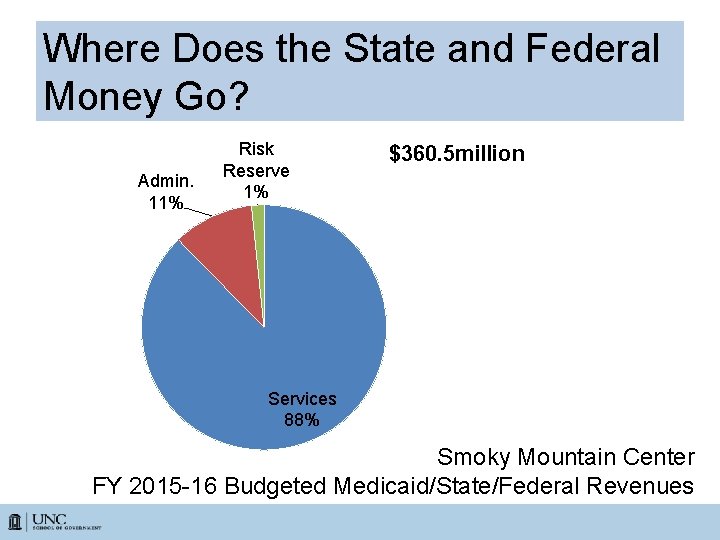
Where Does the State and Federal Money Go? Admin. 11% Risk Reserve 1% $360. 5 million Services 88% Smoky Mountain Center FY 2015 -16 Budgeted Medicaid/State/Federal Revenues
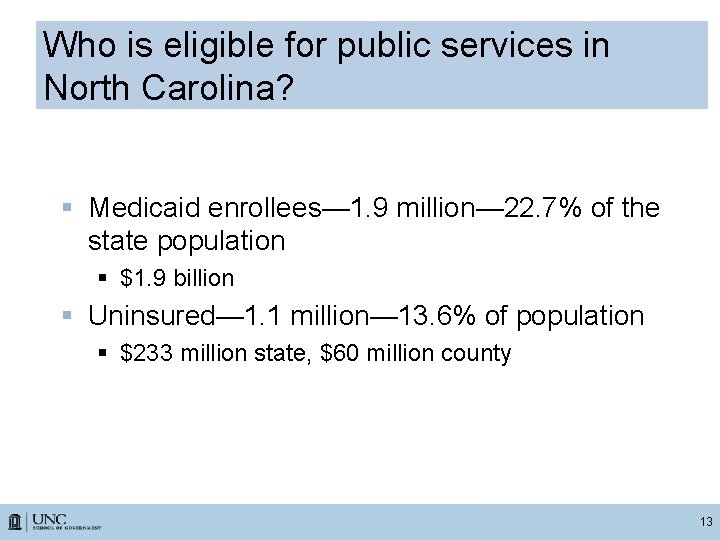
Who is eligible for public services in North Carolina? § Medicaid enrollees— 1. 9 million— 22. 7% of the state population § $1. 9 billion § Uninsured— 1. 1 million— 13. 6% of population § $233 million state, $60 million county 13
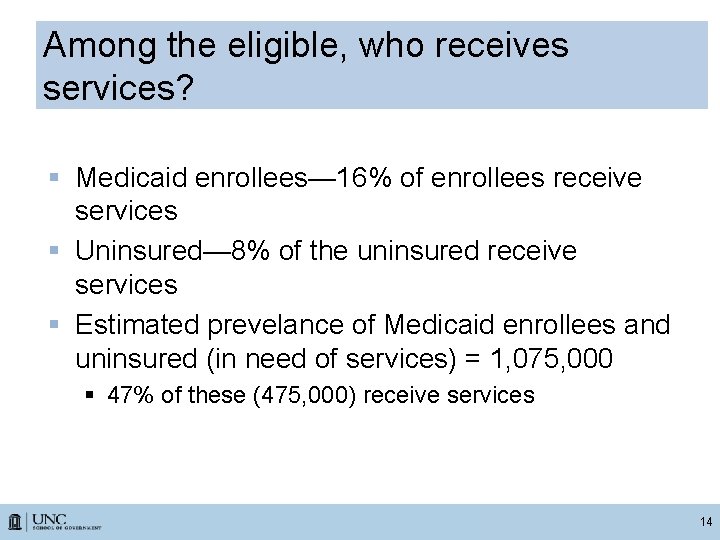
Among the eligible, who receives services? § Medicaid enrollees— 16% of enrollees receive services § Uninsured— 8% of the uninsured receive services § Estimated prevelance of Medicaid enrollees and uninsured (in need of services) = 1, 075, 000 § 47% of these (475, 000) receive services 14
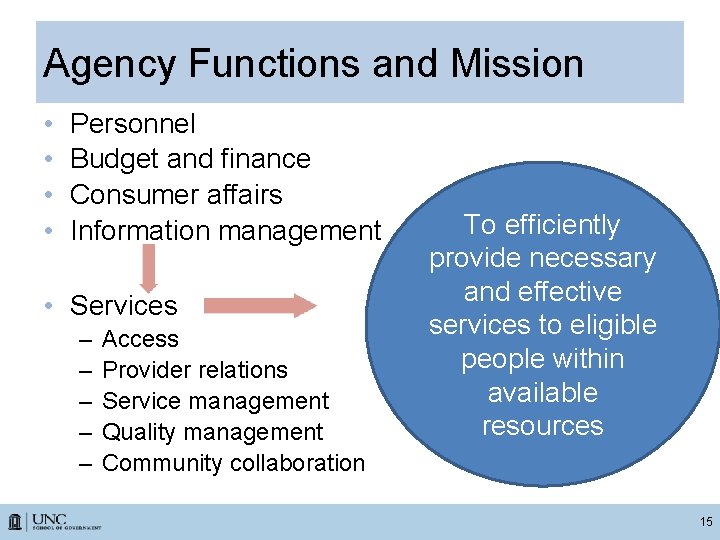
Agency Functions and Mission • • Personnel Budget and finance Consumer affairs Information management • Services – – – Access Provider relations Service management Quality management Community collaboration To efficiently provide necessary and effective services to eligible people within available resources 15
Service Management § § § Approve specific services to individual consumers—“service authorization” Evaluate the medical necessity, clinical appropriateness, and effectiveness of services according to state criteria—“utilization management” Monitor individual care decisions at critical treatment junctures to assure effective care is received when needed—“care coordination”
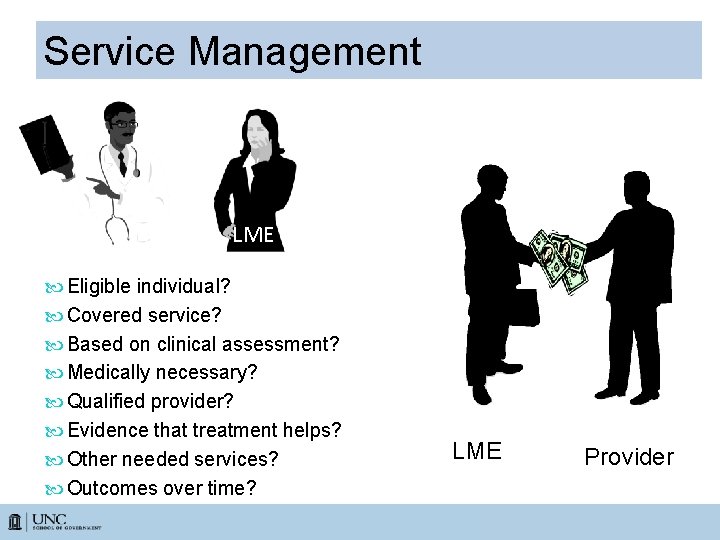
Service Management LME Eligible individual? Covered service? Based on clinical assessment? Medically necessary? Qualified provider? Evidence that treatment helps? Other needed services? Outcomes over time? LME Provider
Quality Management Analyze data on access, service authorization, and claims payment for: 1. high cost/high need consumers 2. utilization of various services in the service array 3. gaps in the service array 4. consumer access, initiation, engagement and retention The foregoing list is only a sample of the many QM activities that LMEs must engage in. 18
Community Collaboration—LME Must q. Establish and maintain effective collaborative working relationships with other public agencies, health care providers, and human services agencies q. Build a community collaborative of crisis/emergency stakeholders that engage in and support crisis prevention and stabilization, and that engages individuals into services after a crisis event
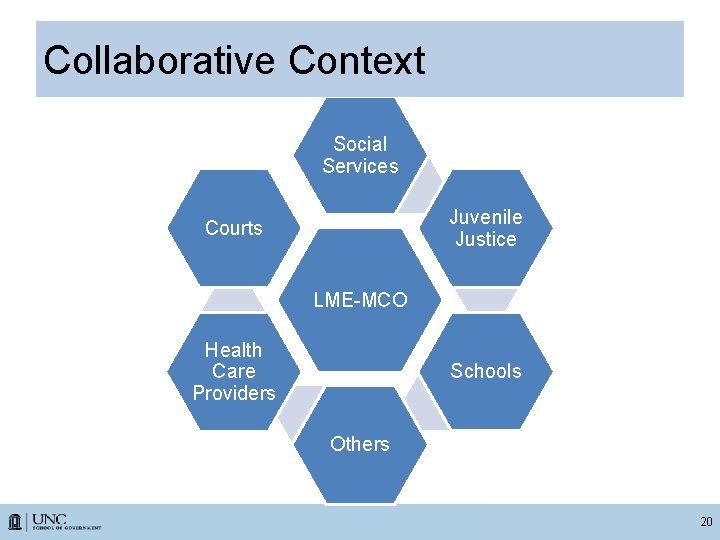
Collaborative Context Social Services Juvenile Justice Courts LME-MCO Health Care Providers Schools Others 20
WHAT DOES THE FUTURE LOOK LIKE? MEDICAID “TRANSFORMATION” 21
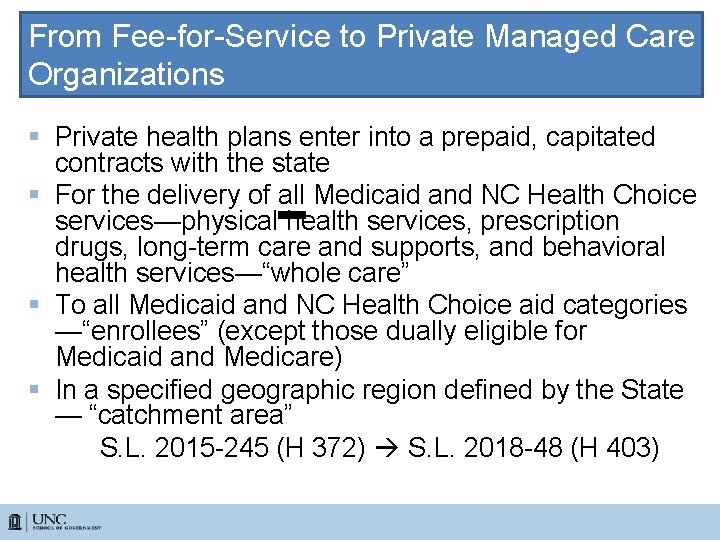
From Fee-for-Service to Private Managed Care Organizations § Private health plans enter into a prepaid, capitated contracts with the state § For the delivery of all Medicaid and NC Health Choice services—physical health services, prescription drugs, long-term care and supports, and behavioral health services—“whole care” § To all Medicaid and NC Health Choice aid categories —“enrollees” (except those dually eligible for Medicaid and Medicare) § In a specified geographic region defined by the State — “catchment area” S. L. 2015 -245 (H 372) S. L. 2018 -48 (H 403)
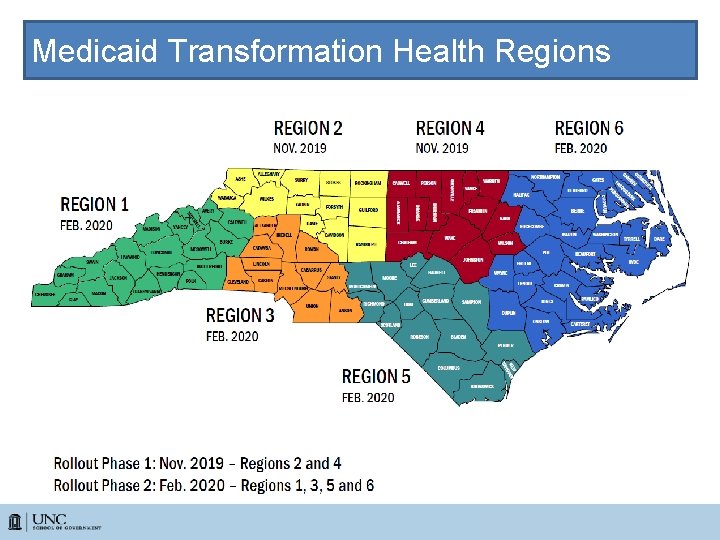
Medicaid Transformation Health Regions
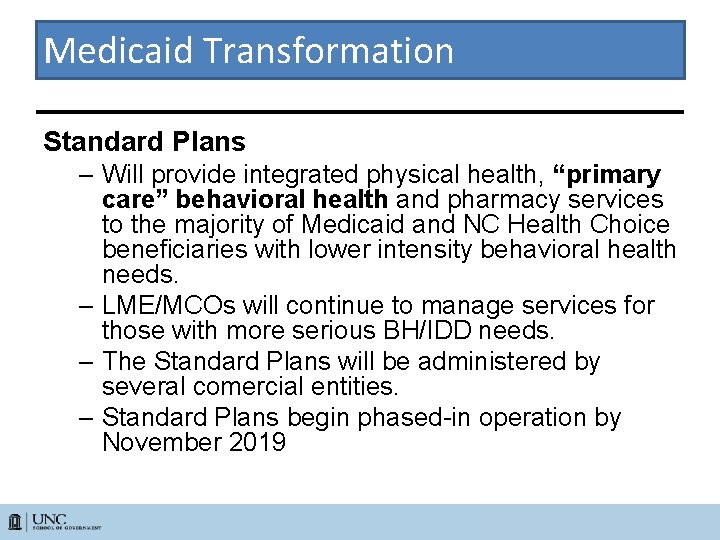
Medicaid Transformation Standard Plans – Will provide integrated physical health, “primary care” behavioral health and pharmacy services to the majority of Medicaid and NC Health Choice beneficiaries with lower intensity behavioral health needs. – LME/MCOs will continue to manage services for those with more serious BH/IDD needs. – The Standard Plans will be administered by several comercial entities. – Standard Plans begin phased-in operation by November 2019 •
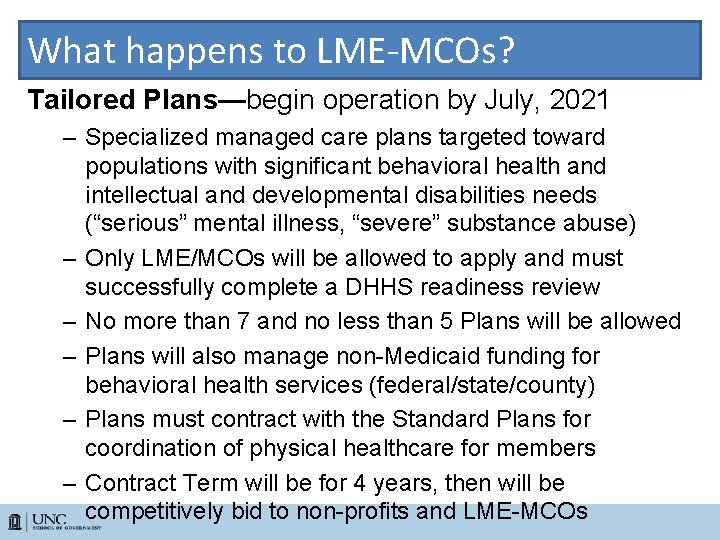
What happens to LME-MCOs? Tailored Plans—begin operation by July, 2021 – Specialized managed care plans targeted toward populations with significant behavioral health and intellectual and developmental disabilities needs (“serious” mental illness, “severe” substance abuse) – Only LME/MCOs will be allowed to apply and must successfully complete a DHHS readiness review – No more than 7 and no less than 5 Plans will be allowed – Plans will also manage non-Medicaid funding for behavioral health services (federal/state/county) – Plans must contract with the Standard Plans for coordination of physical healthcare for members – Contract Term will be for 4 years, then will be competitively bid to non-profits and LME-MCOs
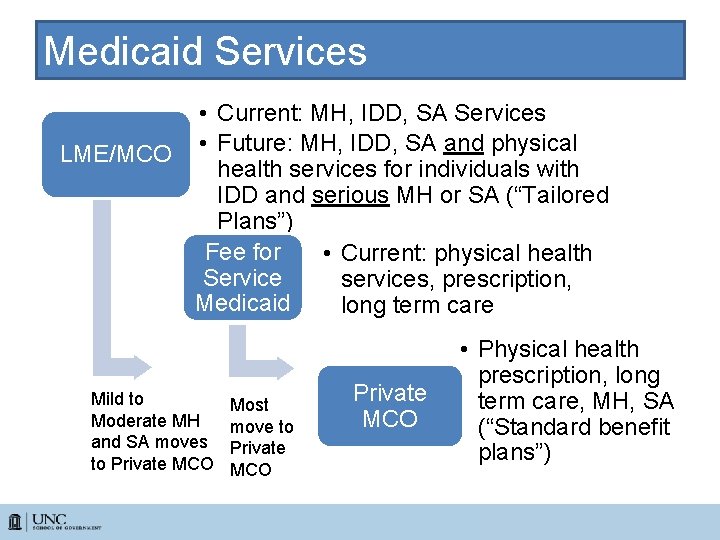
Medicaid Services • Current: MH, IDD, SA Services LME/MCO • Future: MH, IDD, SA and physical health services for individuals with IDD and serious MH or SA (“Tailored Plans”) Fee for • Current: physical health Service services, prescription, Medicaid long term care Mild to Moderate MH and SA moves to Private MCO Most move to Private MCO • Physical health prescription, long term care, MH, SA (“Standard benefit plans”)

Questions? • Mark Botts – 919. 962. 8204 – botts@sog. unc. edu
- Slides: 27