
Demystifying ITIL Understanding ITIL Without the Hype New
- Slides: 22
Demystifying ITIL Understanding ITIL Without the Hype New York Technology Forum November 1, 2005
Agenda § Introduction § Industry Trends § What is ITIL? § ITSM Defined § The ITIL Framework § Should you adopt ITIL for your Company? § Q&A
Industry Trends § Influence of process standards — ISO 9000, Capability Maturity Model (CMM), Six Sigma § Government regulations — Sarbanes-Oxley — HIPAA § Movement to IT Service Management as a comprehensive framework for service delivery
What is ITIL? Information Technology Infrastructure Library § Documented set of best practices for IT Service Management § Originated and maintained in the UK by the Office of Government Commerce (OGC) § Written by consultants, vendors, IT practitioners § Process-based approach to IT service delivery that is internationally accepted and recognized § Active international user group, the IT Service Management Forum (it. SMF) § Over 200, 000 copies of the library have been sold world-wide § Originally published nearly 20 years ago, ITIL was refreshed in 2001 to reflect current best practices
ITIL Defined Information Technology Infrastructure Library § Framework that provides a “common sense”, structured approach § ITIL was developed to be process-driven § Scalable and Flexible —SME’s to Global Multi-National § ITIL is not a standard —Tools, Processes, People cannot be “ITIL compliant”
ITIL Objectives § Optimize resources Utilization § Reduce Costs § Improve Availability § Tune Capacity § Increase Throughput § Improve Scalability
What is ITSM Information Technology Service Management ITSM is an approach that IT organizations can utilize to design, build, integrate, manage, and evolve quality IT services that … § Are customer and businessfocused and process-driven § Meet cost targets § Enable achievement of performance targets as defined in service level agreements (SLAs) Manage services to customers, NOT technology to users
IT Service Management Business Benefits Reduced costs • “Best practices are the key to cost reduction, with potential savings of up to 48%” (source: Gartner) Improved agility Increased IT customer satisfaction • Well-linked and well-understood handoffs between IT processes means that customers and their problems don’t “fall through the cracks, ” providing consistent and more predictable IT services Strong business partnerships • Expectations are clear throughout the value chain Built-in quality improvements
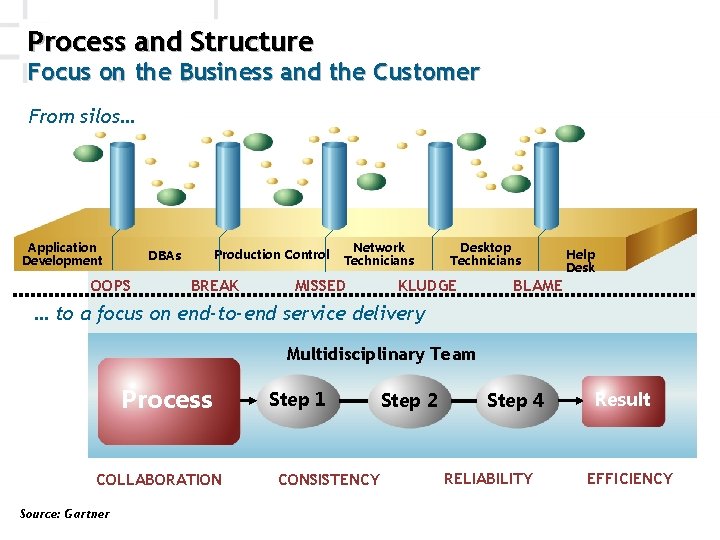
Process and Structure Focus on the Business and the Customer From silos… Application Development Production Control DBAs OOPS BREAK Network Technicians MISSED Desktop Technicians KLUDGE Help Desk BLAME … to a focus on end-to-end service delivery Multidisciplinary Team Process COLLABORATION Source: Gartner Step 1 CONSISTENCY Step 2 Step 4 RELIABILITY Result EFFICIENCY
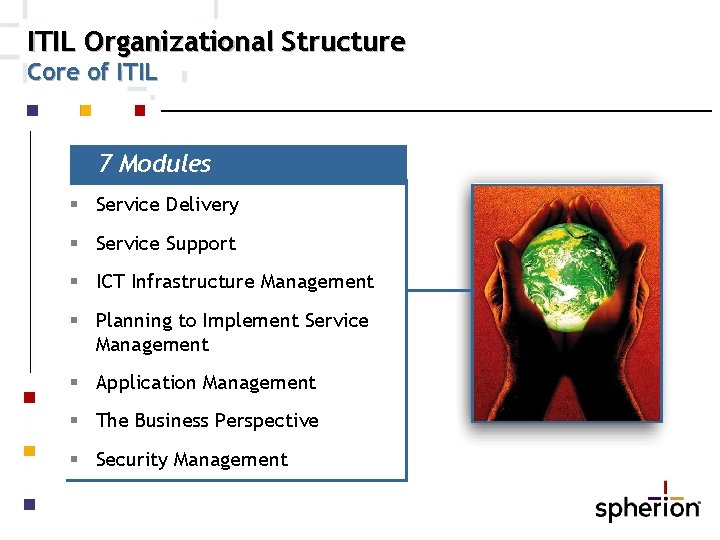
ITIL Organizational Structure Core of ITIL 7 Modules § Service Delivery § Service Support § ICT Infrastructure Management § Planning to Implement Service Management § Application Management § The Business Perspective § Security Management
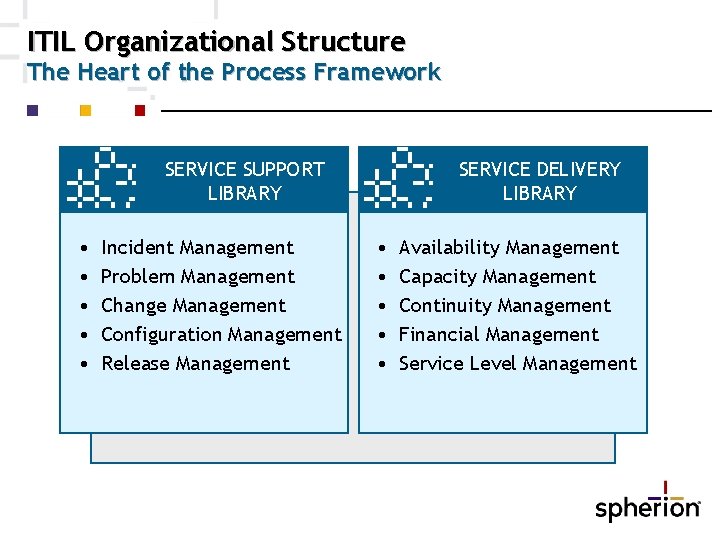
ITIL Organizational Structure The Heart of the Process Framework SERVICE SUPPORT LIBRARY • • • Incident Management Problem Management Change Management Configuration Management Release Management SERVICE DELIVERY LIBRARY • • • Availability Management Capacity Management Continuity Management Financial Management Service Level Management
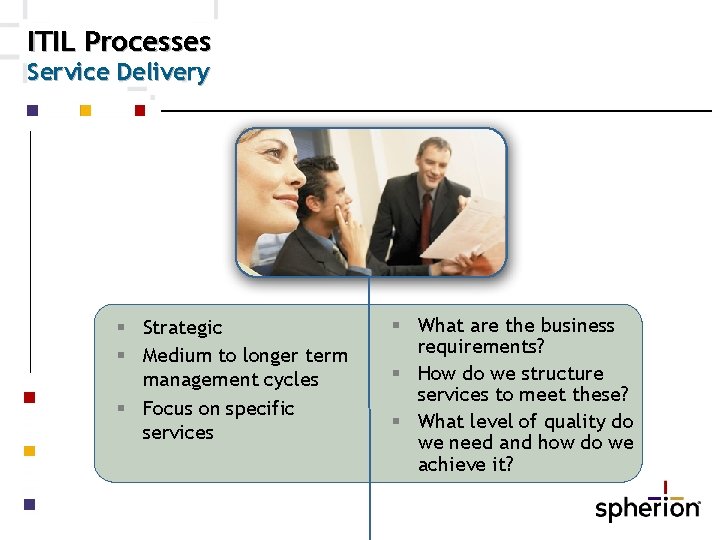
ITIL Processes Service Delivery § Strategic § Medium to longer term management cycles § Focus on specific services § What are the business requirements? § How do we structure services to meet these? § What level of quality do we need and how do we achieve it?
ITIL Processes Service Support § Operational / Tactical § Short to medium-term management cycles § Focus on control of the infrastructure § Maintain flexibility of the infrastructure § A basis for Service Delivery
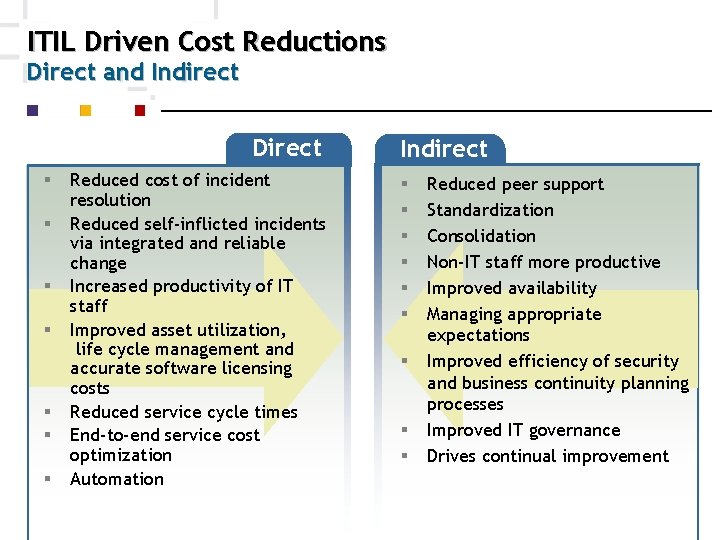
ITIL Driven Cost Reductions Direct and Indirect Direct § § § § Reduced cost of incident resolution Reduced self-inflicted incidents via integrated and reliable change Increased productivity of IT staff Improved asset utilization, life cycle management and accurate software licensing costs Reduced service cycle times End-to-end service cost optimization Automation Indirect § § § § § Reduced peer support Standardization Consolidation Non-IT staff more productive Improved availability Managing appropriate expectations Improved efficiency of security and business continuity planning processes Improved IT governance Drives continual improvement
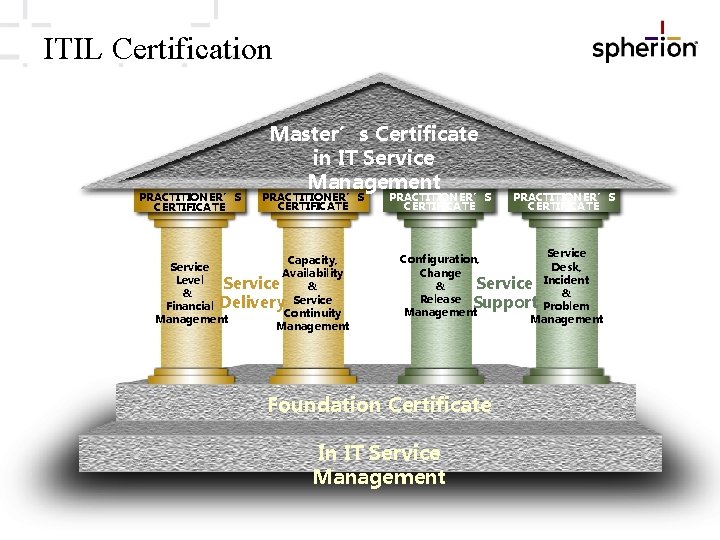
ITIL Certification PRACTITIONER’S CERTIFICATE Master’s Certificate in IT Service Management PRACTITIONER’S CERTIFICATE Capacity, Service Availability Level Service & & Service Financial Delivery Continuity Management PRACTITIONER’S CERTIFICATE Service Configuration, Desk, Change Incident Service & & Release Support Problem Management Foundation Certificate In IT Service Management
Do We Need ITIL? Is our Help Desk Terminology ITIL Compliant? § § § § Help Desk = Service Desk Issues / Service Requests = Incidents Root Cause Analysis = Problem Mgmt. Asset Tracking = Configuration Mgmt. Change Mgmt. = Change Mgmt. Software Rollouts = Release Mgmt. Disaster Recovery = IT Service Continuity Mgmt.
Do We Need ITIL? Are our Help Desk Processes “Aligned” with ITIL? § Incident Mgmt. – Restore normal service operation as quickly as possible § Problem Mgmt. – Prevent recurrence of Incidents § Service Level Mgmt. – Adherence to SLA’s and OLA’s § Change Mgmt. – Ensures standardized methods and procedures are used
Is ITIL Right for Us? Should you Implement in your Help Desk? § ITIL is not an alternative framework, but: — Builds on what has already been started and are doing well — Not an obscure theory, but guidelines based on what has been proven to work — At the core of what we do, not an add-on § ITIL is a well established, easily accessible, affordable process model for IT service management that is built around a set of best practices. § ITIL is better known for its back-office operational process definitions than for its application management processes. § ITIL is based on defining best-practice processes for IT service delivery and support, rather than defining a broad-based control framework. § ITIL's structure enables incremental adoption, which facilitates continuous improvement. Source: Gartner Research
If you Implement ITIL IT Organizations Need To…. § Evaluate and align IT core competencies and the value added to the overall business mission § Improve their customer value through excellent service § Hire, train and retain talented IT resources § Provide more proactive services § Deliver a total system of IT Service Management § Meet new standards and regulations § Get the book “Planning to Implement Service Management”
The Secrets of Successful use of ITIL Gain Senior Management buy-in Tools alone do not solve problems If it isn’t broken, don’t fix it Organizations should adopt the guidelines, principles and concepts of ITIL, and adapt to fit their own environment § Take one step at a time § Communicate and sell at all stages § Be prepared for Change § §
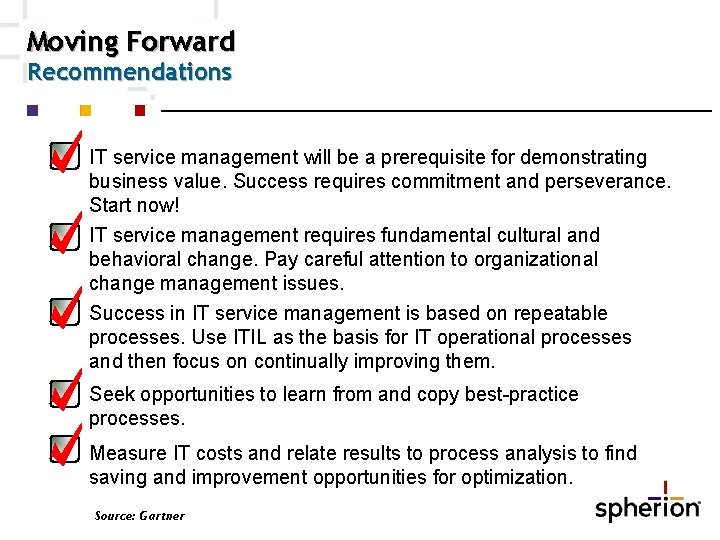
Moving Forward Recommendations IT service management will be a prerequisite for demonstrating business value. Success requires commitment and perseverance. Start now! IT service management requires fundamental cultural and behavioral change. Pay careful attention to organizational change management issues. Success in IT service management is based on repeatable processes. Use ITIL as the basis for IT operational processes and then focus on continually improving them. Seek opportunities to learn from and copy best-practice processes. Measure IT costs and relate results to process analysis to find saving and improvement opportunities for optimization. Source: Gartner
Questions?