
Demystifying DataDriven and Pausible Clocking Schemes Robert Mullins
Demystifying Data-Driven and Pausible Clocking Schemes Robert Mullins Tutorial presented at 18 th UK Asynchronous Forum Newcastle, September 2006
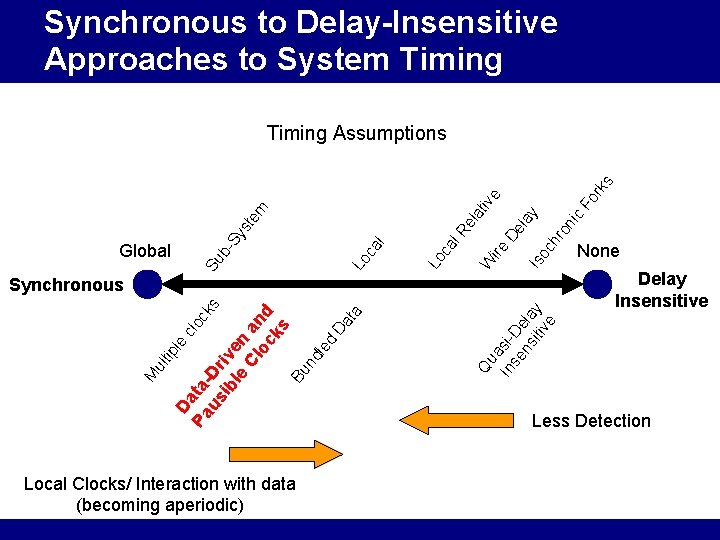
Synchronous to Delay-Insensitive Approaches to System Timing ni ro oc h Is De la c y Fo ive ire W Lo ca l Re l at ys te m -S Su b Global rk s Timing Assumptions Local Clocks/ Interaction with data (becoming aperiodic) Q ua In sise De ns la itiv y e Da ta d le Bu nd M ul tip le Da clo Pa ta ck us -Dr s i ib ve le n Cl an oc d ks Synchronous None Delay Insensitive Less Detection
Introduction • • Clock Stretching Idea History and Uses – Crossing clock domains – Data-driven clocking • Building local clock generators – Data-Driven and Pausible Clocks – Clock-Tree Insertion Delays • Beyond synchronization – Novel Applications

Clock Stretching • Local clock generator is constructed using a tunable delay-line and inverter (ring-oscillator) • We are able to interrupt the ring oscillator and delay the generation of next clock edge until some event has completed • Length of each clock cycle may now vary
Value-Safe Communication • Metastability always an issue when attempting to synchronize an external input to a local clock • Typical solution is to allocate a fixed period of time for metastability to resolve – e. g. two-flip flop synchronizer (1 cycle delay) – Accept a small chance of failure • Pěchouček (1976) – Observed it was “fundamentally impossible to exclude arbitrarily long responses in any flip-flop” – Described circuits to allow the clock period to be stretched until metastability has been resolved

Data-Driven Clocking • Metastable states may be avoided if asynchronous input starts local clock • Pěchouček also outlined such a system – No longer a synchronization issue if clock is quiescent when data arrives • Seitz (Ch. 7, Mead and Conway book) – Seitz creates a self-timed interface or wrapper around synchronous blocks – Used in proprietary designs since 1968 – “Assures performance and correct operation will not be compromised by wire delay in signals or in clock distribution”
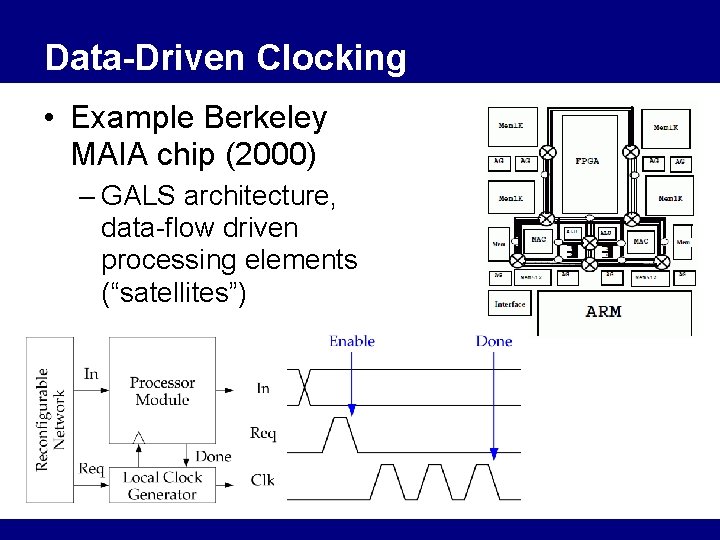
Data-Driven Clocking • Example Berkeley MAIA chip (2000) – GALS architecture, data-flow driven processing elements (“satellites”)
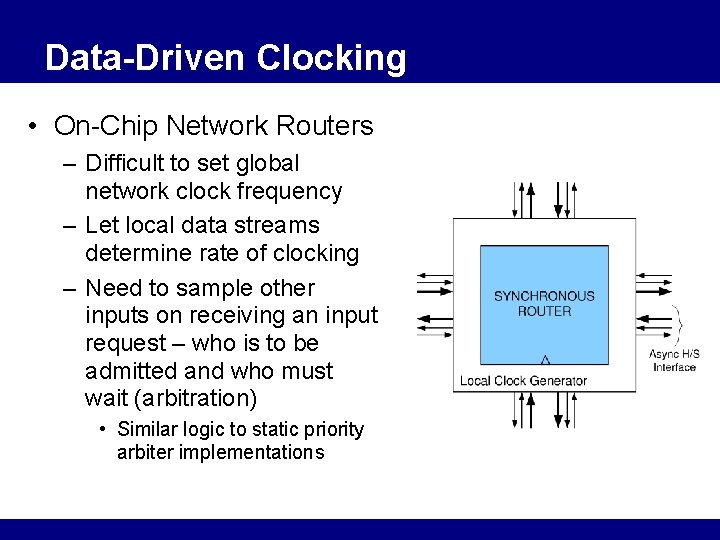
Data-Driven Clocking • On-Chip Network Routers – Difficult to set global network clock frequency – Let local data streams determine rate of clocking – Need to sample other inputs on receiving an input request – who is to be admitted and who must wait (arbitration) • Similar logic to static priority arbiter implementations

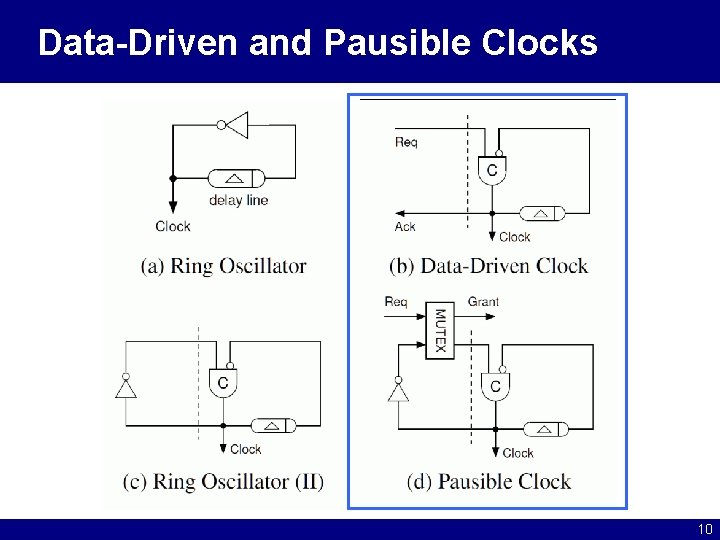
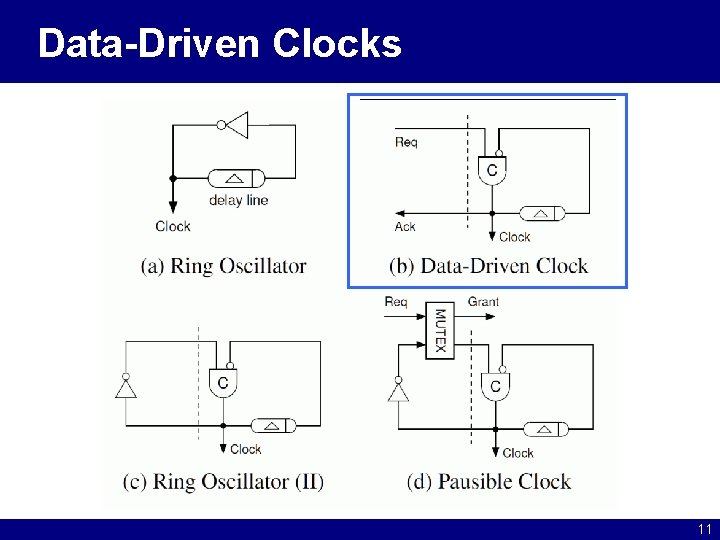
Building local clock generators • Lots of published schemes, but similarities often hidden – Different circuit styles – Different specification & synthesis techniques • Our approach – Introduce two basic types of local clock generator • Data-driven and Pausible • In reality both are very similar, distinction is aimed at understanding circuits and related work – For each case we will look at a number of different input port behaviours we may need • Arbitrated, Sampled and Synchronised – Demonstrate how a complete wrapper may be “assembled”
Data-Driven and Pausible Clocks 10
Data-Driven Clocks 11
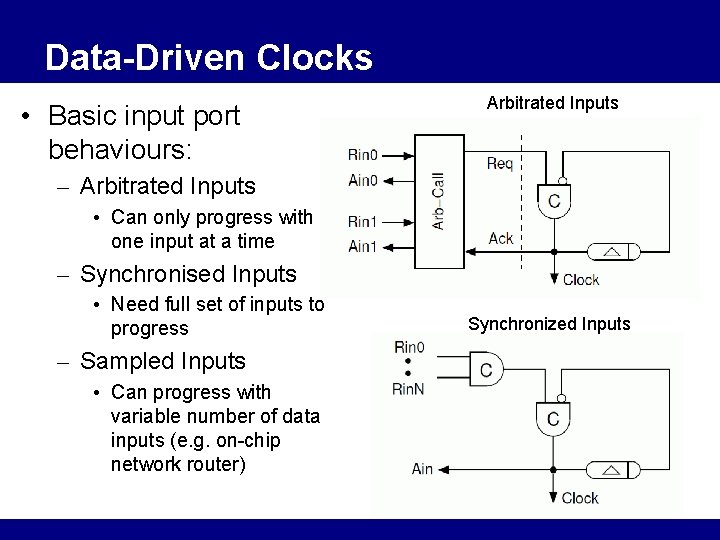
Data-Driven Clocks • Basic input port behaviours: Arbitrated Inputs – Arbitrated Inputs • Can only progress with one input at a time – Synchronised Inputs • Need full set of inputs to progress – Sampled Inputs • Can progress with variable number of data inputs (e. g. on-chip network router) Synchronized Inputs
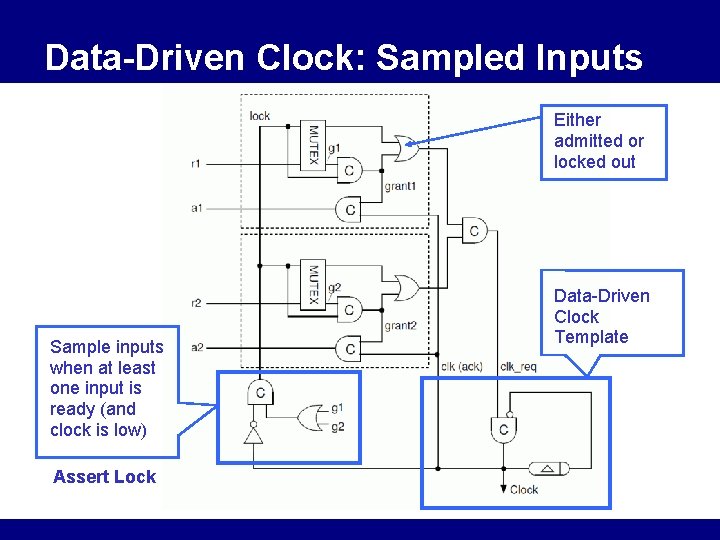
Data-Driven Clock: Sampled Inputs Either admitted or locked out Sample inputs when at least one input is ready (and clock is low) Assert Lock Data-Driven Clock Template
Data-Driven Clocking: Pipelines and Flushing • May require multiple clocks to process a single data item, e. g. when logic is pipelined • Flushing Alternatives: – Eager Flushing • Initialise counter to make N successive requests for a new clock to be generated – Time-Out Flush • May wish to allow pipeline to be data-driven, time-out as last resort and flush using counter – Uninterrupted Flush – Pull-Driven Flush (driven by output) • Flush logic is easy to add, simply appears as additional input
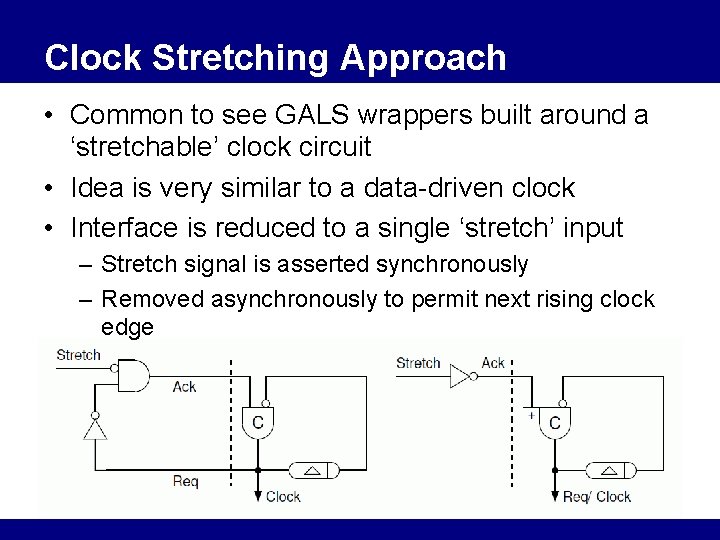
Clock Stretching Approach • Common to see GALS wrappers built around a ‘stretchable’ clock circuit • Idea is very similar to a data-driven clock • Interface is reduced to a single ‘stretch’ input – Stretch signal is asserted synchronously – Removed asynchronously to permit next rising clock edge
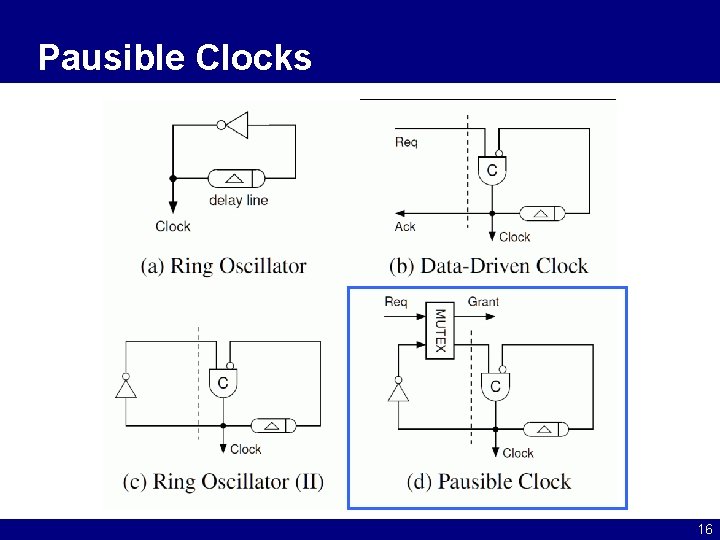
Pausible Clocks 16
Pausible Clock • In contrast to data-driven approach, the clock is normally free-running • Mutual-exclusion element permits clock to be interrupted or paused • Often used to ensure value-safe communication in a GALS system
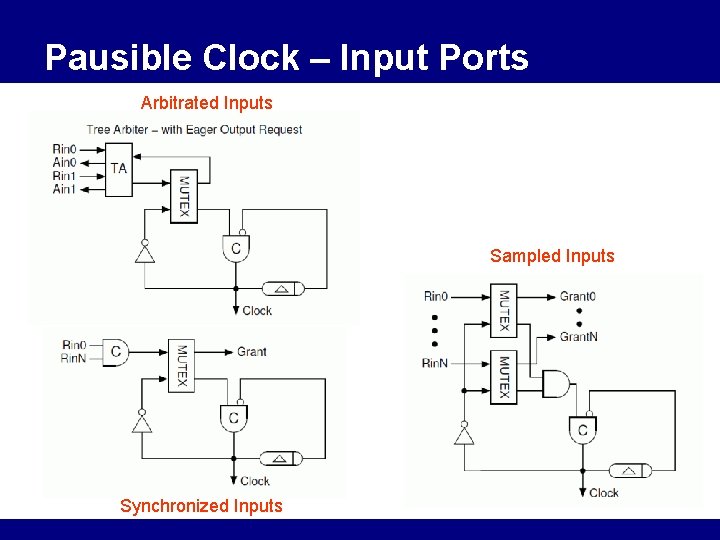
Pausible Clock – Input Ports Arbitrated Inputs Sampled Inputs Synchronized Inputs
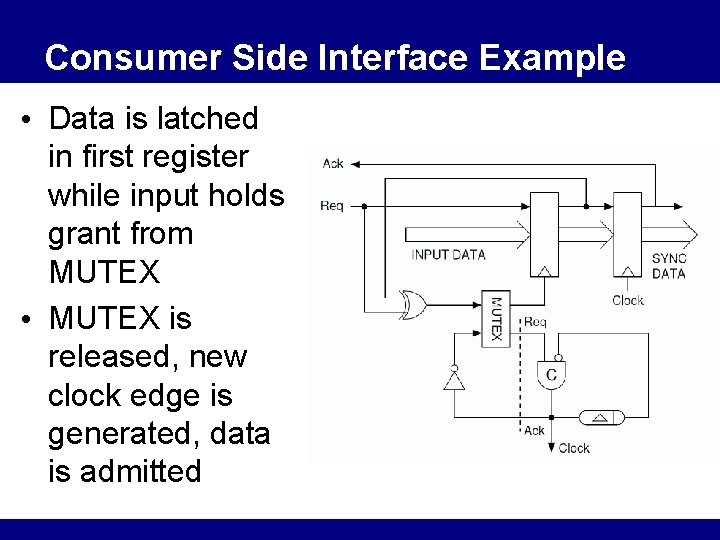
Consumer Side Interface Example • Data is latched in first register while input holds grant from MUTEX • MUTEX is released, new clock edge is generated, data is admitted
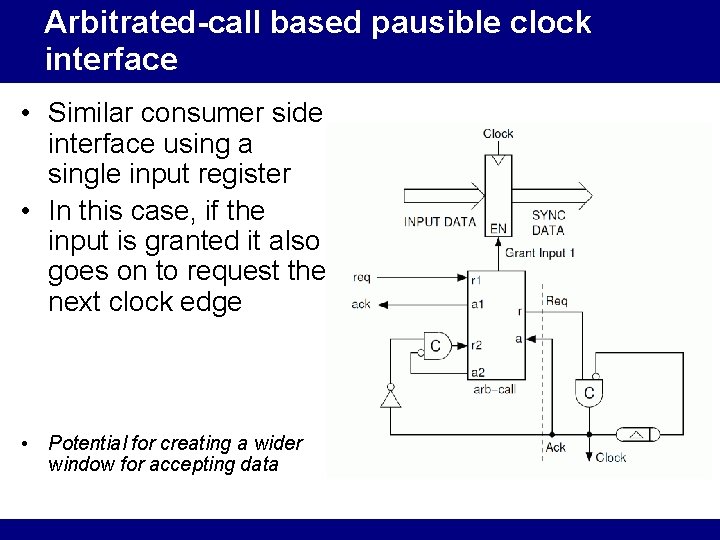
Arbitrated-call based pausible clock interface • Similar consumer side interface using a single input register • In this case, if the input is granted it also goes on to request the next clock edge • Potential for creating a wider window for accepting data
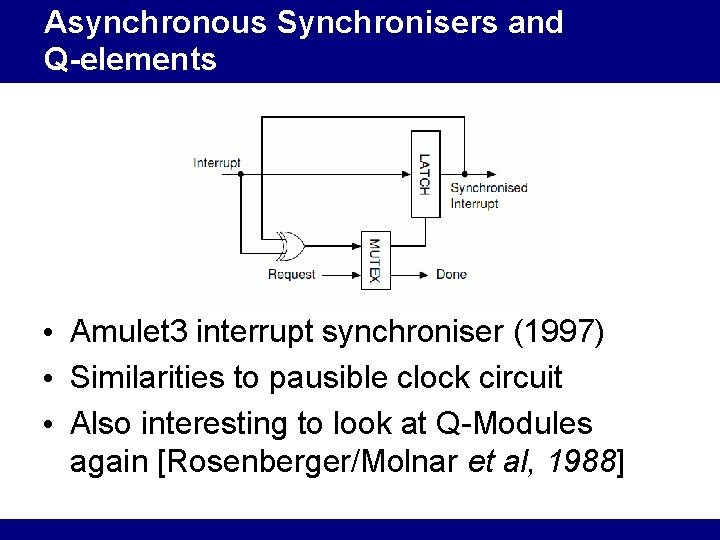
Asynchronous Synchronisers and Q-elements • Amulet 3 interrupt synchroniser (1997) • Similarities to pausible clock circuit • Also interesting to look at Q-Modules again [Rosenberger/Molnar et al, 1988]
Output Ports • Output port types: – Scheduled • Output operation must be completed on a particular clock cycle – Registered • Cannot overwrite output register until is has been read – Polled • Port polls output to determine when data may be sent (synchronisation issue which may require clock period to be extended) • Implementations are based on input port circuits already discussed
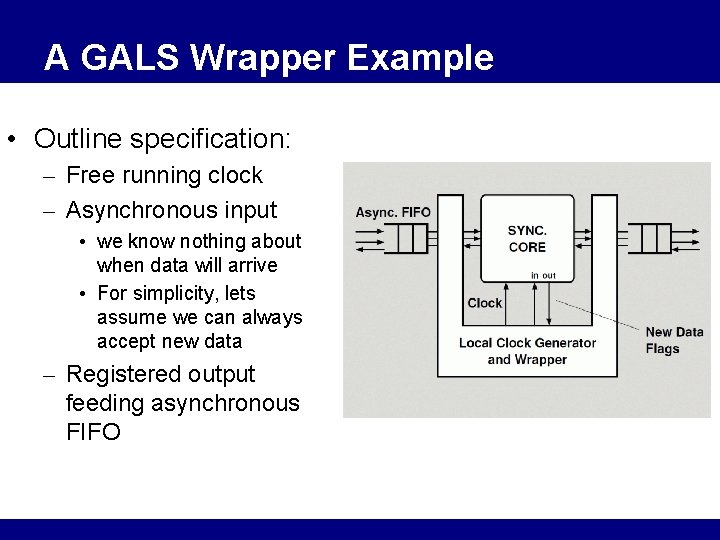
A GALS Wrapper Example • Outline specification: – Free running clock – Asynchronous input • we know nothing about when data will arrive • For simplicity, lets assume we can always accept new data – Registered output feeding asynchronous FIFO
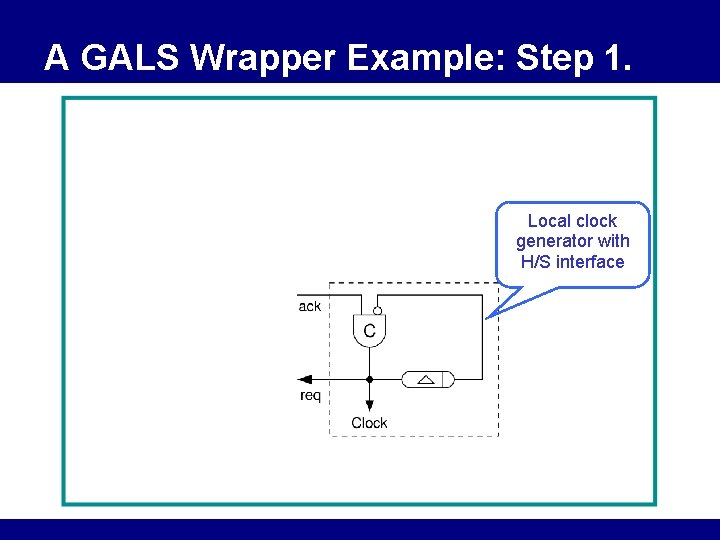
A GALS Wrapper Example: Step 1. Local clock generator with H/S interface
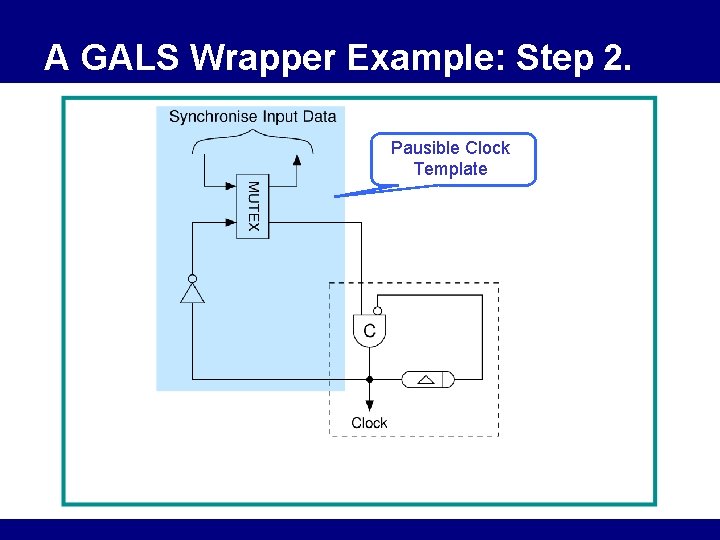
A GALS Wrapper Example: Step 2. Pausible Clock Template
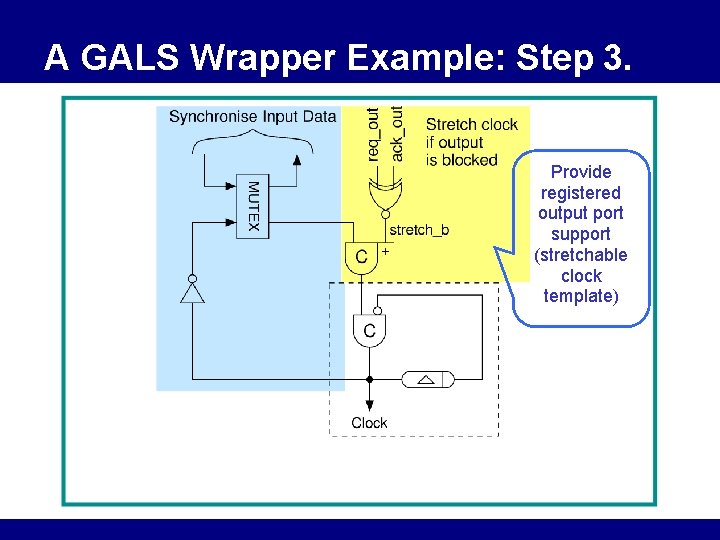
A GALS Wrapper Example: Step 3. Provide registered output port support (stretchable clock template)
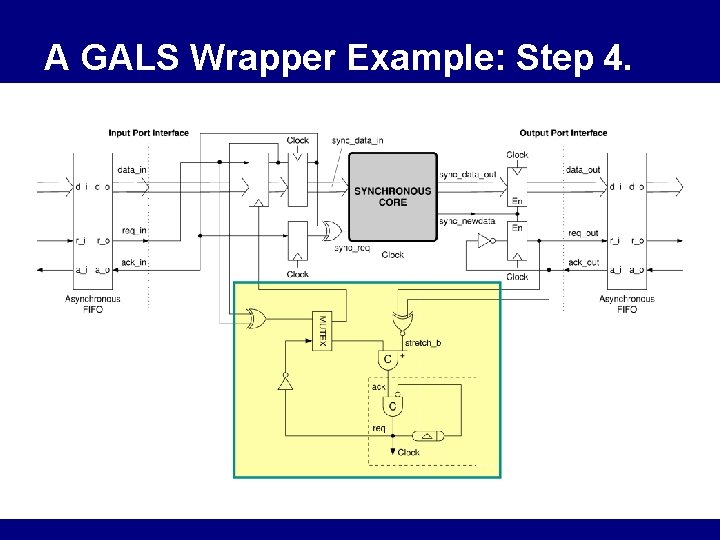
A GALS Wrapper Example: Step 4.
Clock Tree Insertion Delays • Delay from root to leaf of clock tree can be considerable (certainly non-zero!) • If every clock cycle is the same, this clock insertion delay is not normally an issue • If we stretch the clock the insertion delay must be considered in our timing analysis (also true for clock gating in synchronous world) • Not difficult to handle, but can increase time required to admit new data – Very large synchronous islands make little sense if we pursue a GALS approach anyway
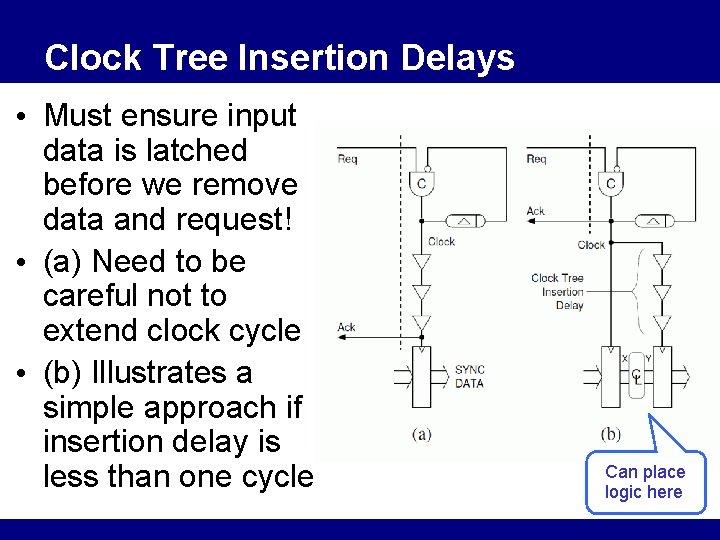
Clock Tree Insertion Delays • Must ensure input data is latched before we remove data and request! • (a) Need to be careful not to extend clock cycle • (b) Illustrates a simple approach if insertion delay is less than one cycle Can place logic here
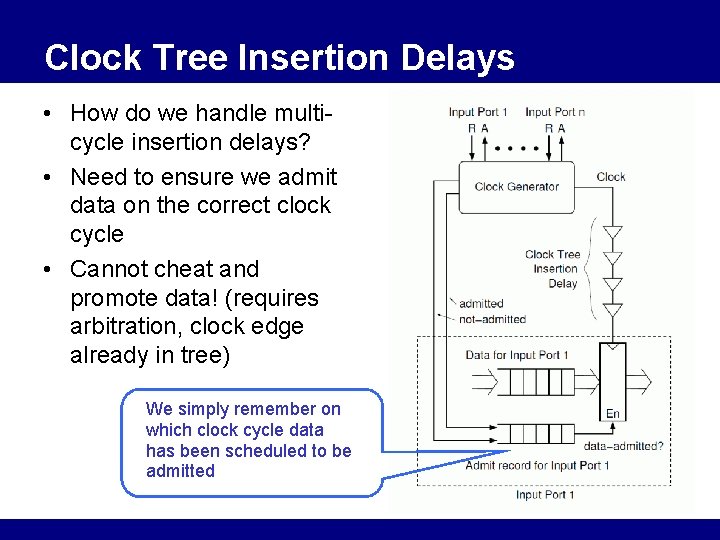
Clock Tree Insertion Delays • How do we handle multicycle insertion delays? • Need to ensure we admit data on the correct clock cycle • Cannot cheat and promote data! (requires arbitration, clock edge already in tree) We simply remember on which clock cycle data has been scheduled to be admitted
Summary • Simple view of elastic clocking ideas • Practical wrappers can be assembled from a few simple circuit templates • Lots I haven’t talked about – approaching specification and synthesis more formally (next talk!) – formal verification • I use Veraci (Paul Cunningham’s Ph. D work) • Verification aided by modular view of wrappers – performance and optimisation of interfaces…
![Novel Applications: Timing Speculation • Circuit-Level Timing Speculation – Razor [ARM/Michigan] • Exploit elastic](http://slidetodoc.com/presentation_image_h/b6dfc70c380a884544f332c36b09305d/image-32.jpg "Novel Applications: Timing Speculation • Circuit-Level Timing Speculation – Razor [ARM/Michigan] • Exploit elastic")
Novel Applications: Timing Speculation • Circuit-Level Timing Speculation – Razor [ARM/Michigan] • Exploit elastic clocking ideas to simplify error recovery mechanism and timing analysis
Novel Applications: Fine-Grain Clock Gating • Power gating techniques increasingly important as static power consumption increases • Multiple levels of sleep – In some cases will require restoration of state • Exploit elastic clocking – Self-timed wake-up process – Simplify timing analysis and implementation – Power gate much smaller blocks – Speculative sleep and wake-up control
Synchronous vs. Asynchronous Control for GALS • Synchronous alternatives – – – 2 Flip-flop synchronizers Clock Gating Pipeline flushing mechanisms Timing analysis and implementation can get complex Not necessarily transparent to IP core architecture • Elastic clocking techniques – Fully transparent, robust, simple to compose blocks and techniques – Optimise common-case and make exceptional cases work
Conclusions • Scaling trends suggest we will soon see hundreds of networked IP cores on a single chip • Timing and integration issues alone suggest a GALS approach based on elastic clocking should play a role – Competition from well established synchronisation techniques • The need to optimise each IP block by exploiting timing speculation, clock, signal and power gating, DVFS etc. may see significant additional advantages – Research opportunity
- Slides: 35