
Demonstration of VAMRAB Abatement Technology at Mandalong Ray
Demonstration of VAM-RAB Abatement Technology at Mandalong Ray Coppins – Project Manager, Mandalong Mine Rod Peet, Project Manager, Corkys Sustainable Energy www. centennialcoal. com. au July 2014
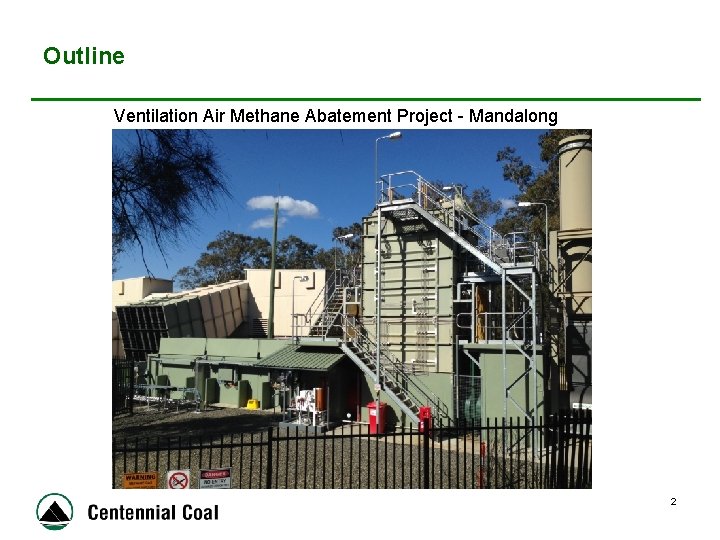
Outline Ventilation Air Methane Abatement Project - Mandalong 2
Acknowledgement and Disclaimer “Funded by Coal Innovation NSW through the Clean Coal Fund, which is administered by the Minister for Mineral Resources” “Any views expressed herein do not necessarily reflect the views of Coal Innovation NSW or the NSW Government” 3
Background • Centennial sought a means of reducing dilute methane in ventilation air (VAM) • Mandalong is the largest producing Mine in the Centennial group • About 78% of total greenhouse emissions from Mandalong are VAM • Significant contribution to emissions and a significant carbon cost 4
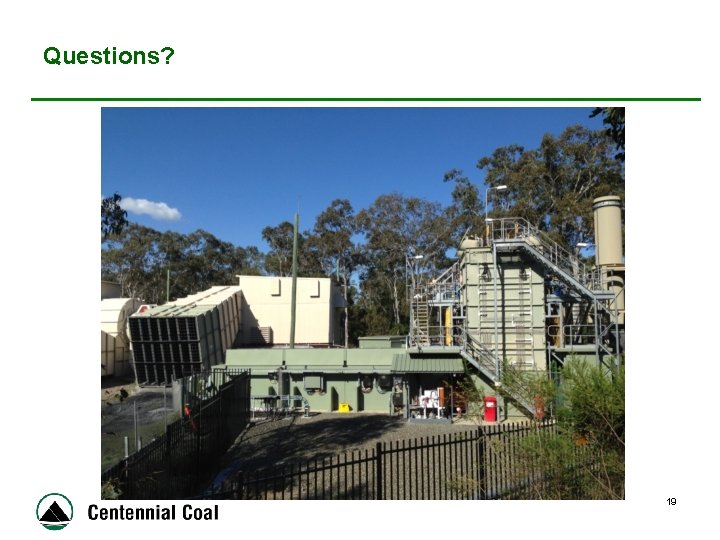
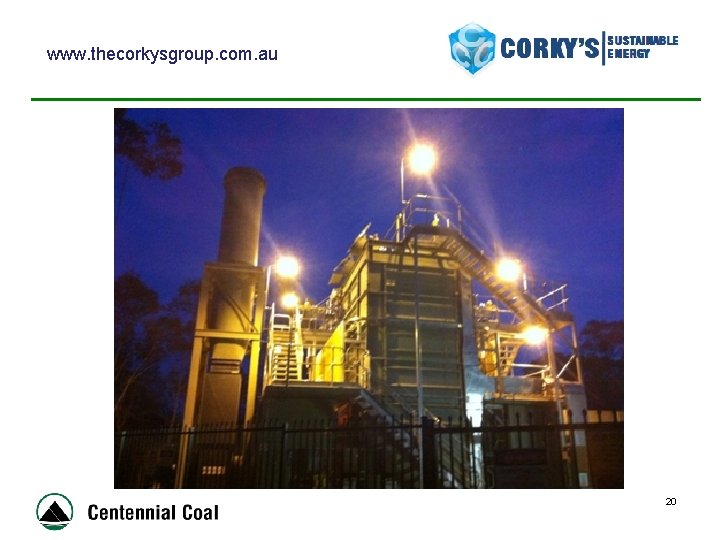
Background • Discussions commenced with Corkys in 2008 with a view to developing a solution • Close working relationship with Corky’s to demonstrate their Ventilation Air Methane Regenerative Thermal Oxidiser – “VAM-RAB” on site at Mandalong • Funding was granted from the NSW Government Clean Coal Fund (CINSW) to demonstrate a 10 m 3/sec unit • Corky’s had a technical design, focus turned to making it a safe design, acceptable to the Mine and its Regulators 5

How Regenerative Heating Works • Regenerative heating uses a heat transfer media • In VAM-RAB this medium is ceramic bricks 6
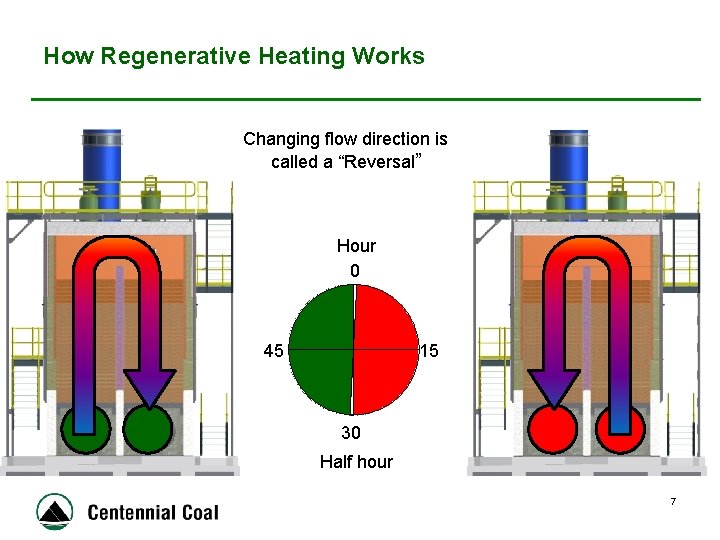
How Regenerative Heating Works Changing flow direction is called a “Reversal” Hour 0 45 15 30 Half hour 7
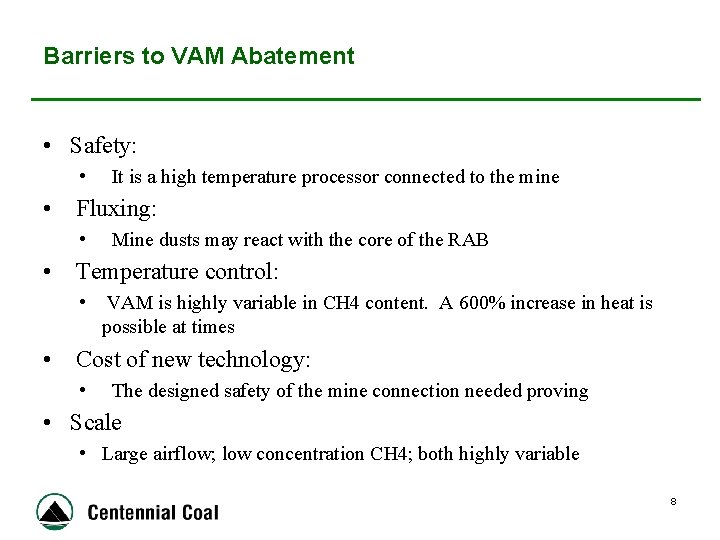
Barriers to VAM Abatement • Safety: • It is a high temperature processor connected to the mine • Fluxing: • Mine dusts may react with the core of the RAB • Temperature control: • VAM is highly variable in CH 4 content. A 600% increase in heat is possible at times • Cost of new technology: • The designed safety of the mine connection needed proving • Scale • Large airflow; low concentration CH 4; both highly variable 8
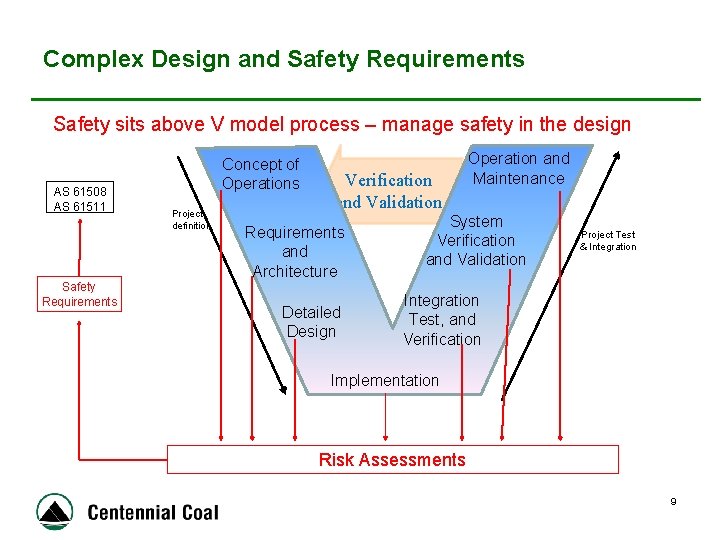
Complex Design and Safety Requirements Safety sits above V model process – manage safety in the design AS 61508 AS 61511 Safety Requirements Concept of Operations Project definition Verification and Validation Requirements and Architecture Detailed Design Operation and Maintenance System Verification and Validation Project Test & Integration Test, and Verification Implementation Risk Assessments 9
Safety Design • 196 Hazards Identified • 2 only managed by SIL (safety critical) – Deflagration caused by: – – uncontrolled machine operation uncontrolled fuel source • 192 managed by Australia Standards/MDG’s and risk assessment controls • R&D project/first-of-type Centennial had specific safety and environmental requirements • Timely engagement of mine regulators who had specific views and thoughts 10
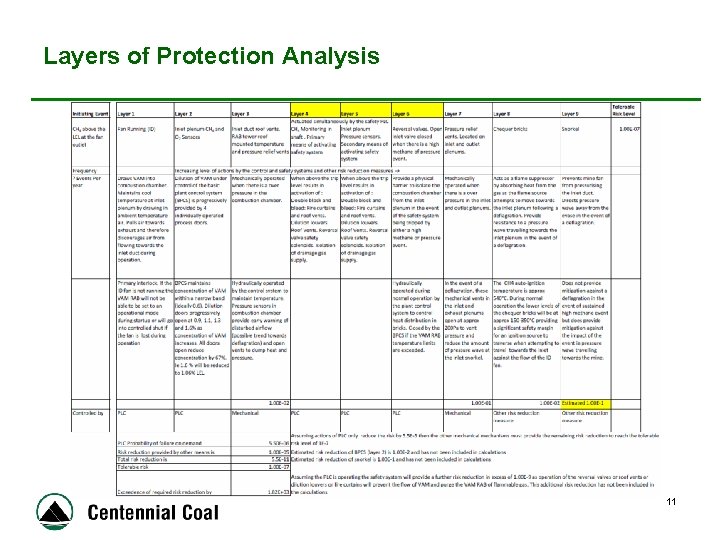
Layers of Protection Analysis 11
Key Design Aspects Key design aspects added during the risk/design process: • Considered return air to the inlet reversal valves as part of the mines return airway (We considered the machine to be directly coupled to the mine) • Deflagration – internal pressure detection, over temperature detection • Inlet fuel limits exceeded • Response time to methane event – How quickly can the plant isolate from the Mine; Underground monitoring, multiple layers of protection. 12
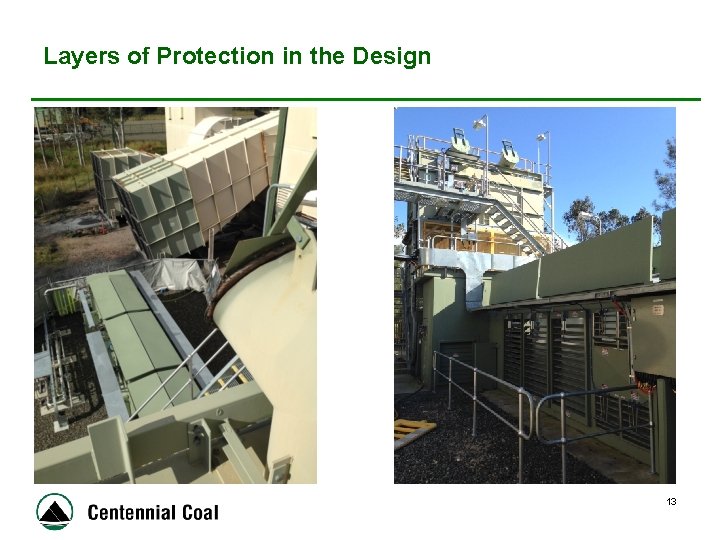
Layers of Protection in the Design 13
Safety Integration Separate phases for offsite and onsite commissioning: • Offsite used CHAIR/HAZOP studies • Independent VAMRAB safety component operability study • Onsite moved from CHAIR to MDG 1010 for risk assessment guidelines to consider mine site perspective • Hazardous Area Assessment • Independent SIL Assessment • Extensive, consultative validation (commissioning) phase using mines Engineering Management processes 14
Outcomes CINSW Funding includes 2 phases of experiments: • Phase 1 is part of onsite commissioning including: • Heat-up • VAM Simulation using mine site natural gas to simulate Ventilation air • A series of experiments to determine operational and practical limits • Phase 2 operates on VAM from the ventilation system: • 12 month seasonal trial • Assessment of bricks following exposure to mine dust 15
Learnings Commissioning of this type of plant very difficult onsite • First of type so the predicted operational parameters agreed upon in the commissioning risk assessment were not practical • The redefining of operational limits managed under the Mine Change Management System which required review of the risk assessments and effect of safety functionality. – MUST HAVE (and use) Robust Change Management Process 16
Learnings Commissioning of this type of plant very difficult onsite • Key hold points established in the commissioning process this included: – review of all relevant risk assessment actions and completion of audits before progressing to each stage: – Pre Power, – Powered, – Cold Commissioning, – Hot (Heating with Burners, Simulated VAM and Mine VAM) • Mine Engineers and design team must communicate well – Task Coordinator 17
Where to From Here • Complete VAM Simulation trial • Scheduled to be completed next month • Connect to Mine ventilation system for 12 months (fulltime if deemed cost effective) • Final evaluation • Use design lessons learned to upscale to full capacity • Develop methods to utilise the heat energy • Carbon/environmental policy is the market driver 18
Questions? 19
www. thecorkysgroup. com. au 20
Compiler’s Note: The following discussion has not been checked for accuracy by the presenters. Questions and Discussion Ken Cram, Outburst Seminar Committee – At full capacity, will you have sufficient units to handle all the ventilation coming up the shaft? Ray – We have two fans each running around 150 m 3/sec. We are going to build the up-scaled plant on one fan. It will be able to deal with 150 m 3/sec at the normal running speed of one fan and be able to bypass the second 150 if we go with one fan. 99% of the time we run the two fans as they are required for the normal operation of the mine. We are looking at 15 m 3 burnt off in the current trail plant, but to scale up to 150 m 3 the plant will be about 4 times the size of the current plant. Rod – The scale-up to handle 10 times the volume only requires a footprint increase of 4 times. Some walls are shared and there is consequent cost savings. This current plant is not the most efficient size, but we built this size to facilitate scale-up. We are currently limited by the size of the fan on the unit, by the height of the stack we can use and by the size of the duct. Ian Gray, Sigra – You are taking in air which you need to initially heat. So, ideally you have a gas drainage system to supply the gas. You take the exhaust gas from the plant. The unit will then self-heat and produce a lot of heat. How do you cool it? 21
Rod – Not all the heating takes place at the bottom. We heat part of the unit to about 750 degrees initially and the unit is isolated from mine air. We then draw air from the shaft. The bottom bricks are less than 50 degrees and the top bricks are around 950 degrees. The mine air goes up through the stack and changes chemical state, catalyses and gives off energy. The air is pulled through at a high flow rate, so heat is transferred to the lower bricks on the far side (? ? ? ), There is a blob of heat that moves up one side then down the other side. We then reverse the process so the hot bricks are cooled by the air coming from the mine while the heat derived from the gas heats the previously cooled bricks. It is a self-sustaining process. Ian – Where are you going to extract heat in due course? Rod – There are two VAM-RABs. We can have a heat exchanger on the top which is good for super-heated steam. If medium heat is needed for mine heating purposes, it can be taken from midway up the stack and if 100 degree heat is required it can be taken from the bottom. At the scale we are considering with 160 m 3/sec input, we should get 16 MW of electrical power. Remember that 78% of the mine’s emissions are coming from the fan, there is a lot of energy available. 360 m 3/sec at 0. 6% CH 4 is a lot of tonnes of CO 2 equivalent. Ray – This is a plant that might not be up-scaled. It is meant to run as a VAMRAB as a demonstration. If it works that will be fine and it might be upgraded. 22
- Slides: 22