
Demonstration of improved Sowing methods Sowing Planting and
- Slides: 45
Demonstration of improved Sowing methods
Sowing, Planting and Transplanting? • Sowing (or seed sowing) is defined as the process of placing the seed in soil to germinate and grow into plant. • In comparison, planting is the putting the plant propagules in soil for growing plants. Propagules can be seedlings, roots, tubers, leaves, or cuttings. • And transplanting is term used for the planting the seedling grown into nursery to different field, pot or plot for different purposes.
Methods of Sowing Seeds may be sown directly or transplanted. For transplanting, the seeds are sown in nursery and the nursery is later transplanted to field. The methods of sowing are enlisted and detailed as under: 1. 2. 3. 4. 5. 6. 7. Broadcasting Dibbling Drilling Sowing behind the country plough Planting Transplanting Strip Planting
1. BROADCASTING Broadcasting is one of the oldest and most common methods of seed sowing, where the seeds are just spread on the soil; the seeds may or may not be covered with soil. Broadcasting may be done manually, or through mechanical spreader or aeroplane. Advantages • This method is cheap. • It takes less time. • Only suitable for small seeded and crops where plant to plant distance is small or does not matter.
Disadvantages of broadcasting • Seed distribution is uneven. • Seeds may or may not be covered by soil. • Seed density and depth are uneven. • Non-uniform seed germination. • Seedling vigor and hence crop stand is affected from uneven distribution.
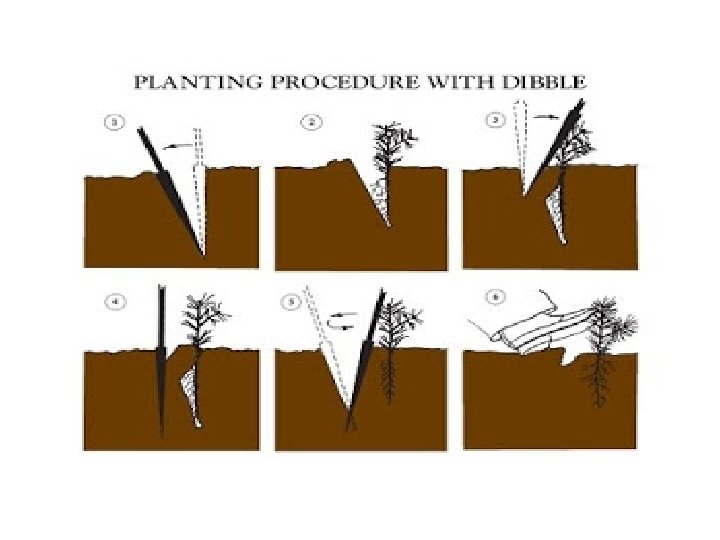
2. DIBBLING Dibbling is the placing of seeds in holes or pits at equal predetermined distances and depths. This is done by dibble, planter or manually. Advantages • Less seed is required. • Rapid and uniform germination. • Good seedling vigor. Disadvantages • Time consuming. • More labor and/or cost is high.
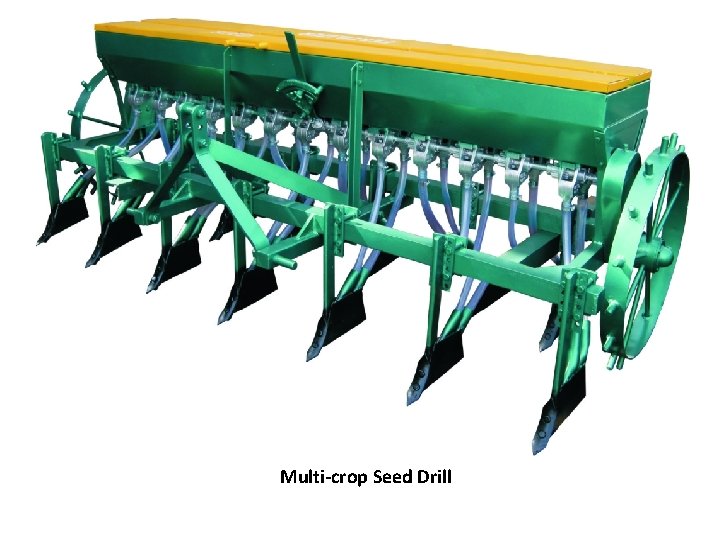
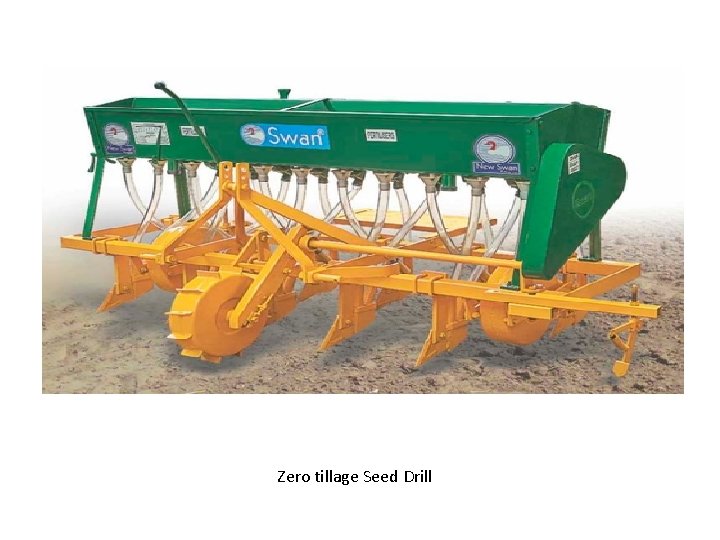
3. DRILLING It is the practice of dropping of seeds in holes, the seeds are then covered and compacted. Drilling is done with seed drill or seed-cumfertilizer drill. Seeds can be drilled continuously in a row or drilling can be done at set distances. Rows can be set according to requirements
Multi-crop Seed Drill
Zero tillage Seed Drill
• Advantages • Less seed is required. • Rapid germination and uniform plant population per unit area. • Manures, fertilizers and amendments can applied with seeds during drilling. • Disadvantages • Time consuming • More labor and/or cost is high
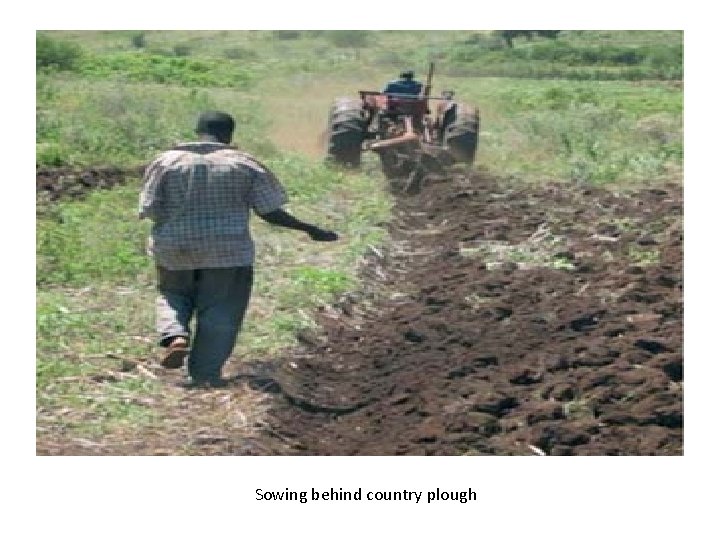
4. SOWING BEHIND THE COUNTRY PLOUGH In this method, the seeds are placed into the furrows ploughed in the field either continuously or at specific distance manually by a man working behind plough. The depth of sowing depends on the depth of plough.
Sowing behind country plough
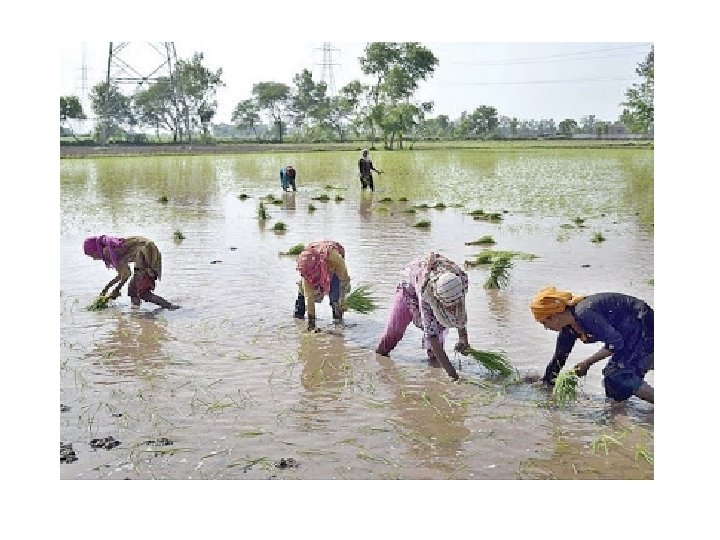
5. PLANTING Planting is the placement of seeds or propagules firmly in the soil for germination and growth. 6. TRANSPLANTING Transplanting is the practice of planting seedlings in main field after pulling out from the nursery. Why nursery is raised? • It is done to reduce the main field duration of the crops thus allowing multiple crops per year. • Extra care can be provided for specific seedlings. • It is done for small seeded crops like rice which requires shallow sowing and frequent irrigation for proper germination.
METHODS OF NURSERY SOWING Method of sowing of nursery depends on the type of soil, water availability, and local custom. i. Wet bed method ii. Dry bed method iii. Rabi method
i. Wet bed method • Soak the seed in water for 24 hours, after that cover the seed with wet jute bags and place it under shade. • Seed will germinate after 36 -48 hours. • Irrigate, plow, puddle and level the field. • Prepare beds of 1 to 1. 5 m width, 4 -5 cm height & any convenient length. • Germinated seed is sown with broadcast method @ 1 kg/Marla for ARRI varieties and @ 500 -750 g/Marla for Basmati varieties. • 1 -1. 5 -inch water should be present before broadcasting the pregerminated seed in evening. • Drainage the water in next evening and again irrigate in next morning. Repeat it for one week. • Maintain a water level of 2 -5 cm, depending on the height of seedlings. • Apply urea 250 g per Marla, if seedling is weak. • Seedlings will be ready for transplanting in 25 -30 days.
ii. Dry bed method • Practiced where puddling is impossible as soils are loamy or silt loam. • Plot is prepared in watter conditions after irrigation. • Dry seed is sown with broadcast method @ 1. 5 kg/Marla for ARRI varieties and @ 750 g/Marla for Basmati varieties. • Straw layer is spread and irrigation is applied. • Straw layer is removed after some days to facilitate sunlight. • Seedling will be ready in 35 -40 days.
iii. Raab method • Practiced in areas of D. G. khan and Muzaffargarh where soil is hard. • Uprooting of nursery is difficult. • Nursery plots are levelled. • Crop residues (5 cm layer) spread uniformly and burnt. • Ash is pressed on soil after cooling. • Dry seed is sown with broadcast method @ 2 kg/Marla for ARRI varieties and @ 1 kg/Marla for Basmati varieties. • Seedling will be ready in 35 -40 days.
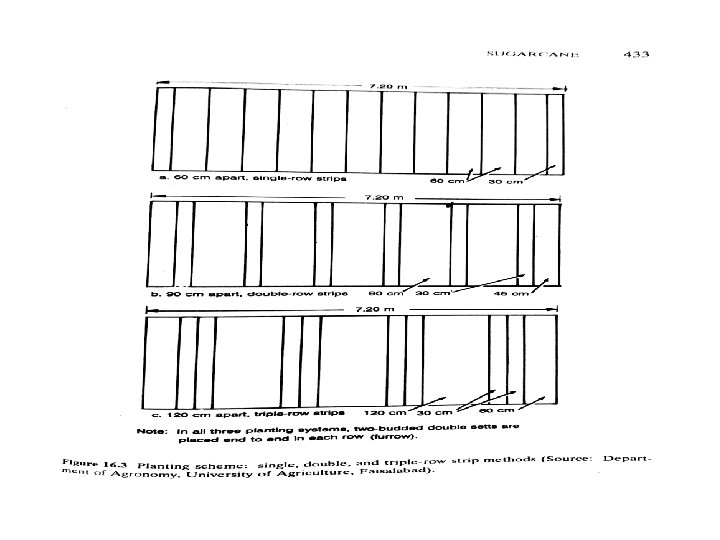
PLANTING METHODS OF SUGARCANE There are two planting methods of sugarcane 1. Strip planning 2. Pit planting 1. Strip planting It is further divided into three methods Single row strip = 60 cm apart Double row strip = 90 cm apart Triple row strip = 120 cm apart
Advantages of strip planting i. Strip planting facilitates interculture and earthing up of crops without damaging the roots. ii. Conservation of irrigation water. iii. Allows efficient and expeditious interculture and earthing up with btractor or bullocks drawn implements. iv. Permits the systematic planting and handling of intercrops without affecting the associated cane crop. Moreover planting of main and intercrops in separate and independent strips not only reduces intercrops competition, but also enables the growers to meet the varying fertilizer requirements, growth pattern and planting time of different crops. v. Eliminates the chances of patchy crop stand since the rows are closely planted.
vi. Facilitates easy application of herbicides since the strips are well spaced. vii. Prevent lodging in case of unusual wind or rain since the strips provide plant support. viii. Improves the air circulation and light penetration which enhances the photosynthetic efficiency of the plants and thus their growth and quality. ix. Causes better rationing and also allows more effective stubbles shaving, which promotes sprouting. x. Reduces crop damage from trampling by wild boars looking for a space to rest.
2. Pit planting • A new technology was developed by UAF in which sugarcane is planted in 100 x 100 cm pits, 50 cm apart with a seeding density of 30 twobudded setts per pit. • Pit are dug to a depth of 60 cm and refilled to a level of 45 cm with the same soil along with 5 kg well rotted FYM per pit mixed well with the soil. Pits are dug at zero tillage and no hoeing or earthing up is done. Fertilizer at the rate of 150100 -100 kg NPK/ha is placed in side the pits.
Advantages of pit planting 1. Reduces lodging since the plants are firmly anchored in the pits thereby increasing leaf area, promoting air circulation and allowing penetration of light. 2. Conserving irrigation water and applied fertilizer and manure. 3. Enables the intercropping of lentil, pea, gram, and wheat in autumn planted cane and mung, mash and cowpea in spring planted cane. 4. Eliminates expenditures on tillage, hoeing, and earthing up because pits are dug at zero tillage. 5. Facilitates mulching to conserve soil moisture and efficient use of herbicides and pesticides. 6. Promotes better ratooning, permitting three to four rations without soil compaction or weeds infestation.
Delinting of Cotton Seed AGRO-5902 Practical
Why delinting is done? • Cottonseed, as the by-product of cotton ginning operation, is covered with fibrous lint. The cottonseed is mainly made up of inner kernel, usually called "meats". • This meaty portion contains all the oil as well as proteins, and it is enclosed in the fibrous hull. Over the hull stick out the cotton fiber which escape the ginning and left on seeds. These cotton fibers are called "lint".
• By processing cotton seeds, we can get maximum benefits. The inner kernel can be planted, fed to livestock, made into cottonseed oil for human consumption, used for fertilizer, or used in products like lotions and soap. • The lint we get from cotton delinting has wide application in cotton blanket, sweat shirt, paper board industry and cotton pulp, etc. Therefore, the cottonseed delinter is very essential in cotton processing.
Methods of Cottonseed Delinting • Two general methods have been developed for removing the lint from cottonseed, which are removing the lint by acid and by delinter machine respectively.
1. Acid delinting • The acid delinting of cottonseed has been used extensively, particularly when the seeds are used for planting. Both sulfuric acid and hydrochloric acid at 100 ml per kg of seed have been used for acid delinting. Due to the generation of heat from the reaction of acid with the moisture, the short cotton fibers on the seed would quickly disintegrate.
• The residue can be washed away with water. After washing, the seed need to be neutralized with soda ash, lime or anhydrous ammonia, which is regard as the wet acid method. However, the concentrated sulfuric acid is extremely corrosive to machinery and dangerous to handle. Some serious problems could emerge, like consuming a large amount of energy to dry the seed and causing soil and water pollution.
2. Mechanical delinting • Mechanical delinting requires more energy than acid delinting, but it does not use any chemicals and can produce a small quantity of usable low grade lint as a by-product. Mechanical delinting is usually accomplished by high speed rotating sharp saws or abrasive surfaces to cut or rub the fibers off from the hull. The advantage of this type operation is that the fibers are not degraded during the operation and can be sold for various purposes.
• Also, since the seeds are to be subsequently crushed for oil or meal, the damage sustained by the seeds is not detrimental to their further use. The delinter machine also provides for the recovery of the lint after separation from the cottonseed. The movement and travel path of the cottonseeds during delinting process is controlled to ensure a high degree of efficiency in the removal of the lint.
SEED TREATMENT WITH FUNGICIDE Following are the definitions of seed treatment Treatment of seed with fungicide for the control of disease i-e loose smut, partial bunt etc. Soaking treatment to enhance germination or to break dormancy. Treatment of seed with inoculums. Equipment Seed of crop, fungicide, electric balance and rotary or simple drum. Objective To control seed borne diseases like loose smut, partial bunt. Procedure 1. Weigh the seed and fungicide on balance according to the rate or ratio (23 g fungicide/kg seed) Amount of seed =800 kg Amount of fungicide = 2/1000 x 800 =1. 6 g 2. Add seed and fungicide in the rotary or simple drum. If rotary drum is used to fully mix the fungicide with seed. If simple drum is used then simply mix the seed and fungicide with a mixing stick.
Inoculation of Legumes • Inoculation is the process of adding rhizobia inoculant to the seed. It is important for farmers to ensure that they inoculate their crops properly so that they can enjoy the benefits of inoculation.
Inoculation Method 1. Spread the seed out on a clean plastic sheet or in a large container. 2. Mix 1 litre of water with 50 grams sugar to make a sugar solution in a clean bucket. The use sugar is to enable the inoculant to stick to seed. 3. Pour the inoculant into the bucket with sugar solution. Make sure that all the inoculant is poured into the bucket. (Do not leave some inoculant in the sachet after opening. Use all of it at once. 4. Stir vigorously with a wooden spoon for 30 seconds.
5. Sprinkle the inoculant mix onto the seed. 6. Do not use a lot of water on the seed because this can result in the outer coat of the seeds peeling off. 7. Turn the seed gently. When the seed is gently coated it will look shiny. 8. The inoculated seed is ready for planting and it may be allowed to dry in a cool shaded place. 9. Sow seed in a moist soil and cover immediately afterwards to protect the rhizobium from sunlight.
Intercultural operation 1. Weeding Removal of weeds is known as weeding. Weed is a plant grown where it is not desired Objectives i. To reduce the competition of weeds to crop plants for light, space, water and nutrients. ii. To get expected output (yield) from crop cultivation. iii. Weeding in dry condition fulfills the objective of natural mulching.
2. Mulching is a method of conserving soil moisture. It is a very important intercultural operation for rabi and rainfed crops. It is done by making a covering on the soil surface which actually reduces the evaporation of soil water. Mulches are the materials used for mulching. Objectives i. To conserve soil moisture. ii. ii. To reduce excess evaporation loss of soil moisture. iii. iii. To ensure economic use of irrigation water. Advantages i. It keeps the soil moist during the dry season. ii. It suppresses weed growth and population. iii. Keeps the soil cool during dry and hot season. iv. Use of mulches like water hyacinth or straw adds significant amount of organic matter to the soil after decomposition. v. Natural mulching aerates the soil which helps better respiration of plant roots. vi. Mulching becomes essential for some crops to prevent contact of product with soil as for example fruits of straw berry plants if come in direct contact with the soil then the fruits will rot. So, mulching becomes essential for strawberry.
Types of mulch i. Natural mulch (water hyacinth, straw, leaves etc. ) ii. Artificial mulch (polythene, paper etc. ) Types of mulching i. Natural mulching ii. Artificial mulching
i. Natural mulching: It is a method of breaking the surface of dry soil and generally done by stirring the soil surface with the help of some implements like niri, khurpi etc. Weeding in dry condition with the help of niri or khurpi results in natural mulching. When the soil becomes drier, water vapour moves upward towards the soil surface through capillary tubes and escapes into the atmosphere. Natural mulching breaks the soil crust and thereby, opening of capillary tubes gets broken and blocked which results in prevention of upward movement of water vapour. Hence, upward movement of capillary water is restricted and soil moisture is conserved.
ii. Artificial mulching: This includes application of plant leaves, straw, water hyacinth, polythene, sawdust etc. so as to provide a covering on the surface soil which can check the evaporation of soil moisture. Mulch crops may also be grown to conserve soil moisture in bare ground by their thick and multilayered foliage, trailing habit and sometimes, self-seeding nature, for instance cow pea, Alylosia.
3. Earthing up consists of lifting up or shifting the soil from the central portion of the space between rows towards the base of plants so as to cover the plant base or certain plant organs grown from below or at the soil surface. Earthing up may be done both under wet and dry conditions of soil. Objectives i. To make better root anchorage. ii. To prevent lodging. iii. To cover stolons and rhizomes in some crops. Advantages i. Earthing up creates ridges and furrows in the crop field which later on serves the purpose of irrigation channel. ii. Earthing up reduces weed growth and population. iii. Earthing up closes the spreading tillers in sugarcane which makes the tying of canes easier. iv. Earthing up increasing the number of tubers in potato and prevents solarization of developing tubers. v. The initiation of new (late) tillers in rice and sugarcane or rhizomes in taro, turmeric and ginger are restricted. vi. The pegs of groundnut, the stolons and the tubers of potato and the stilt roots of maize are covered with earth.
4. Thinning Removal of excess plants after germination from the crop field or seed bed is called thinning. Excess plants in a crop field reduce crop yield due to intra crop competition. As a result, there occurs shortage of space, nutrients, light, air and moisture for individual crop plant which ultimately reduce yield. So, if required, excess seedlings are removed leaving the strongest ones.
5. Gap filling Several frugivorous and granivorous animals and birds feed on many seeds after they are sown in the field. Moreover, after transplanting many seedlings fail to establish them in the new environment and dies. Then. Gap filling with seeds staggers the period of germination and emergence. As a result, ripening periods extend over time and affect the harvesting which is scheduled once for most crops; and this seriously impairs the quality of produce. Objectives of thinning and gap filling The ultimate goal is to ensure the optimum plant population in the crop field. Plant population more than optimum creates competitive condition whereas that less than optimum results in misuse of space, irrigation water and other inputs. Advantages Both thinning and gap filling ensures ideal plant population and optimum utilization of sunlight, space, nutrients, moisture and other inputs which ultimately increases yield.