
Demonstration Network Of groundbased Remote Sensing observations in
Demonstration Network Of ground-based Remote Sensing observations in support of the GMES Atmospheric Service Main achievements (11/2011 -11/2014) François Hendrick and the NDACC/NORS UVVIS Working Group NDACC UV-VIS WG Meeting, Brussels, 9 July 2015 1
NORS general objective Perform the required research and developments to optimize the NDACC data products for the purpose of supporting the quality assessments of the future Copernicus Atmosphere Monitoring Service (CAMS) • Target NORS data products – Tropospheric and stratospheric O 3 columns and profiles – Tropospheric and stratospheric NO 2 columns and profiles – Tropospheric profiles of HCHO and aerosol extinction – Tropospheric and stratospheric columns of CO – Tropospheric and stratospheric columns of CH 4 • 4 NDACC techniques + in-situ surface monitoring: – Lidar, MW, FTIR, UV-VIS (MAX-)DOAS + in-situ surface monitoring • 4 NDACC pilot stations NDACC UV-VIS WG Meeting, Brussels, 9 July 2015 2
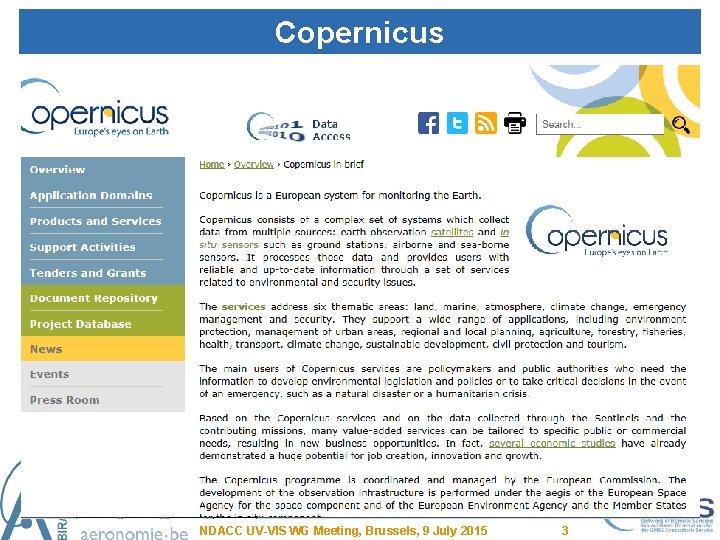
Copernicus NDACC UV-VIS WG Meeting, Brussels, 9 July 2015 3
NORS general objective Perform the required research and developments to optimize the NDACC data products for the purpose of supporting the quality assessments of the future Copernicus Atmosphere Monitoring Service (CAMS) • Target NORS data products – Tropospheric and stratospheric O 3 columns and profiles – Tropospheric and stratospheric NO 2 columns and profiles – Tropospheric profiles of HCHO and aerosol extinction – Tropospheric and stratospheric columns of CO – Tropospheric and stratospheric columns of CH 4 • 4 NDACC techniques + in-situ surface monitoring: – Lidar, MW, FTIR, UV-VIS (MAX-)DOAS + in-situ surface monitoring • 4 NDACC pilot stations NDACC UV-VIS WG Meeting, Brussels, 9 July 2015 4
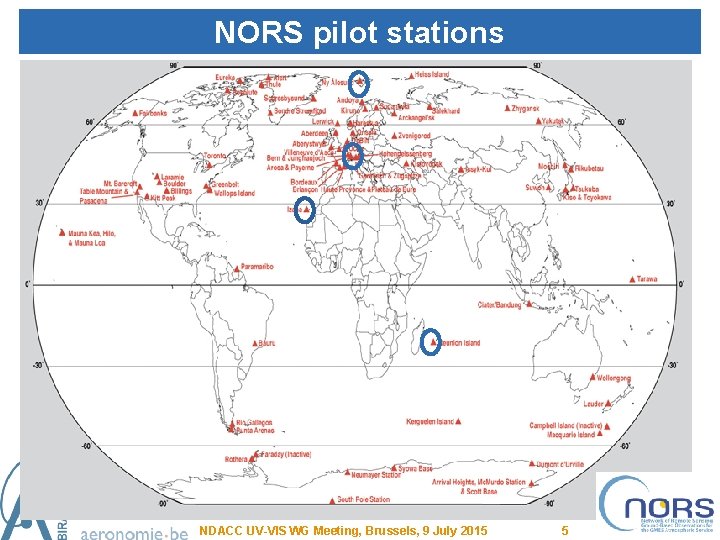
NORS pilot stations NDACC UV-VIS WG Meeting, Brussels, 9 July 2015 5
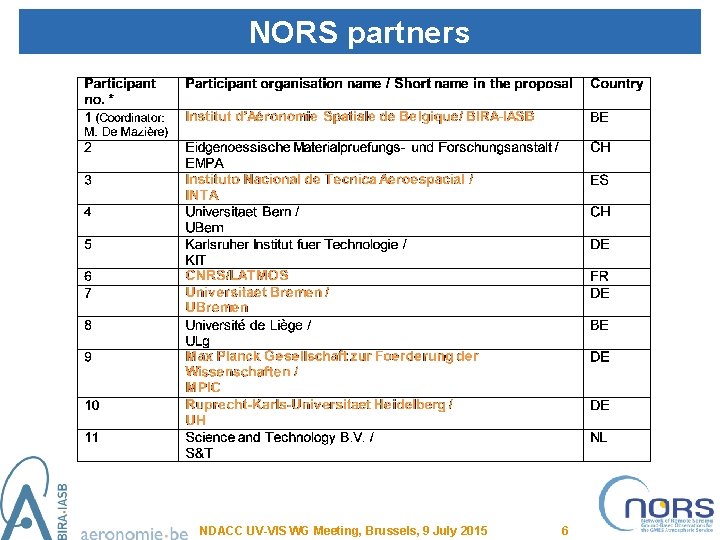
NORS partners NDACC UV-VIS WG Meeting, Brussels, 9 July 2015 6
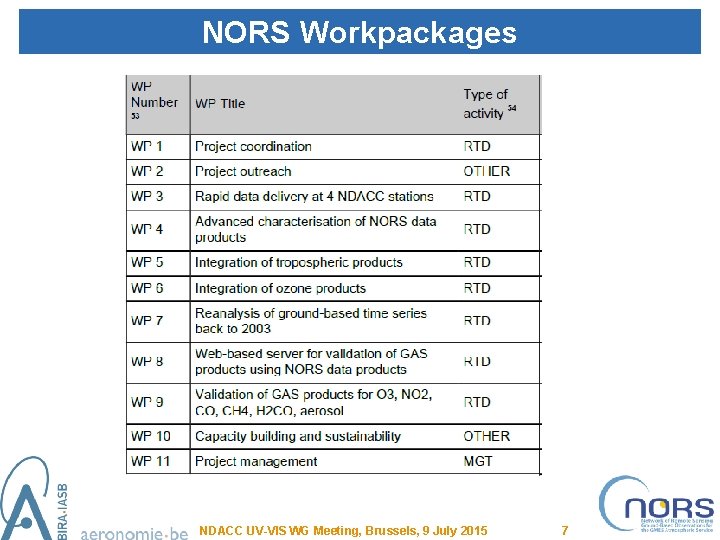
NORS Workpackages NDACC UV-VIS WG Meeting, Brussels, 9 July 2015 7
WP 4: Characterization of NDACC UVVIS data Ø (MAX-)DOAS data harmonization (DOAS settings, NO 2 and O 3 AMF LUTs, profiling methods, …) NDACC UV-VIS WG Meeting, Brussels, 9 July 2015 8
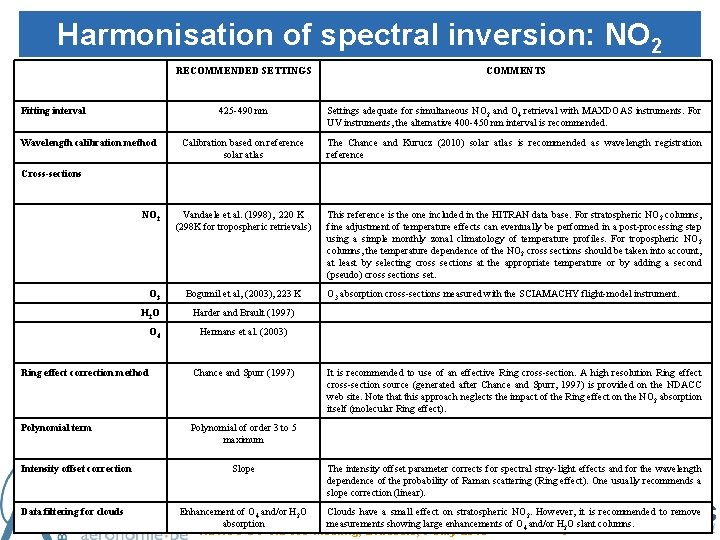
Harmonisation of spectral inversion: NO 2 Fitting interval Wavelength calibration method RECOMMENDED SETTINGS COMMENTS 425 -490 nm Settings adequate for simultaneous NO 2 and O 4 retrieval with MAXDOAS instruments. For UV instruments, the alternative 400 -450 nm interval is recommended. Calibration based on reference solar atlas The Chance and Kurucz (2010) solar atlas is recommended as wavelength registration reference Vandaele et al. (1998), 220 K (298 K for tropospheric retrievals) This reference is the one included in the HITRAN data base. For stratospheric NO 2 columns, fine adjustment of temperature effects can eventually be performed in a post-processing step using a simple monthly zonal climatology of temperature profiles. For tropospheric NO 2 columns, the temperature dependence of the NO 2 cross sections should be taken into account, at least by selecting cross sections at the appropriate temperature or by adding a second (pseudo) cross sections set. Cross-sections NO 2 O 3 H 2 O O 4 Bogumil et al, (2003), 223 K Harder and Brault (1997) Hermans et al. (2003) Ring effect correction method Chance and Spurr (1997) Polynomial term Polynomial of order 3 to 5 maximum Intensity offset correction Data filtering for clouds O 3 absorption cross-sections measured with the SCIAMACHY flight-model instrument. It is recommended to use of an effective Ring cross-section. A high resolution Ring effect cross-section source (generated after Chance and Spurr, 1997) is provided on the NDACC web site. Note that this approach neglects the impact of the Ring effect on the NO 2 absorption itself (molecular Ring effect). Slope The intensity offset parameter corrects for spectral stray-light effects and for the wavelength dependence of the probability of Raman scattering (Ring effect). One usually recommends a slope correction (linear). Enhancement of O 4 and/or H 2 O absorption Clouds have a small effect on stratospheric NO 2. However, it is recommended to remove measurements showing large enhancements of O 4 and/or H 2 O slant columns. NDACC UV-VIS WG Meeting, Brussels, 9 July 2015 9
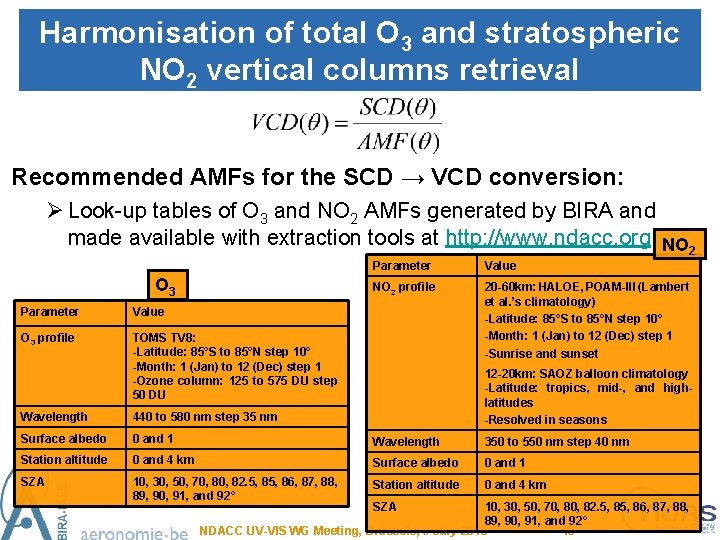
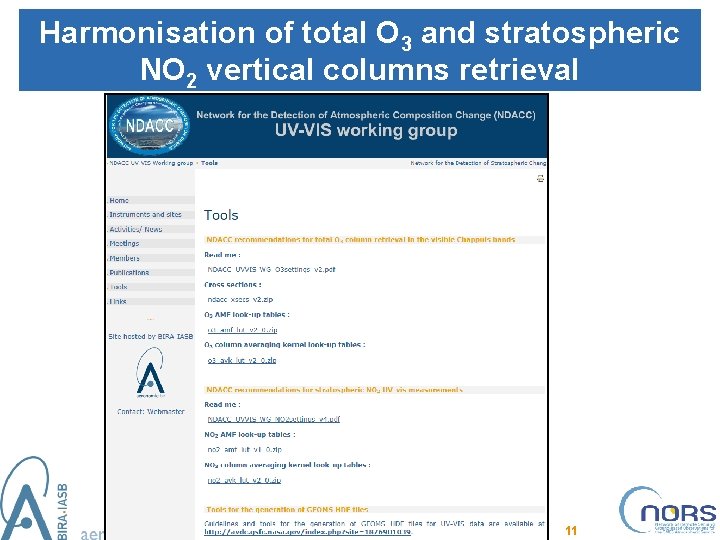
Harmonisation of total O 3 and stratospheric NO 2 vertical columns retrieval Recommended AMFs for the SCD → VCD conversion: Ø Look-up tables of O 3 and NO 2 AMFs generated by BIRA and made available with extraction tools at http: //www. ndacc. org NO 2 O 3 Parameter Value O 3 profile TOMS TV 8: -Latitude: 85°S to 85°N step 10° -Month: 1 (Jan) to 12 (Dec) step 1 -Ozone column: 125 to 575 DU step 50 DU Parameter Value NO 2 profile 20 -60 km: HALOE, POAM-III (Lambert et al. ’s climatology) -Latitude: 85°S to 85°N step 10° -Month: 1 (Jan) to 12 (Dec) step 1 -Sunrise and sunset 12 -20 km: SAOZ balloon climatology -Latitude: tropics, mid-, and highlatitudes -Resolved in seasons Wavelength 440 to 580 nm step 35 nm Surface albedo 0 and 1 Wavelength 350 to 550 nm step 40 nm Station altitude 0 and 4 km Surface albedo 0 and 1 SZA 10, 30, 50, 70, 82. 5, 86, 87, 88, 89, 90, 91, and 92° Station altitude 0 and 4 km SZA 10, 30, 50, 70, 82. 5, 86, 87, 88, 89, 90, 91, and 92° NDACC UV-VIS WG Meeting, Brussels, 9 July 2015 10
Harmonisation of total O 3 and stratospheric NO 2 vertical columns retrieval QA 4 ECV WP 3 Workshop, 19 -20 March 2015, Mainz 11
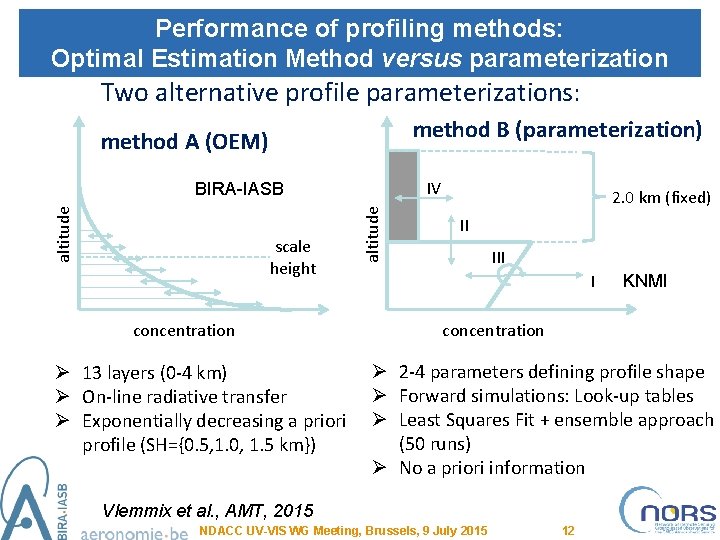
Performance of profiling methods: Optimal Estimation Method versus parameterization Two alternative profile parameterizations: method B (parameterization) method A (OEM) IV scale height concentration Ø 13 layers (0 -4 km) Ø On-line radiative transfer Ø Exponentially decreasing a priori profile (SH={0. 5, 1. 0, 1. 5 km}) altitude BIRA-IASB 2. 0 km (fixed) II I KNMI concentration Ø 2 -4 parameters defining profile shape Ø Forward simulations: Look-up tables Ø Least Squares Fit + ensemble approach (50 runs) Ø No a priori information Vlemmix et al. , AMT, 2015 NDACC UV-VIS WG Meeting, Brussels, 9 July 2015 12
WP 4: Characterization of NDACC UVVIS data Ø (MAX-)DOAS data harmonization (DOAS settings, NO 2 and O 3 AMF LUTs, profiling methods, …) Ø (MAX-)DOAS data characterization representativeness, cloud detection) NDACC UV-VIS WG Meeting, Brussels, 9 July 2015 (spatial 13
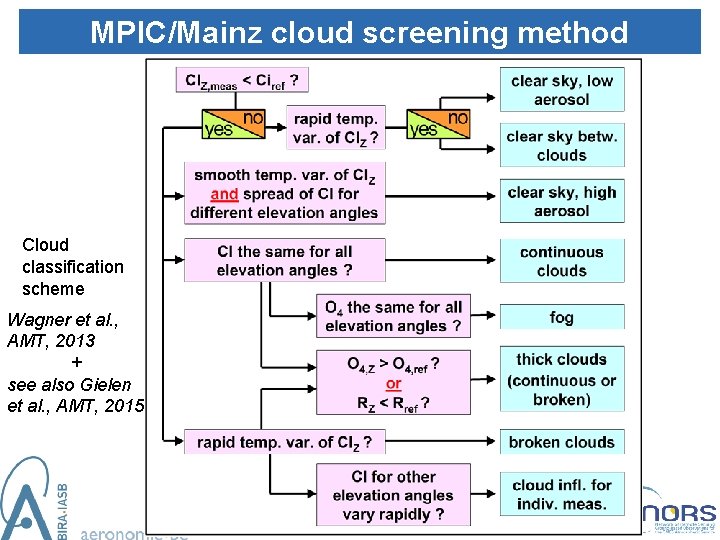
MPIC/Mainz cloud screening method Cloud classification scheme Wagner et al. , AMT, 2013 + see also Gielen et al. , AMT, 2015 NDACC UV-VIS WG Meeting, Brussels, 9 July 2015 14
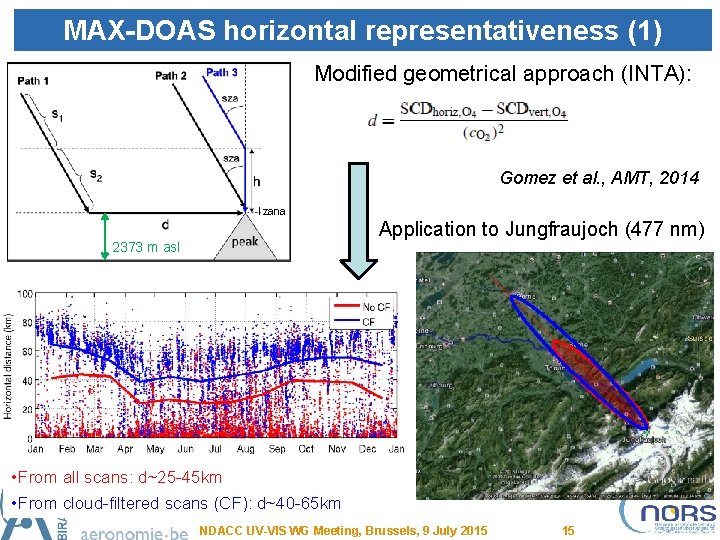
MAX-DOAS horizontal representativeness (1) Modified geometrical approach (INTA): Gomez et al. , AMT, 2014 Izana Application to Jungfraujoch (477 nm) 2373 m asl • From all scans: d~25 -45 km • From cloud-filtered scans (CF): d~40 -65 km NDACC UV-VIS WG Meeting, Brussels, 9 July 2015 15
WP 4: Characterization of NDACC UVVIS data Ø (MAX-)DOAS data harmonization (DOAS settings, NO 2 and O 3 AMF LUTs, profiling methods, …) Ø (MAX-)DOAS data characterization representativeness, cloud detection) (spatial Ø Development of a GEOMS-compliant template for the creation of HDF files for UVVIS measurements NDACC UV-VIS WG Meeting, Brussels, 9 July 2015 16
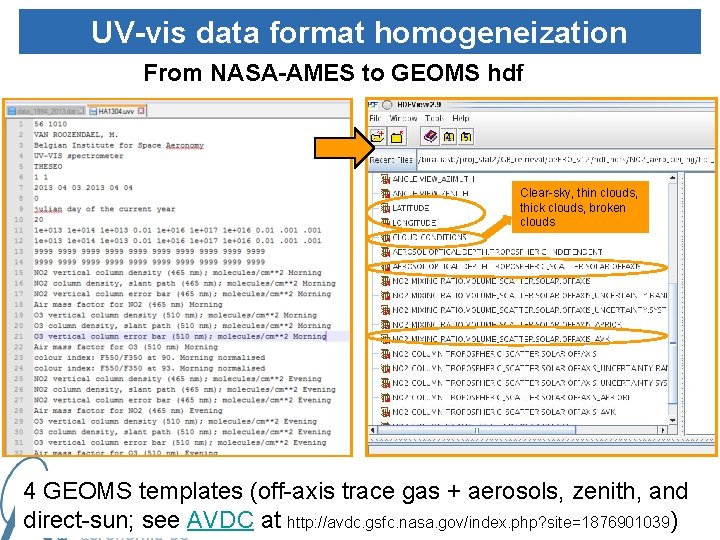
UV-vis data format homogeneization From NASA-AMES to GEOMS hdf Clear-sky, thin clouds, thick clouds, broken clouds 4 GEOMS templates (off-axis trace gas + aerosols, zenith, and direct-sun; see AVDC at http: //avdc. gsfc. nasa. gov/index. php? site=1876901039 ) NDACC UV-VIS WG Meeting, Brussels, 9 July 2015 17
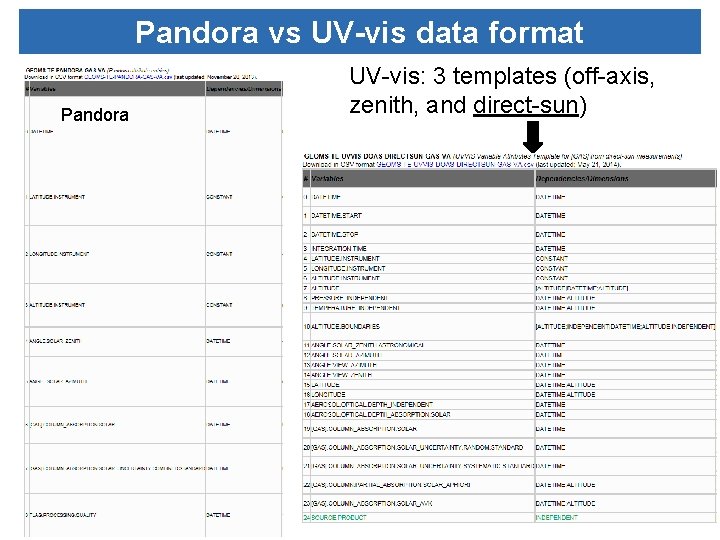
Pandora vs UV-vis data format Pandora UV-vis: 3 templates (off-axis, zenith, and direct-sun)
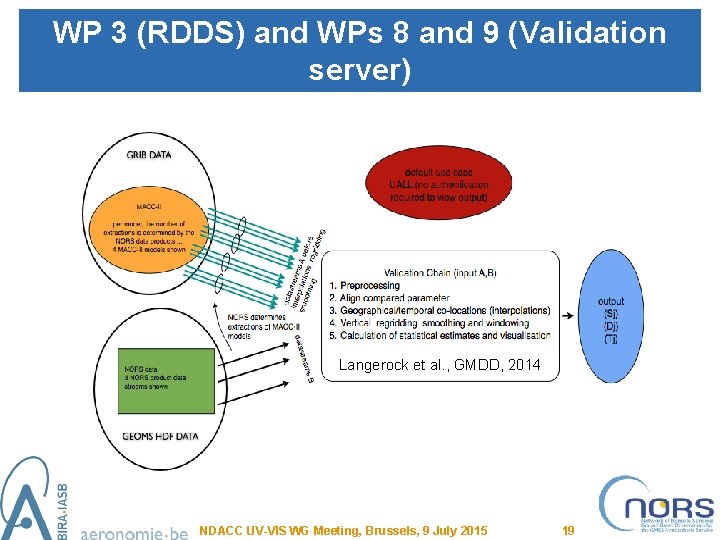
WP 3 (RDDS) and WPs 8 and 9 (Validation server) Langerock et al. , GMDD, 2014 NDACC UV-VIS WG Meeting, Brussels, 9 July 2015 19
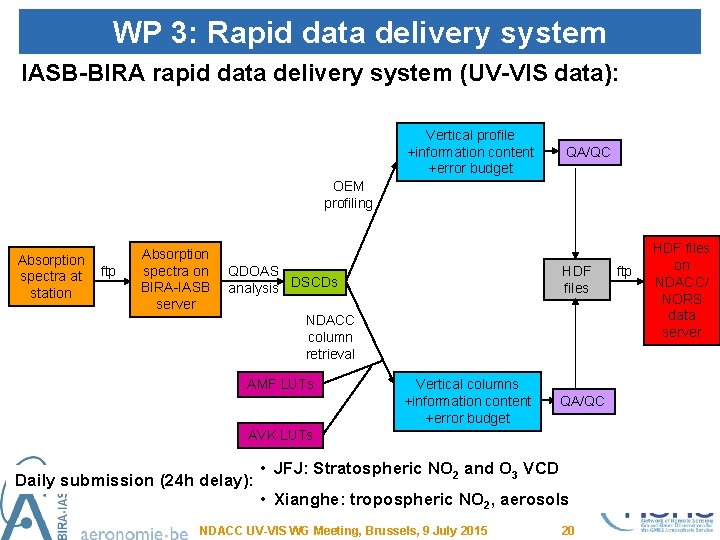
WP 3: Rapid data delivery system IASB-BIRA rapid data delivery system (UV-VIS data): Vertical profile +information content +error budget QA/QC OEM profiling Absorption spectra at station ftp Absorption spectra on BIRA-IASB server QDOAS analysis DSCDs HDF files NDACC column retrieval AMF LUTs Vertical columns +information content +error budget QA/QC AVK LUTs Daily submission (24 h delay): • JFJ: Stratospheric NO 2 and O 3 VCD • Xianghe: tropospheric NO 2, aerosols NDACC UV-VIS WG Meeting, Brussels, 9 July 2015 20 ftp HDF files on NDACC/ NORS data server
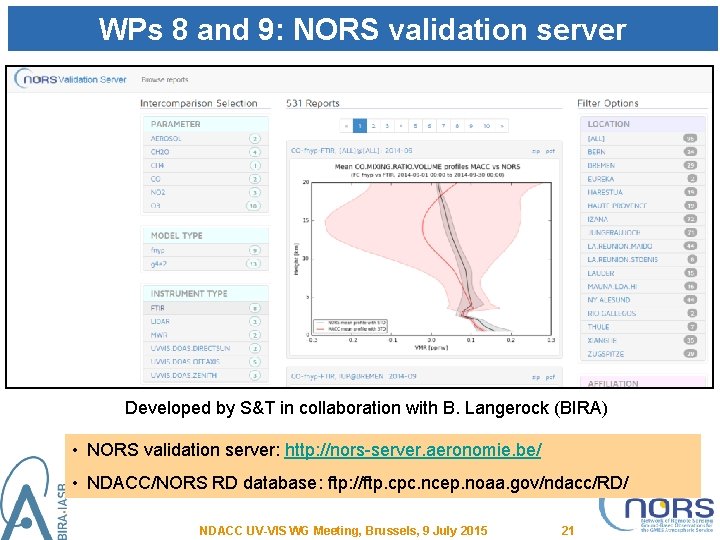
WPs 8 and 9: NORS validation server Developed by S&T in collaboration with B. Langerock (BIRA) • NORS validation server: http: //nors-server. aeronomie. be/ • NDACC/NORS RD database: ftp: //ftp. cpc. ncep. noaa. gov/ndacc/RD/ NDACC UV-VIS WG Meeting, Brussels, 9 July 2015 21
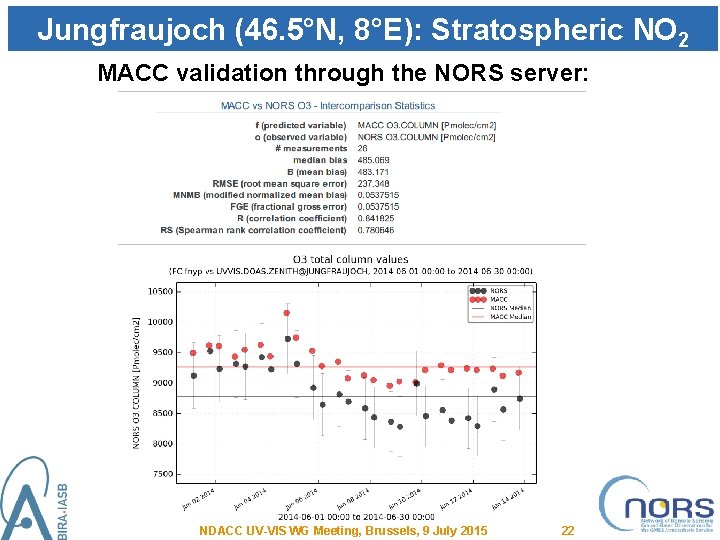
Jungfraujoch (46. 5°N, 8°E): Stratospheric NO 2 MACC validation through the NORS server: NDACC UV-VIS WG Meeting, Brussels, 9 July 2015 22
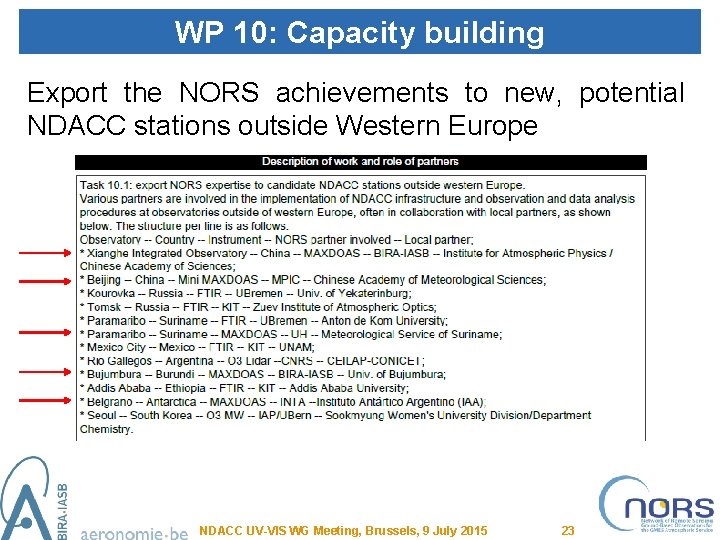
WP 10: Capacity building Export the NORS achievements to new, potential NDACC stations outside Western Europe NDACC UV-VIS WG Meeting, Brussels, 9 July 2015 23
Conclusions and perspectives Significant progress have been achieved during NORS: Ø Data harmonization (recommended settings including ancillary data like e. g. cross-sections and AMF) Ø Data quality assessment (cloud flagging, spatial representativeness) Ø Data reporting (GEOMS hdf) Ø Data delivery (daily submission to NORS RD database) Ø Exportation of the NORS achievements to new stations This significantly improves the usability of UVVIS data for future satellite and model validation efforts (MACCIII, CAMS) Should we apply the NORS concepts/data format to NDACC UVVIS ? ? NDACC UV-VIS WG Meeting, Brussels, 9 July 2015 24
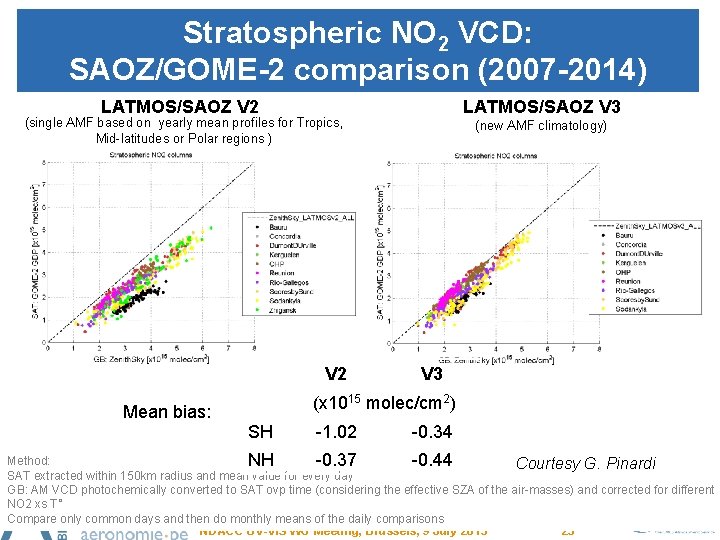
Stratospheric NO 2 VCD: SAOZ/GOME-2 comparison (2007 -2014) LATMOS/SAOZ V 2 LATMOS/SAOZ V 3 (single AMF based on yearly mean profiles for Tropics, Mid-latitudes or Polar regions ) V 2 Mean bias: (new AMF climatology) V 3 (x 1015 molec/cm 2) SH -1. 02 -0. 34 Method: NH -0. 37 -0. 44 Courtesy G. Pinardi SAT extracted within 150 km radius and mean value for every day GB: AM VCD photochemically converted to SAT ovp time (considering the effective SZA of the air-masses) and corrected for different NO 2 xs T° Compare only common days and then do monthly means of the daily comparisons NDACC UV-VIS WG Meeting, Brussels, 9 July 2015 25
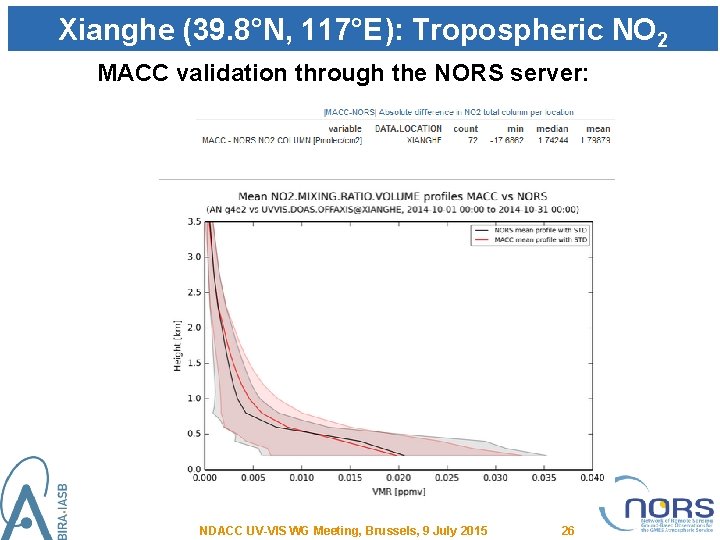
Xianghe (39. 8°N, 117°E): Tropospheric NO 2 MACC validation through the NORS server: NDACC UV-VIS WG Meeting, Brussels, 9 July 2015 26
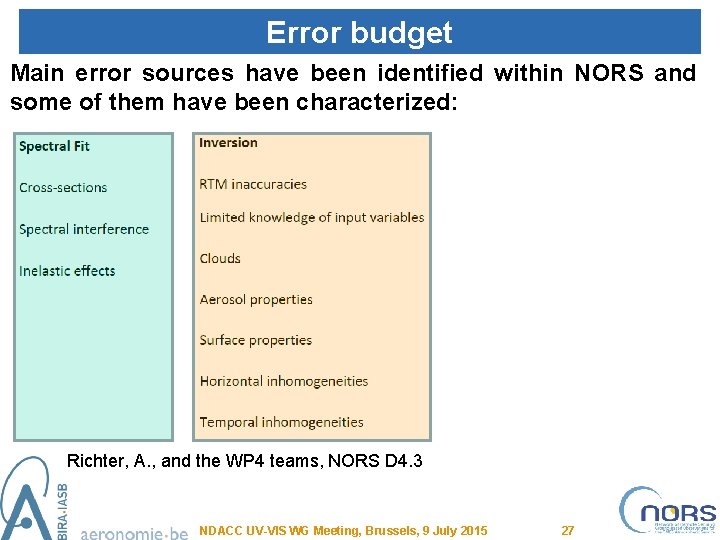
Error budget Main error sources have been identified within NORS and some of them have been characterized: Richter, A. , and the WP 4 teams, NORS D 4. 3 NDACC UV-VIS WG Meeting, Brussels, 9 July 2015 27
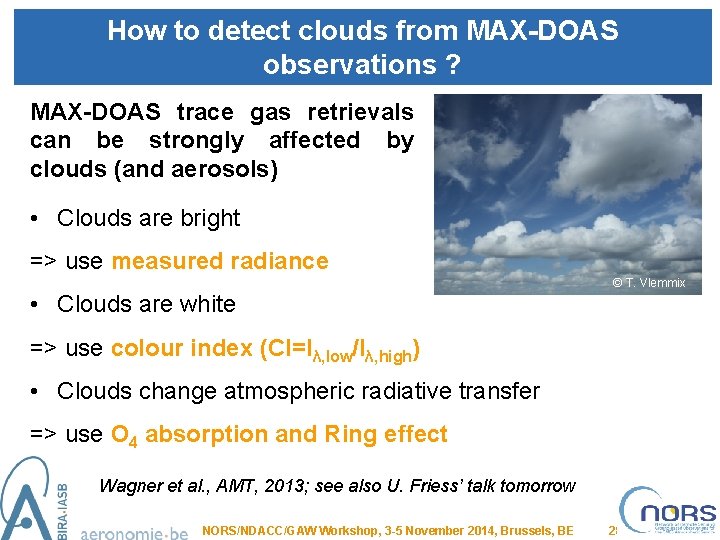
How to detect clouds from MAX-DOAS observations ? MAX-DOAS trace gas retrievals can be strongly affected by clouds (and aerosols) • Clouds are bright => use measured radiance © T. Vlemmix • Clouds are white => use colour index (CI=Iλ, low/Iλ, high) • Clouds change atmospheric radiative transfer => use O 4 absorption and Ring effect Wagner et al. , AMT, 2013; see also U. Friess’ talk tomorrow NORS/NDACC/GAW Workshop, 3 -5 November 2014, Brussels, BE 28
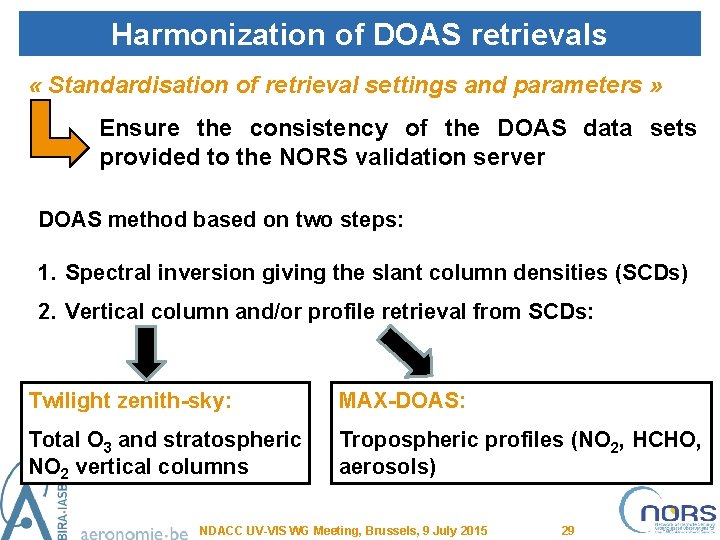
Harmonization of DOAS retrievals « Standardisation of retrieval settings and parameters » Ensure the consistency of the DOAS data sets provided to the NORS validation server DOAS method based on two steps: 1. Spectral inversion giving the slant column densities (SCDs) 2. Vertical column and/or profile retrieval from SCDs: Twilight zenith-sky: MAX-DOAS: Total O 3 and stratospheric NO 2 vertical columns Tropospheric profiles (NO 2, HCHO, aerosols) NDACC UV-VIS WG Meeting, Brussels, 9 July 2015 29
- Slides: 29