
Demonstrating Progress Toward Improving Water Supply Efficiency Tim
- Slides: 24
Demonstrating Progress Toward Improving Water Supply Efficiency Tim Cash, Bill Frechette, Johanna Smith, Wei Zeng Georgia Environmental Protection Division Version 1. 0 May 2019
PRESENTATION OUTLINE • What is Water Loss? • How do we Track It? • Why Track Water Loss? • Water Loss Tracking Requirements in Georgia • Where We Are – The Present • Permit Renewals & Modifications – The Future • Demonstration of Progress • Resources 2
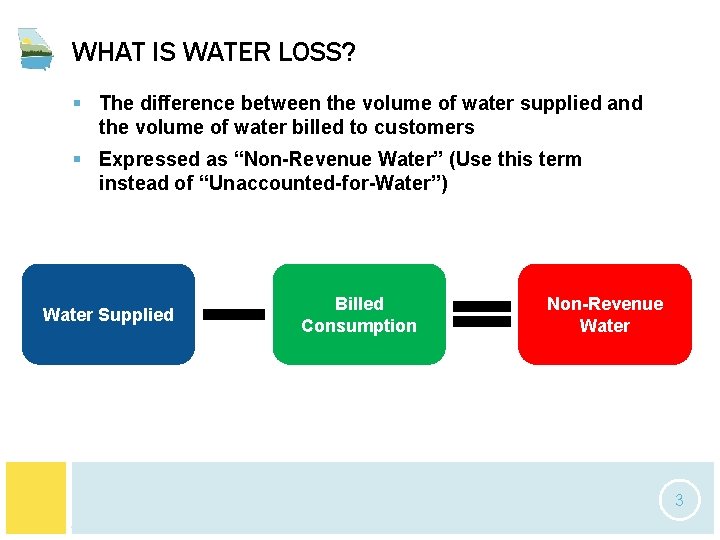
WHAT IS WATER LOSS? § The difference between the volume of water supplied and the volume of water billed to customers § Expressed as “Non-Revenue Water” (Use this term instead of “Unaccounted-for-Water”) Water Supplied Billed Consumption Non-Revenue Water 3
TRACKING WATER LOSS • AWWA M 36 Methodology • Industry Best Practice since 2003 • All water is “Accounted For” • Standard Definitions and Procedures • Georgia Requirement began in 2011 4
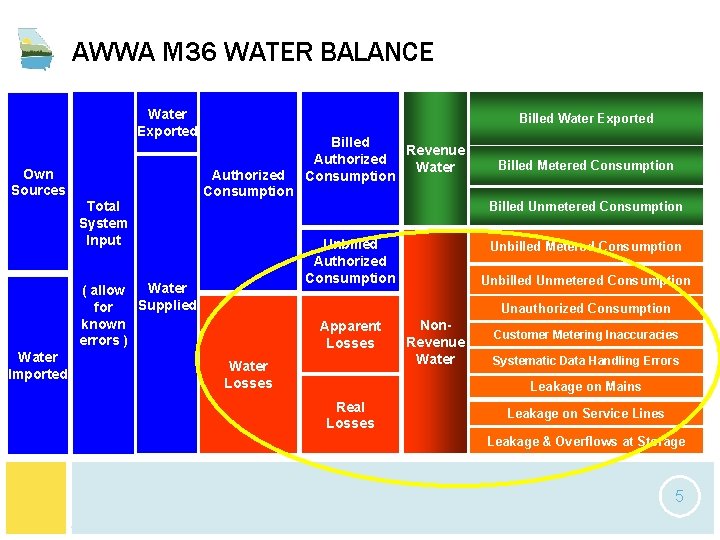
AWWA M 36 WATER BALANCE Water Exported Own Sources Total System Input Billed Water Exported Authorized Consumption Billed Metered Consumption Billed Unmetered Consumption Unbilled Authorized Consumption Water ( allow Supplied for known errors ) Water Imported Billed Revenue Authorized Water Consumption Unbilled Metered Consumption Unbilled Unmetered Consumption Unauthorized Consumption Apparent Losses Water Losses Non. Revenue Water Customer Metering Inaccuracies Systematic Data Handling Errors Leakage on Mains Real Losses Leakage on Service Lines Leakage & Overflows at Storage 5
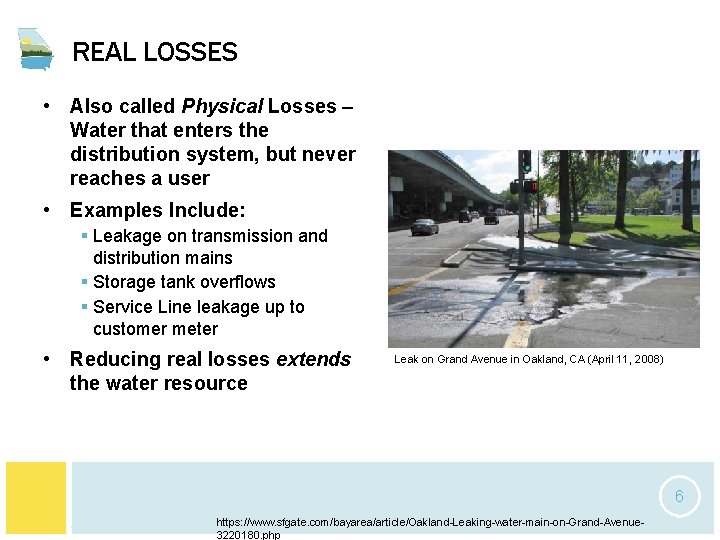
REAL LOSSES • Also called Physical Losses – Water that enters the distribution system, but never reaches a user • Examples Include: § Leakage on transmission and distribution mains § Storage tank overflows § Service Line leakage up to customer meter • Reducing real losses extends the water resource Leak on Grand Avenue in Oakland, CA (April 11, 2008) 6 https: //www. sfgate. com/bayarea/article/Oakland-Leaking-water-main-on-Grand-Avenue 3220180. php
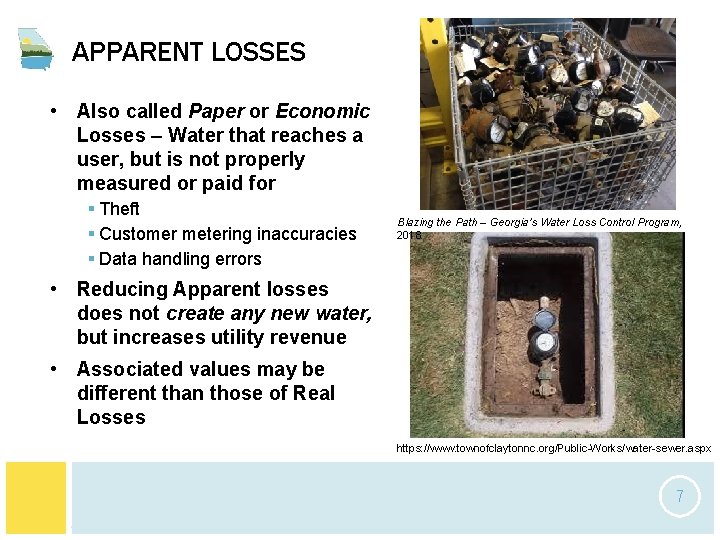
APPARENT LOSSES • Also called Paper or Economic Losses – Water that reaches a user, but is not properly measured or paid for § Theft § Customer metering inaccuracies § Data handling errors Blazing the Path – Georgia’s Water Loss Control Program, 2018 • Reducing Apparent losses does not create any new water, but increases utility revenue • Associated values may be different than those of Real Losses https: //www. townofclaytonnc. org/Public-Works/water-sewer. aspx 7
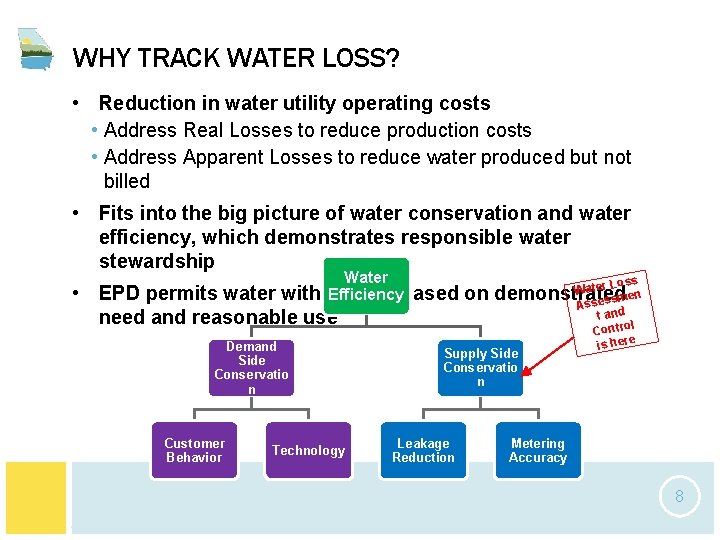
WHY TRACK WATER LOSS? • Reduction in water utility operating costs • Address Real Losses to reduce production costs • Address Apparent Losses to reduce water produced but not billed • Fits into the big picture of water conservation and water efficiency, which demonstrates responsible water stewardship Water withdrawals Efficiencybased • EPD permits water need and reasonable use Demand Side Conservatio n Customer Behavior Technology Loss Water on demonstrated smen Asses Supply Side Conservatio n Leakage Reduction t and l Contro e is her Metering Accuracy 8
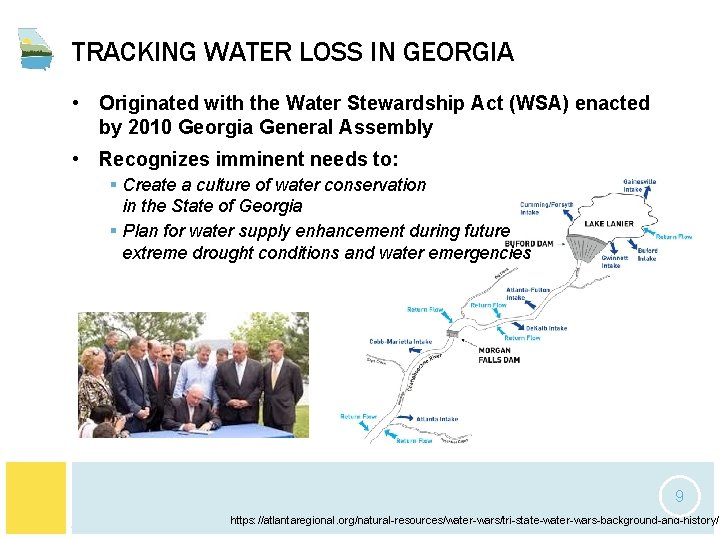
TRACKING WATER LOSS IN GEORGIA • Originated with the Water Stewardship Act (WSA) enacted by 2010 Georgia General Assembly • Recognizes imminent needs to: § Create a culture of water conservation in the State of Georgia § Plan for water supply enhancement during future extreme drought conditions and water emergencies 9 https: //atlantaregional. org/natural-resources/water-wars/tri-state-water-wars-background-and-history/
RULES FOR PUBLIC WATER SYSTEMS TO IMPROVE WATER SUPPLY EFFICIENCY • Georgia Rule 391 -3 -33 enacted to implement WSA • Applies to: • Systems serving >3, 300 individuals • All permit renewals and modifications to increase permitted water withdrawal limits • Requirements Include: • Conduct Annual Water Loss Audits (due March 1) • Development of Water Loss Control Program (as of July 2016) • Development of individual goals to set measures of water supply efficiency (defined by water system) • Demonstration of progress toward improving water supply efficiency 10
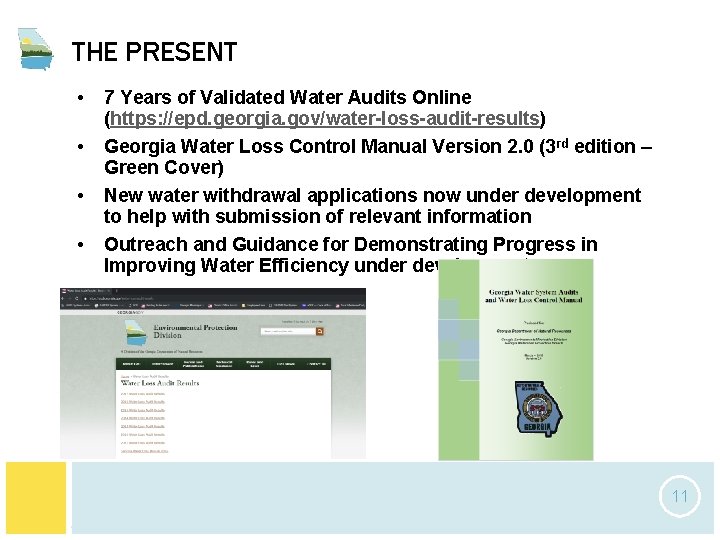
THE PRESENT • 7 Years of Validated Water Audits Online (https: //epd. georgia. gov/water-loss-audit-results) • Georgia Water Loss Control Manual Version 2. 0 (3 rd edition – Green Cover) • New water withdrawal applications now under development to help with submission of relevant information • Outreach and Guidance for Demonstrating Progress in Improving Water Efficiency under development 11
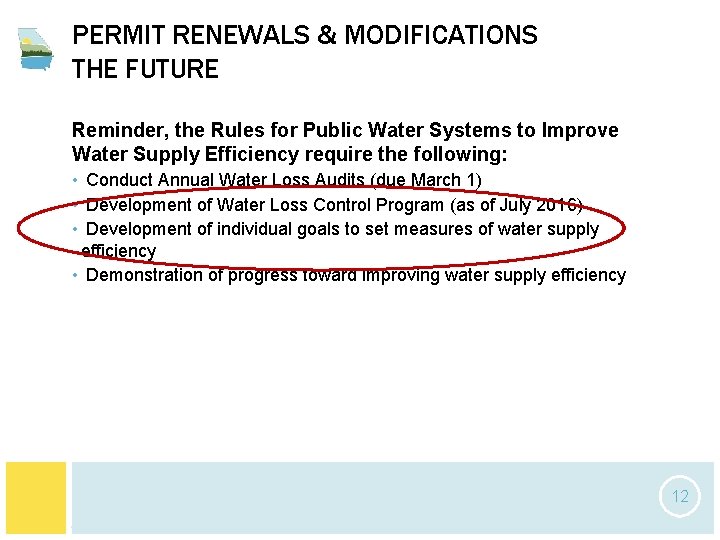
PERMIT RENEWALS & MODIFICATIONS THE FUTURE Reminder, the Rules for Public Water Systems to Improve Water Supply Efficiency require the following: • Conduct Annual Water Loss Audits (due March 1) • Development of Water Loss Control Program (as of July 2016) • Development of individual goals to set measures of water supply efficiency • Demonstration of progress toward improving water supply efficiency 12
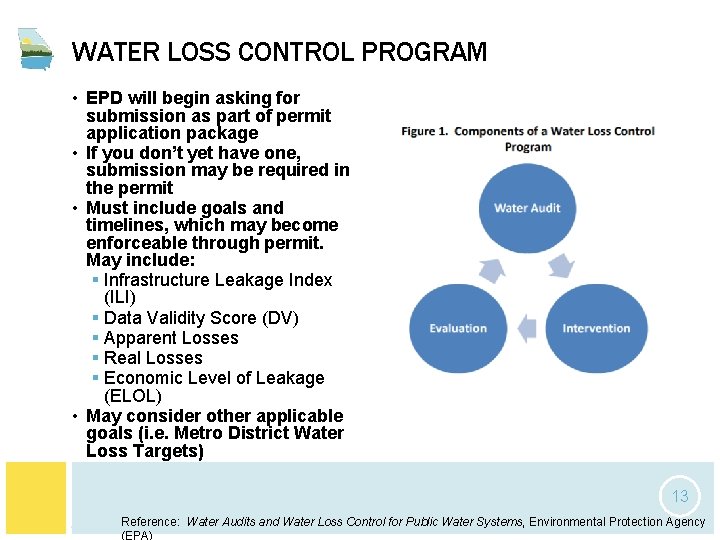
WATER LOSS CONTROL PROGRAM • EPD will begin asking for submission as part of permit application package • If you don’t yet have one, submission may be required in the permit • Must include goals and timelines, which may become enforceable through permit. May include: § Infrastructure Leakage Index (ILI) § Data Validity Score (DV) § Apparent Losses § Real Losses § Economic Level of Leakage (ELOL) • May consider other applicable goals (i. e. Metro District Water Loss Targets) 13 Reference: Water Audits and Water Loss Control for Public Water Systems, Environmental Protection Agency
PERMIT RENEWALS & MODIFICATIONS THE FUTURE Reminder, the Rules for Public Water Systems to Improve Water Supply Efficiency require the following: • Conduct Annual Water Loss Audits (due March 1) • Development of Water Loss Control Program (as of July 2016) • Development of individual goals to set measures of water supply efficiency • Demonstration of progress toward improving water supply efficiency 14
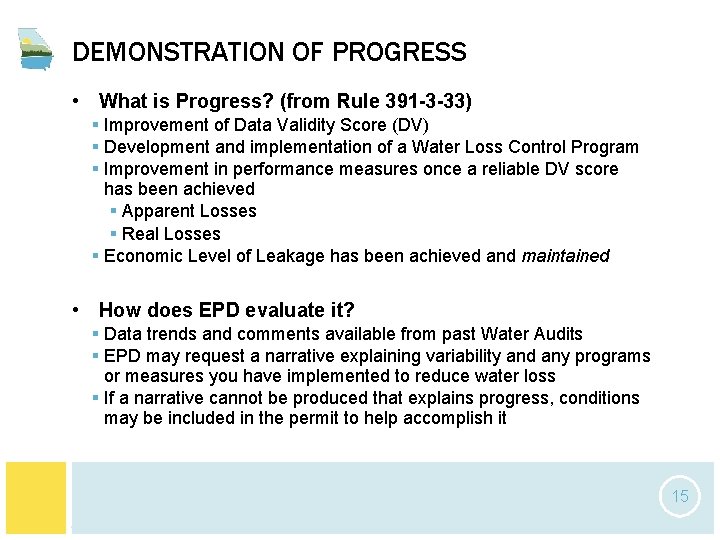
DEMONSTRATION OF PROGRESS • What is Progress? (from Rule 391 -3 -33) § Improvement of Data Validity Score (DV) § Development and implementation of a Water Loss Control Program § Improvement in performance measures once a reliable DV score has been achieved § Apparent Losses § Real Losses § Economic Level of Leakage has been achieved and maintained • How does EPD evaluate it? § Data trends and comments available from past Water Audits § EPD may request a narrative explaining variability and any programs or measures you have implemented to reduce water loss § If a narrative cannot be produced that explains progress, conditions may be included in the permit to help accomplish it 15
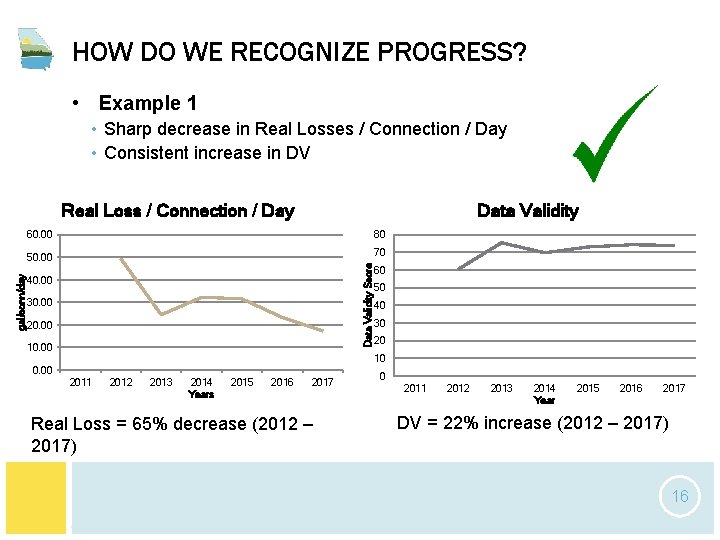
HOW DO WE RECOGNIZE PROGRESS? • Example 1 • Sharp decrease in Real Losses / Connection / Day • Consistent increase in DV Data Validity 60. 00 80 50. 00 70 Data Validity Score gal/conn/day Real Loss / Connection / Day 40. 00 30. 00 20. 00 10. 00 60 50 40 30 20 10 0. 00 2011 2012 2013 2014 Years 2015 2016 2017 Real Loss = 65% decrease (2012 – 2017) 0 2011 2012 2013 2014 Year 2015 2016 2017 DV = 22% increase (2012 – 2017) 16
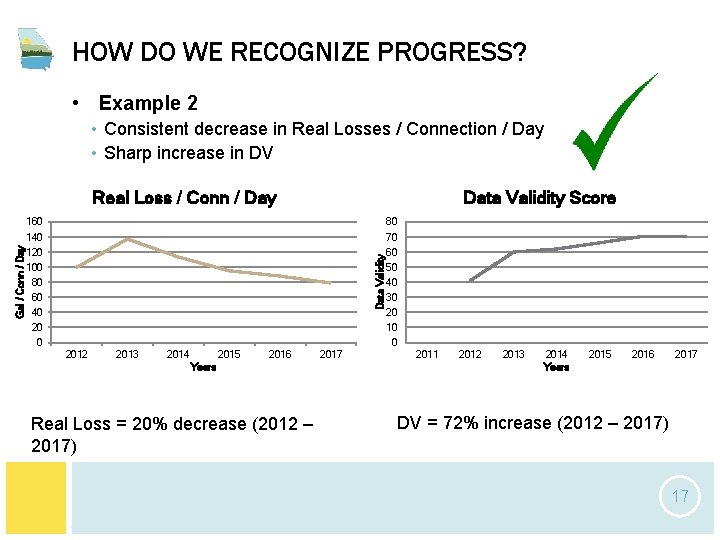
HOW DO WE RECOGNIZE PROGRESS? • Example 2 • Consistent decrease in Real Losses / Connection / Day • Sharp increase in DV Data Validity Score 160 80 140 70 120 60 Data Validity Gal / Conn / Day Real Loss / Conn / Day 100 80 60 40 20 50 40 30 20 10 0 0 2012 2013 2014 2015 2016 Years Real Loss = 20% decrease (2012 – 2017) 2017 2011 2012 2013 2014 Years 2015 2016 2017 DV = 72% increase (2012 – 2017) 17
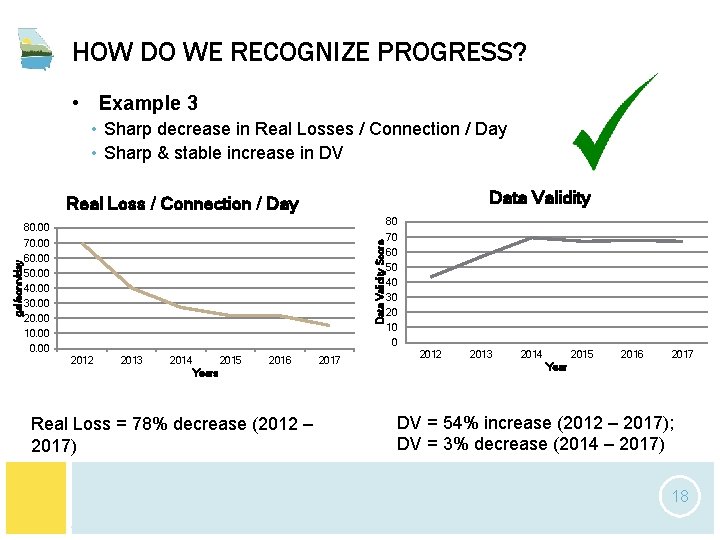
HOW DO WE RECOGNIZE PROGRESS? • Example 3 • Sharp decrease in Real Losses / Connection / Day • Sharp & stable increase in DV Data Validity Real Loss / Connection / Day 80 80. 00 Data Validity Score gal/conn/day 70. 00 60. 00 50. 00 40. 00 30. 00 20. 00 10. 00 70 60 50 40 30 20 10 0 0. 00 2012 2013 2014 2015 2016 Years Real Loss = 78% decrease (2012 – 2017) 2017 2012 2013 2014 2015 2016 2017 Year DV = 54% increase (2012 – 2017); DV = 3% decrease (2014 – 2017) 18
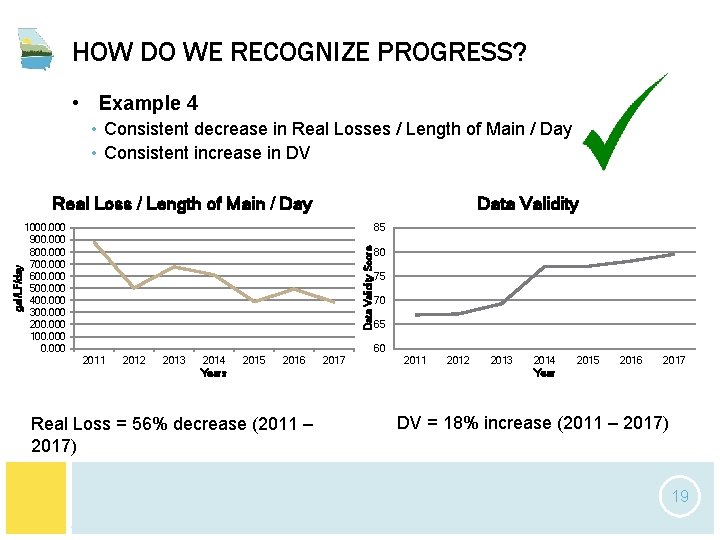
HOW DO WE RECOGNIZE PROGRESS? • Example 4 • Consistent decrease in Real Losses / Length of Main / Day • Consistent increase in DV Data Validity 1000. 000 900. 000 800. 000 700. 000 600. 000 500. 000 400. 000 300. 000 200. 000 100. 000 85 Data Validity Score gal/LF/day Real Loss / Length of Main / Day 80 75 70 65 60 2011 2012 2013 2014 Years 2015 2016 Real Loss = 56% decrease (2011 – 2017) 2017 2011 2012 2013 2014 Year 2015 2016 2017 DV = 18% increase (2011 – 2017) 19
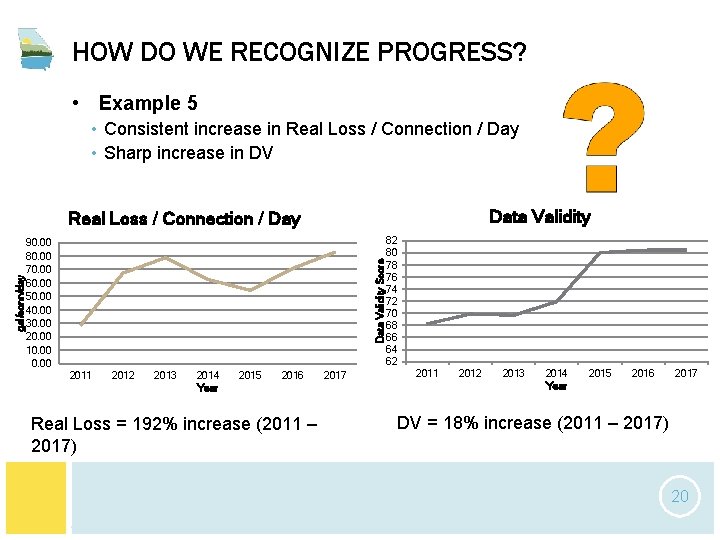
HOW DO WE RECOGNIZE PROGRESS? • Example 5 • Consistent increase in Real Loss / Connection / Day • Sharp increase in DV Data Validity 90. 00 80. 00 70. 00 60. 00 50. 00 40. 00 30. 00 20. 00 10. 00 Data Validity Score gal/conn/day Real Loss / Connection / Day 2011 2012 2013 2014 Year 2015 2016 Real Loss = 192% increase (2011 – 2017) 2017 82 80 78 76 74 72 70 68 66 64 62 2011 2012 2013 2014 Year 2015 2016 2017 DV = 18% increase (2011 – 2017) 20
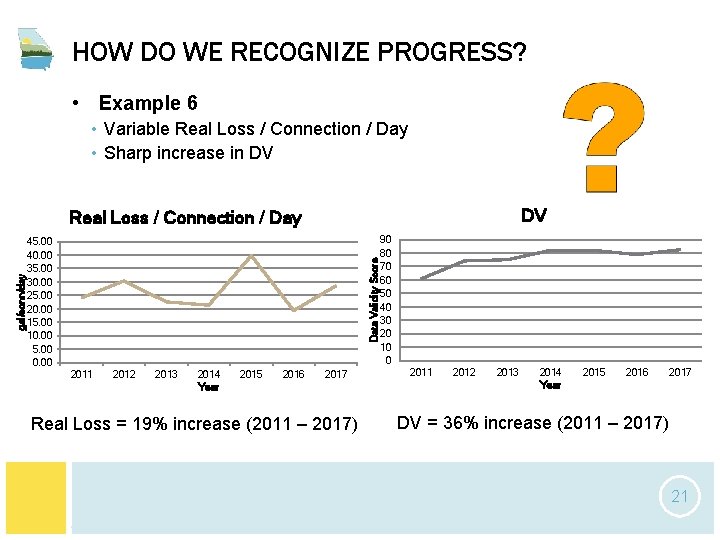
HOW DO WE RECOGNIZE PROGRESS? • Example 6 • Variable Real Loss / Connection / Day • Sharp increase in DV DV 45. 00 40. 00 35. 00 30. 00 25. 00 20. 00 15. 00 10. 00 5. 00 0. 00 Data Validity Score gal/conn/day Real Loss / Connection / Day 2011 2012 2013 2014 Year 2015 2016 2017 Real Loss = 19% increase (2011 – 2017) 90 80 70 60 50 40 30 20 10 0 2011 2012 2013 2014 Year 2015 2016 2017 DV = 36% increase (2011 – 2017) 21
RESOURCES • Georgia Water Loss Control Manual http: //epd. georgia. gov/sites/epd. georgia. gov/files/related_files/site_pag e/GA%20 Water%20 Loss%20 Manual%20 V 2. 0_Final_3 -1518%20 Update. pdf • American Water Works Association Water Loss Control Resources https: //www. awwa. org/Resources-Tools/Resources/Water-Loss-Control • Water Research Foundation Leakage Component Analysis Tools http: //www. waterrf. org/Pages/Projects. aspx? PID=4372 • Georgia Association of Water Professionals (GAWP) Water Loss Auditing Guidance https: //gawp. site-ym. com/page/Water. Loss. Audits • Georgia Rural Water Association (GRWA) Water Loss Technical Assistance Program http: //www. grwa. org/news. cfm? id=6146 • Water Audits and Water Loss Control for Public Water Systems (EPA) https: //www. epa. gov/sites/production/files/201504/documents/epa 816 f 13002. pdf 22
RESOURCES GAWP Advanced Water Loss Control Workshop May 21, 2019, 10: 00 AM – 3: 30 PM GAWP Headquarters – Greene Room § Interpreting Audits Results / Next Steps § Understanding Components of Real and Apparent Losses § Tools Available § Leakage Component Analysis (LCA) Model § Data Needed for LCA Tool § Utility Case Studies Register by May 19, 2019 23
QUESTIONS? Johanna Smith Surface Water Unit Manager Water Supply Program Wei Zeng Water Supply Program Manager Phone: 404 -656 -6937 Email: Johanna. Smith@dnr. ga. gov Phone: 404 -463 -2883 Email: Wei. Zeng@dnr. ga. gov Bill Frechette Groundwater Unit Manager Water Supply Program Tim Cash Water Supply Program Phone: 404 -656 -6937 Email: Bill. Frechette@dnr. ga. gov Phone: 404 -463 -3948 Email: Tim. Cash@dnr. ga. gov 24