
Demonstrate Data Protection by Design for IT Systems
Demonstrate Data Protection by Design for IT Systems Claiming to take privacy seriously isn’t enough; it’s time to show your work. Info-Tech Research Group Inc. is a global leader in providing IT research and advice. Info-Tech’s products and services combine actionable insight and relevant advice with ready-to-use tools and templates that cover the full spectrum of IT concerns. © 1997 -2019 Info-Tech Research Group Inc. Info-Tech Research Group 1
ANALYST PERSPECTIVE Privacy now! No excuses. Organizations – especially small and medium-sized businesses – often struggle to demonstrate their privacy controls to stakeholders in a tangible way. Because these organizations rarely have the resources for a dedicated privacy program, sometimes they opt for nothing. However, there is a third option between a full privacy program and no program at all: you can start implementing the principles of data protection by design. While using the data protection by design framework is not the same thing as having a full privacy program, incorporating that framework into your IT system rollout lays the foundation for a larger program to develop. The important thing, though, is to keep a record of the controls you’re using to achieve the principles of data protection by design. This should be a detailed document, not just a checklist. Logan Rohde, Research Specialist, Security, Risk, and Compliance Info-Tech Research Group 2
Our understanding of the problem This Research Is is Designed For: This Research Will Help You: üPrivacy Officer üUnderstand data protection by design. üAppreciate the relationship and difference between data protection by design and privacy by design. üAccount for privacy controls in IT systems. This Research Will Also Assist: This Research Will Help Them: You: üCISO üSecurity Architect üCIO üIT Managers üIT Directors üSystems Architects üOther IT personnel involved in systems design üImplement data protection by design for new and existing IT systems Info-Tech Research Group 3
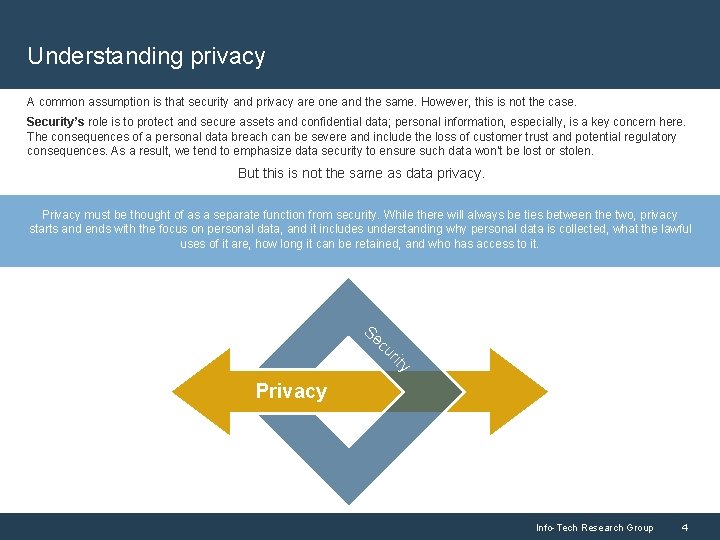
Understanding privacy A common assumption is that security and privacy are one and the same. However, this is not the case. Security’s role is to protect and secure assets and confidential data; personal information, especially, is a key concern here. The consequences of a personal data breach can be severe and include the loss of customer trust and potential regulatory consequences. As a result, we tend to emphasize data security to ensure such data won’t be lost or stolen. But this is not the same as data privacy. Privacy must be thought of as a separate function from security. While there will always be ties between the two, privacy starts and ends with the focus on personal data, and it includes understanding why personal data is collected, what the lawful uses of it are, how long it can be retained, and who has access to it. Se cu rit y Privacy Info-Tech Research Group 4
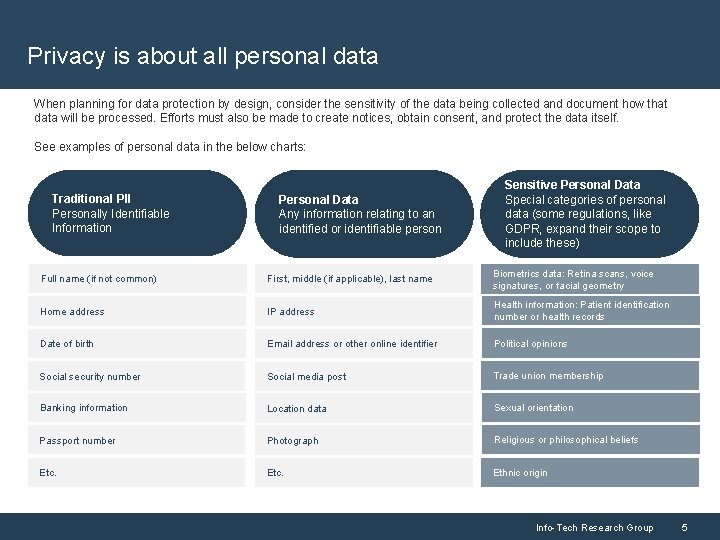
Privacy is about all personal data When planning for data protection by design, consider the sensitivity of the data being collected and document how that data will be processed. Efforts must also be made to create notices, obtain consent, and protect the data itself. See examples of personal data in the below charts: Traditional PII Personally Identifiable Information Personal Data Any information relating to an identified or identifiable person Sensitive Personal Data Special categories of personal data (some regulations, like GDPR, expand their scope to include these) Full name (if not common) First, middle (if applicable), last name Biometrics data: Retina scans, voice signatures, or facial geometry Home address IP address Health information: Patient identification number or health records Date of birth Email address or other online identifier Political opinions Social security number Social media post Trade union membership Banking information Location data Sexual orientation Passport number Photograph Religious or philosophical beliefs Etc. Ethnic origin Info-Tech Research Group 5
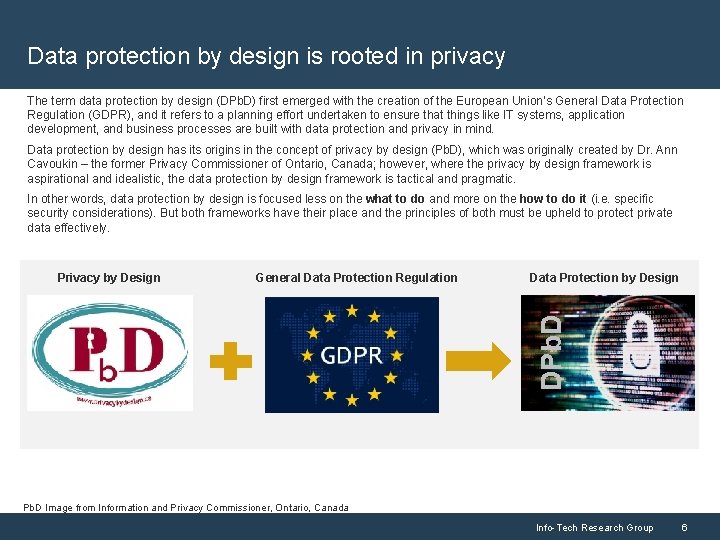
Data protection by design is rooted in privacy The term data protection by design (DPb. D) first emerged with the creation of the European Union’s General Data Protection Regulation (GDPR), and it refers to a planning effort undertaken to ensure that things like IT systems, application development, and business processes are built with data protection and privacy in mind. Data protection by design has its origins in the concept of privacy by design (Pb. D), which was originally created by Dr. Ann Cavoukin – the former Privacy Commissioner of Ontario, Canada; however, where the privacy by design framework is aspirational and idealistic, the data protection by design framework is tactical and pragmatic. In other words, data protection by design is focused less on the what to do and more on the how to do it (i. e. specific security considerations). But both frameworks have their place and the principles of both must be upheld to protect private data effectively. General Data Protection Regulation Data Protection by Design DPb. D Privacy by Design Pb. D Image from Information and Privacy Commissioner, Ontario, Canada Info-Tech Research Group 6
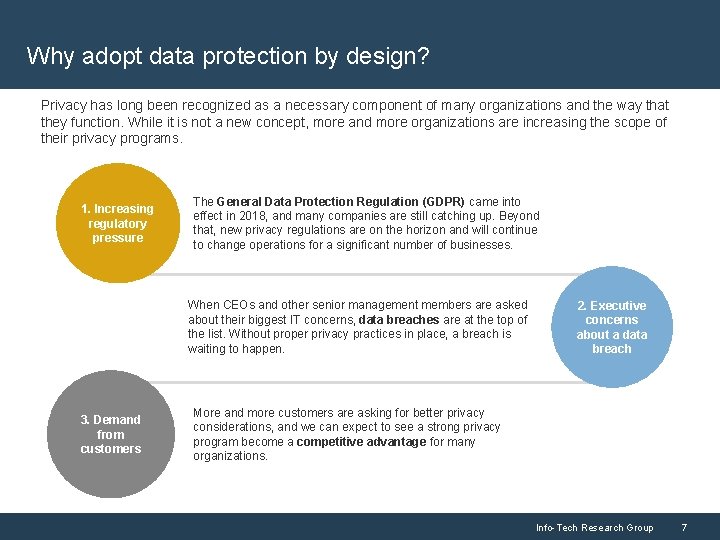
Why adopt data protection by design? Privacy has long been recognized as a necessary component of many organizations and the way that they function. While it is not a new concept, more and more organizations are increasing the scope of their privacy programs. 1. Increasing regulatory pressure The General Data Protection Regulation (GDPR) came into effect in 2018, and many companies are still catching up. Beyond that, new privacy regulations are on the horizon and will continue to change operations for a significant number of businesses. When CEOs and other senior management members are asked about their biggest IT concerns, data breaches are at the top of the list. Without proper privacy practices in place, a breach is waiting to happen. 3. Demand from customers 2. Executive concerns about a data breach More and more customers are asking for better privacy considerations, and we can expect to see a strong privacy program become a competitive advantage for many organizations. Info-Tech Research Group 7
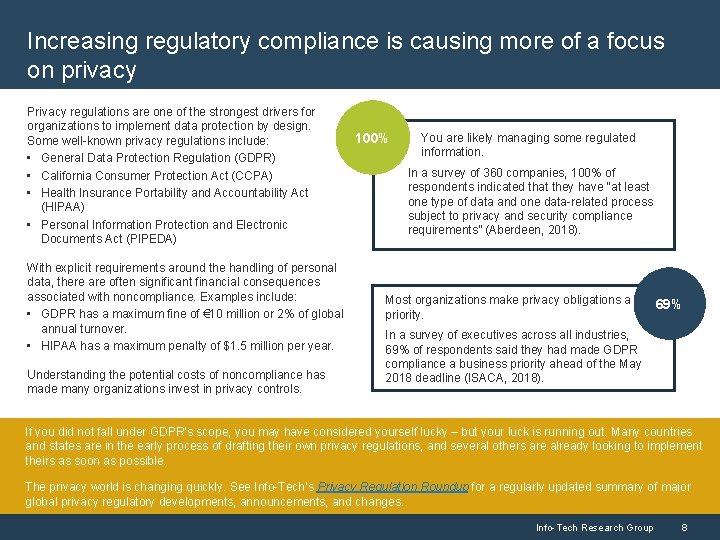
Increasing regulatory compliance is causing more of a focus on privacy Privacy regulations are one of the strongest drivers for organizations to implement data protection by design. Some well-known privacy regulations include: • General Data Protection Regulation (GDPR) • California Consumer Protection Act (CCPA) • Health Insurance Portability and Accountability Act (HIPAA) • Personal Information Protection and Electronic Documents Act (PIPEDA) With explicit requirements around the handling of personal data, there are often significant financial consequences associated with noncompliance. Examples include: • GDPR has a maximum fine of € 10 million or 2% of global annual turnover. • HIPAA has a maximum penalty of $1. 5 million per year. Understanding the potential costs of noncompliance has made many organizations invest in privacy controls. 100% You are likely managing some regulated information. In a survey of 360 companies, 100% of respondents indicated that they have “at least one type of data and one data-related process subject to privacy and security compliance requirements” (Aberdeen, 2018). Most organizations make privacy obligations a priority. 69% In a survey of executives across all industries, 69% of respondents said they had made GDPR compliance a business priority ahead of the May 2018 deadline (ISACA, 2018). If you did not fall under GDPR’s scope, you may have considered yourself lucky – but your luck is running out. Many countries and states are in the early process of drafting their own privacy regulations, and several others are already looking to implement theirs as soon as possible. The privacy world is changing quickly. See Info-Tech’s Privacy Regulation Roundup for a regularly updated summary of major global privacy regulatory developments, announcements, and changes. Info-Tech Research Group 8
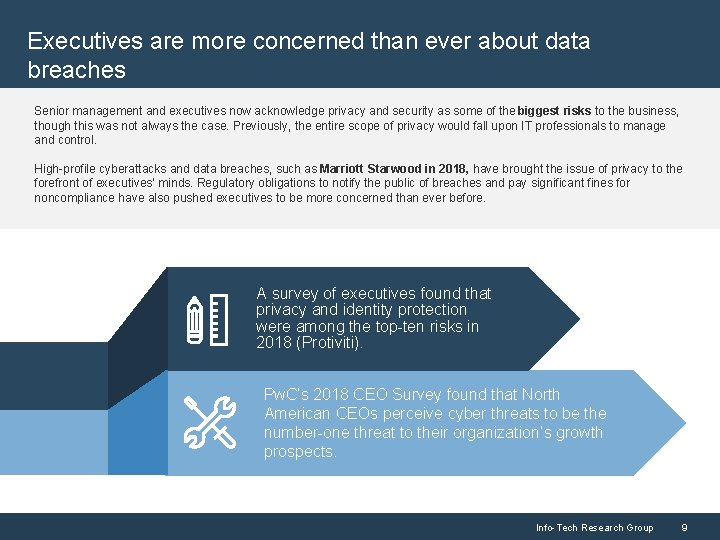
Executives are more concerned than ever about data breaches Senior management and executives now acknowledge privacy and security as some of the biggest risks to the business, though this was not always the case. Previously, the entire scope of privacy would fall upon IT professionals to manage and control. High-profile cyberattacks and data breaches, such as Marriott Starwood in 2018, have brought the issue of privacy to the forefront of executives’ minds. Regulatory obligations to notify the public of breaches and pay significant fines for noncompliance have also pushed executives to be more concerned than ever before. A survey of executives found that privacy and identity protection were among the top-ten risks in 2018 (Protiviti). Pw. C’s 2018 CEO Survey found that North American CEOs perceive cyber threats to be the number-one threat to their organization’s growth prospects. Info-Tech Research Group 9
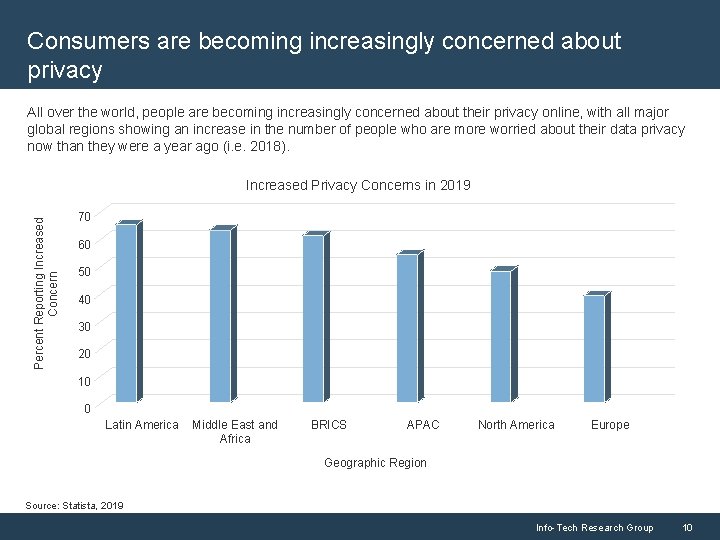
Consumers are becoming increasingly concerned about privacy All over the world, people are becoming increasingly concerned about their privacy online, with all major global regions showing an increase in the number of people who are more worried about their data privacy now than they were a year ago (i. e. 2018). Percent Reporting Increased Concern Increased Privacy Concerns in 2019 70 60 50 40 30 20 10 0 Latin America Middle East and Africa BRICS APAC North America Europe Geographic Region Source: Statista, 2019 Info-Tech Research Group 10
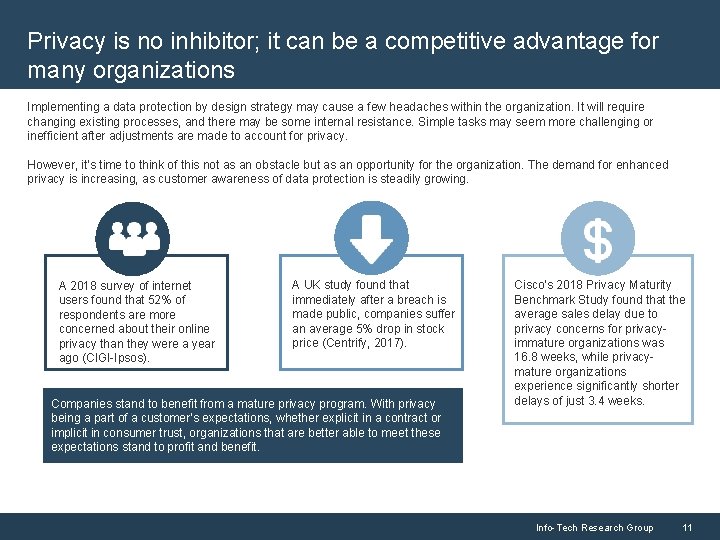
Privacy is no inhibitor; it can be a competitive advantage for many organizations Implementing a data protection by design strategy may cause a few headaches within the organization. It will require changing existing processes, and there may be some internal resistance. Simple tasks may seem more challenging or inefficient after adjustments are made to account for privacy. However, it’s time to think of this not as an obstacle but as an opportunity for the organization. The demand for enhanced privacy is increasing, as customer awareness of data protection is steadily growing. A 2018 survey of internet users found that 52% of respondents are more concerned about their online privacy than they were a year ago (CIGI-Ipsos). A UK study found that immediately after a breach is made public, companies suffer an average 5% drop in stock price (Centrify, 2017). Companies stand to benefit from a mature privacy program. With privacy being a part of a customer’s expectations, whether explicit in a contract or implicit in consumer trust, organizations that are better able to meet these expectations stand to profit and benefit. Cisco’s 2018 Privacy Maturity Benchmark Study found that the average sales delay due to privacy concerns for privacyimmature organizations was 16. 8 weeks, while privacymature organizations experience significantly shorter delays of just 3. 4 weeks. Info-Tech Research Group 11
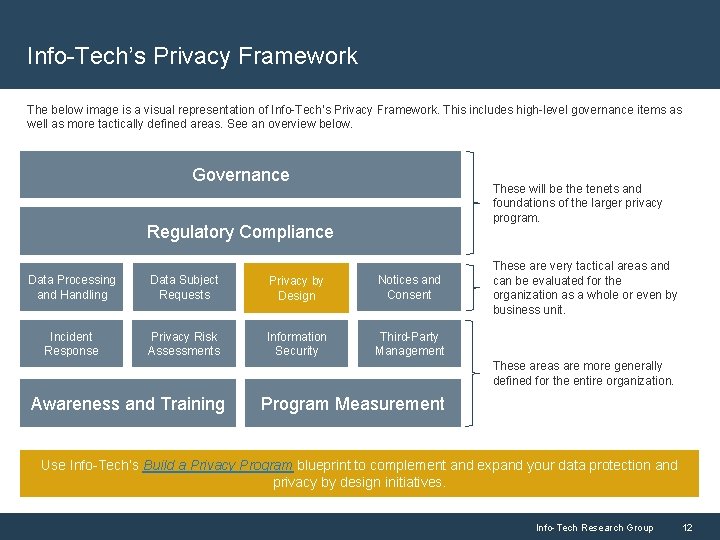
Info-Tech’s Privacy Framework The below image is a visual representation of Info-Tech’s Privacy Framework. This includes high-level governance items as well as more tactically defined areas. See an overview below. Governance These will be the tenets and foundations of the larger privacy program. Regulatory Compliance Data Processing and Handling Data Subject Requests Privacy by Design Notices and Consent Incident Response Privacy Risk Assessments Information Security Third-Party Management These are very tactical areas and can be evaluated for the organization as a whole or even by business unit. These areas are more generally defined for the entire organization. Awareness and Training Program Measurement Use Info-Tech’s Build a Privacy Program blueprint to complement and expand your data protection and privacy by design initiatives. Info-Tech Research Group 12
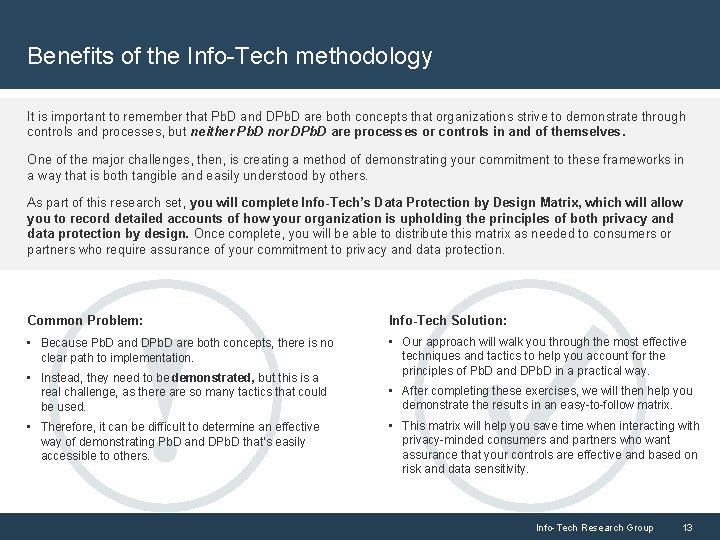
Benefits of the Info-Tech methodology It is important to remember that Pb. D and DPb. D are both concepts that organizations strive to demonstrate through controls and processes, but neither Pb. D nor DPb. D are processes or controls in and of themselves. One of the major challenges, then, is creating a method of demonstrating your commitment to these frameworks in a way that is both tangible and easily understood by others. As part of this research set, you will complete Info-Tech’s Data Protection by Design Matrix, which will allow you to record detailed accounts of how your organization is upholding the principles of both privacy and data protection by design. Once complete, you will be able to distribute this matrix as needed to consumers or partners who require assurance of your commitment to privacy and data protection. Common Problem: Info-Tech Solution: • Because Pb. D and DPb. D are both concepts, there is no clear path to implementation. • Our approach will walk you through the most effective techniques and tactics to help you account for the principles of Pb. D and DPb. D in a practical way. • Instead, they need to be demonstrated, but this is a real challenge, as there are so many tactics that could be used. • Therefore, it can be difficult to determine an effective way of demonstrating Pb. D and DPb. D that’s easily accessible to others. • After completing these exercises, we will then help you demonstrate the results in an easy-to-follow matrix. • This matrix will help you save time when interacting with privacy-minded consumers and partners who want assurance that your controls are effective and based on risk and data sensitivity. Info-Tech Research Group 13
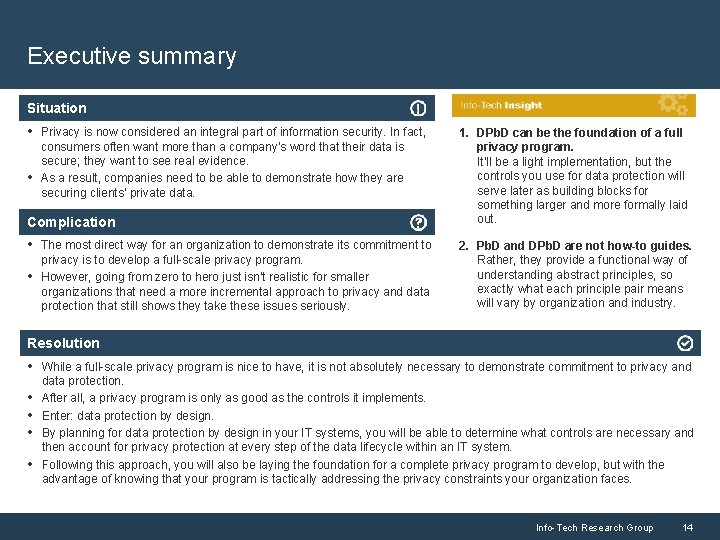
Executive summary Situation • Privacy is now considered an integral part of information security. In fact, • consumers often want more than a company’s word that their data is secure; they want to see real evidence. As a result, companies need to be able to demonstrate how they are securing clients’ private data. Complication • The most direct way for an organization to demonstrate its commitment to • privacy is to develop a full-scale privacy program. However, going from zero to hero just isn’t realistic for smaller organizations that need a more incremental approach to privacy and data protection that still shows they take these issues seriously. 1. DPb. D can be the foundation of a full privacy program. It’ll be a light implementation, but the controls you use for data protection will serve later as building blocks for something larger and more formally laid out. 2. Pb. D and DPb. D are not how-to guides. Rather, they provide a functional way of understanding abstract principles, so exactly what each principle pair means will vary by organization and industry. Resolution • While a full-scale privacy program is nice to have, it is not absolutely necessary to demonstrate commitment to privacy and • • data protection. After all, a privacy program is only as good as the controls it implements. Enter: data protection by design. By planning for data protection by design in your IT systems, you will be able to determine what controls are necessary and then account for privacy protection at every step of the data lifecycle within an IT system. Following this approach, you will also be laying the foundation for a complete privacy program to develop, but with the advantage of knowing that your program is tactically addressing the privacy constraints your organization faces. Info-Tech Research Group 14
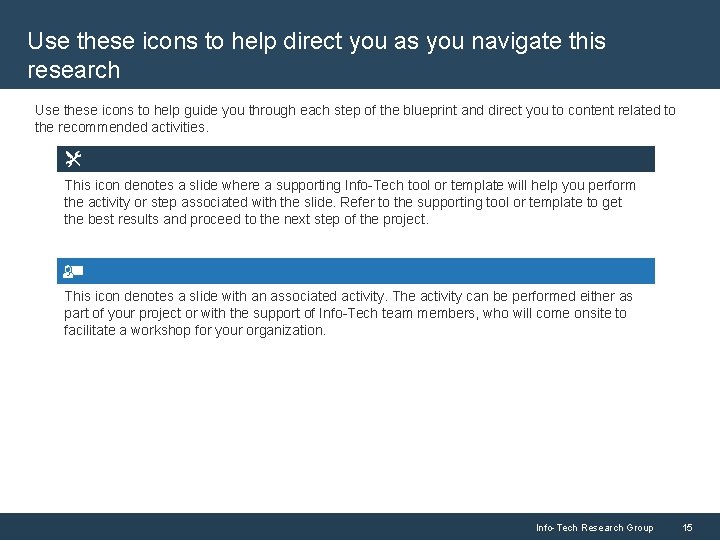
Use these icons to help direct you as you navigate this research Use these icons to help guide you through each step of the blueprint and direct you to content related to the recommended activities. This icon denotes a slide where a supporting Info-Tech tool or template will help you perform the activity or step associated with the slide. Refer to the supporting tool or template to get the best results and proceed to the next step of the project. This icon denotes a slide with an associated activity. The activity can be performed either as part of your project or with the support of Info-Tech team members, who will come onsite to facilitate a workshop for your organization. Info-Tech Research Group 15
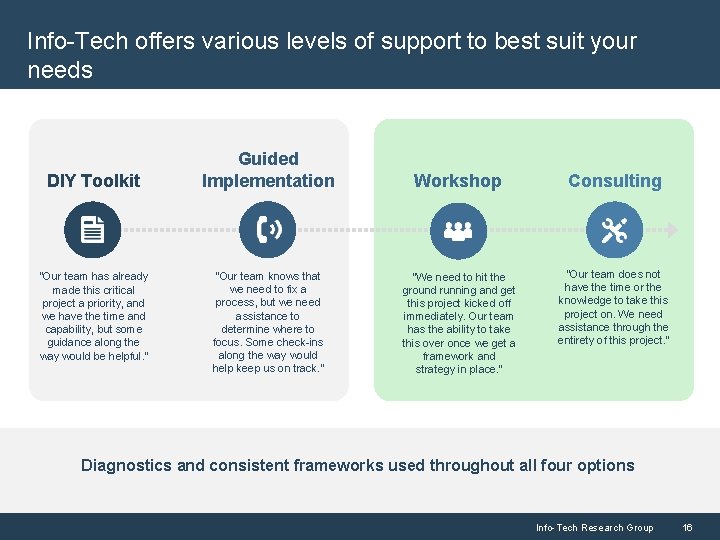
Info-Tech offers various levels of support to best suit your needs DIY Toolkit “Our team has already made this critical project a priority, and we have the time and capability, but some guidance along the way would be helpful. ” Guided Implementation Workshop Consulting “Our team knows that we need to fix a process, but we need assistance to determine where to focus. Some check-ins along the way would help keep us on track. ” “We need to hit the ground running and get this project kicked off immediately. Our team has the ability to take this over once we get a framework and strategy in place. ” “Our team does not have the time or the knowledge to take this project on. We need assistance through the entirety of this project. ” Diagnostics and consistent frameworks used throughout all four options Info-Tech Research Group 16
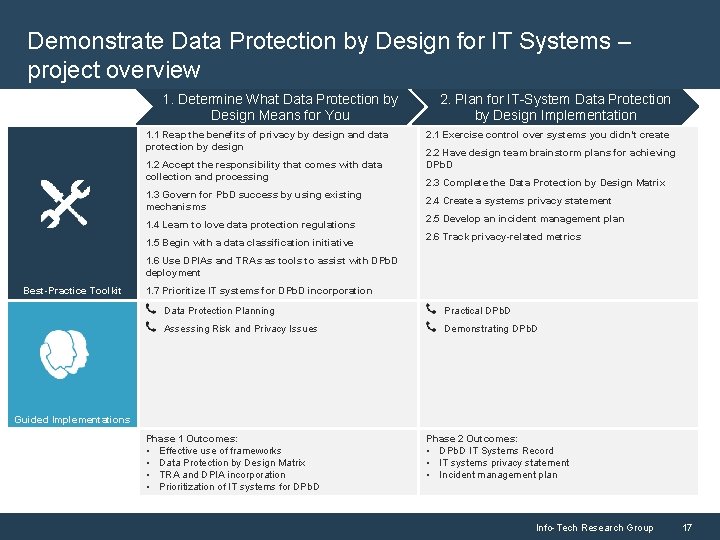
Demonstrate Data Protection by Design for IT Systems – project overview 1. Determine What Data Protection by Design Means for You 1. 1 Reap the benefits of privacy by design and data protection by design 1. 2 Accept the responsibility that comes with data collection and processing 1. 3 Govern for Pb. D success by using existing mechanisms 1. 4 Learn to love data protection regulations 1. 5 Begin with a data classification initiative 2. Plan for IT-System Data Protection by Design Implementation 2. 1 Exercise control over systems you didn’t create 2. 2 Have design team brainstorm plans for achieving DPb. D 2. 3 Complete the Data Protection by Design Matrix 2. 4 Create a systems privacy statement 2. 5 Develop an incident management plan 2. 6 Track privacy-related metrics 1. 6 Use DPIAs and TRAs as tools to assist with DPb. D deployment Best-Practice Toolkit 1. 7 Prioritize IT systems for DPb. D incorporation Data Protection Planning Practical DPb. D Assessing Risk and Privacy Issues Demonstrating DPb. D Guided Implementations Phase 1 Outcomes: • Effective use of frameworks • Data Protection by Design Matrix • TRA and DPIA incorporation • Prioritization of IT systems for DPb. D Phase 2 Outcomes: • DPb. D IT Systems Record • IT systems privacy statement • Incident management plan Info-Tech Research Group 17
- Slides: 17