
DEMONETISATIONASSESSMENT AND APPEAL CA R KRISHNAN FCA DISA


- Slides: 66
DEMONETISATIONASSESSMENT AND APPEAL CA. R. KRISHNAN, FCA, DISA
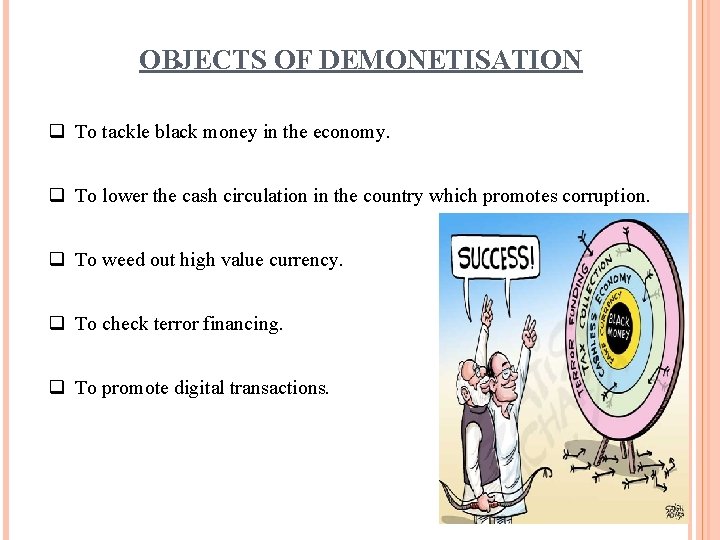
OBJECTS OF DEMONETISATION To tackle black money in the economy. To lower the cash circulation in the country which promotes corruption. To weed out high value currency. To check terror financing. To promote digital transactions.
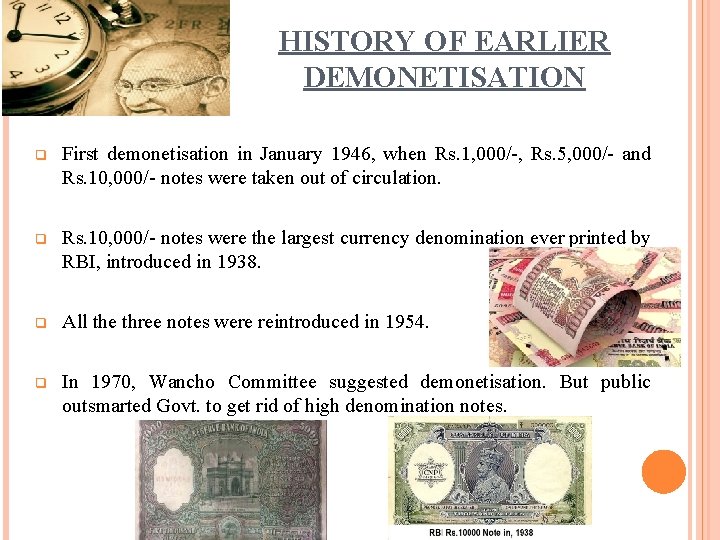
HISTORY OF EARLIER DEMONETISATION First demonetisation in January 1946, when Rs. 1, 000/-, Rs. 5, 000/- and Rs. 10, 000/- notes were taken out of circulation. Rs. 10, 000/- notes were the largest currency denomination ever printed by RBI, introduced in 1938. All the three notes were reintroduced in 1954. In 1970, Wancho Committee suggested demonetisation. But public outsmarted Govt. to get rid of high denomination notes.
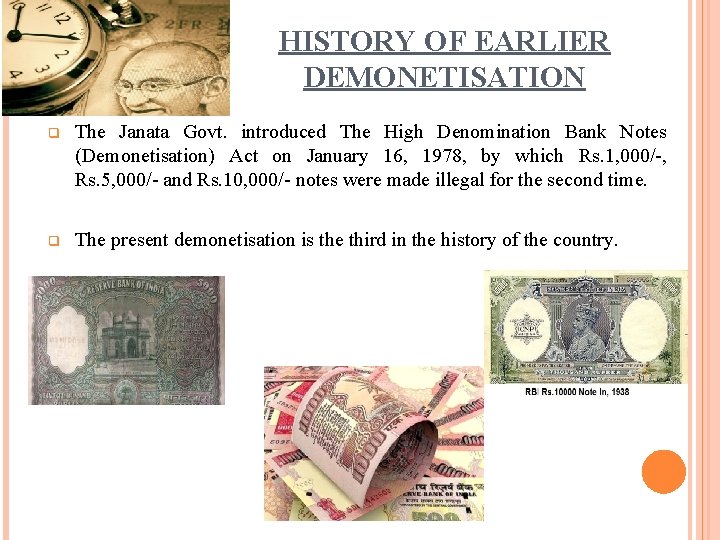
HISTORY OF EARLIER DEMONETISATION The Janata Govt. introduced The High Denomination Bank Notes (Demonetisation) Act on January 16, 1978, by which Rs. 1, 000/-, Rs. 5, 000/- and Rs. 10, 000/- notes were made illegal for the second time. The present demonetisation is the third in the history of the country.
CASH DEPOSIT IN BANK ACCOUNT. Taxing provisions: Section 68 - Cash credit Section 69 - Unexplained Investments Section 69 A Unexplained Money etc.
SECTION 68 - CASH CREDIT
INGREDIENTS OF SECTION 68: 1. Any sum found credited in the books of an assessee 2. Assessee offers no explanation about the nature & source thereof, or 3. Explanation offered is not satisfactory in the opinion of the AO Consequences: The sum so credited may be charged as income of the assessee for that P. Y. (year in which it is found credited)
ONUS LIES ON ASSESSEE TO PROVE THE FOLLOWING: a) b) c) The identity of the creditor is established; The capacity/creditworthiness of the creditor is beyond doubt; The transaction is genuine. Once an assessee proves the identity, creditworthiness and genuineness of the creditor, the onus shifts on the AO
AO TO CONDUCT PROPER ENQUIRIES BEFORE MAKING ANY ADDITION… CIT Vs. United Commercial and Industrial Co. (Pvt. ) Ltd. (1991) 187 ITR 596 (Cal) CIT vs. Precision Finance Pvt. Ltd. (1994) 208 ITR 465 (Cal) Korlay Trading Co. , . Ltd. (1998) 232 ITR 820 (Cal). CIT vs. Metachem Industries (2000) 245 ITR 160 (MP) Kamal Motors v. CIT [2003] 131 Taxman 155 (Raj. ). CIT vs. Oasis Hospitalities Pvt. Ltd. , 333 ITR 119 (Delhi)(2011). CIT v. R. S. Rathore [1995] 212 ITR 390 (Raj. ), Life Insurance Corporation of India vs. CIT (1996) 219 ITR 410 (SC)
SOURCE OF SOURCE NEED NOT BE PROVED BY THE ASSESSEE: DCIT v Rohini Builders (2002) 256 ITR 360 (Guj) Hastimal v. CIT 49 ITR 273 (Mad. ) Tolaram Daga v. CIT 59 ITR 632 (Assam) Nemichand kothari v. CIT 264 ITR 254 (Gau. ) Murlidhar Lahorimal v. CIT 280 ITR 512 (Guj. )
SECTION 69 UNEXPLAINED INVESTMENTS
INGREDIENTS OF SECTION 69 • There should have been investments made by assessee • Such Investments are not recorded in Accounts (if any) books of • assesseeoffers no explanation about the nature and source of the investments, or • explanation offered by him is not satisfactory, in the opinion of the Assessing Officer. Consequences: The value of the investments may be deemed to be the income of the assessee of such financial year (year in which investment are made)
SECTION 69 AUNEXPLAINED MONEY, ETC.
INGREDIENTS OF SEC. 69 A • Assessee found to be owner of any money, bullion, jewellery or other valuable article, • Such assets are not recorded in books of accounts(if any) • The assessee offers no explanation about the nature and source of acquisition or • Explanation offered is not Satisfactory in the opinion of AO Consequences: The value of the such asset may be deemed the income of the assessee of such financial. to be
SECTION 69 BAMOUNT OF INVESTMENTS, ETC. NOT FULLY DISCLOSED IN BOOKS OF ACCOUNTS
INGREDIENTS OF SEC. 69 B • This section is similar to Section 69 & Section 69 A. • As per this section, if assessee is found to be owner of any investment, bullion, jewellery or other valuable article in excess of what has been disclosed in Books of Accounts, then such excess value of the specified assets will be deemed as income of the assessee 16
SECTION 69 CUNEXPLAINED EXPENDITURE, ETC.
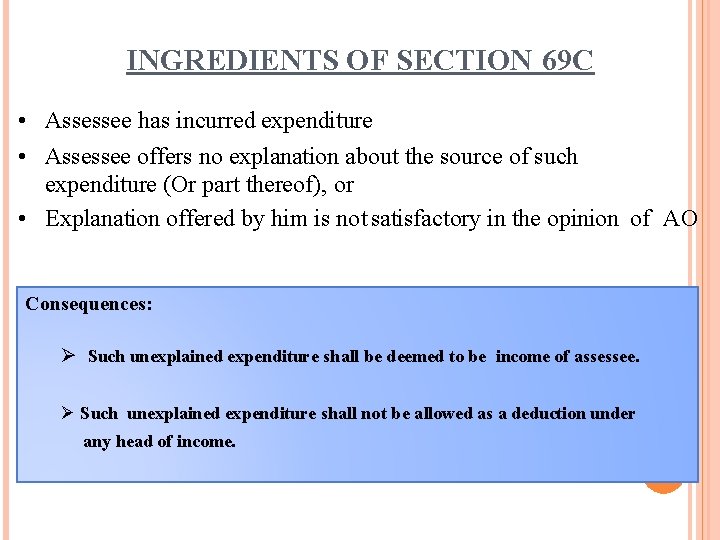
INGREDIENTS OF SECTION 69 C • Assessee has incurred expenditure • Assessee offers no explanation about the source of such expenditure (Or part thereof), or • Explanation offered by him is not satisfactory in the opinion of AO Consequences: Such unexplained expenditure shall be deemed to be income of assessee. Such unexplained expenditure shall not be allowed as a deduction under any head of income.
AMENDMENTS IN THE ACT
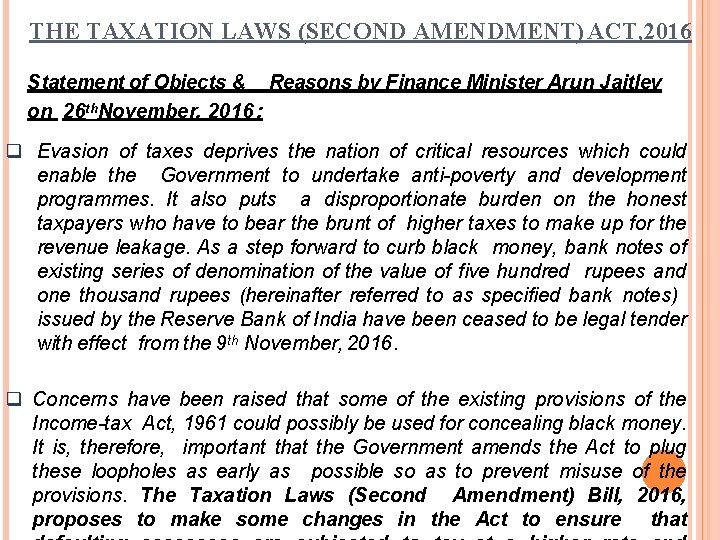
THE TAXATION LAWS (SECOND AMENDMENT) ACT, 2016 Statement of Objects & Reasons by Finance Minister Arun Jaitley on 26 th. November, 2016 : Evasion of taxes deprives the nation of critical resources which could enable the Government to undertake anti-poverty and development programmes. It also puts a disproportionate burden on the honest taxpayers who have to bear the brunt of higher taxes to make up for the revenue leakage. As a step forward to curb black money, bank notes of existing series of denomination of the value of five hundred rupees and one thousand rupees (hereinafter referred to as specified bank notes) issued by the Reserve Bank of India have been ceased to be legal tender with effect from the 9 th November, 2016. Concerns have been raised that some of the existing provisions of the Income-tax Act, 1961 could possibly be used for concealing black money. It is, therefore, important that the Government amends the Act to plug these loopholes as early as possible so as to prevent misuse of the provisions. The Taxation Laws (Second Amendment) Bill, 2016, proposes to make some changes in the Act to ensure that
SECTION 115 BBETAXATION OF DEEMED INCOME U/S. 68 -69 D
TAXATION The Taxation Laws (Second Amendment) Act, 2016 • Tax on income referred to in section 68, 69 A, 69 B, 69 C or 69 D whether included in ROI or added by AO – tax rate 60% (from 30%) • Finance Act 2017 provides for a surcharge on such income at 25% of tax. • Effective rate becomes 75. 00% + Cess( upto AY 2018 -19 – 3%) ( from AY 2019 -20 - 4%)
TAXATION Amendment to Section 115 BBE by The Taxation Laws (Second Amendment) Act, 2016 Whether applicable for entire F. Y. 2016 -17? • Legislations which modified accrued rights or which impose obligations or impose new duties or attach a new disability have to be treated as prospective unless the legislative intent is clearly to give the enactment a retrospective effect; unless the legislation is for purpose of supplying an obvious omission in a former legislation or to explain a former legislation. -CIT v. Vatika Township (P. ) Ltd. [2014] 367 ITR 466 (SC).
Assurances given by Officials Immediately after demonetisation, an assurance was given by the Government that cash deposit upto Rs. 2, 50, 000/- shall not be inquired in the cases of small businessman, housewives, artist, labour, etc. through advertisements and media. Thereafter, Hon’ble Prime minister on 12/11/2016 made a public announcement that deposit of notes upto Rs. 2, 50, 000/- made by married woman will not be subject to any sort of inquiries. But, no official circular was issued in this regard. Representation was made by CTC on 14/11/2016 requesting to clarify this issue by way of Circular. No Circular is issued clarifying the same. Instead we have amendment which does not have any threshold limit. Even small amount of Rs. 50, 000/- can be covered u/s 115 BBE. 7
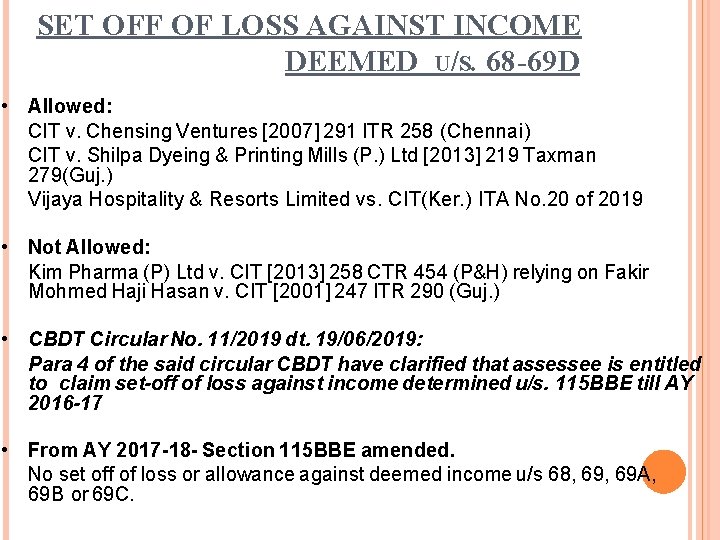
SET OFF OF LOSS AGAINST INCOME DEEMED U/S. 68 -69 D • Allowed: CIT v. Chensing Ventures [2007] 291 ITR 258 (Chennai) CIT v. Shilpa Dyeing & Printing Mills (P. ) Ltd [2013] 219 Taxman 279(Guj. ) Vijaya Hospitality & Resorts Limited vs. CIT(Ker. ) ITA No. 20 of 2019 • Not Allowed: Kim Pharma (P) Ltd v. CIT [2013] 258 CTR 454 (P&H) relying on Fakir Mohmed Haji Hasan v. CIT [2001] 247 ITR 290 (Guj. ) • CBDT Circular No. 11/2019 dt. 19/06/2019: Para 4 of the said circular CBDT have clarified that assessee is entitled to claim set-off of loss against income determined u/s. 115 BBE till AY 2016 -17 • From AY 2017 -18 - Section 115 BBE amended. No set off of loss or allowance against deemed income u/s 68, 69 A, 69 B or 69 C.
OTHER TAX IMPLICATIONS • The following would also be other implications of deemed income u/s. 68 -69 D: (1) no deduction in respect of any expenditure, (2) no deduction in respect of any allowance, (3) no set-off of any losses, against such deemed income
PENAL PROVISIONS
SECTION 271 AAC
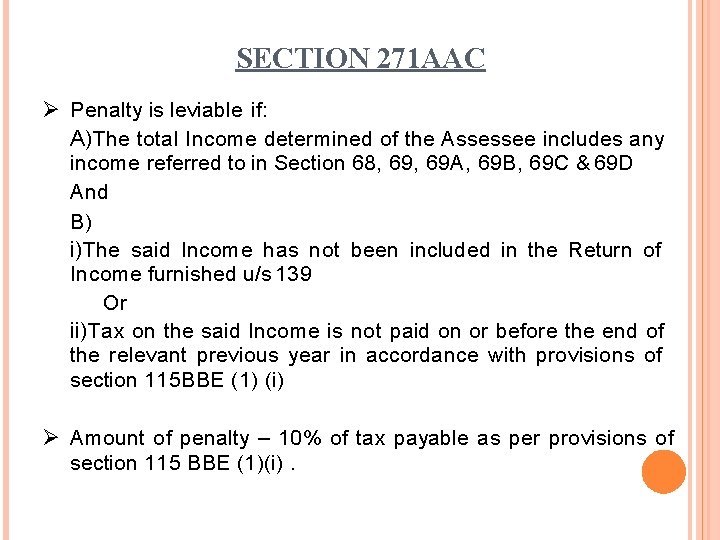
SECTION 271 AAC Penalty is leviable if: A)The total Income determined of the Assessee includes any income referred to in Section 68, 69 A, 69 B, 69 C & 69 D And B) i)The said Income has not been included in the Return of Income furnished u/s 139 Or ii)Tax on the said Income is not paid on or before the end of the relevant previous year in accordance with provisions of section 115 BBE (1) (i) Amount of penalty – 10% of tax payable as per provisions of section 115 BBE (1)(i).
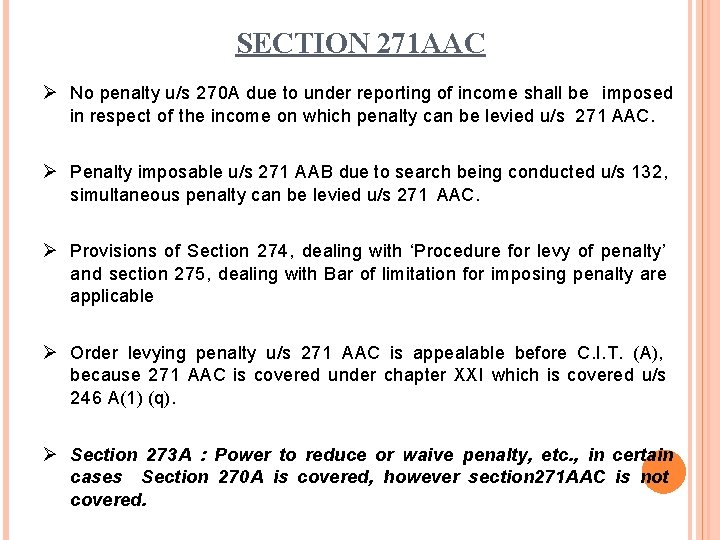
SECTION 271 AAC No penalty u/s 270 A due to under reporting of income shall be imposed in respect of the income on which penalty can be levied u/s 271 AAC. Penalty imposable u/s 271 AAB due to search being conducted u/s 132, simultaneous penalty can be levied u/s 271 AAC. Provisions of Section 274, dealing with ‘Procedure for levy of penalty’ and section 275, dealing with Bar of limitation for imposing penalty are applicable Order levying penalty u/s 271 AAC is appealable before C. I. T. (A), because 271 AAC is covered under chapter XXI which is covered u/s 246 A(1) (q). Section 273 A : Power to reduce or waive penalty, etc. , in certain cases Section 270 A is covered, however section 271 AAC is not covered.
SECTION 271 AAB
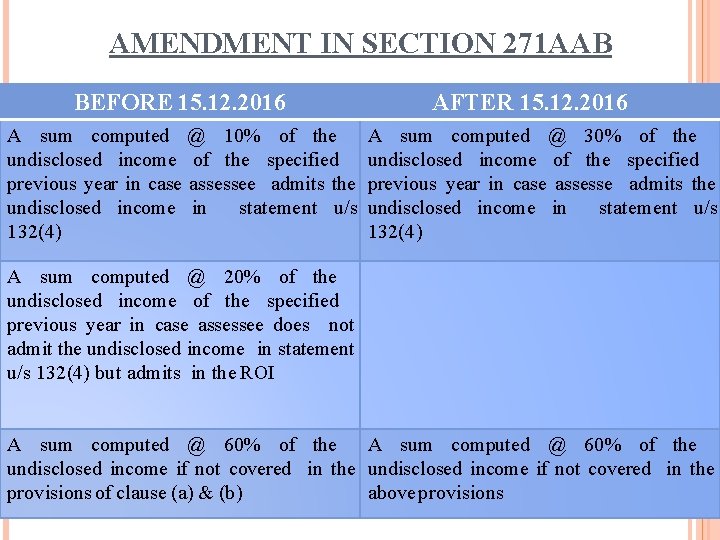
AMENDMENT IN SECTION 271 AAB BEFORE 15. 12. 2016 A sum computed @ 10% of the undisclosed income of the specified previous year in case assessee admits the undisclosed income in statement u/s 132(4) AFTER 15. 12. 2016 A sum computed @ 30% of the undisclosed income of the specified previous year in case assesse admits the undisclosed income in statement u/s 132(4) A sum computed @ 20% of the undisclosed income of the specified previous year in case assessee does not admit the undisclosed income in statement u/s 132(4) but admits in the ROI A sum computed @ 60% of the undisclosed income if not covered in the provisions of clause (a) & (b) above provisions
270 A PENALTY FOR UNDER REPORTED / MISREPORTED INCOME 270 A(1) to 270 A(12)
NOTIFICATION F. NO. 225/391/2017 DATED 24 -11 -2017 • CBDT issues directions for scrutiny assessment in case of revised ITRs filed post DEMONETISATION • Revision of Income-tax return (ITR) is allowed only if any omission or wrong statement is noticed therein by the assessee. Such omission or wrong statement may have occurred due to a bonafide and inadvertent error or a mistake on the part of assessee. • However, post DEMONETISATION period, it was found that some of the assessees tried to build an explanation for cash deposits in their bank accounts by manipulating their books of accounts and filing revised or belated ITRs. • Filing revised or belated ITRs just to build an explanation for cash deposits in bank account becomes questionable and, therefore, the transaction disclosed in it which are over and above the original return are liable to be taxed under anti-abuse provisions of the Income-tax Act.
IT DEPARTMENT CHECKLIST TO TRACE UNACCOUNTED DEMONETISATION CASH Salient Features of Check List All Unaccounted Cash Deposits made between 9 th Nov, 2016 and 31 st Dec, 2016 to be examined If tax paid disputes amount has to be checked with the bank Return filing Compliance TI of Tax payer in 2016 -17 GTI including exempt income of taxpayer in FY 2016 -17 % of tax deposit to GTI ( including exempt income)
Salient Features of Check List AO to look into the nature of deposit after assessing the explanation provided by the tax payer Vis a viz quantum of unaccounted deposit according to AO Verification check point include whether quarterly VAT Return is revised in the post demonetisation period If small part of cash is deposited in or withdrawn from the bank despite having huge cash in hand.
Salient Features of Check List If there is large change in the purchases and sales figures betweeen original &n revised returns, the changes are for genuine reasns Assessemnt procedure as per check list include – if books rejected and if additions made under 68 to 69 D, whether tax is calculated as per section 115 BBE& whether penalty u/s 271 AAC have been levied To examine monthly cash sales and cash deposits from the period April 2016 to Nov 8, 2016
DIFFERENT SCENARIOS THAT COULD ARISE IN TAX ASSESSMENTS No books of accounts to explain cash deposited in banks Books of accounts available, but no sufficient cash balance in the books to explain the cash deposits Carrying of high cash balance in the books of accounts consistently Increased cash balance prior to deposit of money in the bank
DIFFERENT SCENARIOS THAT COULD ARISE IN TAX ASSESSMENTS Admission of having transacted in demonetisation notes post 8. 11. 2016 Claim of unusual exempted income like agriculture income to explain deposits Past saving, Sale of Assets already declared in ITR available as cash balance, Gifts from relatives who has sources etc. , Unusual increase in sales for which VAT Returns have been filed VAT return pending for October 2016 filed originally showing increased sales than usual
DIFFERENT SCENARIOS THAT COULD ARISE IN TAX ASSESSMENTS Income declared year after year under 44 AD/no book maintained cases without books of accounts- whether availability can be claimed Cash deposited by others in your account , where identity can also be established AO threatening to intimate other agencies of the offence of dealing in demonetised notes, where assessee admits having dealt with banned notes. Search, post demonetisation finds assessee in possession of demonetised notes. Can Sec 69 A be invoked in respect of those notes ?
JUDICIAL PRECEDENTS
ONUS OF PROOF Onus is on assessee to prove positively the source and nature of an amount received by him in accounting year, and if he fails to discharge that onus, income-tax authorities are entitled to draw an inference that amount received was of an income nature. Where assessee not having satisfactorily proved source and nature of amount which he encashed on demonetisation, revenue authorities were perfectly justified in drawing an inference that said sum was of an income nature. -Chunilal Rastogi vs. CIT [1955] 28 ITR 341 (Pat. ) -Anil Kumar Singh vs. CIT [1972] 84 ITR 307 (Cal. ) -M. L. Tewary vs. CIT [1955] 27 ITR 630 (PAT. )
ONUS OF PROOF Cash in hand in books: Where amount en-cashed on DEMONETISATION was part of cash balance in the books of account, AO cannot disbelieve a part of such cash balance as being not of specified denominations, when the books are not rejected. -Lalchand Bhagat Ambica Ram vs. CIT [1959] 37 ITR 288(SC). Affidavit of payers: When assessee submitted books of account showing relevant entries showing payment being made to them which resulted in cash in its books and also submitted affidavits of payers, Revenue authorities cannot hold that it was not possible that all payments after a particular date were being made in multiples of Rs. 1000. No addition can be sustained based on pure surmise. - Mehta Parikh & Co. v. CIT [1956] 30 ITR 181 (SC).
ONUS OF PROOF Adhoc Bifurcation of cash between different denominations: Where there was sufficient balance on date of deposit, Assessing Officer cannot make additions of part of amount for want of details of receipts of some of high denomination notes. There was no justification for adding a portion of amount tendered by assessee for encashment of high denomination notes as income of assessee from undisclosed sources for alleged failure of assessee to furnish source of acquisition of amount in such notes. -Narendra G. Goradia vs. CIT [1998] 234 ITR 571 (Bombay) -Lakshmi Rice Mills vs. CIT [1974] 97 ITR 258 (Pat. )
ONUS OF PROOF Cash in hand – denomination of notes It was possible that even in a cash balance of a very large amount there may be no high denomination notes at all. Equally it was possible that even , in a cash balance of a small amount almost the entire cash balance may be made up only of high denomination notes. When both the possibilities were there, it could not be said that those or any of them represented the income of the assessee from some undisclosed source. -Gur Prasad Hari Das vs. CIT [1963] 47 ITR 634 (All. )
ONUS OF PROOF Logical to keep cash in high denomination notes: If the cash balance of the assessee-company was steadily increasing it would not be at all unreasonable to accept the explanation given by the assessee-company that, for the sake of convenience, the cash balance was being kept in high denomination currency notes. High denomination currency notes could be stored more easily and, at the time of accounting, they would have facilitated counting. Since the balance was increasing steadily, the assessee might not have felt it necessary to keep the balance in currency notes of low denomination. Such an explanation by assessee is not an unreasonable explanation. - Kanpur Steel Co. Ltd. v. CIT [1957] 32 ITR 56 (ALL. )
ONUS OF PROOF No books: Cash from past savings: Where the assessee did not maintain accounts and hence did not produce any Home Chest Account though it was his case that the high denomination notes were savings from his personal allowance, there was no warrant for drawing an adverse inference. Assessee produced details of withdrawals for past 7 years, and claimed the amount encashed on DEMONETISATION as to be out of savings from such withdrawals, such an explanation can not be rejected by AO. -Sri Nilkantha Narayan Singh vs. CIT [1951] 20(Pat. ) ITR 8
• Pass book supplied by the bank is not books maintained by the assessee and hence addition can not be made u/s 68 in respect of credits in such pass book. CIT v. Bhaichand N. Gandhi [1982] 141 ITR 67 (Bom. ) Smt. Manasi Mahendra Pitkar v. ITO [2016] 160 ITD 605 (Mumbai - Trib. ) • Where in respect of huge amount of cash deposited in bank, assessee failed to give list of persons who advanced cash to him along with their confirmation in respect of said cash credits, Assessing Officer was justified in adding said amount to assessee's taxable income under section 68. Sudhir Kumar Sharma (HUF) v. CIT [2014] 46 taxmann. com 340 (Punjab & Haryana)
BOOKS NOT MAINTAINED Though section 68 of the Act may not be strictly applicable since the assessee was not maintaining any books of account and the bank statement cannot be considered as the assessee’s books of account, on the basis of the judgment of the Supreme Court in the case of A. Govindarajulu Mudaliar v. CIT [1958] 34 ITR 807, it is the onus of the assessee to explain the cash received by him and if there is no explanation or acceptable evidence to prove the nature and source of the receipt, the amount may be added as the assessee’s income on general principles and it is not necessary to invoke section 68, nor is it necessary for the income-tax authorities to point out the source of the monies received. Even if section 68 is not applicable, the cash deposit in the bank can be asked to be explained by the assessee under section 69 or section 69 B of Act. [Manoj Aggarwal v. DCIT [2008] 113 ITD 377 (DELHI) (SB)]
AMOUNT SEIZED AFTER THE CUT OFF DATE ? Whether ‘money’ for the purpose of Section 69 A? • The expression ‘money’ has different shades of meaning. In the context of income-tax provisions, it can only be a currency token, bank notes or other circulating medium in general use, which has the representative value. Therefore, the currency notes on the day when they were found to be in possession of the assessee should have had the representative value, namely, it could be tendered as a money, which has intrinsic value. When, the RBI refused to exchange the high denomination notes when they were tendered for exchange, they were only scrap of paper and they could not be used as circulating medium in general use as the representative value and, therefore, it could not be said that the assessee was in possession of unexplained money. • CIT vs. Andhra Pradesh Yarn Combines (P. ) Ltd. [2006]
BUSINESS RECEIPTS Amount credited in business books can normally be presumed as business receipt. When an amount is credited in business books, it is not an unreasonable inference to draw that it is a receipt from business, if the explanation given by the assessee as to how the amounts came to be received is rejected by all the incometax authorities as untenable Lakhmichand Baijnath V. Cit [1959] 35 Itr 416 (Sc).
IMPORTANT CASE LAWS RELATING TO TAXABILITY OF BLACK MONEY Where ITAT accepted only 22 demonetised Rs. 1, 000/- notes as possibly available with the assessee out of 28 notes deposited, were there was sufficient cash balances, the high court held that finding of ITAT was based on surmises and conjectures and cannot be upheld. -Madhuri Das Narain Das vs. CIT 671 ITR 368 (All)
IMPORTANT CASE LAWS RELATING TO TAXABILITY OF BLACK MONEY Explanation of the assessee is found unsatisfactory Assessee filed sworn statement that she won jackpot in horse races AO and Settlement commission Discredited her version Theory of human probabilities applied - Sumati Dayal vs. CIT 214 ITR 801 (SC)
IMPORTANT CASE LAWS RELATING TO TAXABILITY OF BLACK MONEY Search at assessee premises revealed that, assessee had purchased a property A. Assessee explained that his company R had received cash of Rs. 1 Cr out of sale of another property G, which amount was utilized for purchasing A. However buyer of G property denied having paid cash to company R. AO held that purchases of A property remained unexplained and made addition accordingly. On appeal addition was deleted on the ground that company R had declared capital gain including the cash proceeds of Rs. 1 Cr
IMPORTANT CASE LAWS RELATING TO TAXABILITY OF BLACK MONEY Hon’ble High court concurred with the appellate authoroties with their findings. - CIT vs. Tilak Raj Anand 373 ITR 1 (Del)
IMPORTANT CASE LAWS RELATING TO TAXABILITY OF BLACK MONEY Unexplained investment found during search Cash shortage as per books of accounts, ITAT allowed set off to extend of cash shortage. On appeal to High court , held that where undisclosed income remained unexplained by the assessee, there is no reason to give setoff on presumption that said amount would have gone towards unexplained investment -CIT vs. Meriya Bankers Chits and Investment 232 Taxmann 117 (Ker)
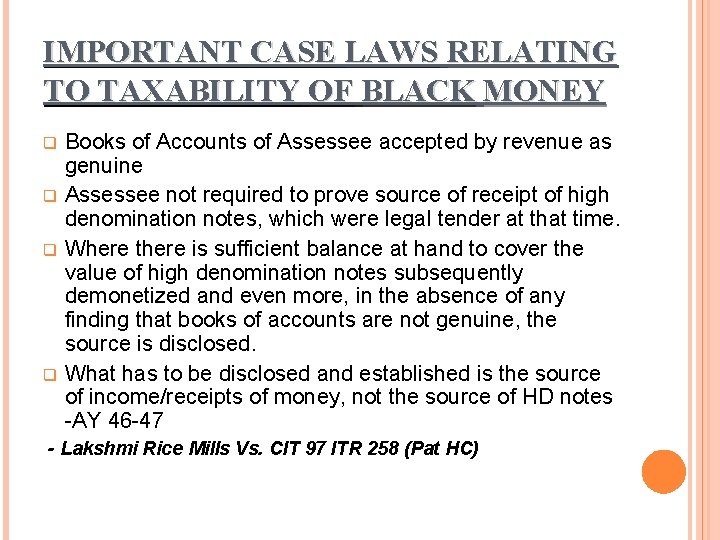
IMPORTANT CASE LAWS RELATING TO TAXABILITY OF BLACK MONEY Books of Accounts of Assessee accepted by revenue as genuine Assessee not required to prove source of receipt of high denomination notes, which were legal tender at that time. Where there is sufficient balance at hand to cover the value of high denomination notes subsequently demonetized and even more, in the absence of any finding that books of accounts are not genuine, the source is disclosed. What has to be disclosed and established is the source of income/receipts of money, not the source of HD notes -AY 46 -47 - Lakshmi Rice Mills Vs. CIT 97 ITR 258 (Pat HC)
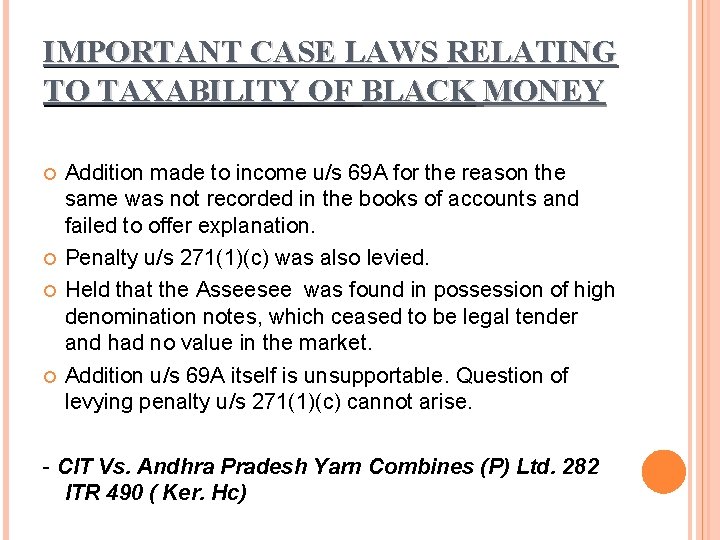
IMPORTANT CASE LAWS RELATING TO TAXABILITY OF BLACK MONEY Addition made to income u/s 69 A for the reason the same was not recorded in the books of accounts and failed to offer explanation. Penalty u/s 271(1)(c) was also levied. Held that the Asseesee was found in possession of high denomination notes, which ceased to be legal tender and had no value in the market. Addition u/s 69 A itself is unsupportable. Question of levying penalty u/s 271(1)(c) cannot arise. - CIT Vs. Andhra Pradesh Yarn Combines (P) Ltd. 282 ITR 490 ( Ker. Hc)
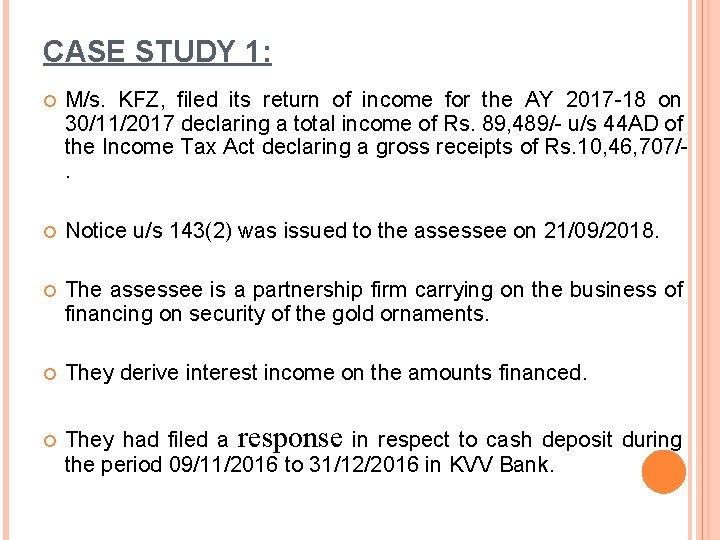
CASE STUDY 1: M/s. KFZ, filed its return of income for the AY 2017 -18 on 30/11/2017 declaring a total income of Rs. 89, 489/- u/s 44 AD of the Income Tax Act declaring a gross receipts of Rs. 10, 46, 707/. Notice u/s 143(2) was issued to the assessee on 21/09/2018. The assessee is a partnership firm carrying on the business of financing on security of the gold ornaments. They derive interest income on the amounts financed. They had filed a response in respect to cash deposit during the period 09/11/2016 to 31/12/2016 in KVV Bank.
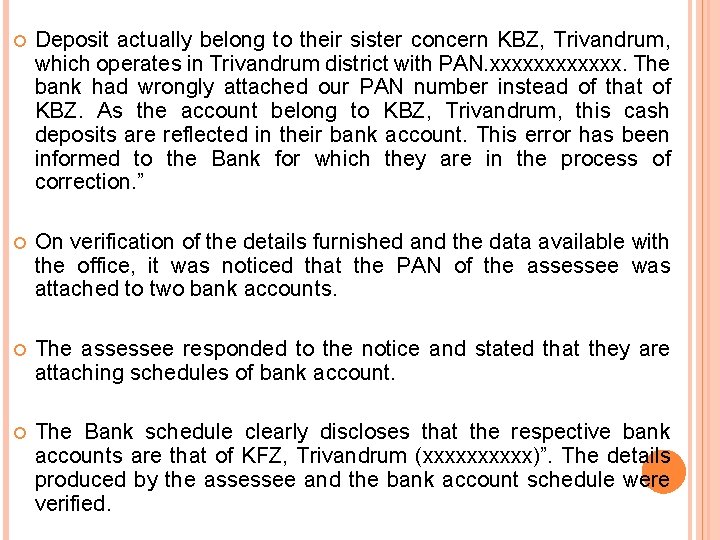
Deposit actually belong to their sister concern KBZ, Trivandrum, which operates in Trivandrum district with PAN. xxxxxx. The bank had wrongly attached our PAN number instead of that of KBZ. As the account belong to KBZ, Trivandrum, this cash deposits are reflected in their bank account. This error has been informed to the Bank for which they are in the process of correction. ” On verification of the details furnished and the data available with the office, it was noticed that the PAN of the assessee was attached to two bank accounts. The assessee responded to the notice and stated that they are attaching schedules of bank account. The Bank schedule clearly discloses that the respective bank accounts are that of KFZ, Trivandrum (xxxxx)”. The details produced by the assessee and the bank account schedule were verified.
CASE STUDY 2: The assessee is a firm engaged in the manufacturing of empty tins which are mainly used by cashew industry. The assessee has e-filed return of income for the assessment year 2017 -18 on 24/12/2017 declaring total income of Rs. 1, 14, 010/-. The case was selected for complete scrutiny under CASS and notice u/s. 143(2) issued to the assessee online electronically on 24/08/2018 requesting to produce any evidence / information in support of the said return of income by 28/09/2018. A notice u/s. 142(1) dated 04/11/2019 along with a questionnaire was sent online electronically to the assessee requiring to furnish the information called for as per annexure on or before 19/11/2019. The case was selected for complete scrutiny mainly to verify the abnormal increase in the cash deposits made during the demonetization period (09/11/2016 to 30/12/2016) as compared to average rate of cash deposits made during the pre-demonetization period.
The assessee vide letters dated 20/11/2019 & 27/11/2019 has stated that the firm had deposited a sum of Rs. 28, 82, 000/- during the demonetization period [Rs. 20, 000/- in the Current Account with ABC Bank, (A/c. No. xxx……) and Rs. 8, 000/- in the OD account with XYZ Ltd. , (A/c. No. xx…)] and the entire cash deposited in the bank accounts were out of the sale proceeds from the sale of empty tins. The assessee has submitted bank account statements, monthwise sale and cash deposit figures, audited financial statements etc. in support of the claim. The details submitted by the assessee and the bank account statements were verified and the explanations / clarifications given by the assessee regarding the source of the cash deposits made during the previous year 2016 -17 are found to be adequate and acceptable.
CASE STUDY 3: M/s. KFZ, filed its return of income for the A. Yr 2017 -18 on 30/11/2017 declaring a total income of Rs. 445150/- u/s 44 AD of the Income Tax Act declaring a gross receipts of Rs. 4815586/-. The assessee has e-filed return of income for the assessment year 2017 -18 on 30/07/2017 declaring total income of Rs. 445150/-. The case was selected for limited scrutiny under CASS for verification of cash deposits and notice u/s. 143(2) on issued to the assessee online electronically on 30/08/2018 calling for the details such as source of fund bank statement , p&l , BS etc. A notice u/s. 142(1) dated 26/07/2019 along with a questionnaire was sent online electronically to the assessee requiring to furnish the information called for as per annexure on or before 12/08/2019.
The case was selected for limited scrutiny mainly to verify the abnormal increase in the cash deposits made during the demonetization period (09/11/2016 to 30/12/2016) as compared to average rate of cash deposits made during the pre-demonetization period. The assessee vide letters dated 11/08/2019 specifies that his total cash deposits during the year amounted to Rs. 1, 25, 63, 409/- and his cash withdrawals totaled to Rs. 9805900. The assessee has submitted bank account statements, month wise sale and cash deposit figures, audited financial statements etc. in support of the claim. The details submitted by the assessee and the bank account statements were verified and the explanations / clarifications given by the assessee regarding the source of the cash deposits made during the previous year 2016 -17 are found to be adequate and acceptable.