
Demographic Distributional Effect of HighSpeed Railway HSR Evidence
Demographic Distributional Effect of High-Speed Railway (HSR) Evidence from Taiwan Jiaxuan Lu University of Southern California October 19 th, 2019 88 th International Atlantic Economic Conference The author of this study remains neutral regarding the legal and political status of Taiwan. Throughout this study, Taiwan refers to Taiwan Main Island from the geographical perspective. The author reserves his rights to define all terms used in this research.
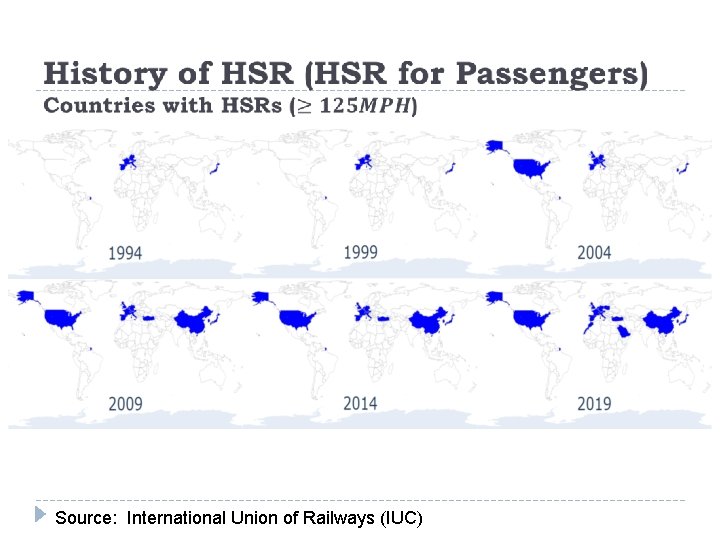
Source: International Union of Railways (IUC)
Backgrounds � More HSRs in the Future � Belt and Road Initiative & Eurasian Rail Bridges (Huang, 2016; Cai, 2017) � California, United States � HSR’s Pros and Cons � Job-Creation; Political Integration; Environmental Friendliness; Tourism; etc. � Excessive Infrastructure in Mainland China and Japan � Developing Countries: e. g. Malaysia
HSR’s Demographic Distributional Effect � HSR: (Passenger) High-Speed Railway � Demographic Agglomeration: � The trend that there are more people moving from nonurbanized/rural counties to urbanized counties than those in the opposite direction. � Demographic Dispersion: � The trend that there are more people moving from urbanized counties to non-urbanized/rural counties than those in the opposite direction. � Preview of Conclusion: � Taiwan’s HSR promotes its demographic agglomeration.
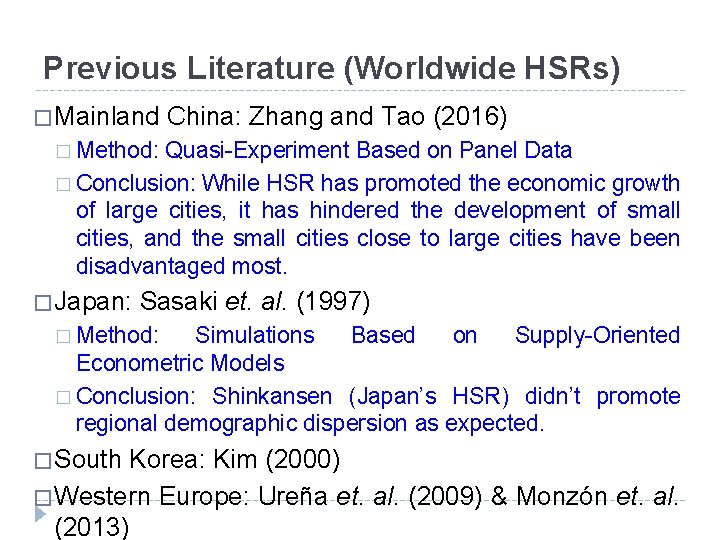
Previous Literature (Worldwide HSRs) � Mainland China: Zhang and Tao (2016) � Method: Quasi-Experiment Based on Panel Data � Conclusion: While HSR has promoted the economic growth of large cities, it has hindered the development of small cities, and the small cities close to large cities have been disadvantaged most. � Japan: Sasaki et. al. (1997) � Method: Simulations Based on Supply-Oriented Econometric Models � Conclusion: Shinkansen (Japan’s HSR) didn’t promote regional demographic dispersion as expected. � South Korea: Kim (2000) � Western Europe: Ureña et. al. (2009) & Monzón et. al. (2013)

Map of Taiwan’s HSR Capital City: Taipei Largest Port: Kaohsiung Why Taiwan? • Very Recent HSR Project • Many Detailed Data • Post-Rapid-Development Source: Official Website of Taiwan High Speed Rail (legend edited by the
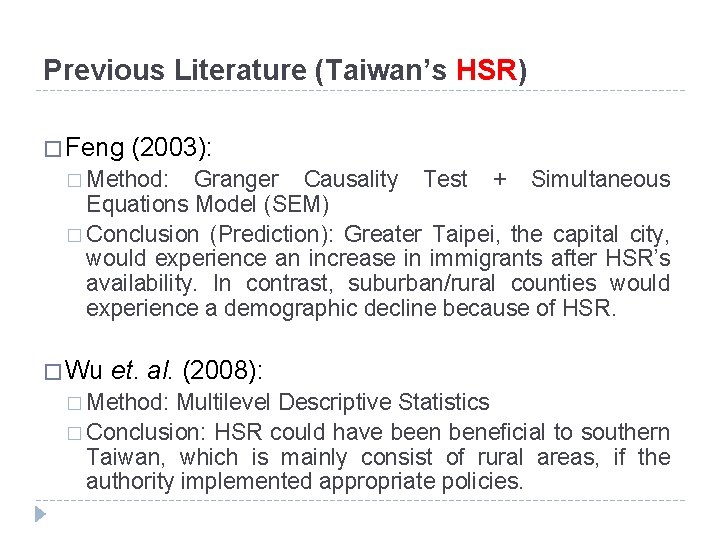
Previous Literature (Taiwan’s HSR) � Feng (2003): � Method: Granger Causality Test + Simultaneous Equations Model (SEM) � Conclusion (Prediction): Greater Taipei, the capital city, would experience an increase in immigrants after HSR’s availability. In contrast, suburban/rural counties would experience a demographic decline because of HSR. � Wu et. al. (2008): � Method: Multilevel Descriptive Statistics � Conclusion: HSR could have been beneficial to southern Taiwan, which is mainly consist of rural areas, if the authority implemented appropriate policies.
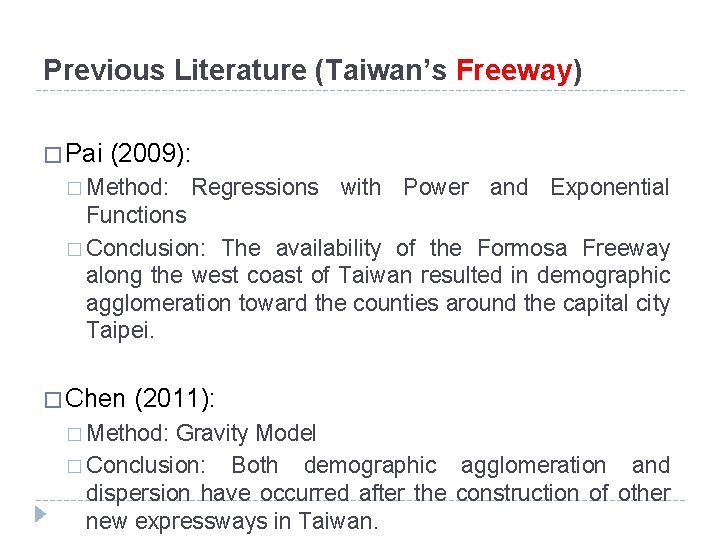
Previous Literature (Taiwan’s Freeway) � Pai (2009): � Method: Regressions with Power and Exponential Functions � Conclusion: The availability of the Formosa Freeway along the west coast of Taiwan resulted in demographic agglomeration toward the counties around the capital city Taipei. � Chen (2011): � Method: Gravity Model � Conclusion: Both demographic agglomeration and dispersion have occurred after the construction of other new expressways in Taiwan.
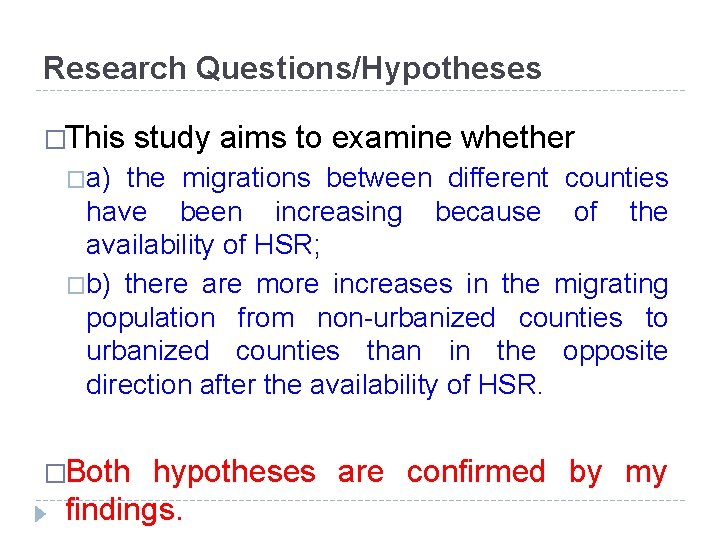
Research Questions/Hypotheses �This study aims to examine whether �a) the migrations between different counties have been increasing because of the availability of HSR; �b) there are more increases in the migrating population from non-urbanized counties to urbanized counties than in the opposite direction after the availability of HSR. �Both hypotheses are confirmed by my findings.
Outlines � Gravity Model + Interaction Terms � Standard Deviation of County-Level Population � Counterfactual Analysis (Robustness Check)
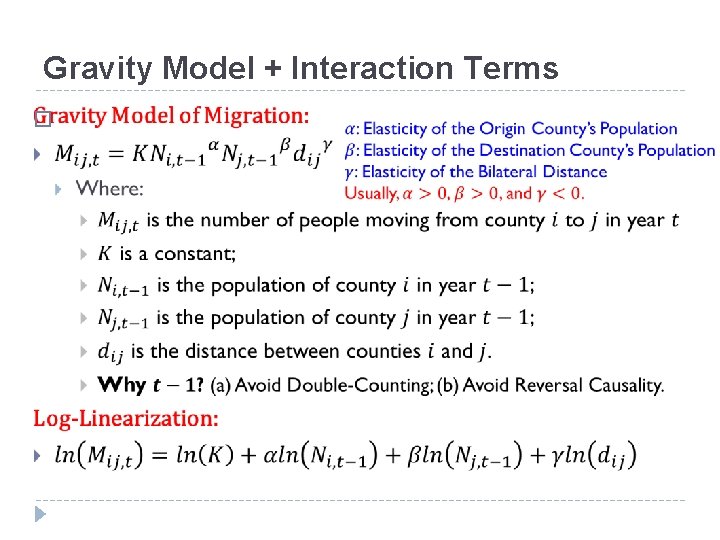
Gravity Model + Interaction Terms �
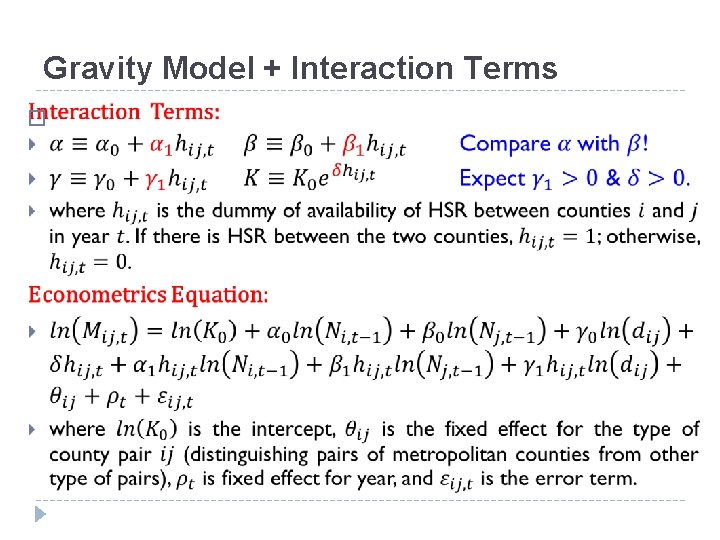
Gravity Model + Interaction Terms �
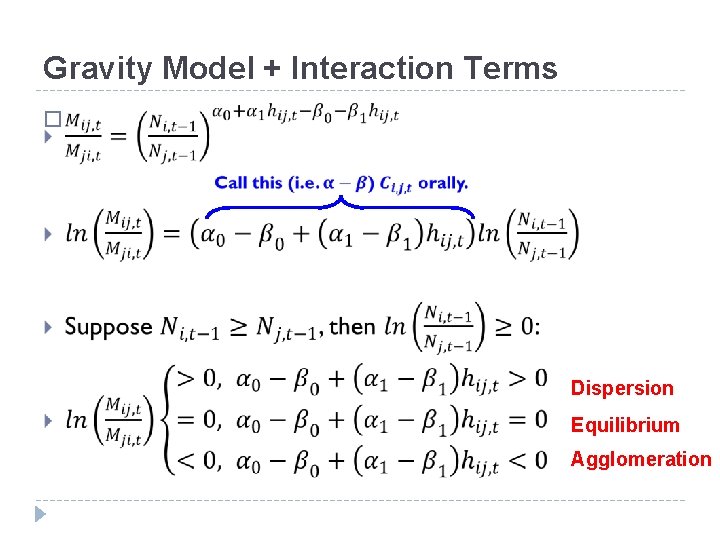
Gravity Model + Interaction Terms � Dispersion Equilibrium Agglomeration
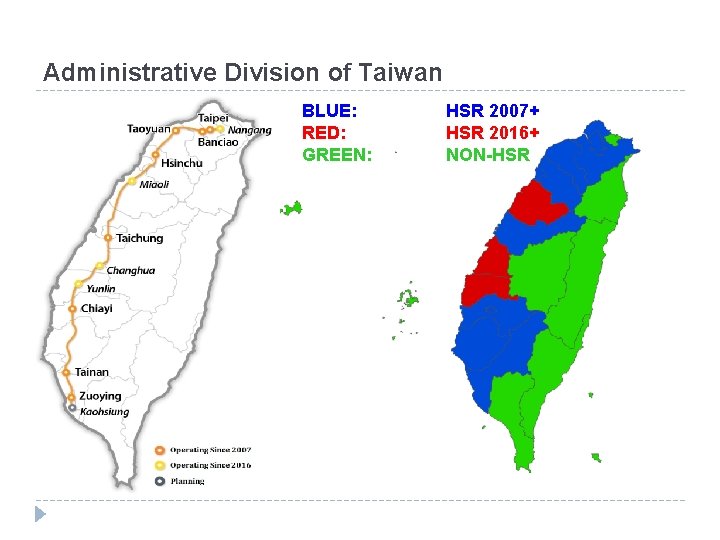
Administrative Division of Taiwan BLUE: RED: GREEN: HSR 2007+ HSR 2016+ NON-HSR
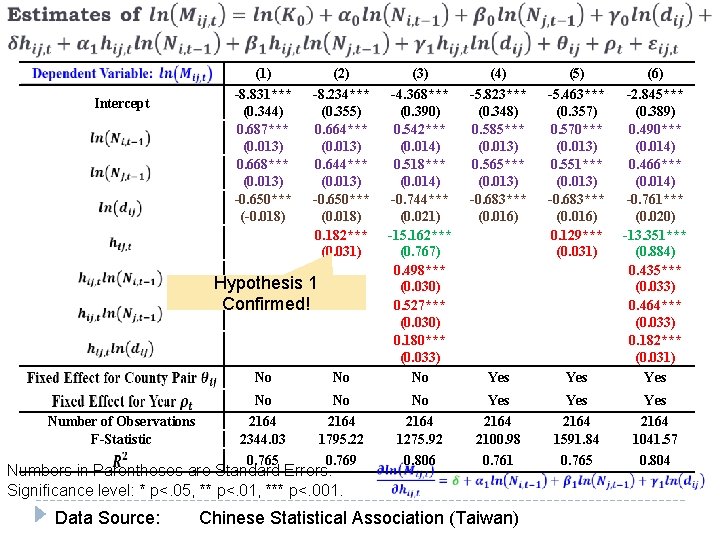
Intercept (1) -8. 831*** (0. 344) 0. 687*** (0. 013) 0. 668*** (0. 013) -0. 650*** (-0. 018) (2) -8. 234*** (0. 355) 0. 664*** (0. 013) 0. 644*** (0. 013) -0. 650*** (0. 018) 0. 182*** (0. 031) No No (3) -4. 368*** (0. 390) 0. 542*** (0. 014) 0. 518*** (0. 014) -0. 744*** (0. 021) -15. 162*** (0. 767) 0. 498*** (0. 030) 0. 527*** (0. 030) 0. 180*** (0. 033) No No 2164 2344. 03 0. 765 No 2164 1795. 22 0. 769 No 2164 1275. 92 0. 806 Hypothesis 1 Confirmed! Number of Observations F-Statistic Numbers in Parentheses are Standard Errors. Significance level: * p<. 05, ** p<. 01, *** p<. 001. Data Source: (4) -5. 823*** (0. 348) 0. 585*** (0. 013) 0. 565*** (0. 013) -0. 683*** (0. 016) (5) -5. 463*** (0. 357) 0. 570*** (0. 013) 0. 551*** (0. 013) -0. 683*** (0. 016) 0. 129*** (0. 031) Yes (6) -2. 845*** (0. 389) 0. 490*** (0. 014) 0. 466*** (0. 014) -0. 761*** (0. 020) -13. 351*** (0. 884) 0. 435*** (0. 033) 0. 464*** (0. 033) 0. 182*** (0. 031) Yes 2164 2100. 98 0. 761 Yes 2164 1591. 84 0. 765 Yes 2164 1041. 57 0. 804 Chinese Statistical Association (Taiwan)
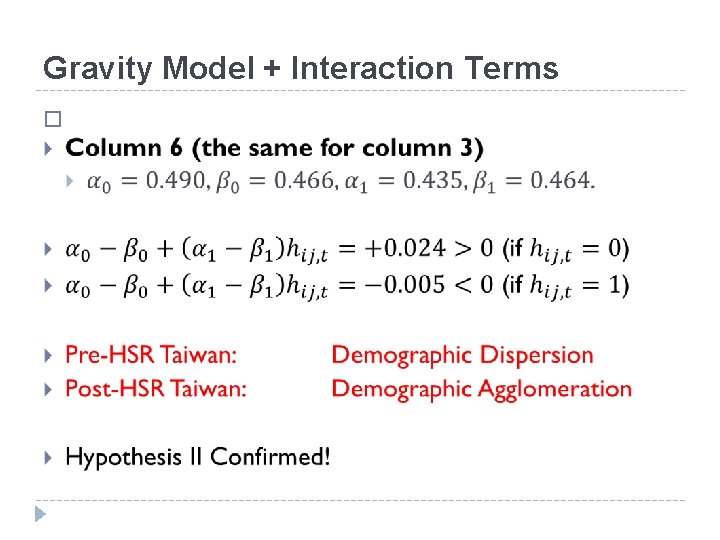
Gravity Model + Interaction Terms �
Outlines � Gravity Model + Interaction Terms � Standard Deviation of County-Level Population � Counterfactual Analysis (Robustness Check)
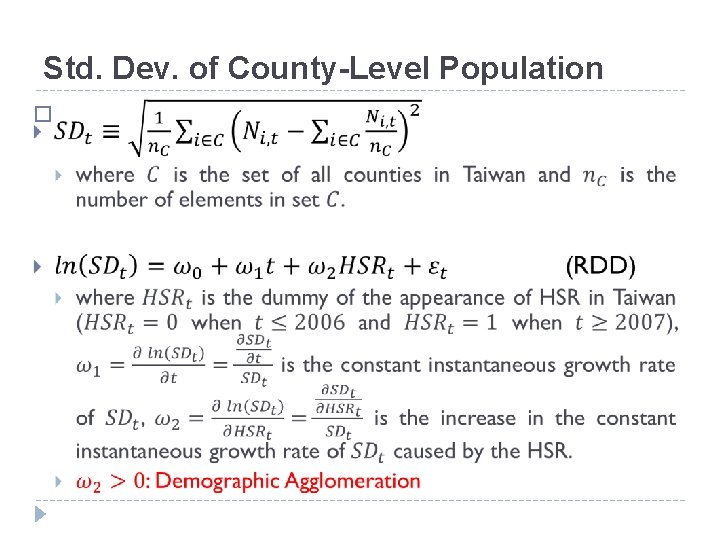
Std. Dev. of County-Level Population �
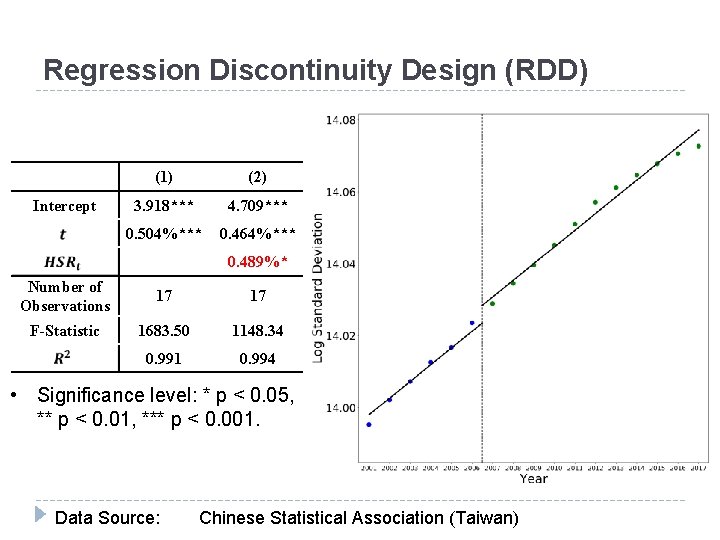
Regression Discontinuity Design (RDD) Intercept (1) (2) 3. 918*** 4. 709*** 0. 504%*** 0. 464%*** 0. 489%* Number of Observations 17 17 F-Statistic 1683. 50 1148. 34 0. 991 0. 994 • Significance level: * p < 0. 05, ** p < 0. 01, *** p < 0. 001. Data Source: Chinese Statistical Association (Taiwan)
Outlines � Gravity Model + Interaction Terms � Standard Deviation of County-Level Population � Counterfactual Analysis (Robustness Check)
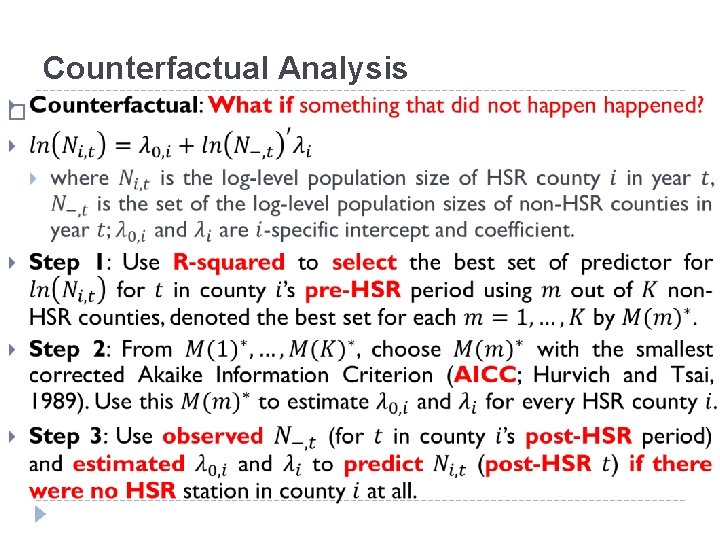
Counterfactual Analysis �
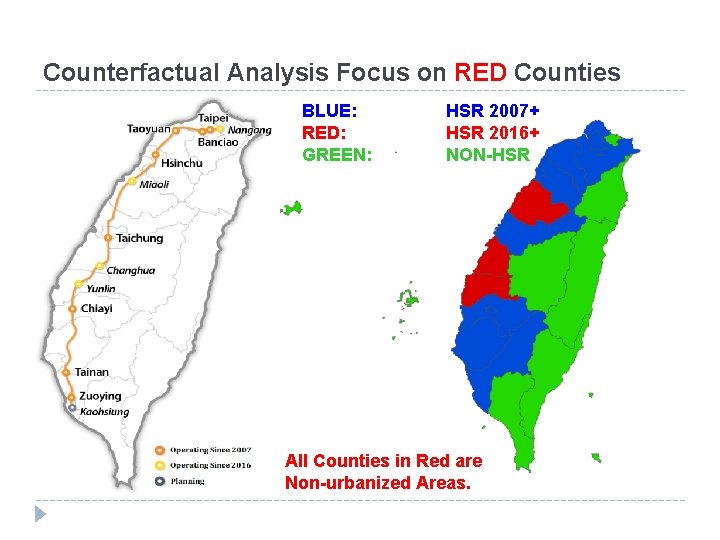
Counterfactual Analysis Focus on RED Counties BLUE: RED: GREEN: HSR 2007+ HSR 2016+ NON-HSR All Counties in Red are Non-urbanized Areas.
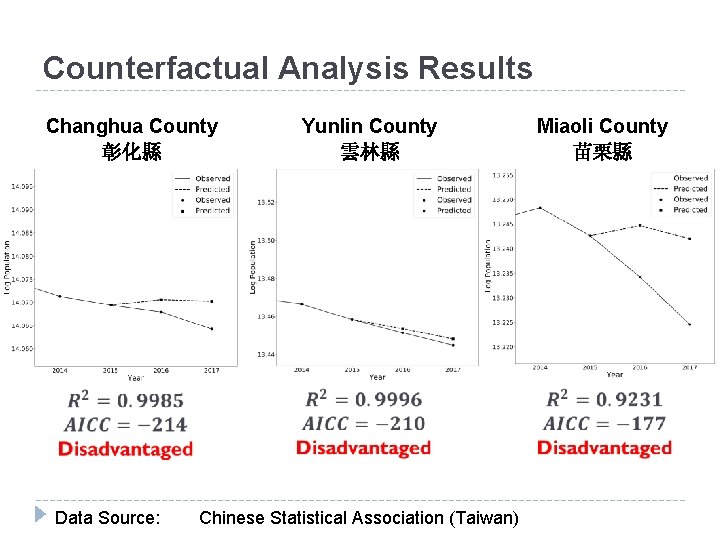
Counterfactual Analysis Results Changhua County 彰化縣 Data Source: Yunlin County 雲林縣 Chinese Statistical Association (Taiwan) Miaoli County 苗栗縣
Conclusions �Taiwan’s HSR has significantly increased the migrating population between different counties. (Hypothesis I) �There are more increases in the migrating population from non-urbanized areas to urbanized areas than in the opposite direction after HSR’s availability. (Hypothesis II) �Encountering the trend of Demographic Agglomeration, the authority of Taiwan should adopt the policies that help improve the economic vitality of the suburban areas so as to alleviate the demographic inequality.
Future Research � Are the demographic effects exerted by HSR permanent as assumed by the “Gravity Model+ Interaction Term”? � In reality, this could be misleading because those effects might only last for several years. � If there were Taiwan’s economic data (e. g. GDP) decomposed into county level, it would have been better to control the economic factors behind intercounty migrations. � Long-run � Studies effects on rural areas are also important. in the future might be able to conduct counterfactual analyses including more post-HSR observations (instead of just two years, i. e. 2016 and 2017, in my analysis).
- Slides: 25