
Demodulation of DSBSC AM Signals n Suppose that
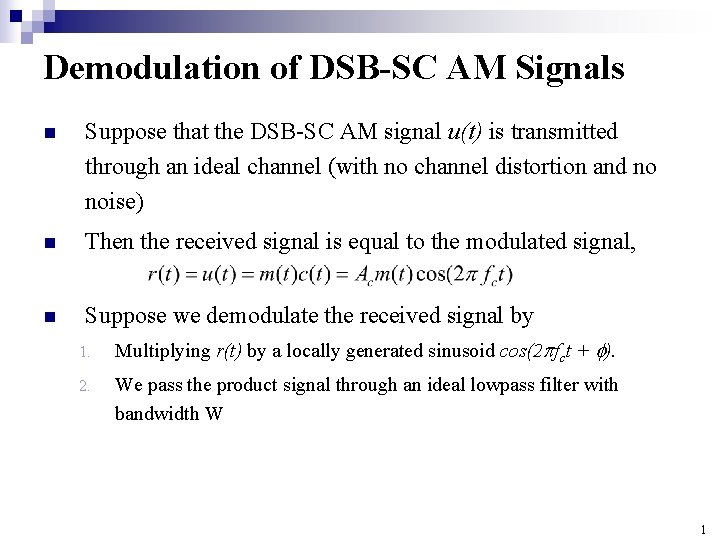
Demodulation of DSB-SC AM Signals n Suppose that the DSB-SC AM signal u(t) is transmitted through an ideal channel (with no channel distortion and no noise) n Then the received signal is equal to the modulated signal, n Suppose we demodulate the received signal by 1. Multiplying r(t) by a locally generated sinusoid cos(2 fct + ). 2. We pass the product signal through an ideal lowpass filter with bandwidth W 1
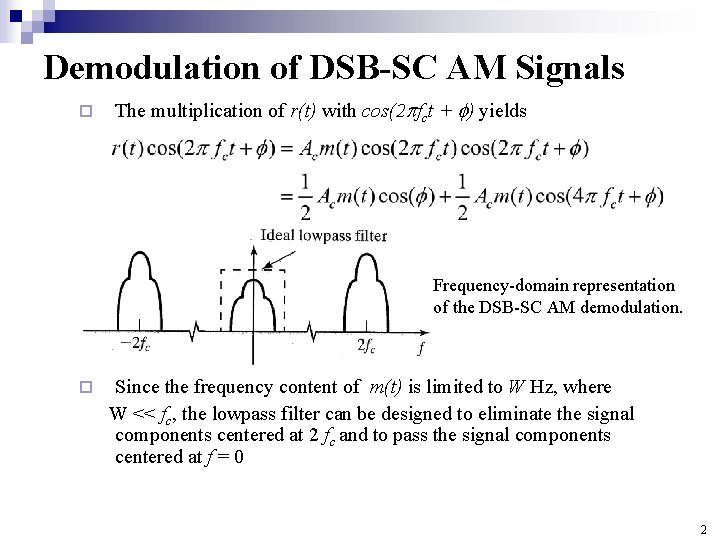
Demodulation of DSB-SC AM Signals ¨ The multiplication of r(t) with cos(2 fct + ) yields Frequency-domain representation of the DSB-SC AM demodulation. ¨ Since the frequency content of m(t) is limited to W Hz, where W << fc, the lowpass filter can be designed to eliminate the signal components centered at 2 fc and to pass the signal components centered at f = 0 2
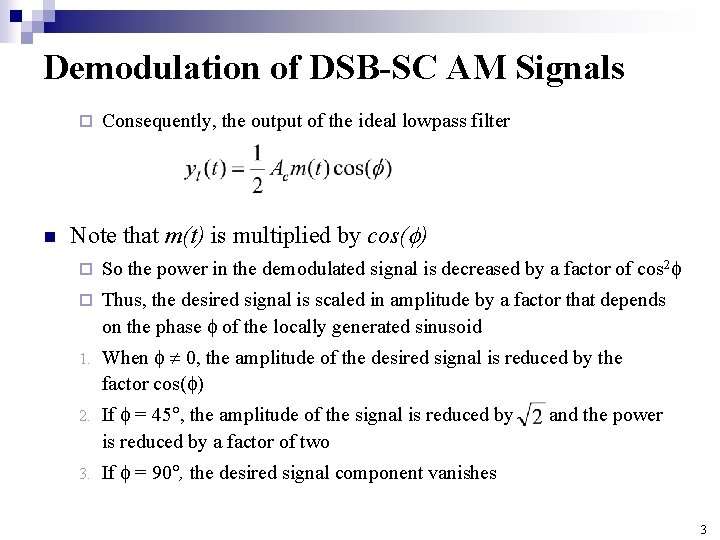
Demodulation of DSB-SC AM Signals ¨ n Consequently, the output of the ideal lowpass filter Note that m(t) is multiplied by cos( ) ¨ So the power in the demodulated signal is decreased by a factor of cos 2 ¨ Thus, the desired signal is scaled in amplitude by a factor that depends on the phase of the locally generated sinusoid 1. When 0, the amplitude of the desired signal is reduced by the factor cos( ) 2. If = 45 , the amplitude of the signal is reduced by a factor of two 3. If = 90 , the desired signal component vanishes and the power 3

Demodulation of DSB-SC AM Signals n The preceding discussion demonstrates the need for a phasecoherent or synchronous demodulator for recovering the message signal m(t) from the received signal n That is, the phase of the locally generated sinusoid should ideally be equal to 0 (the phase of the received-carrier signal) A sinusoid that is phase-locked to the phase of the received carrier can be generated at the receiver in one of two ways n 4
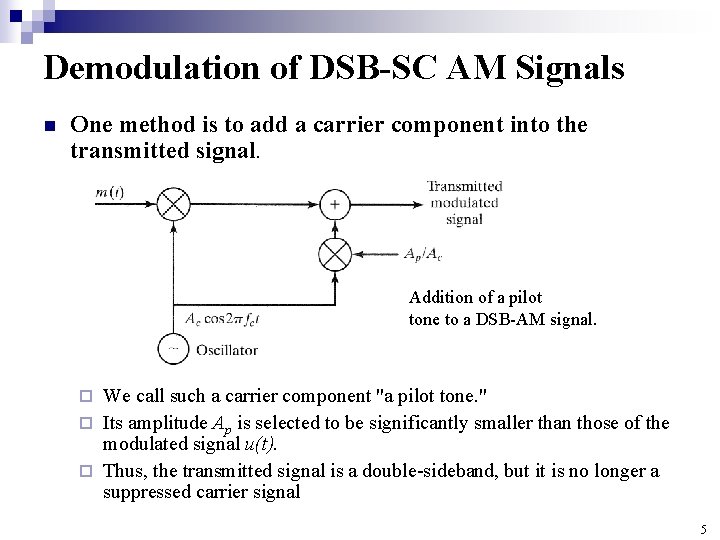
Demodulation of DSB-SC AM Signals n One method is to add a carrier component into the transmitted signal. Addition of a pilot tone to a DSB-AM signal. We call such a carrier component "a pilot tone. " ¨ Its amplitude Ap is selected to be significantly smaller than those of the modulated signal u(t). ¨ Thus, the transmitted signal is a double-sideband, but it is no longer a suppressed carrier signal ¨ 5
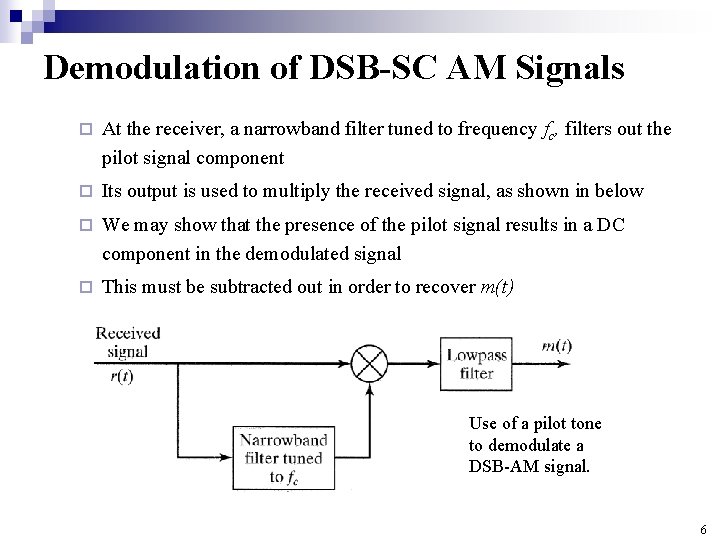
Demodulation of DSB-SC AM Signals ¨ At the receiver, a narrowband filter tuned to frequency fc, filters out the pilot signal component ¨ Its output is used to multiply the received signal, as shown in below ¨ We may show that the presence of the pilot signal results in a DC component in the demodulated signal ¨ This must be subtracted out in order to recover m(t) Use of a pilot tone to demodulate a DSB-AM signal. 6

Demodulation of DSB-SC AM Signals n Adding a pilot tone to the transmitted signal has a disadvantage ¨ It requires that a certain portion of the transmitted signal power must be allocated to the transmission of the pilot n As an alternative, we may generate a phase-locked sinusoidal carrier from the received signal r(t) without the need of a pilot signal ¨ This can be accomplished by the use of a phase-locked loop, as described in Section 6. 4. 7

Conventional Amplitude Modulation n A conventional AM signal consists of a large carrier component, in addition to the double-sideband AM modulated signal ¨ The transmitted signal is expressed as n n The message waveform is constrained to satisfy the condition that |m(t)| 1 We observe that Acm(t) cos(2 fct) is a double-sideband AM signal and Accos(2 fct) is the carrier component A conventional AM signal in the time domain 8
Conventional Amplitude Modulation n n As we will see later in this chapter, the existence of this extra carrier results in a very simple structure for the demodulator That is why commercial AM broadcasting generally employs this type of modulation As long as |m(t)| 1, the amplitude Ac[1 + m(t)] is always positive ¨ This is the desired condition for conventional DSB AM that makes it easy to demodulate, as we will describe On the other hand, if m(t) < -1 for some t , the AM signal is overmodulated and its demodulation is rendered more complex 9
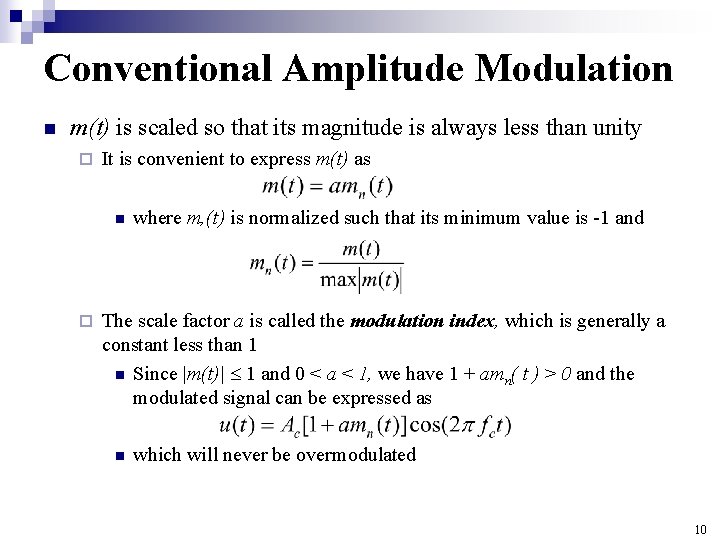
Conventional Amplitude Modulation n m(t) is scaled so that its magnitude is always less than unity ¨ It is convenient to express m(t) as n ¨ where m, (t) is normalized such that its minimum value is -1 and The scale factor a is called the modulation index, which is generally a constant less than 1 n Since |m(t)| 1 and 0 < a < 1, we have 1 + amn( t ) > 0 and the modulated signal can be expressed as n which will never be overmodulated 10
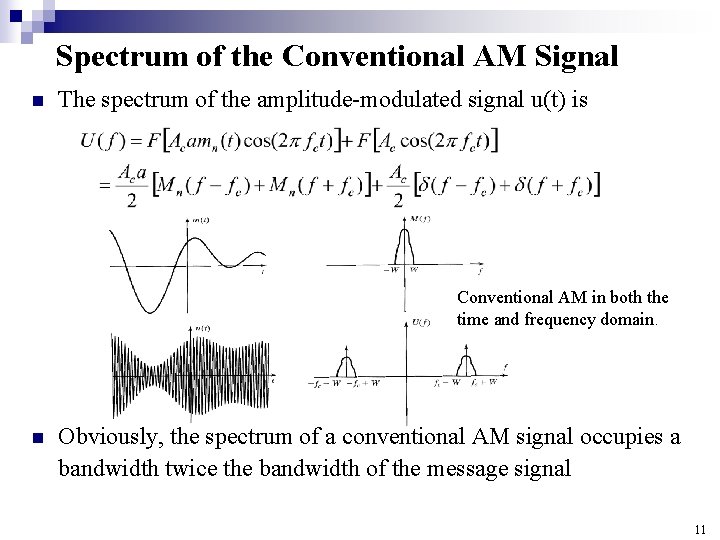
Spectrum of the Conventional AM Signal n The spectrum of the amplitude-modulated signal u(t) is Conventional AM in both the time and frequency domain. n Obviously, the spectrum of a conventional AM signal occupies a bandwidth twice the bandwidth of the message signal 11
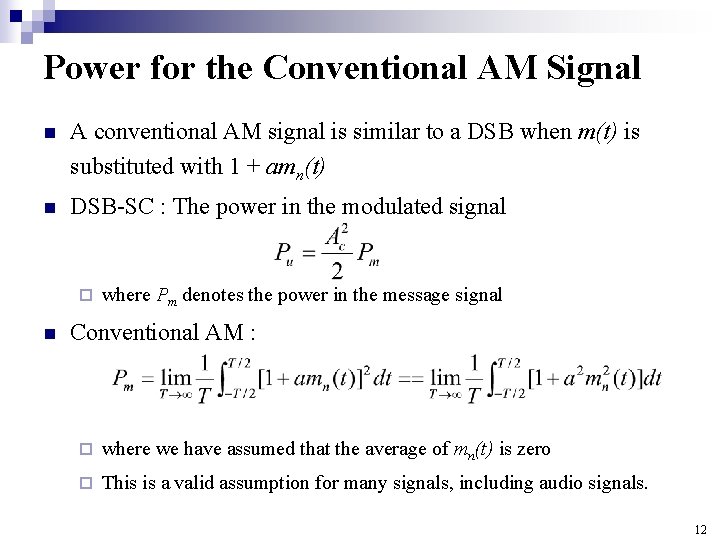
Power for the Conventional AM Signal n A conventional AM signal is similar to a DSB when m(t) is substituted with 1 + amn(t) n DSB-SC : The power in the modulated signal ¨ n where Pm denotes the power in the message signal Conventional AM : ¨ where we have assumed that the average of mn(t) is zero ¨ This is a valid assumption for many signals, including audio signals. 12
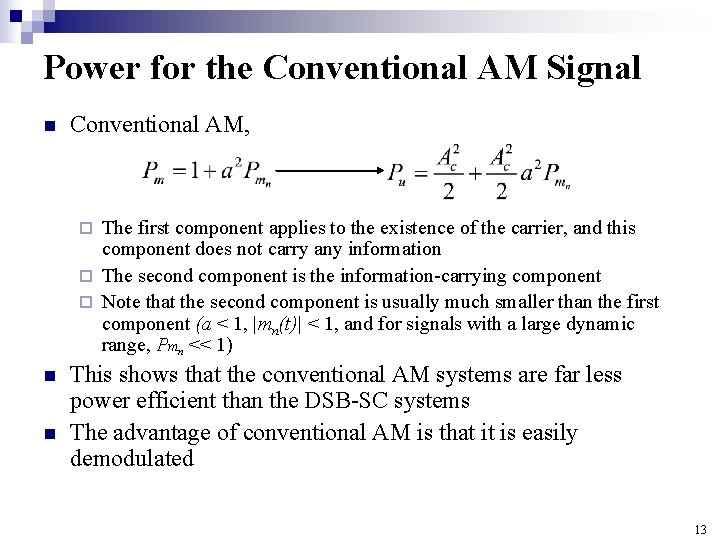
Power for the Conventional AM Signal n Conventional AM, The first component applies to the existence of the carrier, and this component does not carry any information ¨ The second component is the information-carrying component ¨ Note that the second component is usually much smaller than the first component (a < 1, |mn(t)| < 1, and for signals with a large dynamic range, Pmn << 1) ¨ n n This shows that the conventional AM systems are far less power efficient than the DSB-SC systems The advantage of conventional AM is that it is easily demodulated 13
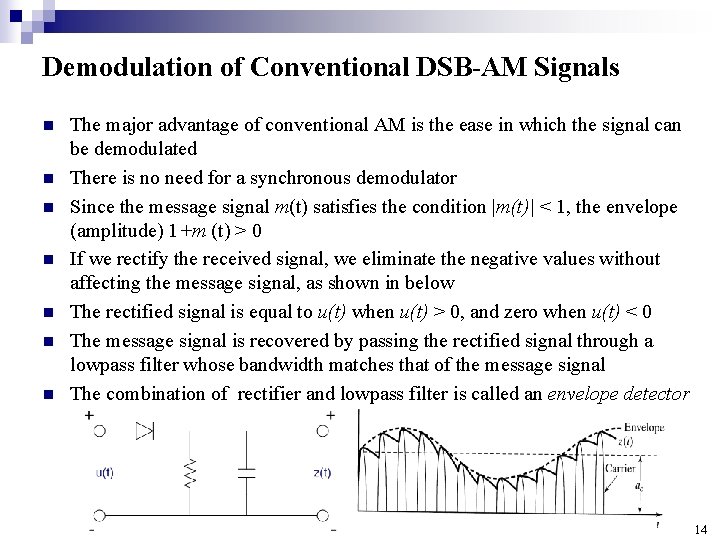
Demodulation of Conventional DSB-AM Signals n n n n The major advantage of conventional AM is the ease in which the signal can be demodulated There is no need for a synchronous demodulator Since the message signal m(t) satisfies the condition |m(t)| < 1, the envelope (amplitude) 1+m (t) > 0 If we rectify the received signal, we eliminate the negative values without affecting the message signal, as shown in below The rectified signal is equal to u(t) when u(t) > 0, and zero when u(t) < 0 The message signal is recovered by passing the rectified signal through a lowpass filter whose bandwidth matches that of the message signal The combination of rectifier and lowpass filter is called an envelope detector 14
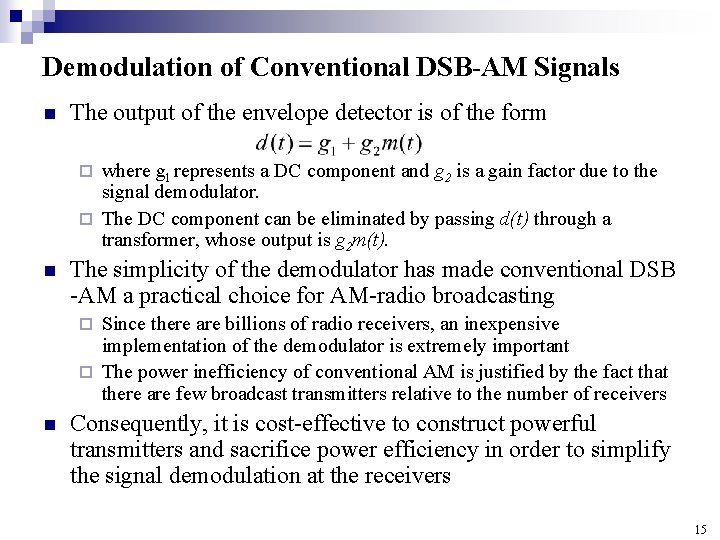
Demodulation of Conventional DSB-AM Signals n The output of the envelope detector is of the form where gl represents a DC component and g 2 is a gain factor due to the signal demodulator. ¨ The DC component can be eliminated by passing d(t) through a transformer, whose output is g 2 m(t). ¨ n The simplicity of the demodulator has made conventional DSB -AM a practical choice for AM-radio broadcasting Since there are billions of radio receivers, an inexpensive implementation of the demodulator is extremely important ¨ The power inefficiency of conventional AM is justified by the fact that there are few broadcast transmitters relative to the number of receivers ¨ n Consequently, it is cost-effective to construct powerful transmitters and sacrifice power efficiency in order to simplify the signal demodulation at the receivers 15
- Slides: 15