
Democracy Justice Sustainability Is radical inequality consistent with
Democracy, Justice & Sustainability
• Is radical inequality consistent with sustainability? • What's the role of human development in sustainability? • What opportunities does green development hold for empowerment? • What opportunities does empowerment hold for green development?
Principles of a Green Economy 1. The Primacy of Human Need, Service, Use-value, Intrinsic Value & Quality 2. Following Natural Flows 3. Waste Equals Food 4. Elegance and Multifunctionality 5. Appropriate Scale / Linked Scale 6. Diversity 7. Self-Reliance, Self-Organization, Self-Design 8. Participation & Direct Democracy 9. Human Creativity and Development 10. The Strategic role of the Built-environment, the Landscape & Spatial Design

Evolution & Democracy • individual consciousness & civilization (class society) – – individuation king nobility Axial revolutions: individuation & democracy • industrial capitalism: undermining landed class with economic growth – formal political democracy for working class • Fordist state / socialism: transitional, concerns with welfare • full economic democracy: individuation, creativity & commons • from representative to direct democracy
Social Movements & Historical Potentials • classical capitalist development – labour, socialist, populist concern with distribution of wealth • post-WWII : new social movements concerns with quality, and the nature of wealth, not just its fair distribution. – peace, human rights, ecology, selfdetermination, human potential, etc. – elimination of all forms of domination: human over nature, nation over nation, class over class, men over women, etc. – growing emphasis on positive alternatives in all the new movements
A Green Economy 1. The Service Economy “Hot Showers and Cold Beer” Nutrition, Illumination, Entertainment, Access, Shelter, Community, etc. “People production” 2. The “Lake Economy” Flowing with nature, Every output an input, Closedloop organization, Let nature do the work. “Biomimicry”: integrate with and imitate natural systems.
Human Development in the Green Economy • Production: human creativity the key • Consumption: “end-use” Direct targeting of human need = massive resource savings • Regulation: participation at all levels.
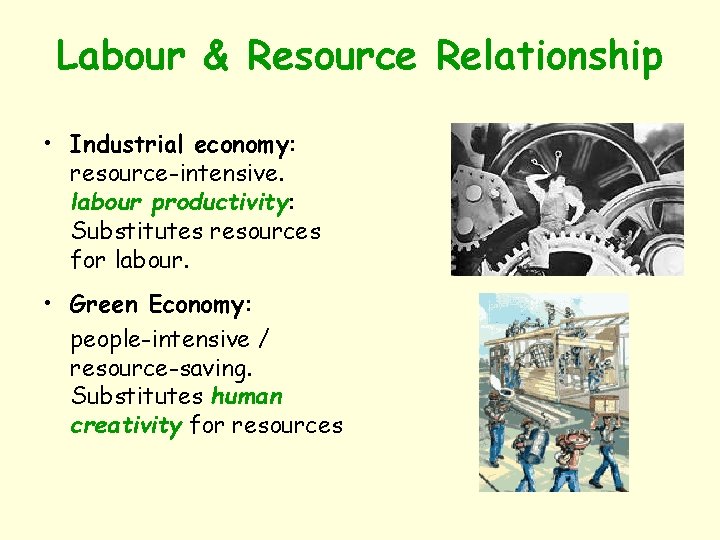
Labour & Resource Relationship • Industrial economy: resource-intensive. labour productivity: Substitutes resources for labour. • Green Economy: people-intensive / resource-saving. Substitutes human creativity for resources
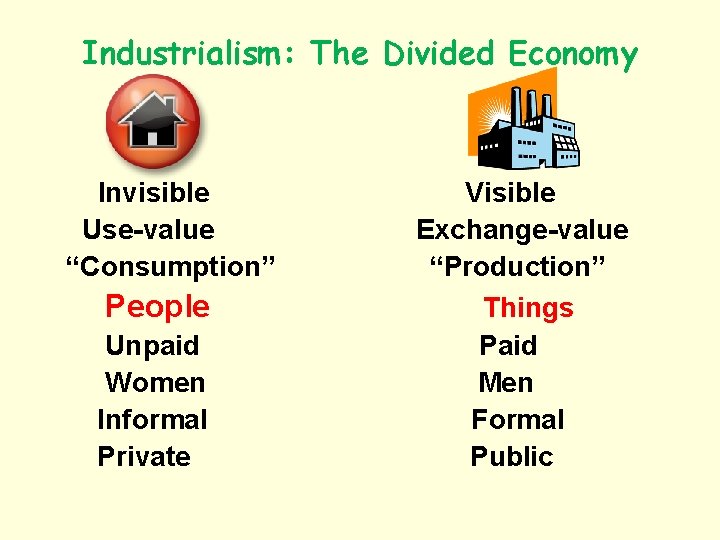
Industrialism: The Divided Economy Invisible Use-value “Consumption” People Unpaid Women Informal Private Visible Exchange-value “Production” Things Paid Men Formal Public
Scarcity, Class Power & Waste • War production, suburbanization and effective demand. • Waste of resources • Waste of human potential
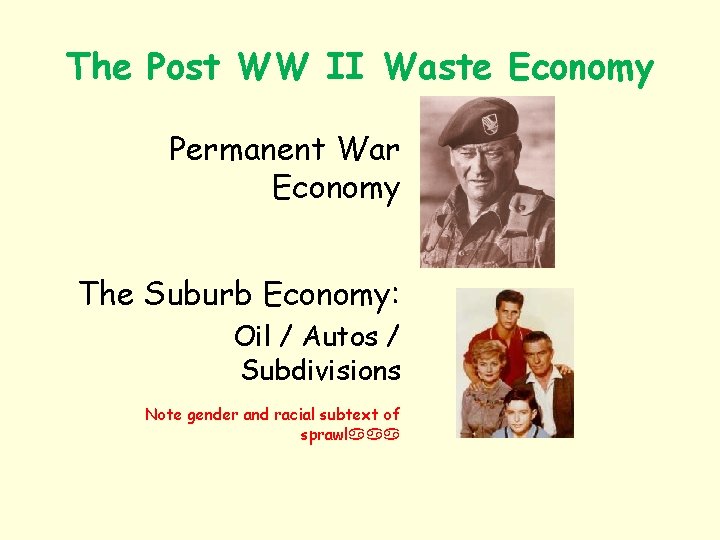
The Post WW II Waste Economy Permanent War Economy The Suburb Economy: Oil / Autos / Subdivisions Note gender and racial subtext of sprawlaaa
Fordism & the Reinforcement of Industrial Wealth Matter Money Waste Debt Fordism Keynesianism Suburbanization/ Consumer Economy War Industry Paper Economy Planned Inflation New forms of creditmoney
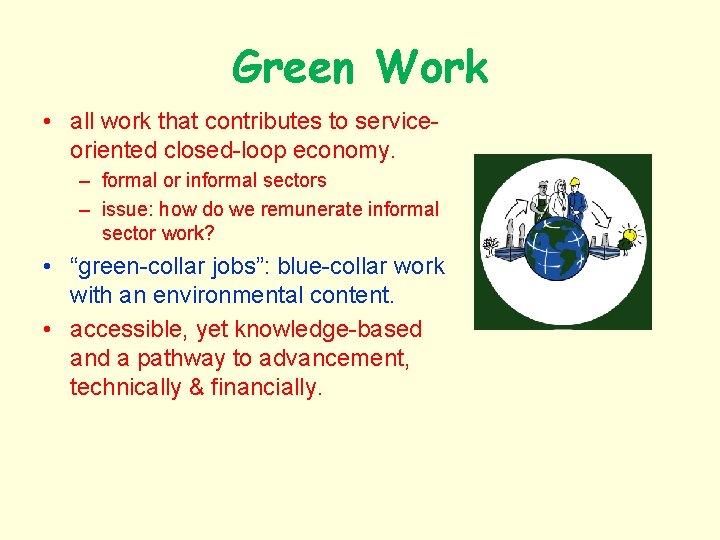
Green Work • all work that contributes to serviceoriented closed-loop economy. – formal or informal sectors – issue: how do we remunerate informal sector work? • “green-collar jobs”: blue-collar work with an environmental content. • accessible, yet knowledge-based and a pathway to advancement, technically & financially.
Evolving Work • early worker power: based on craft skills or key sectors like railroads in 19 th century. • early/mid 20 th century: rise of industrial unionism: filling organizational space in new mass production. Power based in solidarity across whole industries. • rise of intellectual and white-collar work: public education and rise of bureaucracy (hierarchies of white-collar work). – increasing dominance of big organizations: the corporation as “industrial government” (Bazelon) • Fordism & women as domestic consumption managers. • chronic problem of job-creation: technological unemployment, “surplus populations”,
Evolving Work-2 • 50 s Industrial unionism: the peak of working class power within production – 60 s: emergence of new social movements for quality of life outside the factory gates: peace, feminism, ecology, human & civil rights, counterculture, human potential, etc. • 1973: beginning of long decline in real wages for North American working class. • 1979 -81: economic growth now dependent on polarization of income and wealth. • 1980’s: empty financialization begins displacing mass material production and consumption as key capitalist driver of development.
Evolving Work-3 • work polarization: growing sector of financial producer services, along with an even greater explosion of Mc. Jobs. • intensifying evaporation of middle class in North America. • economic bubbles accessible mainly to the rich or upper middle-class: tech boom of the 90 s. Housing bubble of 2000 s actively exploited the poor & disempowered. • 70 s through 90 s: gradual evolution of green development movement—from energy efficiency and appropriate technology movement of the 70 s to breakthroughs in green building and local-sustainable food systems recently. • 2000 s: increasing connection of marginalized communities with green economic regeneration; growing interest of hardpressed organized labour in people-intensive green development; rise of an anti-corporate community business movement.
- Slides: 16