
Democracy in Theory and Practice 9 The Future


- Slides: 28
Democracy in Theory and Practice 9. The Future of Democracy: Innovations and Reforms Dr Max Jaede, 2020
Recap of last week • Deliberative democrats argue that public justification and debate can enhance the quality and legitimacy of decision-making in modern liberal democracies • Agonistic or radical pluralists are critical of deliberative democracy and highlight positive aspects of certain forms of political conflict
Outline of this class • Referendums and citizen initiatives • Participatory governance and budgeting • Deliberative mini-publics
Referendums and citizen initiatives
Referendums • Referendums (or referenda) are votes on a single issue which may be binding or (formally) advisory • As exercises in direct democracy, referendums are meant to increase citizen participation and to decide important political/constitutional matters • Often they require a minimum turnout or a super-majority • Worldwide, the number of referendums tripled in the 1990 s and has remained at a high level since then
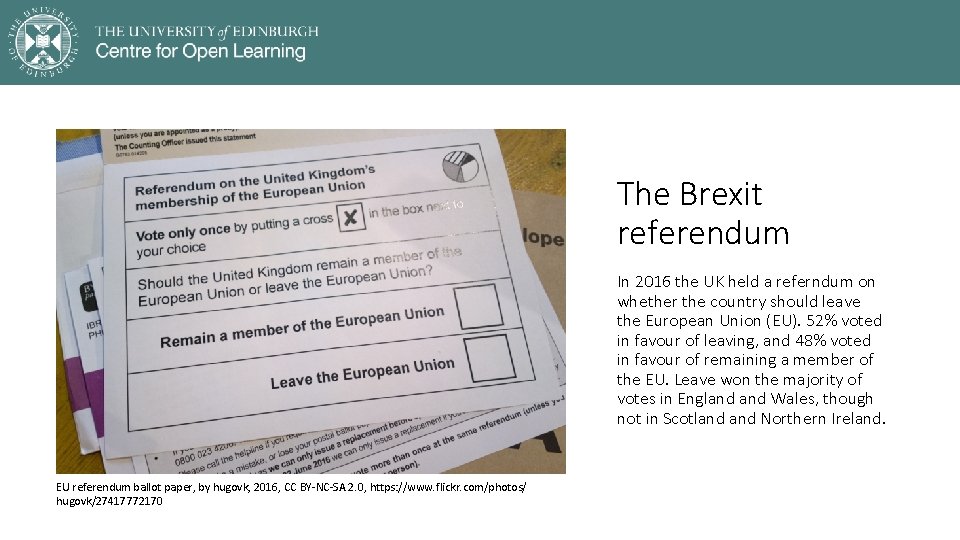
The Brexit referendum In 2016 the UK held a referndum on whether the country should leave the European Union (EU). 52% voted in favour of leaving, and 48% voted in favour of remaining a member of the EU. Leave won the majority of votes in England Wales, though not in Scotland Northern Ireland. EU referendum ballot paper, by hugovk, 2016, CC BY-NC-SA 2. 0, https: //www. flickr. com/photos/ hugovk/27417772170
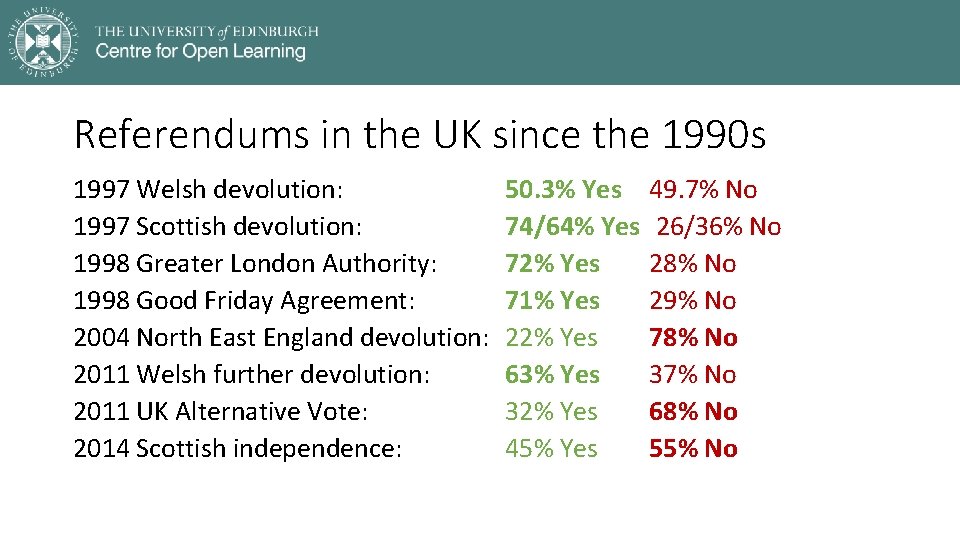
Referendums in the UK since the 1990 s 1997 Welsh devolution: 1997 Scottish devolution: 1998 Greater London Authority: 1998 Good Friday Agreement: 2004 North East England devolution: 2011 Welsh further devolution: 2011 UK Alternative Vote: 2014 Scottish independence: 50. 3% Yes 74/64% Yes 72% Yes 71% Yes 22% Yes 63% Yes 32% Yes 45% Yes 49. 7% No 26/36% No 28% No 29% No 78% No 37% No 68% No 55% No
The pros and cons of referendums • Referendums are very inclusive and, if designed well, give clear results with a high level of legitimacy • But, referendums may reduce complex issues to binary either/or choices, which prevent compromise and serious consideration of the trade-offs involved • Politicians can interpret vague propositions according to their own preferences (e. g. , what does ‘leave the EU’ mean? ) • Voters can only hold themselves to account for the outcome of a referendum – unlike in periodic elections
Citizen initiatives • Citizen initiatives allow a certain number of citizens to achieve a certain objective, such as: • to hold a debate in parliament (e. g. e-petitions in the UK); • to recall an office-holder; • to put a proposition to a referendum; • to introduce legislation. • This democratic mechanism originated in Switzerland has been adopted by other countries (and the EU), though it is less common than referendums
Participatory governance and budgeting
Participatory governance and budgeting • Public institutions are experimenting with various participatory arrangements which seek to ensure cooperation with stakeholders and (self- or purposefully selected) citizens • Participatory budgeting (PB) is a process which allows citizens to take part in deciding how public resources should be allocated, typically at the local level Participedia. net is a global database on democratic innovations such as PB.
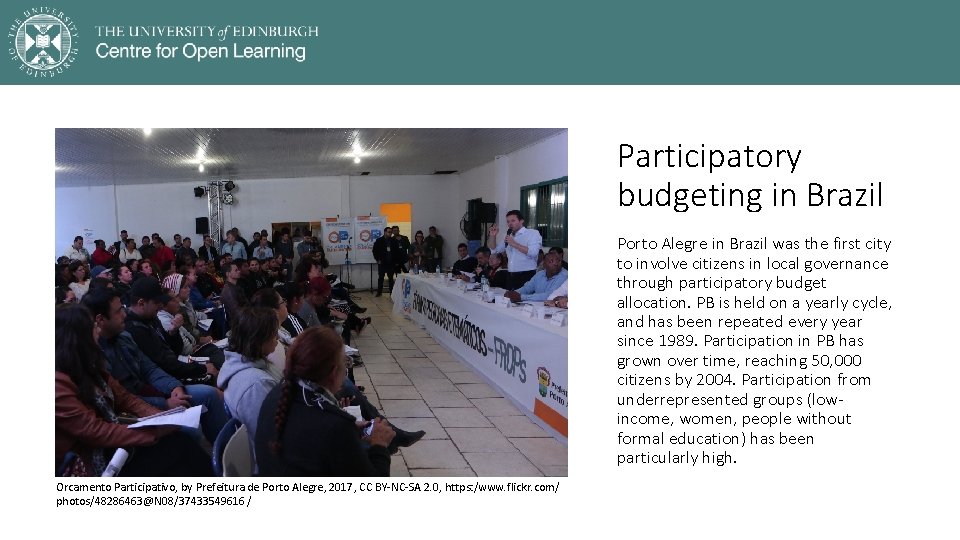
Participatory budgeting in Brazil Porto Alegre in Brazil was the first city to involve citizens in local governance through participatory budget allocation. PB is held on a yearly cycle, and has been repeated every year since 1989. Participation in PB has grown over time, reaching 50, 000 citizens by 2004. Participation from underrepresented groups (lowincome, women, people without formal education) has been particularly high. Orcamento Participativo, by Prefeitura de Porto Alegre, 2017, CC BY-NC-SA 2. 0, https: /www. flickr. com/ photos/48286463@N 08/37433549616/
Participatory budgeting in Scotland • The Scottish Government supports PB across Scotland, including through small grants for community groups which are selected through PB (Community Choices Fund) • Council Leaders have committed to a target of 1% of council budgets to be subject to PB by 2021 • Public institutions and stakeholders have created a PB Charter which sets out key principles (pbscotland. scot/charter)
Deliberative mini-publics
Deliberative mini-publics • ‘Mini-publics’ are forums of randomly selected citizens which are representative of the wider electorate • The focus is on deliberation (weighing options and making choices), as opposed to dialogue (building mutual understanding) or debate (winning an argument) • Participants are exposed to different perspectives, re-examine their preferences, and seek to find some level of agreement to inform political decision-making
Types of mini-public • Citizens’ jury: a small group of citizens (12 -25) that come together to reach a collective decision or recommendation on a policy issue • Citizens’ assembly: larger than a citizens’ jury (usually 30 -160 people) and more intensive (often meetings over several weekends) • Deliberative polling: combines techniques of public opinion research and public deliberation
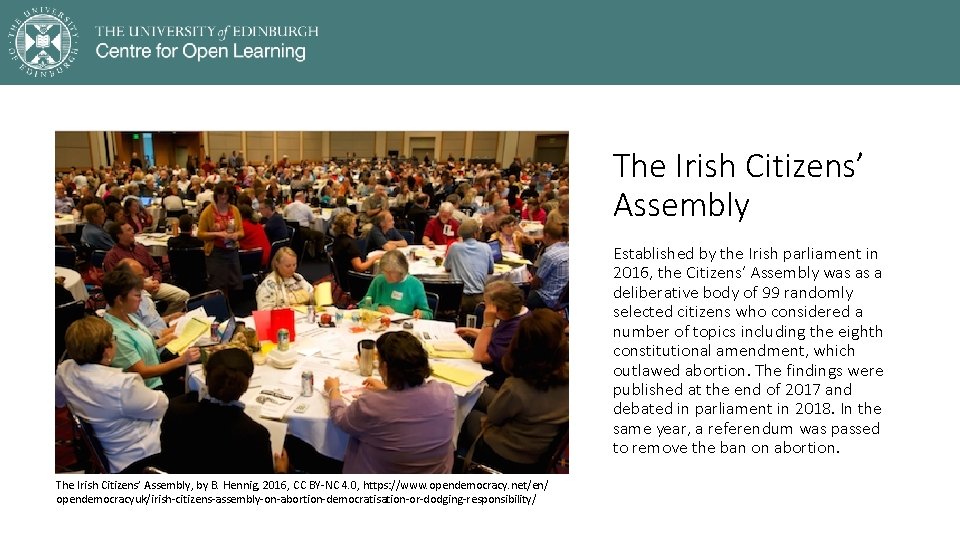
The Irish Citizens’ Assembly Established by the Irish parliament in 2016, the Citizens’ Assembly was as a deliberative body of 99 randomly selected citizens who considered a number of topics including the eighth constitutional amendment, which outlawed abortion. The findings were published at the end of 2017 and debated in parliament in 2018. In the same year, a referendum was passed to remove the ban on abortion. The Irish Citizens’ Assembly, by B. Hennig, 2016, CC BY-NC 4. 0, https: //www. opendemocracy. net/en/ opendemocracyuk/irish-citizens-assembly-on-abortion-democratisation-or-dodging-responsibility/
The view from the inside ‘My experience shows that some of the most polarising issues can be tackled in this manner. […] I felt empowered and informed – it gave me the language and skills to have difficult discussions. In a room of 100 people, only a handful ever tried to create division or build walls among us. I think most people want to find things to agree on and to discover common ground – through this we can always learn new ways to go forward. ’ Louise Caldwell, a randomly selected member of the 2016 Irish Citizens’ Assembly on abortion and other issues, The Guardian, 16 Jan 2019
Citizens’ Assembly of Scotland (2019 -20) • Comprises 130 citizens broadly representative of the adult population • Meets over six weekends from October 2019 to April 2020 to consider: • what kind of country are we seeking to build • how best can we overcome the challenges Scotland the world face in the 21 st century, including those arising from Brexit, and • what further work should be carried out to give us the information we need to make informed choices about the future of the country • The report on Scotland’s future will be laid before the Scottish Parliament for scrutiny and debate, and the Scottish Government has committed to act on recommendations within 90 days
UK Climate Change Assembly (2020) • Set up by six Select Committees of the House of Commons to understand public preferences on how the UK should tackle climate change • The assembly has 100 randomly selected members, who together are representative of the UK population • Meetings over four weekends from January to March 2020 • Members will hear evidence on the choices the UK faces, discuss them, and make recommendations about what the UK should do to become ‘net zero’ by 2050
Experiences with mini-publics so far • Examples from around the world show that deliberative mini-publics can and do influence public policy, but their impacts vary and are often indirect • Procedural design matters, e. g. publicity or the use of independent facilitators can limit elite power • The effectiveness of mini-publics depends on the public legitimacy of the process and, ultimately, the willingness of politicians or policymakers to act on the recommendations
Institutional reforms • Some scholars view mini-publics as preliminary experiments for more large-scale, participatory democratic practices • Alternatively, mini-publics could become institutionalised as permanent features of democracy • The ‘Ostbelgian model’: in 2019 the German speaking community of Belgium set up a permanent Citizen Council, consisting of 24 members, which will work with temporary citizens’ assemblies and propose policy recommendations to the elected parliament • In the UK, there are proposals to replace the House of Lords with a permanent citizens’ chamber
Summary and discussion
Summary • Referendums are highly inclusive but may reduce complex matters to binary choices, and there is a potential problem with accountability for the result • Participatory budgeting allows citizens to take part in deciding how public resources should be allocated, often at the local level • Deliberative mini-publics are representative citizen bodies intended to facilitate collective preference formation and informed decisionmaking on important policy issues
Discussion questions 1. How has democracy in the UK changed since 1918? (Gamble, 2019) 2. What are the similarities and differences between the various ‘democratic innovations’ discussed by Elstub and Escobar (2019)? 3. Do you think citizens‘ assemblies can play a positive role in shaping governance and public policy?
Reference list Curato, N. et al. , 2017. Twelve Key Findings in Deliberative Democracy Research. Daedalus, 146(3), pp. 28 -38. Elstub, S. and Escobar, O. , 2019. Defining and Typologising Democratic Innovations. In: Elstub, S. and Escobar, O. eds. The Handbook of Democratic Innovation and Governance. Cheltenham: Edward Elgar. Ch. 1. Fishkin, J. S. , 2018. Democracy When the People Are Thinking: Revitalizing Our Politics Through Public Deliberation. Oxford: Oxford University Press. Gamble, A. , 2019. A Hundred Years of British Democracy. In Gamble, A. and Wright, T. eds. Rethinking Democracy. Oxford: Wiley. Ch. 3.
This presentation is an Open Educational Resource. It was originally created for a lifelong learning course (SCQF level 7) at the Centre for Open Learning. You are free to use, share, and adapt this work. To view a copy of the license, visit https: //creativecommons. org/licenses/by-sa/4. 0/ © Max Jaede, University of Edinburgh, 2020, CC BY-SA 4. 0
Centre for Open Learning The University of Edinburgh Paterson’s Land Holyrood Road Edinburgh EH 8 8 AQ T: 0131 6504400 E: col@ed. ac. uk W: www. ed. ac. uk/open-learning Facebook: www. facebook. com/uoeshortcourses Twitter: www. twitter. com/uoeshortcourses