
Democracy in Theory and Practice 7 Modern Democracy

- Slides: 29
Democracy in Theory and Practice 7. Modern Democracy: The Global Context Dr Max Jaede, 2020
Recap of last week • There are different views on the legitimate role of the state vis-à-vis the private sphere and the market • The rise of the welfare state and economic planning over the course of the 20 th century has prompted a ‘neoliberal’ backlash • International organisations such as the WTO and IMF have promoted free-market, neoliberal policies
Outline of this class • Sovereignty and national self-determination • Democracy, the international system and globalisation • Theories of cosmopolitan democracy • Cosmopolitanism in practice
Sovereignty and national selfdetermination
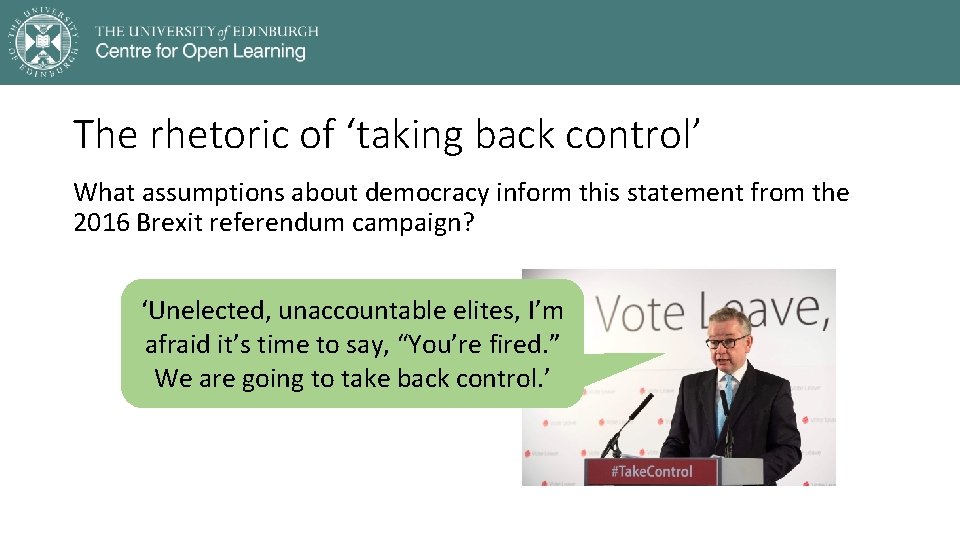
The rhetoric of ‘taking back control’ What assumptions about democracy inform this statement from the 2016 Brexit referendum campaign? ‘Unelected, unaccountable elites, I’m afraid it’s time to say, “You’re fired. ” We are going to take back control. ’
United Nations Charter, Article 1 The Purposes of the United Nations are: 1. To maintain international peace and security […]; 2. To develop friendly relations among nations based on respect for the principle of equal rights and self-determination of peoples […]; 3. To achieve international co-operation in solving international problems of an economic, social, cultural, or humanitarian character […]; 4. To be a centre for harmonizing the actions of nations in the attainment of these common ends.
United Nations Charter, Article 2 The Organization and its Members, in pursuit of the Purposes stated in Article 1, shall act in accordance with the following Principles: 1. The Organization is based on the principle of the sovereign equality of all its Members. 2. All Members […] shall fulfill in good faith the obligations assumed by them in accordance with the present Charter. 3. All Members shall settle their […] disputes by peaceful means […]. 4. All Members shall refrain […] from the threat or use of force against the territorial integrity or political independence of any state […].
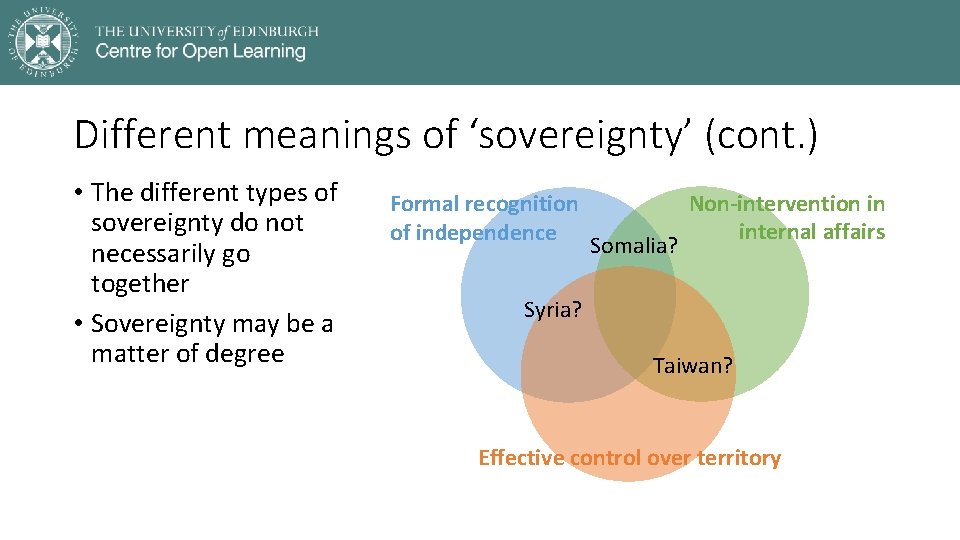
Different meanings of ‘sovereignty’ • Recognition of a state’s formal independence (and thus of sovereign equality) by other states • Exclusion of external actors from the state’s authority structures (non -intervention) • Ability of national governments to exercise effective control within the state’s territory (‘monopoly over the legitimate use of force’, Max Weber), and possibly, to regulate cross-border movements of goods, people, ideas, pollutants, etc.
Different meanings of ‘sovereignty’ (cont. ) • The different types of sovereignty do not necessarily go together • Sovereignty may be a matter of degree Formal recognition of independence Somalia? Non-intervention in internal affairs Syria? Taiwan? Effective control over territory
Democracy, the international system and globalisation
Democracy and international relations • Democratic theory has traditionally been concerned with democracy within a given society, and (wrongly? ) assumed that the fate of a national community is largely in its own hands • It is generally agreed that the international system lacks a central authority capable of enforcing laws, and that it is (at least partially) shaped by power politics • In practice, norms of sovereignty have been frequently violated, both voluntarily (through international treaties and conventions) and involuntarily (conquests, coercion, etc. )
Sovereignty as ‘organised hypocrisy’? ‘Of all the social environments within which human beings operate, the international system is one of the most complex and weakly institutionalised. It lacks authorative hierarchies. Rulers are likely to be more responsive to domestic material and ideational incentives than international ones. Norms are sometimes mutually inconsistent. Power is asymmetrical. No rule or set of rules can cover all circumstances. […] Organised hypocrisy is the norm. ’ Stephen Krasner (1999, p. 42)
Sovereignty and globalisation • An alternative view is that traditional forms of sovereignty (and thus democracy) have been undermined by more recent developments • Globalisation, the process by which states, markets and societies are becoming increasingly interconnected, intensified since the early 1990 s • Powerful non-state actors, including international organisations (UN, WTO, IMF, EU, etc. ) and multinational corporations, seem to lack democratic legitimacy
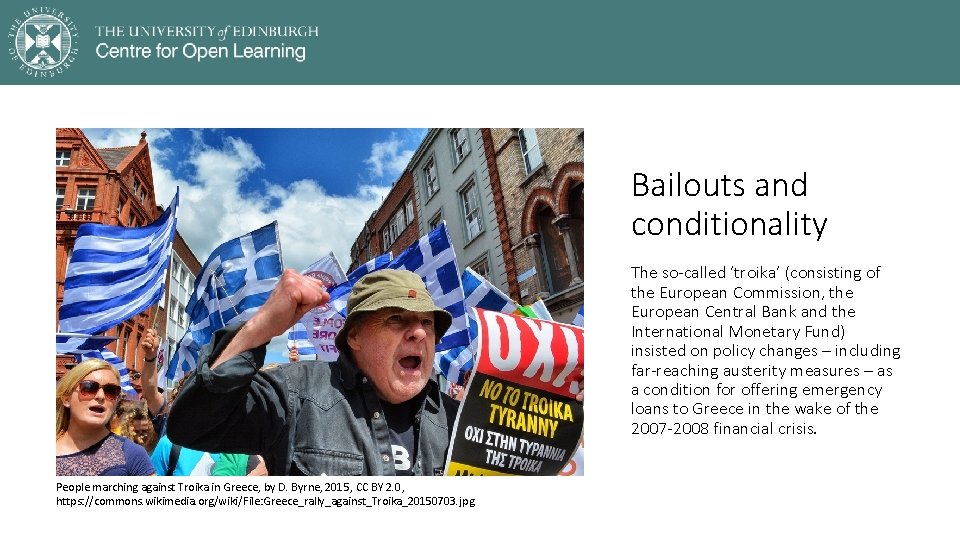
Bailouts and conditionality The so-called ‘troika’ (consisting of the European Commission, the European Central Bank and the International Monetary Fund) insisted on policy changes – including far-reaching austerity measures – as a condition for offering emergency loans to Greece in the wake of the 2007 -2008 financial crisis. People marching against Troika in Greece, by D. Byrne, 2015, CC BY 2. 0, https: //commons. wikimedia. org/wiki/File: Greece_rally_against_Troika_20150703. jpg
Theories of cosmopolitan democracy
The meaning of ‘cosmopolitanism’ • Cosmopolitanism maintains that our membership in a single human community is the ground of morality and/or that there should be some kind of world government • The Greek philosopher Diogenes declared himself a ‘citizen of the world’ [kosmopolites] in the 4 th century BC • In Toward Perpetual Peace (1795), Immanuel Kant outlined a (semi-) cosmopolitan global order Are you a cosmopolitan?
Cosmopolitan democracy • Theorists of cosmopolitan democracy argue that the state should no longer be the sole locus of democracy • Extending and deepening democracy across world regions and global networks is meant to complement democracy at the national level • Existing institutions, such as the UN and EU, should be reformed in order to ensure greater democratic legitimacy and accountability, and to create additional avenues for citizen participation
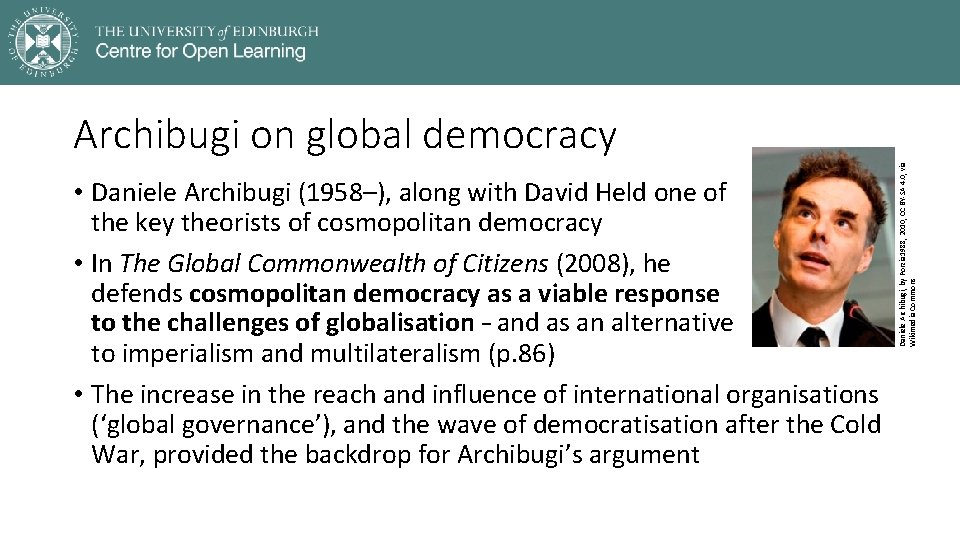
• Daniele Archibugi (1958–), along with David Held one of the key theorists of cosmopolitan democracy • In The Global Commonwealth of Citizens (2008), he defends cosmopolitan democracy as a viable response to the challenges of globalisation – and as an alternative to imperialism and multilateralism (p. 86) • The increase in the reach and influence of international organisations (‘global governance’), and the wave of democratisation after the Cold War, provided the backdrop for Archibugi’s argument Daniele Archibugi, by Porzia 1988, 2010, CC BY-SA 4. 0, via Wikimedia Commons Archibugi on global democracy
Objections to cosmopolitan democracy • Critics have argued that it is impossible to change the current system of states • A world government may become despotic, or undermine the selfdetermination of peoples • The social conditions required for democracy to function, such as a shared public sphere, do not exist beyond the state • Democratic representation of citizens in the EU is an interesting test case (Bellamy and Castiglione, 2013)
Cosmopolitanism in practice
Government policies • Archibugi (2008, p. 119) mentions the possibility that governments become ‘champions of cosmopolitanism’ • E. g. , there are plans in Scotland to extend voting rights to all legal residents, regardless of their nationality (Scottish Elections (Franchise and Representation) Bill 2019/20) • The Scottish Government’s international development strategy is also framed in cosmopolitan language (‘Scotland acting as a good global citizen’), but do the policies really amount to cosmopolitanism?
Global citizenship initiatives • The International Development Education Association Scotland (IDEAS) is a network of organisations that support ‘education for global citizenship’ • According to IDEAS, a global citizen is someone who: • • is aware of the wider world and has a sense of their own role as a world citizen; respects and values diversity; has an understanding of how the world works; is outraged by social injustice; participates in the community at a range of levels, from the local to the global; is willing to act to make the world a more equitable and sustainable place; takes responsibility for their actions.
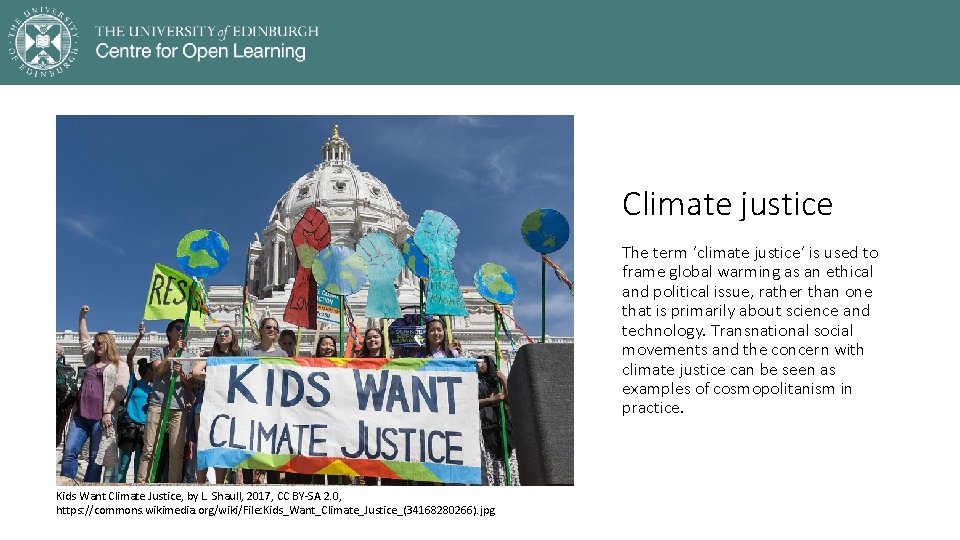
Climate justice The term ‘climate justice’ is used to frame global warming as an ethical and political issue, rather than one that is primarily about science and technology. Transnational social movements and the concern with climate justice can be seen as examples of cosmopolitanism in practice. Kids Want Climate Justice, by L. Shaull, 2017, CC BY-SA 2. 0, https: //commons. wikimedia. org/wiki/File: Kids_Want_Climate_Justice_(34168280266). jpg
Summary and discussion
Summary • Democratic theory has traditionally assumed that the fate of a society is largely is in its own hands • The nature of the international system and globalisation raise doubts about this assumption • Formal sovereignty does not necessarily go along with the absence of external influences or an ability to exercise control • Theories of cosmopolitan democracy advocate extending and deepening democracy beyond the state
Discussion questions 1. What are the main features of cosmopolitan democracy, as outlined by Archibugi (2008)? 2. Do you think progress towards this goal is possible? If so, how? 3. What are possible alternative forms of global governance?
Reference list Archibugi, D. , 2008. The Architecture of Cosmopolitan Democracy. In: The Global Commonwealth of Citizens: Toward Cosmopolitan Democracy. Princeton: Princeton University Press. Ch. 4. Bellamy, R. and Castiglione, D. , 2013. Three Models of Democracy, Political Community and Representation in the EU. Journal of European Public Policy, 20(2), pp. 206 -223. Held, D. , 2006. Democracy, the Nation-State and the Global System. In: Models of Democracy. 3 rd ed. Cambridge: Polity. Ch. 11. Krasner, S. D. , 1999. Sovereignty and Its Discontents. In: Sovereignty: Organized Hypocrisy. Princeton: Princeton University Press. Ch. 1.
This presentation is an Open Educational Resource. It was originally created for a lifelong learning course (SCQF level 7) at the Centre for Open Learning. You are free to use, share, and adapt this work. To view a copy of the license, visit https: //creativecommons. org/licenses/by-sa/4. 0/ © Max Jaede, University of Edinburgh, 2020, CC BY-SA 4. 0
Centre for Open Learning The University of Edinburgh Paterson’s Land Holyrood Road Edinburgh EH 8 8 AQ T: 0131 6504400 E: col@ed. ac. uk W: www. ed. ac. uk/open-learning Facebook: www. facebook. com/uoeshortcourses Twitter: www. twitter. com/uoeshortcourses