
Democracy in Theory and Practice 2 Classic Models



- Slides: 35
Democracy in Theory and Practice 2. Classic Models: Athenian Democracy Dr Max Jaede, 2020
Recap of last week • The word derives from the ancient Greek demokratia, a compound of demos (the people) and kratia (power or rule) • A historical approach allows us to trace important debates about democracy and to distinguish different models which have evolved over time • Semantic, normative and descriptive questions about democracy are difficult to disentangle
Outline of this class • The origins of democracy: freedom and equality • Institutions of Athenian democracy • Shortcomings of Athenian democracy • Direct democracy today
The origins of democracy: freedom and equality
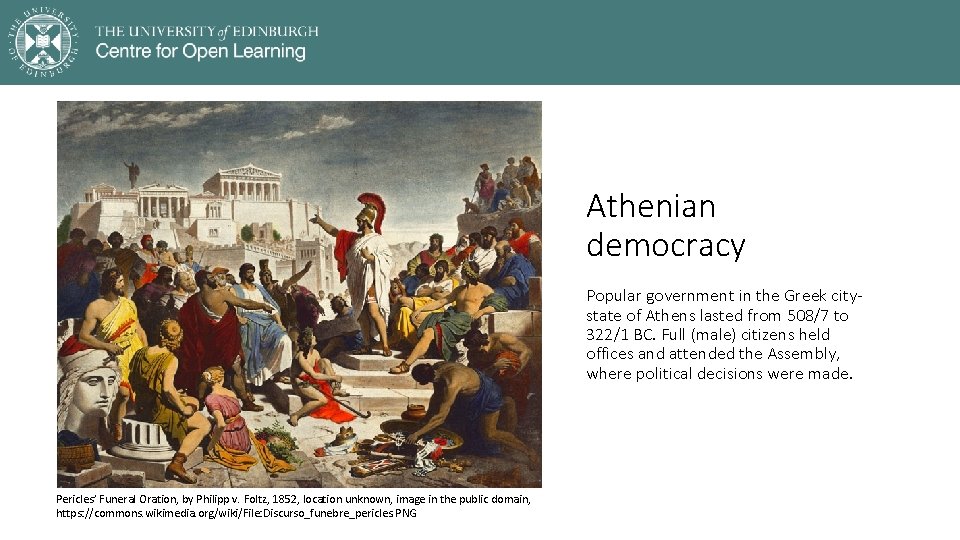
Athenian democracy Popular government in the Greek citystate of Athens lasted from 508/7 to 322/1 BC. Full (male) citizens held offices and attended the Assembly, where political decisions were made. Pericles’ Funeral Oration, by Philipp v. Foltz, 1852, location unknown, image in the public domain, https: //commons. wikimedia. org/wiki/File: Discurso_funebre_pericles. PNG
Greeks vs. barbarians • Although Athenian democracy is the best and most influential example, other Greek city-states were also democratic (e. g. Chios, Kos, Rhodes, Thebes) • The ancient Greeks came to think of themselves as collectively free, in contrast to unfree ‘barbarians’ (non-Greek slaves and non-Greek speaking peoples, including the Persians)
The origins of Athenian democracy • Cleisthenes’ reforms in 508/7 BC are usually considered to be the origin of Athenian democracy, which lasted until the Macedonians took over power • Prior to these reforms, Athens was dominated by competing aristocratic clans and ruled by different ‘tyrants’ who seized power unlawfully • Cleisthenes established equal rights for all (male) citizens, a set of new democratic institutions, and new ‘tribes’ (basically voting districts) to break up older tribal allegiances
Pericles on freedom and equality ‘Our constitution is called a democracy because power is in the hands not of a minority but of the whole people. When it is a question of settling private disputes, everyone is equal before the law; when it is a question of putting one person before another in positions of public responsibility, what counts is not membership of a particular class, but the actual ability which the man possesses. […] And just as our political life is free and open, so is our day-to-day life in our relations with each other. ’ Extract from Pericles’ funeral oration in Thucydides’ History of the Peloponnesian War, written in the 5 th century BC (Held, 2006, p. 13)
Aristotle on freedom and equality According to Aristotle’s Politics (written 335 -323 BC), democracy is based on the interrelated values of liberty and equality: 1. Liberty A. ‘Ruling and being ruled in turn’ (political liberty; implies respect for the law) B. ‘Living as one chooses’ (private liberty) 2. Equality – the moral and practical basis of 1 A A. Equal voting power and right to speak in the Assembly B. In principle, equal chances to hold office (in later years, some office holders were also financially remunerated)
Institutions of Athenian democracy
The Assembly • The Assembly was the main lawmaking body and also decided on finance, taxation, foreign affairs, etc. • It met at least 40 times a year • All ca. 30, 000 male citizens over 20 had the right to attend, speak and vote at the Assembly • Many citizens did not attend the Assembly most of the time, and at least intially, the meeting place could only accommodate around 6, 000 people
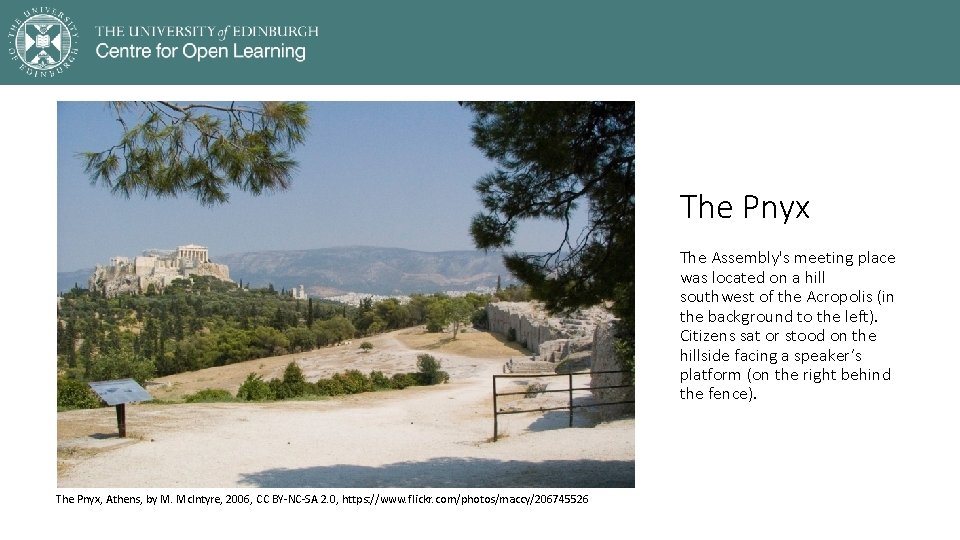
The Pnyx The Assembly's meeting place was located on a hill southwest of the Acropolis (in the background to the left). Citizens sat or stood on the hillside facing a speaker’s platform (on the right behind the fence). The Pnyx, Athens, by M. Mc. Intyre, 2006, CC BY-NC-SA 2. 0, https: //www. flickr. com/photos/maccy/206745526
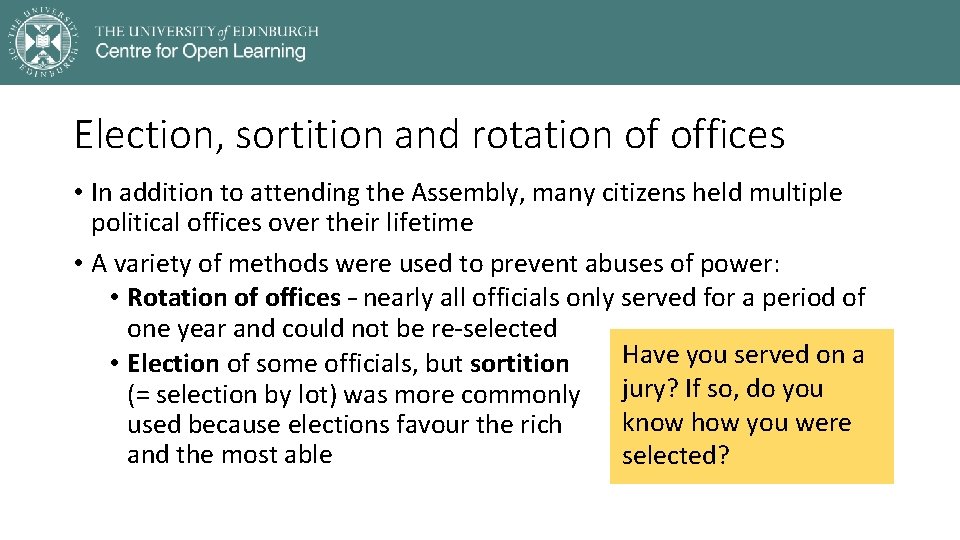
Election, sortition and rotation of offices • In addition to attending the Assembly, many citizens held multiple political offices over their lifetime • A variety of methods were used to prevent abuses of power: • Rotation of offices – nearly all officials only served for a period of one year and could not be re-selected Have you served on a • Election of some officials, but sortition (= selection by lot) was more commonly jury? If so, do you know how you were used because elections favour the rich and the most able selected?
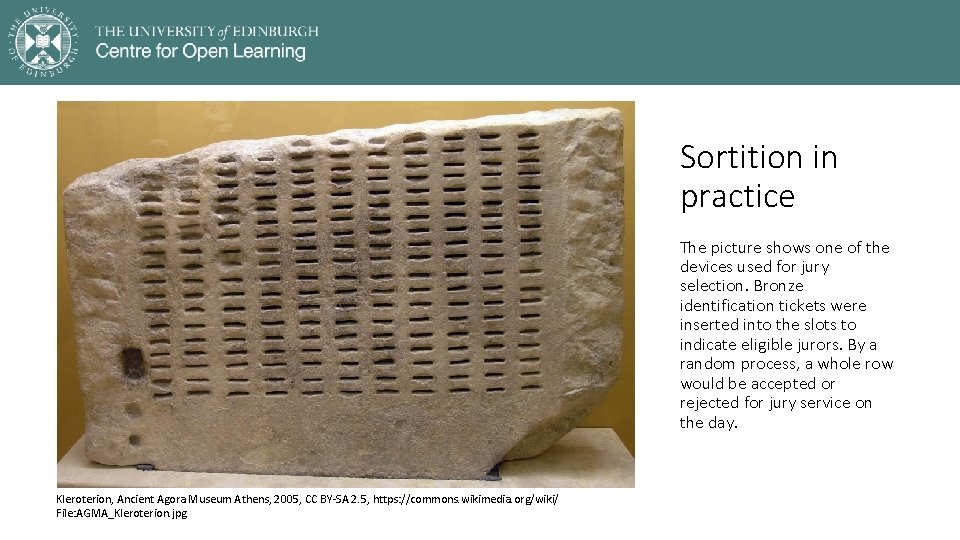
Sortition in practice The picture shows one of the devices used for jury selection. Bronze identification tickets were inserted into the slots to indicate eligible jurors. By a random process, a whole row would be accepted or rejected for jury service on the day. Kleroterion, Ancient Agora Museum Athens, 2005, CC BY-SA 2. 5, https: //commons. wikimedia. org/wiki/ File: AGMA_Kleroterion. jpg
The Council of 500 • The Council of 500 – also known as ‘Boule’ – fulfilled executive functions and prepared the agenda for the Assembly • It consisted of 50 randomly selected citizens over 30 from each of the ten tribes, and met almost daily • 50 members of the Council always served as a standing committee (one of whom was chosen by lot to chair Council and Assembly meetings on that day) • The institution probably derived from an advisory body of nobles which existed before Cleisthenes’ reforms
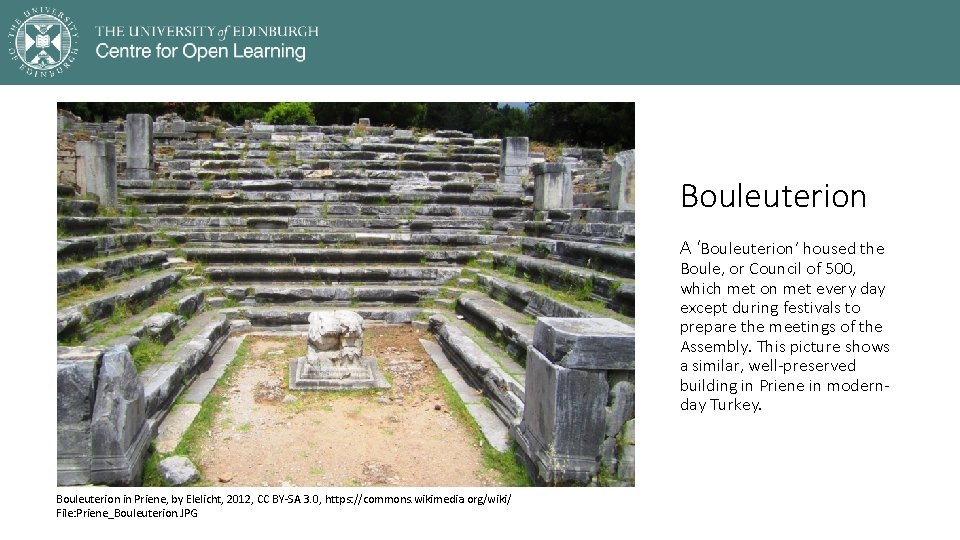
Bouleuterion A ‘Bouleuterion’ housed the Boule, or Council of 500, which met on met every day except during festivals to prepare the meetings of the Assembly. This picture shows a similar, well-preserved building in Priene in modernday Turkey. Bouleuterion in Priene, by Elelicht, 2012, CC BY-SA 3. 0, https: //commons. wikimedia. org/wiki/ File: Priene_Bouleuterion. JPG
Panels of judges • Each year ca. 6, 000 citizens served as jurors in the courts (or rather, as panels of judges – there were no professional judges) • Assemblies of citizen judges were very large, consisting of 201, 401 or 501 individuals • Courts were regarded as an essential part of the democracy • When Athens started to pay citizen judges, this became a source of income for older and poorer citizens
Generals and magistrates • 10 generals, one from each tribe, were elected and accountable to the Assembly • In addition, 600 magistrates, who were supported by secretaries, carried out administrative functions • The most important magistrates were elected, others selected by lot • All of these officials could only serve for one year at a time • A special court scrutinised the work of all office holders after the end of their term of office
Shortcomings of Athenian democracy
Exclusive citizenship • By today‘s standards, Athenian democracy was highly problematic • Women, metics (foreigners) and slaves did not have citizen rights: Thorley (2004, p. 79) estimates that during the 5 th century BC, the number of citizens was 30, 000 – 50, 000 out of a total population of 250, 000 – 300, 000 • Athens’ wealth and the citizens’ leisure to participate in political life were based on a slave economy and imperial expansion Do you think ancient Athens was really a democracy?
Size and ineffectiveness • The Assembly’s processes were slow and it had to deal with a huge amount of business, including matters of the expanding Delian League/Athenian Empire • Although ancient Athens is often described as a ‘small city-state’ or a ‘face-to-face society’ (Crick, 2002, p. 18), it was very large by ancient standards • The majority lived in Athens’ agricultural hinterland – e. g. , Marathon on the east coast of Attica is ca. 25 miles away from Athens
Factionalism and poor decisions • Politics was dominated by citizens of high birth and rank such as Pericles (495– 429 BC), an influential orator in the Assembly who was repeatedly elected as a general • Democratic practice entailed informal networks and intrigues, competing factions, and frequent accusations and trials against office holders • Democratic Athens lost the Peloponnesian War (431– 404 BC) against a league led by aristocratic Sparta
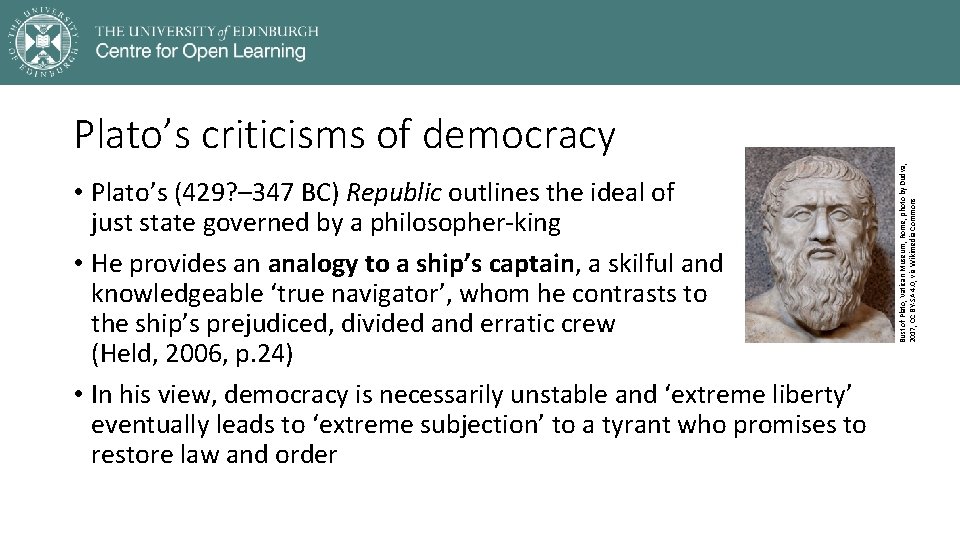
• Plato’s (429? – 347 BC) Republic outlines the ideal of just state governed by a philosopher-king • He provides an analogy to a ship’s captain, a skilful and knowledgeable ‘true navigator’, whom he contrasts to the ship’s prejudiced, divided and erratic crew (Held, 2006, p. 24) • In his view, democracy is necessarily unstable and ‘extreme liberty’ eventually leads to ‘extreme subjection’ to a tyrant who promises to restore law and order Bust of Plato, Vatican Museum, Rome, photo by Dudva, 2017, CC BY-SA 4. 0, via Wikimedia Commons Plato’s criticisms of democracy
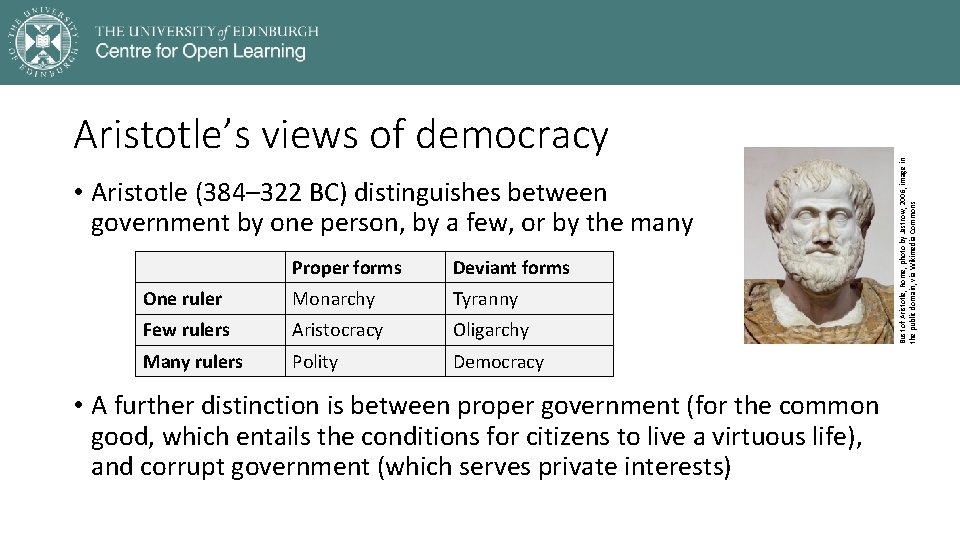
• Aristotle (384– 322 BC) distinguishes between government by one person, by a few, or by the many Proper forms Deviant forms One ruler Monarchy Tyranny Few rulers Aristocracy Oligarchy Many rulers Polity Democracy • A further distinction is between proper government (for the common good, which entails the conditions for citizens to live a virtuous life), and corrupt government (which serves private interests) Bust of Aristotle, Rome, photo by Jastrow, 2006, image in the public domain, via Wikimedia Commons Aristotle’s views of democracy
Aristotle’s views of democracy (cont. ) • Aristotle holds that, in theory, monarchy is the best proper form of government • He argues that, of the three deviant forms, democracy is the least bad (cf. Churchill: ‘Democracy is the worst form of government, except for all the others’) • Aristotle ultimately seems to favour a ‘mixed constitution’, which combines monarchical, aristocratic and democratic elements and reconciles claims of the wealthy and the poor
Direct democracy today
Full direct democracy • From the mid 19 th century, ‘democracy’ was taken to denote indirect, representative democracy, which is now distinguished from so-called ‘direct democracy’ • In the fullest sense, direct democracy means that (A) citizens meet at an assembly and (B) decide political issues/choose among alternative measures • Today, there are only a few cases of this pure form of direct democracy at the sub-state or local level
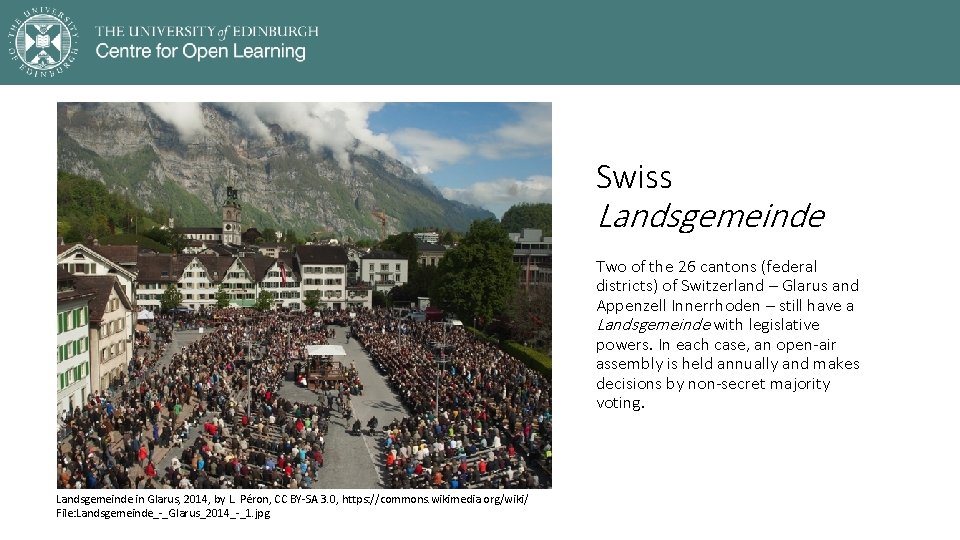
Swiss Landsgemeinde Two of the 26 cantons (federal districts) of Switzerland – Glarus and Appenzell Innerrhoden – still have a Landsgemeinde with legislative powers. In each case, an open-air assembly is held annually and makes decisions by non-secret majority voting. Landsgemeinde in Glarus, 2014, by L. Péron, CC BY-SA 3. 0, https: //commons. wikimedia. org/wiki/ File: Landsgemeinde_-_Glarus_2014_-_1. jpg
Partial direct democracy • There are elements of direct democracy in many representative democracies, e. g. : • Popular initiatives, referendums and recalls • Participatory budgeting • Citizens’ juries/assemblies • However, modern practices are in many ways different from direct democracy in ancient Athens • The direct or indirect quality of democratic government is generally a matter of degree, rather than either/or
Summary and discussion
Summary • Democracy in ancient Athens was characterised by an extremely high degree of citizen participation in government • Equality of citizens was the practical and moral basis of political liberty, understood as ‘ruling and being ruled in turn’ • Key democratic institutions included sortition (selection by lot) and rotation of offices • Athenian democracy has been criticised for its ineffectiveness, instability, and the exclusiveness of citizenship
Discussion questions 1. What do you associate with the word ‘citizenship’? 2. What are the main similarities and differences between the Athenian model and democracy today? 3. Why were many philosophers critical of democracy?
Reference list Crick, B. , 2002. The Place From Where We Started. In: Democracy: A Very Short Introduction. Oxford: Oxford University Press. Ch. 2. Hansen, M. H. , 1992. The Tradition of Athenian Democracy A. D. 1750 -1990. Greece & Rome, 39(1), pp. 14 -30. Held, D. , 2006. Classical Democracy: Athens. In: Models of Democracy. 3 rd ed. Cambridge: Polity. Ch. 1. Raaflaub, K. , Ober, J. , and Wallace, R. W. eds. 2007. The Origins of Democracy in Ancient Greece. Berkeley: University of California Press.
This presentation is an Open Educational Resource. It was originally created for a lifelong learning course (SCQF level 7) at the Centre for Open Learning. You are free to use, share, and adapt this work. To view a copy of the license, visit https: //creativecommons. org/licenses/by-sa/4. 0/ © Max Jaede, University of Edinburgh, 2020, CC BY-SA 4. 0
Centre for Open Learning The University of Edinburgh Paterson’s Land Holyrood Road Edinburgh EH 8 8 AQ T: 0131 6504400 E: col@ed. ac. uk W: www. ed. ac. uk/open-learning Facebook: www. facebook. com/uoeshortcourses Twitter: www. twitter. com/uoeshortcourses