
Democracy and Legitimacy How do states maintain legitimacy



- Slides: 32
Democracy and Legitimacy
• How do states maintain legitimacy? • Are modern societies facing a crisis of legitimation? • Why is political legitimacy so often linked to the claim to be democratic? • What are the core features of democratic rule? • What models of democratic rule have been advanced? • How do democratic systems operate in practice?
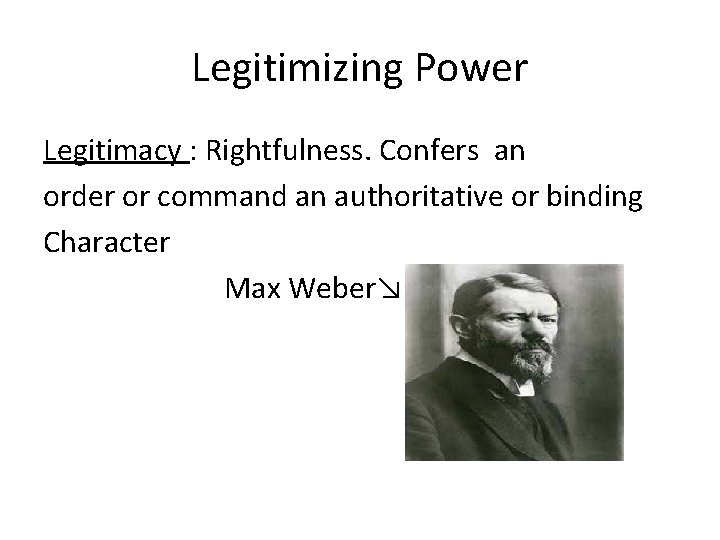
Legitimizing Power Legitimacy : Rightfulness. Confers an order or command an authoritative or binding Character Max Weber↘
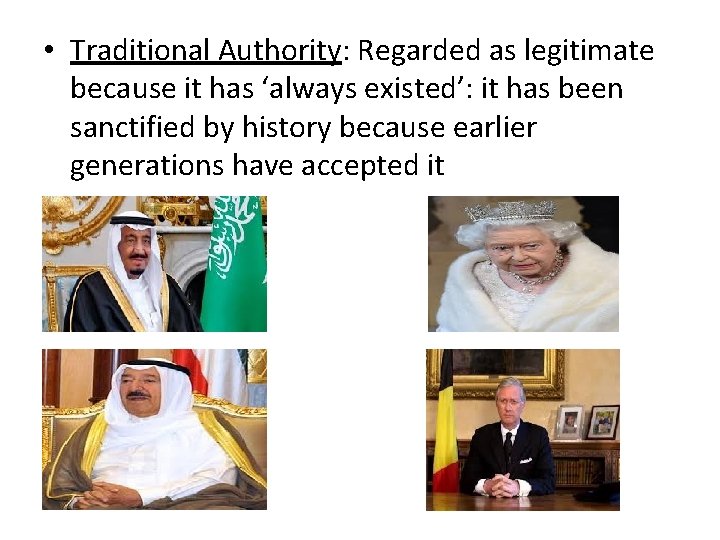
• Traditional Authority: Regarded as legitimate because it has ‘always existed’: it has been sanctified by history because earlier generations have accepted it
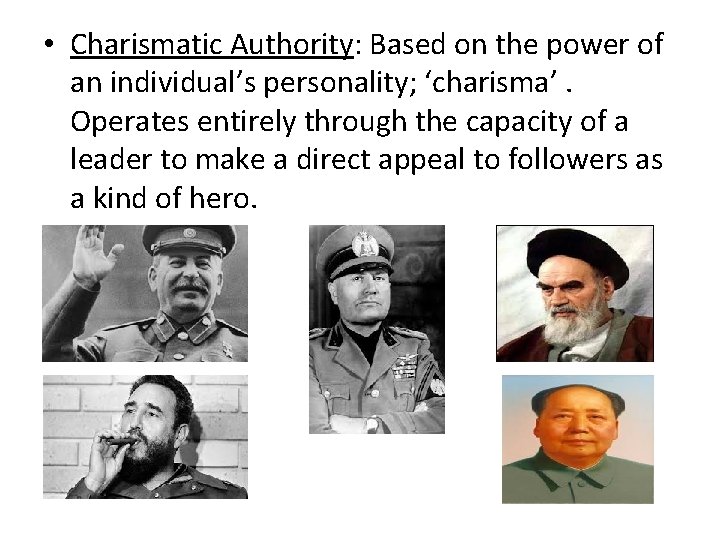
• Charismatic Authority: Based on the power of an individual’s personality; ‘charisma’. Operates entirely through the capacity of a leader to make a direct appeal to followers as a kind of hero.
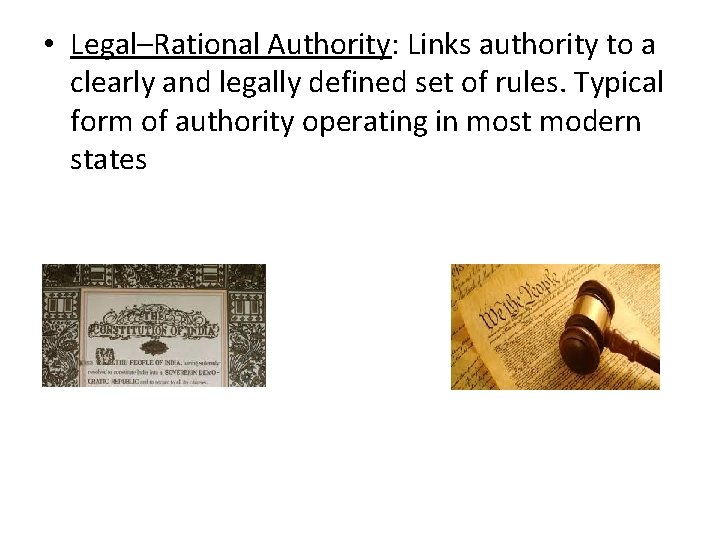
• Legal–Rational Authority: Links authority to a clearly and legally defined set of rules. Typical form of authority operating in most modern states
Democratic legitimacy • Consent: Assent or permission; agreement to be governed or ruled. • Trust: The level of confidence people have in one another in discharging their civic responsibilities. The belief that politicians and leaders in particular will keep their promises.
Non-democratic legitimacy • Elections: albeit one-party, sometimes noncompetitive or ‘rigged’ elections • Non-democratic regimes have sought performance legitimation based on their ability to deliver rising living standards, public order, improved education and health care. • Ideological legitimation has been used, either in an attempt to uphold the leader’s, military’s or party’s right to rule, or to establish broader goals and principles that invest the larger regime with a sense of rightfulness.
Legitimation Crises and Revolutions • Revolution: A popular uprising, involving extra -legal mass action, which brings about fundamental change. • Reform: Change brought about within a system, usually by peaceful and incremental measures
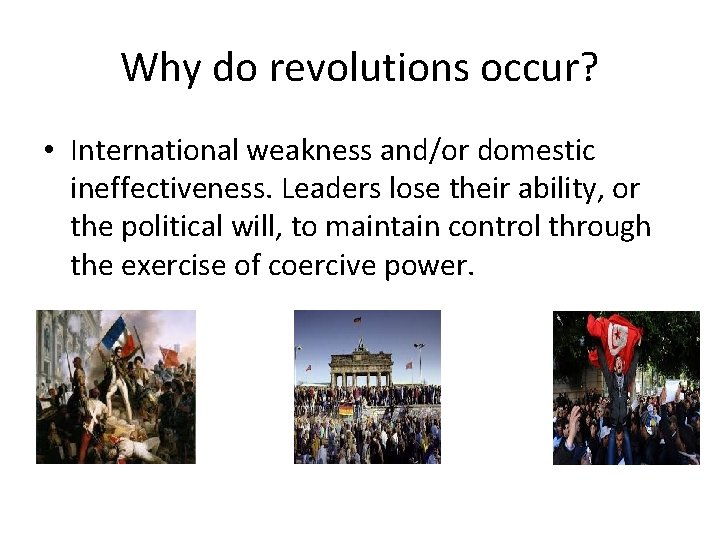
Why do revolutions occur? • International weakness and/or domestic ineffectiveness. Leaders lose their ability, or the political will, to maintain control through the exercise of coercive power.
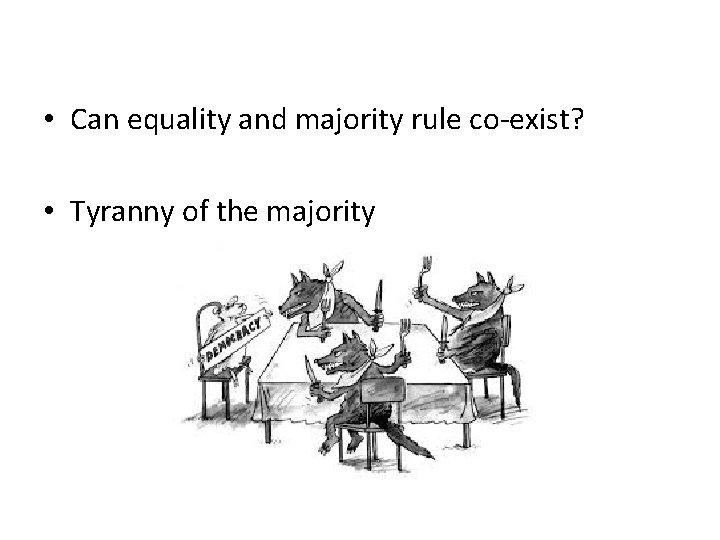
DEMOCRACY • Political Equality: Equal distribution of political power and influence. Can thus be thought of as the core principle of democracy • Majority rule: The rule that the will of the majority overrides the will of the minority • Can these two principles co exist?
• Can equality and majority rule co-exist? • Tyranny of the majority
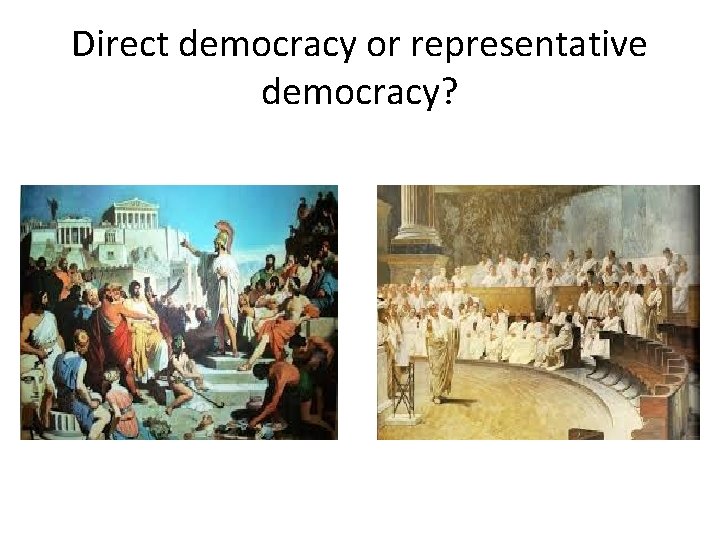
Direct democracy or representative democracy?
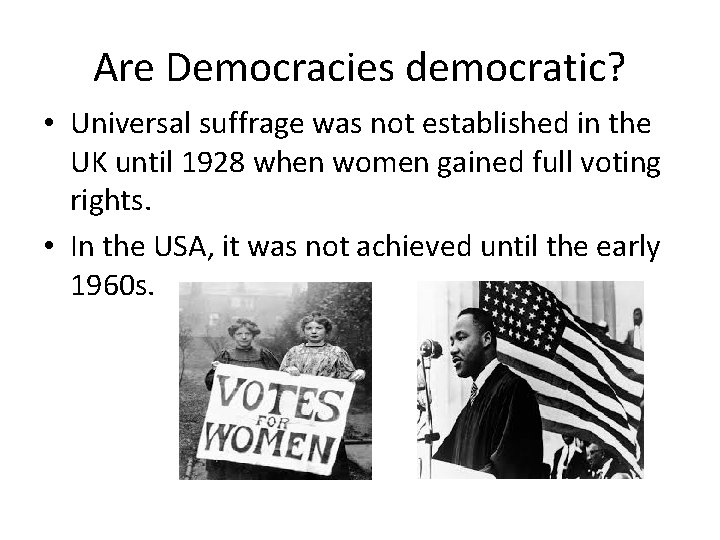
Are Democracies democratic? • Universal suffrage was not established in the UK until 1928 when women gained full voting rights. • In the USA, it was not achieved until the early 1960 s.
• What was the first state to achieve universal suffrage?
Models of democracy • • classical democracy protective democracy developmental democracy people’s democracy
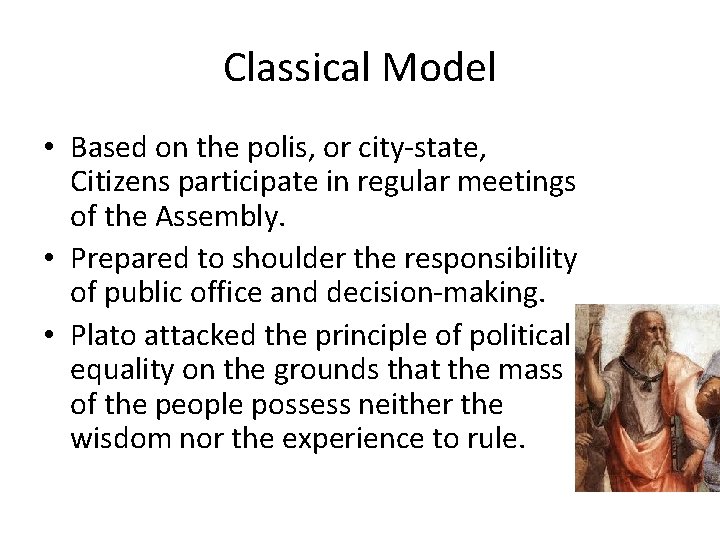
Classical Model • Based on the polis, or city-state, Citizens participate in regular meetings of the Assembly. • Prepared to shoulder the responsibility of public office and decision-making. • Plato attacked the principle of political equality on the grounds that the mass of the people possess neither the wisdom nor the experience to rule.
Protective democracy • Democracy was seen less as a mechanism through which the public could participate in political life, and more as a device through which citizens could protect themselves from the encroachments of government • Limited and indirect form of democracy • Natural rights: God-given rights that are fundamental to human beings and are therefore inalienable (they cannot betaken away).
Developmental Democracy • Citizens are ‘free’ only when they participate directly and continuously in shaping the life of their community. • General will: The genuine interests of a collective body, equivalent to the common good; the will of all to act selflessly. • Accountability: A duty to explain one’s conduct and be open to criticism by others.
People’s Democracy • Various democratic models that the Marxist tradition has generated. • Deliberative democracy: A form of democracy that emphasizes the need for discourse and debate to help to define the public interest. • Leninist democracy: Organized on the basis of ‘democratic centralism’, articulates the interest of the proletariat.
Views on Democracy • • • pluralism elitism corporatism the New Right Marxism.
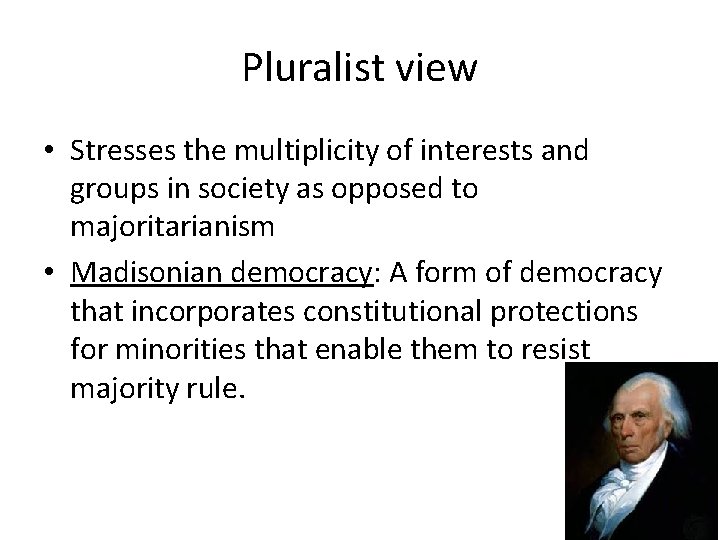
Pluralist view • Stresses the multiplicity of interests and groups in society as opposed to majoritarianism • Madisonian democracy: A form of democracy that incorporates constitutional protections for minorities that enable them to resist majority rule.
Elitist view • Elite rule, either as an inevitable and desirable feature of social existence, or as a remediable and regrettable one. • Elitism: a minority in whose hands power, wealth or privilege is concentrated
Corporatist view • Fascist Italy tried to construct a ‘corporate state’ by integrating both managers and workers into the processes of government • Neocorporatism: A tendency found in western democracies for organized interests to be granted privileged and institutionalized access to policy formulation.
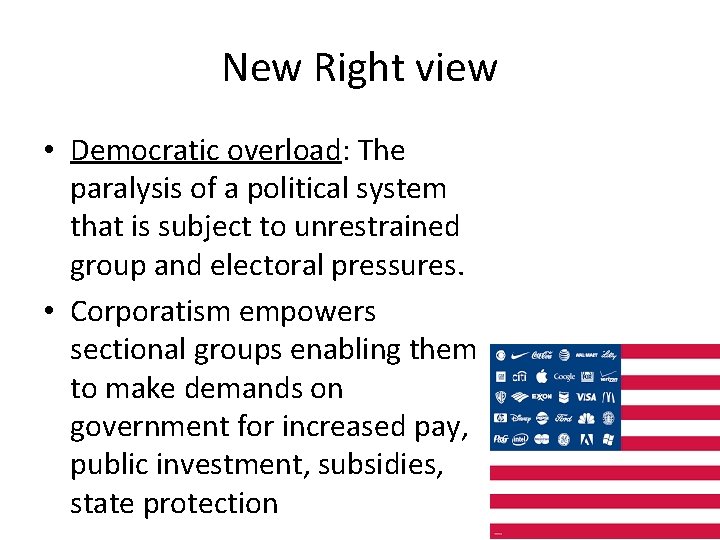
New Right view • Democratic overload: The paralysis of a political system that is subject to unrestrained group and electoral pressures. • Corporatism empowers sectional groups enabling them to make demands on government for increased pay, public investment, subsidies, state protection
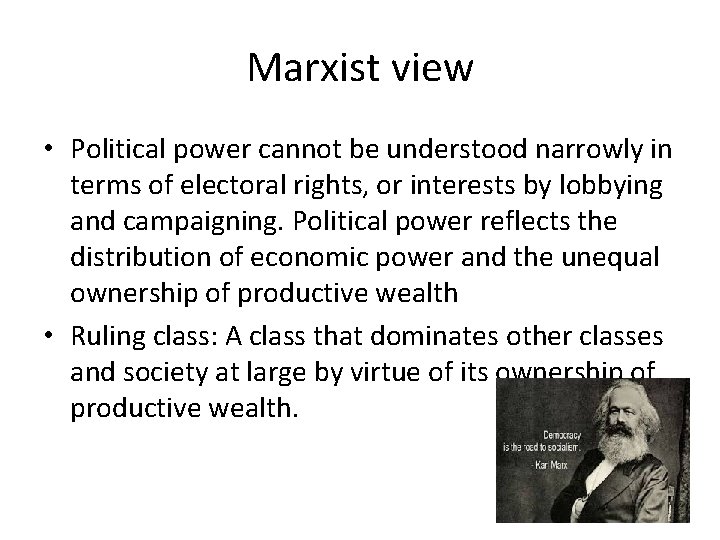
Marxist view • Political power cannot be understood narrowly in terms of electoral rights, or interests by lobbying and campaigning. Political power reflects the distribution of economic power and the unequal ownership of productive wealth • Ruling class: A class that dominates other classes and society at large by virtue of its ownership of productive wealth.
Cosmopolitan democracy • Form of democracy that operates at supranational levels of governance based on the idea of transnational or global citizenship • World parliament • Multilevel system of post-sovereign governance in which transnational nongovernmental groups and associations interact.