
Demobilization and After Action Planning for an Extended
Demobilization and After Action Planning for an Extended Public Health Incident Jeff Shaw Courtney Wetternach
Presentation Objectives • Understand the importance of demobilization planning at all levels of incident management • Understand the demobilization planning process • Demonstrate development of a Demobilization Plan for an extended public health incident. • Demonstrate the process of evaluating response activities against CDC public health preparedness capabilities in an after action review and report. • Understand information collection and data analysis after an extended public health incident for use in an after action report and improvement plan.
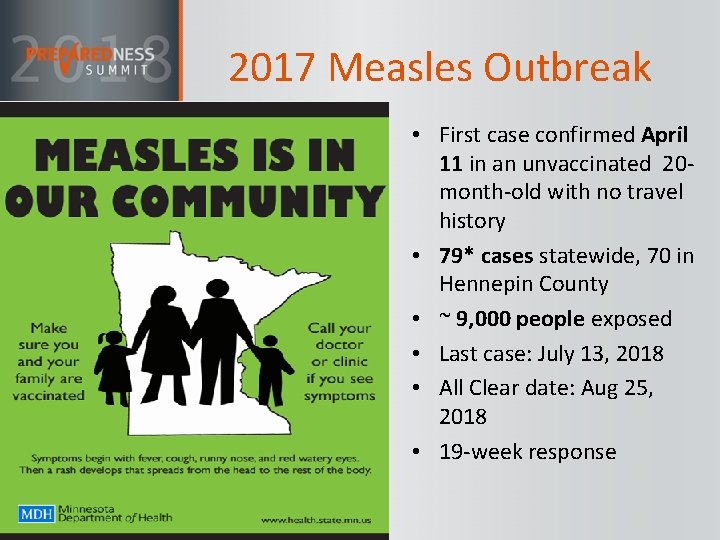
2017 Measles Outbreak • First case confirmed April 11 in an unvaccinated 20 month-old with no travel history • 79* cases statewide, 70 in Hennepin County • ~ 9, 000 people exposed • Last case: July 13, 2018 • All Clear date: Aug 25, 2018 • 19 -week response
Response Summary • • • 13 Operational periods 90+ staff, 2 MRC volunteers City, County, State involvement Multi-disciplinary Coalition partner coordination and information-sharing

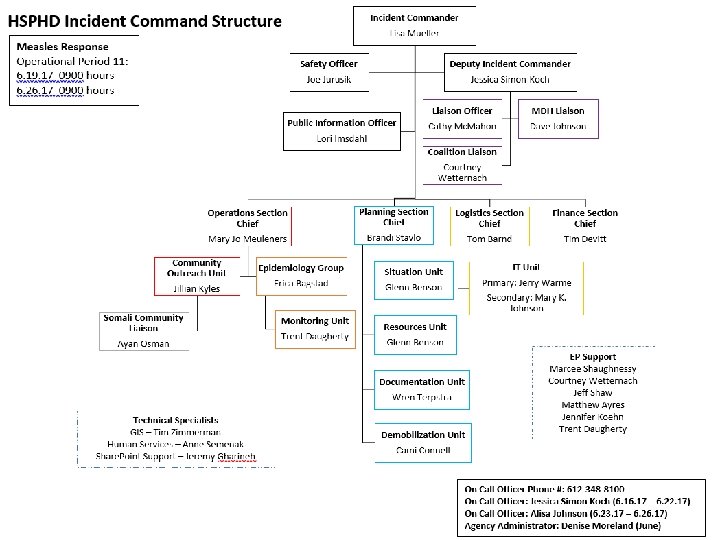
Incident Command System (ICS)

Demobilization • The release and return of resources that are no longer required during or after an incident/event. • Does not signal an “end to operations”. – Transition/addition of resources • Requires the support of all incident management personnel. • Also considers activities that may need to continue after the response phase has ended.
How has your jurisdiction accomplished demobilization? Does your jurisdiction have a Demobilization Plan (or template)?
Demobilization “Idea” Requirements: • Someone to recognize the need to demobilize resources. • Selling the idea to the Incident Commander. • Buy in from section chiefs/branch managers to identify resources to demobilize. • Addition/assignment of staff to lead demobilization planning.
2017 Hennepin County Measles Response Demobilization Process
![Demobilization Unit Leader • Activated OP 9 • IAP demobilization objectives: [OP 9] Consider](http://slidetodoc.com/presentation_image_h2/c2a02bacc723a31f129effb16233592b/image-11.jpg "Demobilization Unit Leader • Activated OP 9 • IAP demobilization objectives: [OP 9] Consider")
Demobilization Unit Leader • Activated OP 9 • IAP demobilization objectives: [OP 9] Consider demobilization plans. [OP 10 -11] Develop demobilization plans. [OP 12 a, b] Implement and monitor demobilization plans. [OP 13] Communicate demobilization plans to staff, partner organizations and the public, as appropriate. – [OP 13] Schedule and prepare for After Action Review. – – • Responsible to develop and implement Demobilization Plan
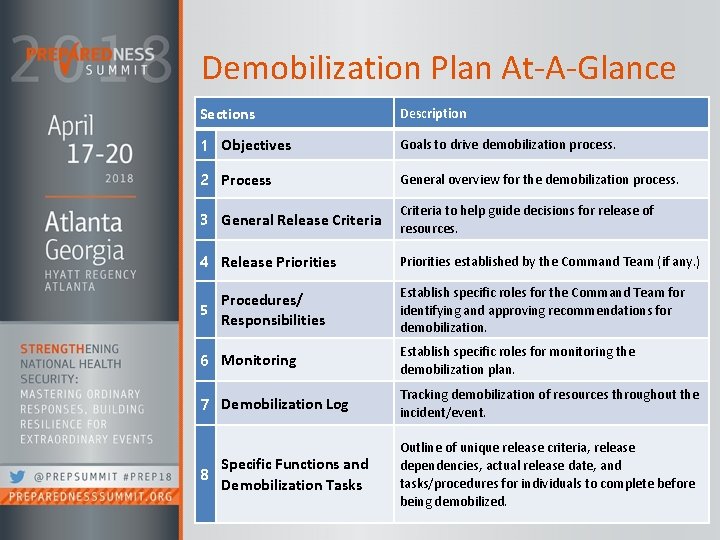
Demobilization Plan At-A-Glance Sections Description 1 Objectives Goals to drive demobilization process. 2 Process General overview for the demobilization process. 3 General Release Criteria to help guide decisions for release of resources. 4 Release Priorities established by the Command Team (if any. ) Procedures/ 5 Responsibilities Establish specific roles for the Command Team for identifying and approving recommendations for demobilization. 6 Monitoring Establish specific roles for monitoring the demobilization plan. 7 Demobilization Log Tracking demobilization of resources throughout the incident/event. 8 Specific Functions and Demobilization Tasks Outline of unique release criteria, release dependencies, actual release date, and tasks/procedures for individuals to complete before being demobilized.

Demobilization Introduction 1. Lead initial discussion about demobilization with full Command Team at a Daily Briefing. – For the Measles 2017, 30 minutes were added onto the scheduled 1 hour meeting at the Department Operations Center (DOC). 2. Direct each section to discuss recommendations for demobilization at tactical meetings. 3. Add an agenda item to Daily Briefings to allow time for presentation of recommendations, discussion, and approval by the Incident Commander. 4. Develop Demobilization Plan with information as it is acquired.
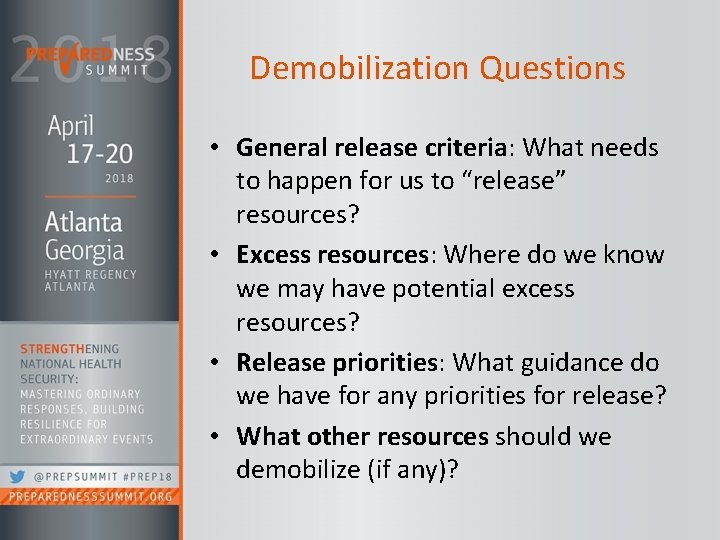
Demobilization Questions • General release criteria: What needs to happen for us to “release” resources? • Excess resources: Where do we know we may have potential excess resources? • Release priorities: What guidance do we have for any priorities for release? • What other resources should we demobilize (if any)?
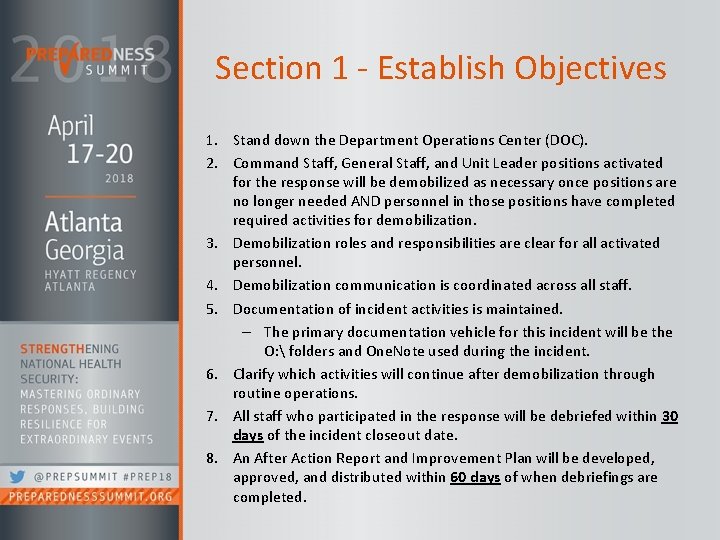
Section 1 - Establish Objectives 1. Stand down the Department Operations Center (DOC). 2. Command Staff, General Staff, and Unit Leader positions activated for the response will be demobilized as necessary once positions are no longer needed AND personnel in those positions have completed required activities for demobilization. 3. Demobilization roles and responsibilities are clear for all activated personnel. 4. Demobilization communication is coordinated across all staff. 5. Documentation of incident activities is maintained. – The primary documentation vehicle for this incident will be the O: folders and One. Note used during the incident. 6. Clarify which activities will continue after demobilization through routine operations. 7. All staff who participated in the response will be debriefed within 30 days of the incident closeout date. 8. An After Action Report and Improvement Plan will be developed, approved, and distributed within 60 days of when debriefings are completed.
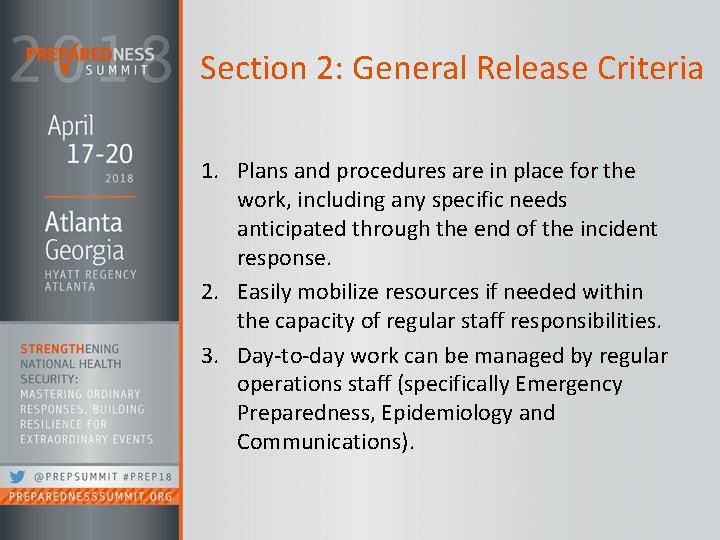
Section 2: General Release Criteria 1. Plans and procedures are in place for the work, including any specific needs anticipated through the end of the incident response. 2. Easily mobilize resources if needed within the capacity of regular staff responsibilities. 3. Day-to-day work can be managed by regular operations staff (specifically Emergency Preparedness, Epidemiology and Communications).
Section 3: Release Priorities The following release priorities have been established by the Incident Command staff: 1. Inform Minnesota Department of Health (MDH) of Hennepin County’s plans to demobilize. 2. Consult with Emergency Preparedness (EP) and Epidemiology Units to monitor capacity to manage remaining incident response tasks and work within normal operations.
Section 4: Release Procedures 1. Incident Commander approves demobilization plan, resources orders, and demobilizations. 2. Planning Section Chief in coordination with Emergency Preparedness (EP) staff are responsible for monitoring and management of the Demobilization Plan. 3. Command Staff and Section Chiefs have ongoing responsibility to identify excess resources and provide priorities/recommendations for demobilization to the Planning Chief. 4. For positions that have been deactivated (designated as technical expert/support), supervisors will determine the level of activity needed from each position to achieve the objectives (e. g. , attending briefings or tactics meetings).
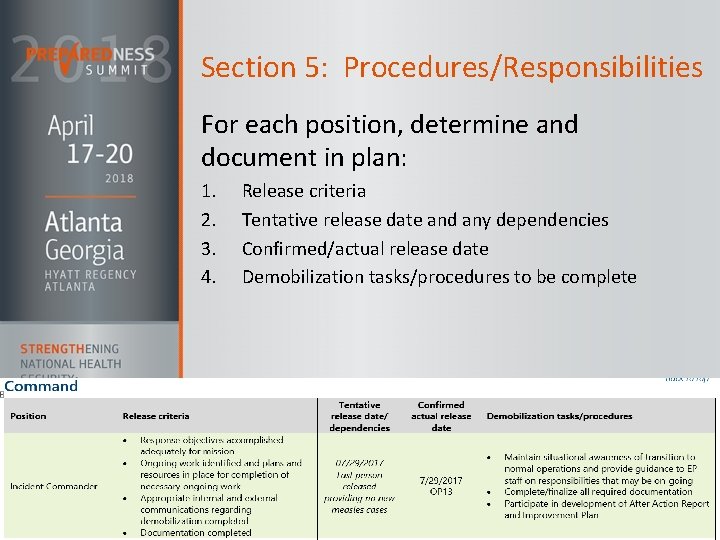
Section 5: Procedures/Responsibilities For each position, determine and document in plan: 1. 2. 3. 4. Release criteria Tentative release date and any dependencies Confirmed/actual release date Demobilization tasks/procedures to be complete
Measles 2017 Demobilization Plan
Section 6: Monitoring 1. Incident Action Plan (IAP) development will include discussion of resources needed to achieve objectives and respond to changes in the incident/situation. 2. Command Section Chiefs will identify operational resources that are or will be in excess of what is needed and prepare list for Planning Section/EP for review at weekly in-person Command Team briefings. 3. The Planning Section will be responsible for updating the Demobilization Log and communicating about the demobilization plan including, but not limited to, remaining tasks/procedures and dependencies for release of resources.
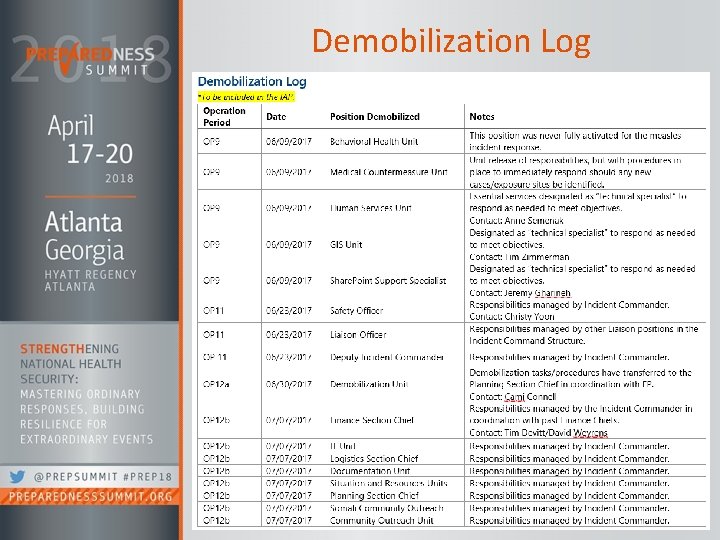
Demobilization Log
After Action Review 1. After Action Review/Debrief 2. After Action Report and Improvement Plan 3. Tools and Resources
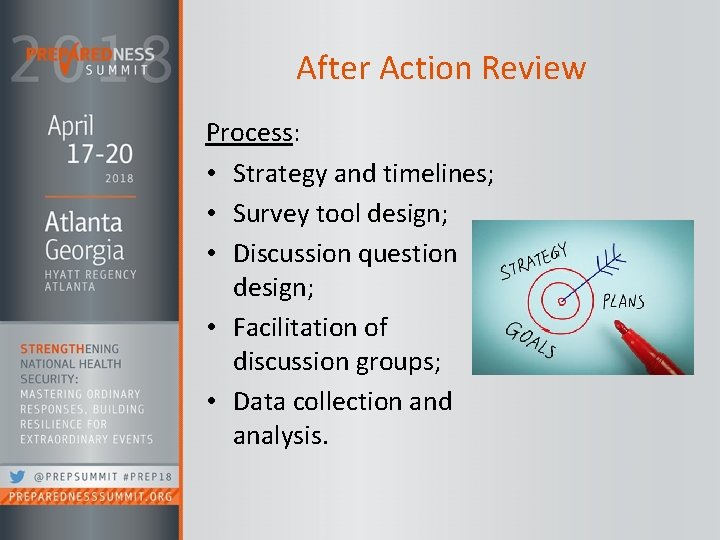
After Action Review Process: • Strategy and timelines; • Survey tool design; • Discussion question design; • Facilitation of discussion groups; • Data collection and analysis.
Debriefing Strategy • Make a plan! – Who will conduct/facilitate to process? – Consider who, what, when, where, and how – Scope – Timelines – Accountability • Goal: all staff who participated in the response have the opportunity to provide feedback.

Measles 2017 Debrief Plan
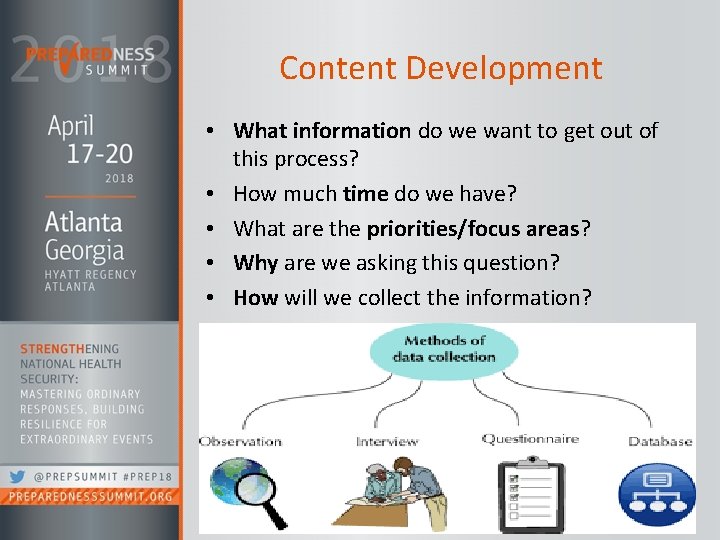
Content Development • What information do we want to get out of this process? • How much time do we have? • What are the priorities/focus areas? • Why are we asking this question? • How will we collect the information?
Survey • Sent to ALL responders – 78% response rate • Included both open and closed-ended questions • Open for 1 month – 3 reminders Link to survey questions
EP Staff Debrief
Responder Debrief • 10 Discussion groups – Grouped by position • • • 90 minutes 3 -10 people/session 67% participation rate Semi-structured group interviews Ground rules and expectations
After Action Report and Improvement Plan Process: • Capability assessment; • Data analysis; • Writing the AAR; • Developing and tracking corrective actions
Assess Capabilities Assessment Tool for AARs
Data Analysis 1. Categorize 2. Organize 3. Analyze
Debriefing data summary • Includes both quantitative and qualitative data Measles Debrief Summary
Data collection: Lessons learned • Very time-consuming for an extended response • In the end, the qualitative survey data and discussion questions were duplicative. • Where does EP staff feedback fit? • Debrief timing
Writing the After Action Report • Capabilities, Functions, Tasks, and Resource Elements! • Data collection plan • Improvement Plan – work backwards? • Consider: – – – PHEP/CRI grant requirements CDC Operational Readiness Review NACCHO Project Public Health Ready Public Health Accreditation requirements Other
Improvement Plan
Tools and Resources 1. Demobilization Plan Development Standard Operating Procedure (SOP) 2. Demobilization Plan template 3. After Action Plan strategy template 4. Survey Tool template 5. Discussion Questions template 6. Final 2017 Measles After Action Report and Improvement Plan (if requested).

Q&A
Thank you! Jeff Shaw Senior Planning Analyst Hennepin County Public Health Emergency Preparedness Jeffrey. Shaw@Hennepin. us Courtney Wetternach, MPH Principal Planning Analyst Hennepin County Public Health Emergency Preparedness Courtney. Wetternach@Hennepin. us
- Slides: 40