
Demand Response Research Center Accomplishments and Future Directions
- Slides: 16
Demand Response Research Center Accomplishments and Future Directions Mary Ann Piette Research Director - Demand Response Research Center State Energy Advisory Board Meeting Lawrence Berkeley National Laboratory Berkeley – August 14, 2007
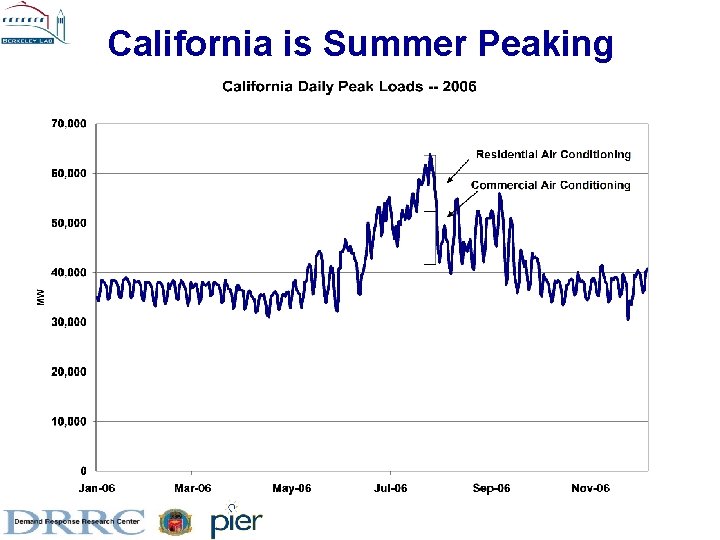
California is Summer Peaking
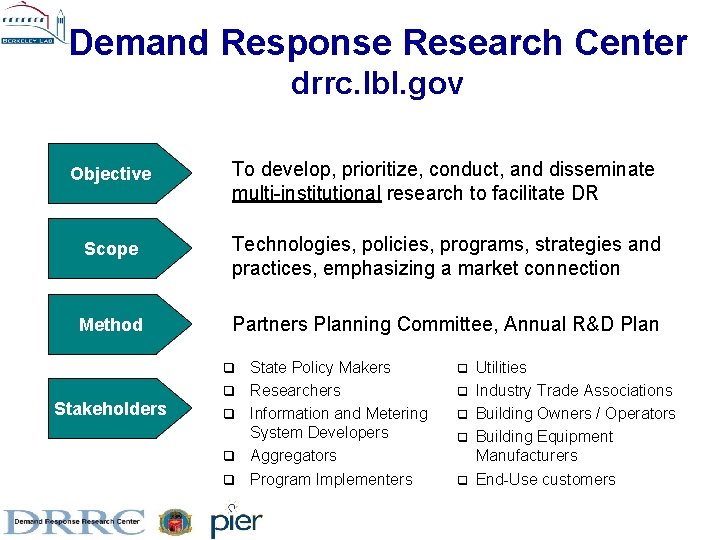
Demand Response Research Center drrc. lbl. gov Objective To develop, prioritize, conduct, and disseminate multi-institutional research to facilitate DR Scope Technologies, policies, programs, strategies and practices, emphasizing a market connection Method Partners Planning Committee, Annual R&D Plan q Stakeholders q q State Policy Makers Researchers Information and Metering System Developers Aggregators Program Implementers q q q Utilities Industry Trade Associations Building Owners / Operators Building Equipment Manufacturers End-Use customers
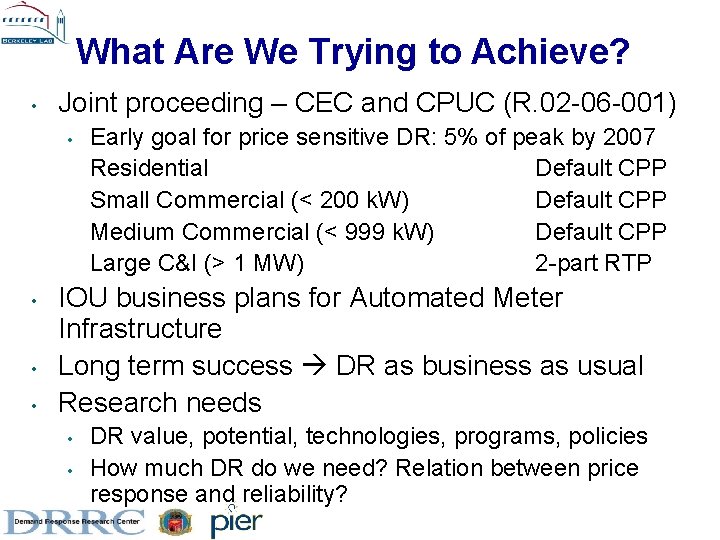
What Are We Trying to Achieve? • Joint proceeding – CEC and CPUC (R. 02 -06 -001) • • Early goal for price sensitive DR: 5% of peak by 2007 Residential Default CPP Small Commercial (< 200 k. W) Default CPP Medium Commercial (< 999 k. W) Default CPP Large C&I (> 1 MW) 2 -part RTP IOU business plans for Automated Meter Infrastructure Long term success DR as business as usual Research needs • • DR value, potential, technologies, programs, policies How much DR do we need? Relation between price response and reliability?
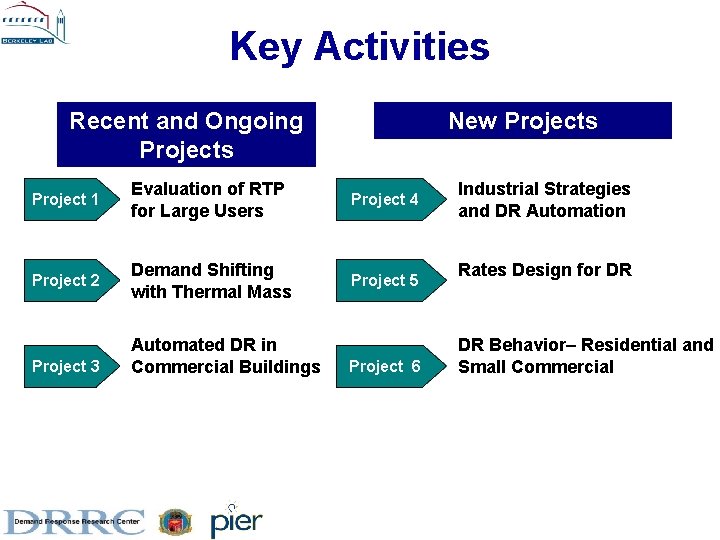
Key Activities Recent and Ongoing Projects New Projects Project 1 Evaluation of RTP for Large Users Project 4 Project 2 Demand Shifting with Thermal Mass Project 5 Project 3 Automated DR in Commercial Buildings Project 6 Industrial Strategies and DR Automation Rates Design for DR DR Behavior– Residential and Small Commercial
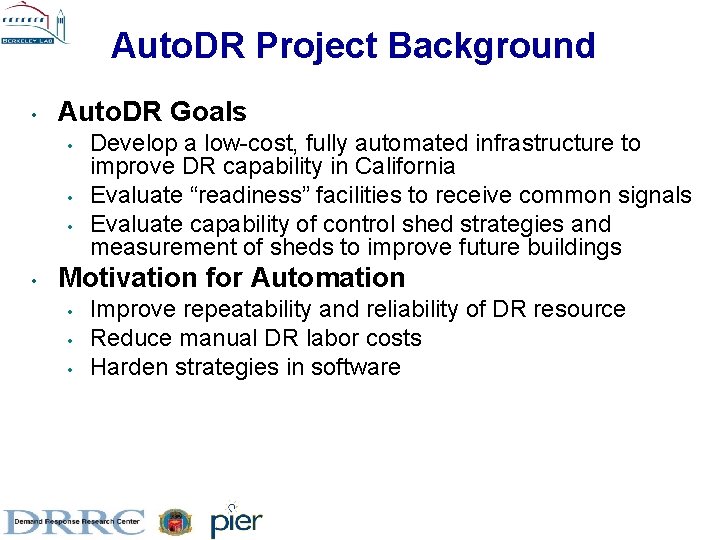
Auto. DR Project Background • Auto. DR Goals • • Develop a low-cost, fully automated infrastructure to improve DR capability in California Evaluate “readiness” facilities to receive common signals Evaluate capability of control shed strategies and measurement of sheds to improve future buildings Motivation for Automation • • • Improve repeatability and reliability of DR resource Reduce manual DR labor costs Harden strategies in software
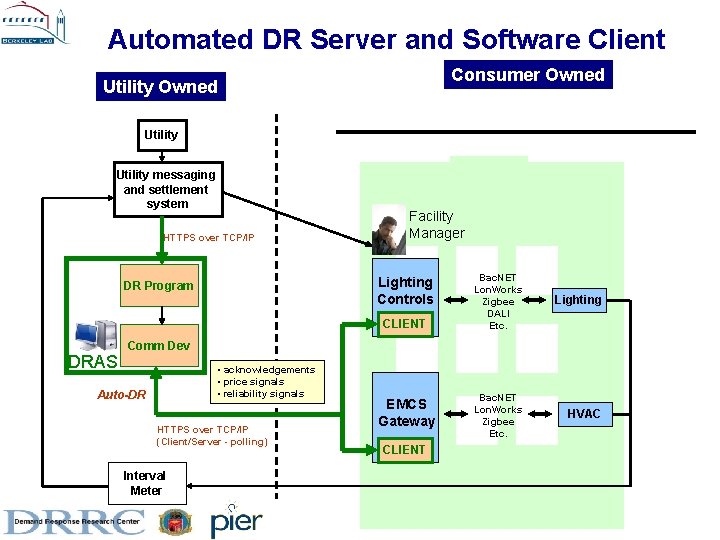
Automated DR Server and Software Client Consumer Owned Utility messaging and settlement system HTTPS over TCP/IP Facility Manager Lighting Controls DR Program CLIENT DRAS Bac. NET Lon. Works Zigbee DALI Etc. Lighting Bac. NET Lon. Works Zigbee Etc. HVAC Comm Dev • acknowledgements • price signals • reliability signals Auto-DR HTTPS over TCP/IP (Client/Server - polling) Interval Meter EMCS Gateway CLIENT
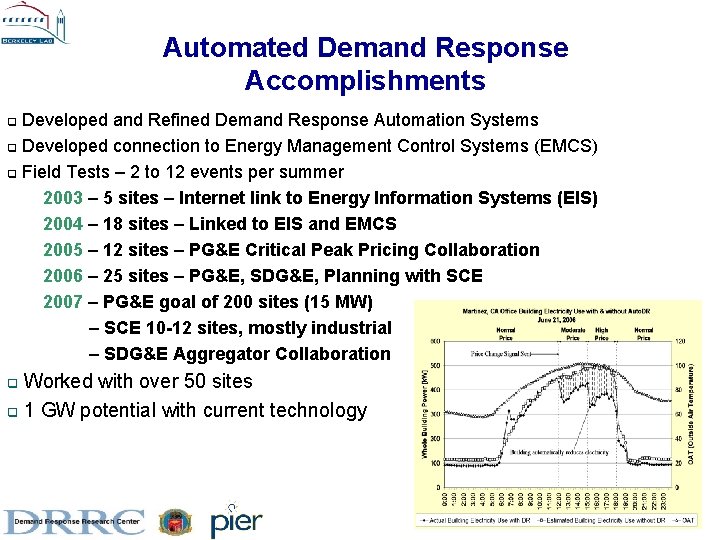
Automated Demand Response Accomplishments Developed and Refined Demand Response Automation Systems q Developed connection to Energy Management Control Systems (EMCS) q Field Tests – 2 to 12 events per summer 2003 – 5 sites – Internet link to Energy Information Systems (EIS) 2004 – 18 sites – Linked to EIS and EMCS 2005 – 12 sites – PG&E Critical Peak Pricing Collaboration 2006 – 25 sites – PG&E, SDG&E, Planning with SCE 2007 – PG&E goal of 200 sites (15 MW) – SCE 10 -12 sites, mostly industrial – SDG&E Aggregator Collaboration q Worked with over 50 sites q 1 GW potential with current technology q
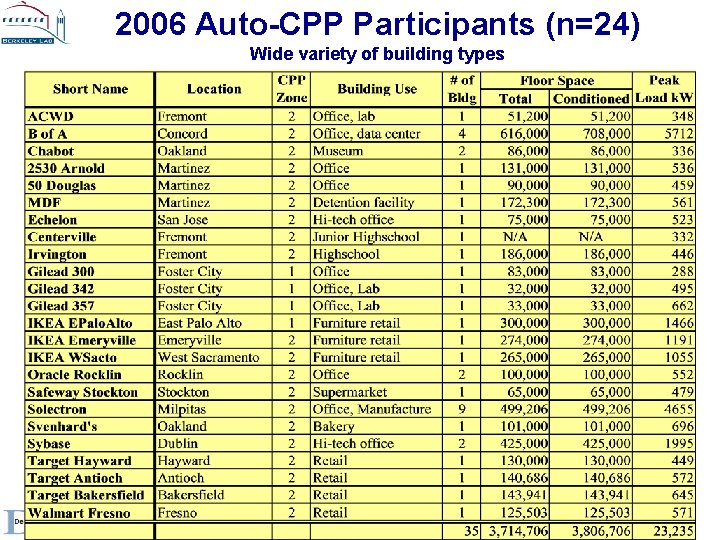
2006 Auto-CPP Participants (n=24) Wide variety of building types
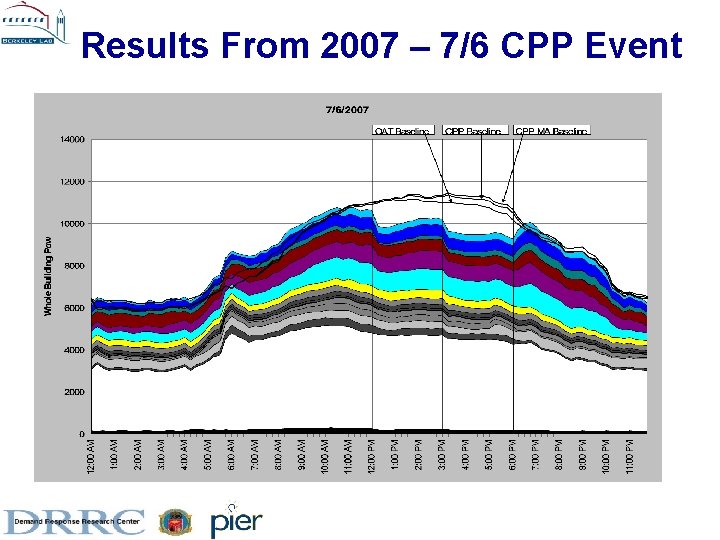
Results From 2007 – 7/6 CPP Event
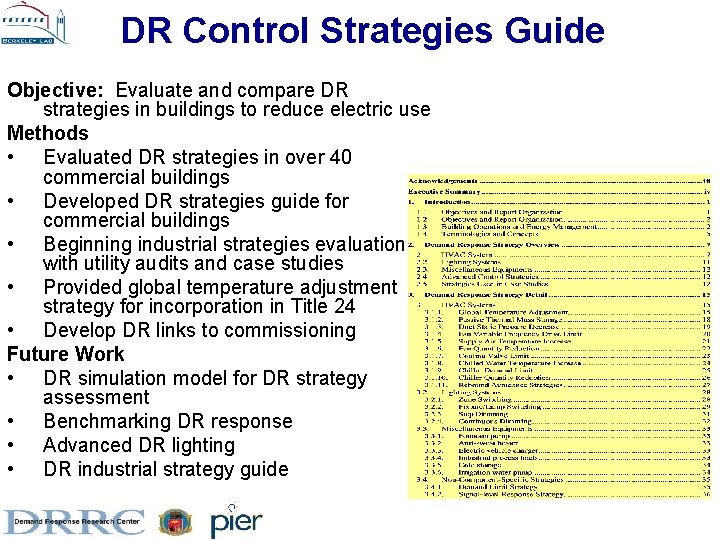
DR Control Strategies Guide Objective: Evaluate and compare DR strategies in buildings to reduce electric use Methods • Evaluated DR strategies in over 40 commercial buildings • Developed DR strategies guide for commercial buildings • Beginning industrial strategies evaluation with utility audits and case studies • Provided global temperature adjustment strategy for incorporation in Title 24 • Develop DR links to commissioning Future Work • DR simulation model for DR strategy assessment • Benchmarking DR response • Advanced DR lighting • DR industrial strategy guide
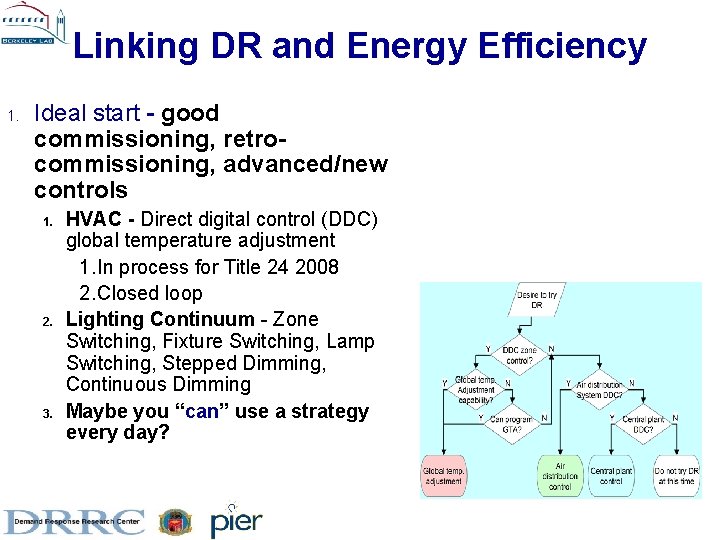
Linking DR and Energy Efficiency 1. Ideal start - good commissioning, retrocommissioning, advanced/new controls 1. 2. 3. HVAC - Direct digital control (DDC) global temperature adjustment 1. In process for Title 24 2008 2. Closed loop Lighting Continuum - Zone Switching, Fixture Switching, Lamp Switching, Stepped Dimming, Continuous Dimming Maybe you “can” use a strategy every day?
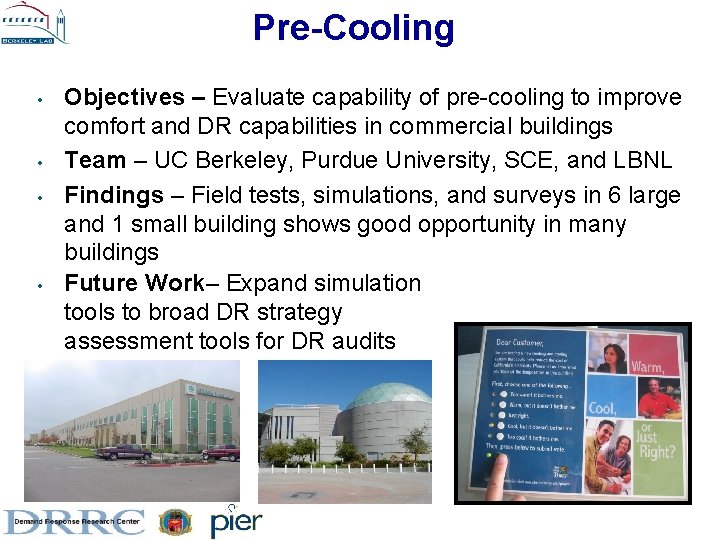
Pre-Cooling • • Objectives – Evaluate capability of pre-cooling to improve comfort and DR capabilities in commercial buildings Team – UC Berkeley, Purdue University, SCE, and LBNL Findings – Field tests, simulations, and surveys in 6 large and 1 small building shows good opportunity in many buildings Future Work– Expand simulation tools to broad DR strategy assessment tools for DR audits
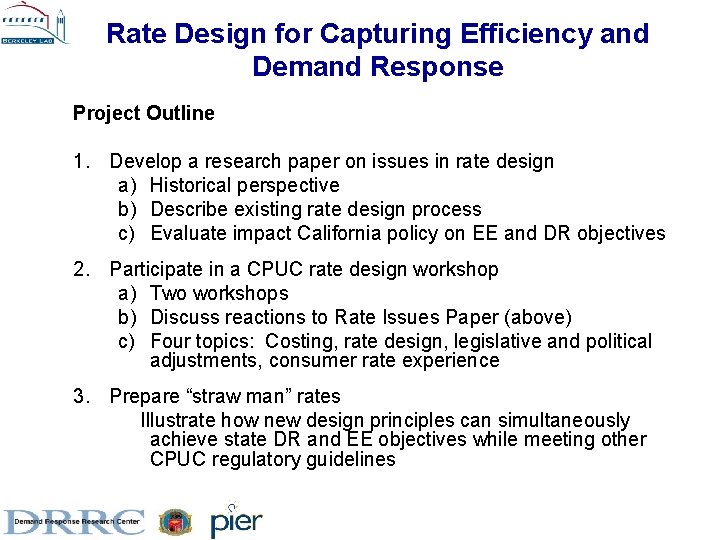
Rate Design for Capturing Efficiency and Demand Response Project Outline 1. Develop a research paper on issues in rate design a) Historical perspective b) Describe existing rate design process c) Evaluate impact California policy on EE and DR objectives 2. Participate in a CPUC rate design workshop a) Two workshops b) Discuss reactions to Rate Issues Paper (above) c) Four topics: Costing, rate design, legislative and political adjustments, consumer rate experience 3. Prepare “straw man” rates Illustrate how new design principles can simultaneously achieve state DR and EE objectives while meeting other CPUC regulatory guidelines
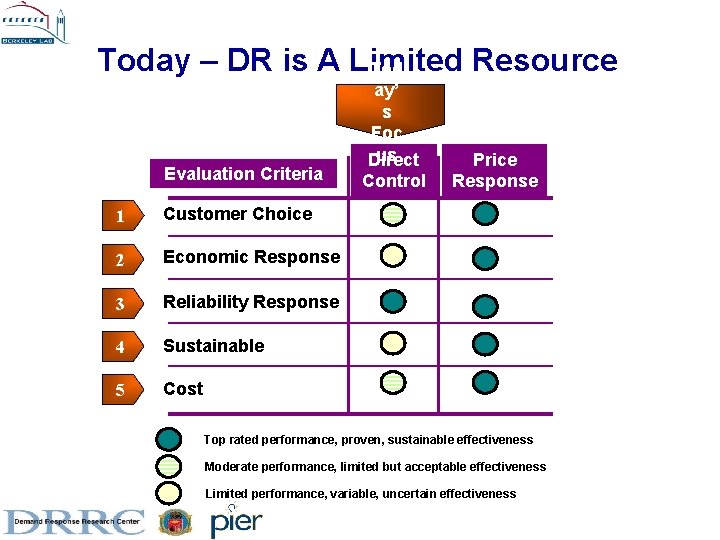
Today – DR is A Limited Resource Tod Evaluation Criteria 1 Customer Choice 2 Economic Response 3 Reliability Response 4 Sustainable 5 Cost ay’ s Foc us Direct Control Price Response Top rated performance, proven, sustainable effectiveness Moderate performance, limited but acceptable effectiveness Limited performance, variable, uncertain effectiveness
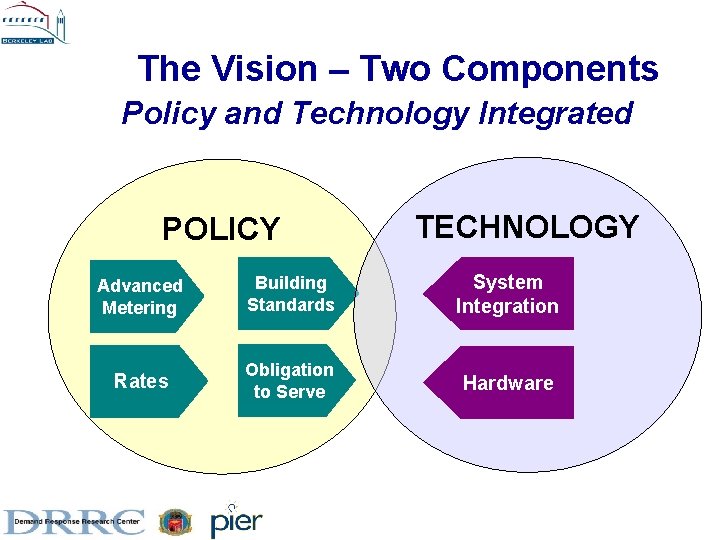
The Vision – Two Components Policy and Technology Integrated POLICY TECHNOLOGY Advanced Metering Building Standards System Integration Rates Obligation to Serve Hardware