
Demand Response in PJM 2009 NASUCA MidYear Meeting
- Slides: 16
Demand Response in PJM 2009 NASUCA Mid-Year Meeting June 30, 2009 Boston, MA Panel: Price Responsive Demand – A Long-Term Bargain for Consumers? Paul M. Sotkiewicz, Ph. D. Senior Economist, Markets PJM Interconnection, LLC www. pjm. com 1 PJM© 2008
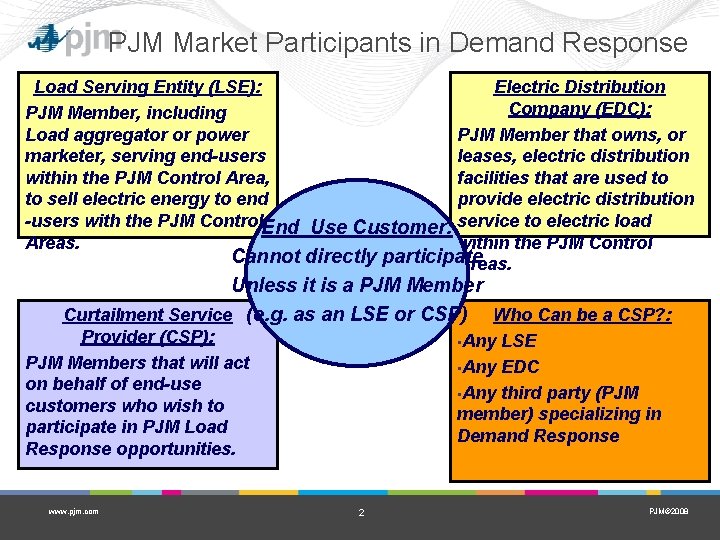
PJM Market Participants in Demand Response Load Serving Entity (LSE): Electric Distribution Company (EDC): PJM Member, including Load aggregator or power PJM Member that owns, or marketer, serving end-users leases, electric distribution within the PJM Control Area, facilities that are used to to sell electric energy to end provide electric distribution -users with the PJM Control. End Use Customer: service to electric load Areas. within the PJM Control Cannot directly participate Areas. Unless it is a PJM Member Curtailment Service (e. g. as an LSE or CSP) Who Can be a CSP? : Provider (CSP): PJM Members that will act on behalf of end-use customers who wish to participate in PJM Load Response opportunities. www. pjm. com • Any LSE • Any EDC • Any third party (PJM member) specializing in Demand Response 2 PJM© 2008
What is Demand Response? From an operational perspective: • It is the ability of consumers to change consumption in response to energy market prices. • It is the ability of consumers to reduce consumption in response to a notice from a system operator to meet system needs such as a contingency or emergency situation to maintain reliability. www. pjm. com 3 PJM© 2008
What is Demand Response? From a customer perspective: • It is the ability of consumers to control energy expenditures through reductions in, or changing patterns of, consumption. – Reduction of consumption during high price events and possibly shifting that consumption to lower priced periods – Committing to reductions in usage during peak periods and/or “emergency of contingency events” for reliability needs www. pjm. com 4 PJM© 2008
What is Demand Response? From a load serving entity (LSE) or electricity distribution company (EDC) perspective: • It is the ability of consumers to help the LSE/EDC to avoid high cost purchases/production or avoid new capacity purchases/builds – May help reduce overall costs for remaining LSE/EDC customers www. pjm. com 5 PJM© 2008
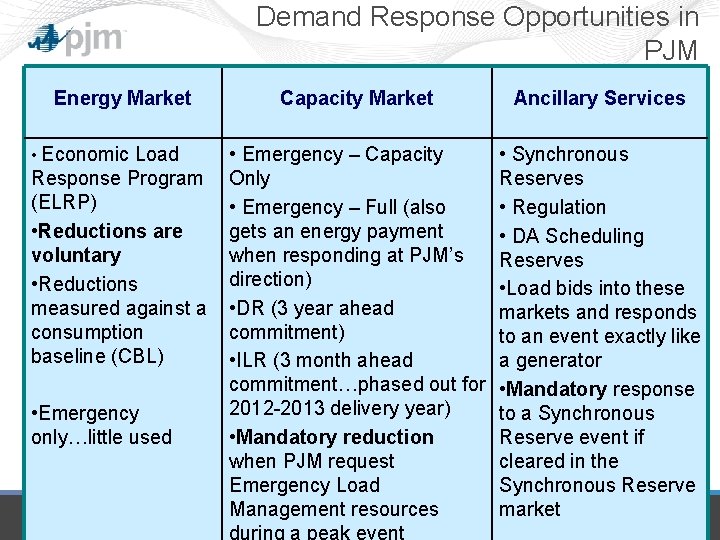
Demand Response Opportunities in PJM Energy Market • Economic Load Response Program (ELRP) • Reductions are voluntary • Reductions measured against a consumption baseline (CBL) • Emergency only…little used www. pjm. com Capacity Market Ancillary Services • Emergency – Capacity Only • Emergency – Full (also gets an energy payment when responding at PJM’s direction) • DR (3 year ahead commitment) • ILR (3 month ahead commitment…phased out for 2012 -2013 delivery year) • Mandatory reduction when PJM request Emergency Load 6 Management resources • Synchronous Reserves • Regulation • DA Scheduling Reserves • Load bids into these markets and responds to an event exactly like a generator • Mandatory response to a Synchronous Reserve event if cleared in the Synchronous Reserve market PJM© 2008
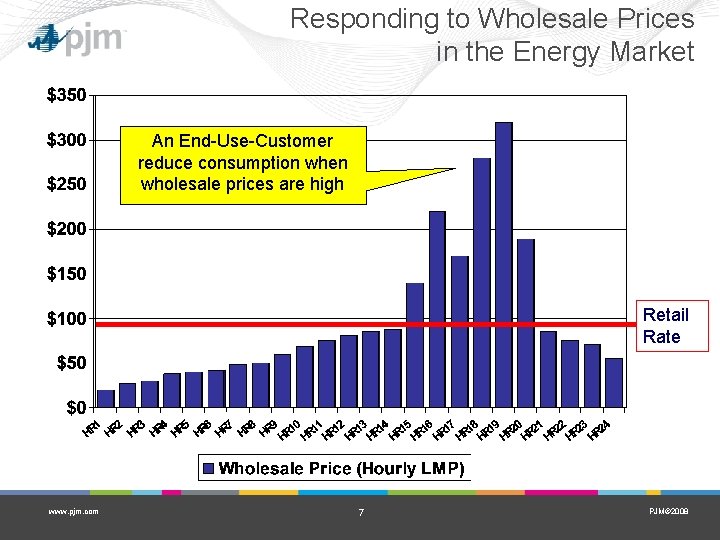
Responding to Wholesale Prices in the Energy Market An End-Use-Customer reduce consumption when wholesale prices are high Retail Rate www. pjm. com 7 PJM© 2008
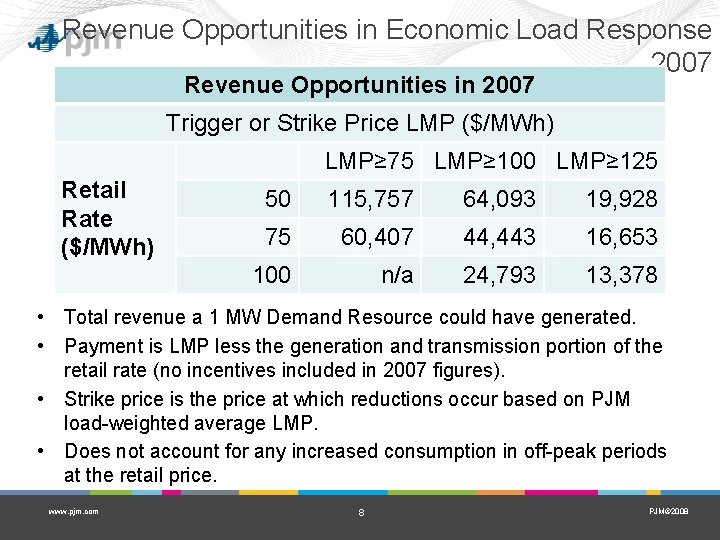
Revenue Opportunities in Economic Load Response 2007 Revenue Opportunities in 2007 Trigger or Strike Price LMP ($/MWh) LMP≥ 75 LMP≥ 100 LMP≥ 125 Retail Rate ($/MWh) 50 115, 757 64, 093 19, 928 75 60, 407 44, 443 16, 653 100 n/a 24, 793 13, 378 • Total revenue a 1 MW Demand Resource could have generated. • Payment is LMP less the generation and transmission portion of the retail rate (no incentives included in 2007 figures). • Strike price is the price at which reductions occur based on PJM load-weighted average LMP. • Does not account for any increased consumption in off-peak periods at the retail price. www. pjm. com 8 PJM© 2008
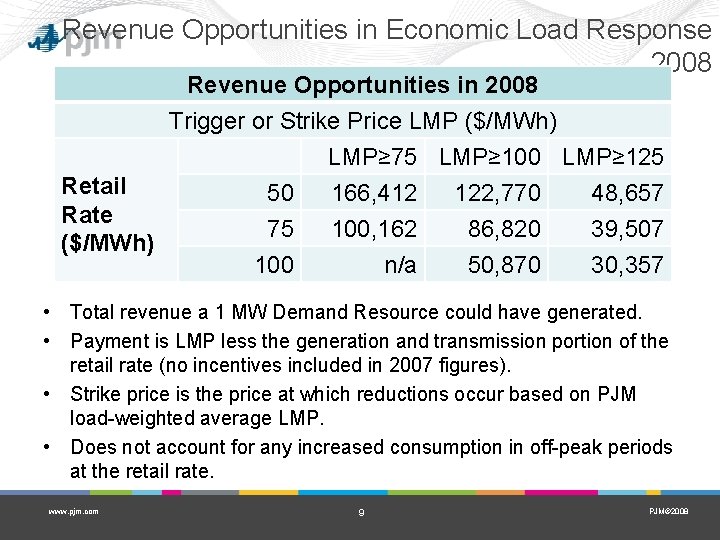
Revenue Opportunities in Economic Load Response 2008 Retail Rate ($/MWh) Revenue Opportunities in 2008 Trigger or Strike Price LMP ($/MWh) LMP≥ 75 LMP≥ 100 LMP≥ 125 50 166, 412 122, 770 48, 657 75 100, 162 n/a 86, 820 50, 870 39, 507 30, 357 • Total revenue a 1 MW Demand Resource could have generated. • Payment is LMP less the generation and transmission portion of the retail rate (no incentives included in 2007 figures). • Strike price is the price at which reductions occur based on PJM load-weighted average LMP. • Does not account for any increased consumption in off-peak periods at the retail rate. www. pjm. com 9 PJM© 2008
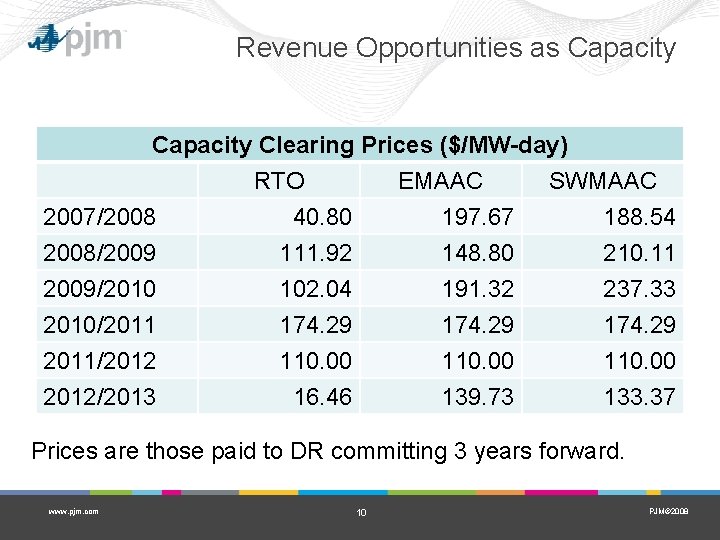
Revenue Opportunities as Capacity Clearing Prices ($/MW-day) RTO EMAAC SWMAAC 2007/2008 40. 80 197. 67 188. 54 2008/2009 111. 92 148. 80 210. 11 2009/2010/2011/2012/2013 102. 04 174. 29 110. 00 16. 46 191. 32 174. 29 110. 00 139. 73 237. 33 174. 29 110. 00 133. 37 Prices are those paid to DR committing 3 years forward. www. pjm. com 10 PJM© 2008
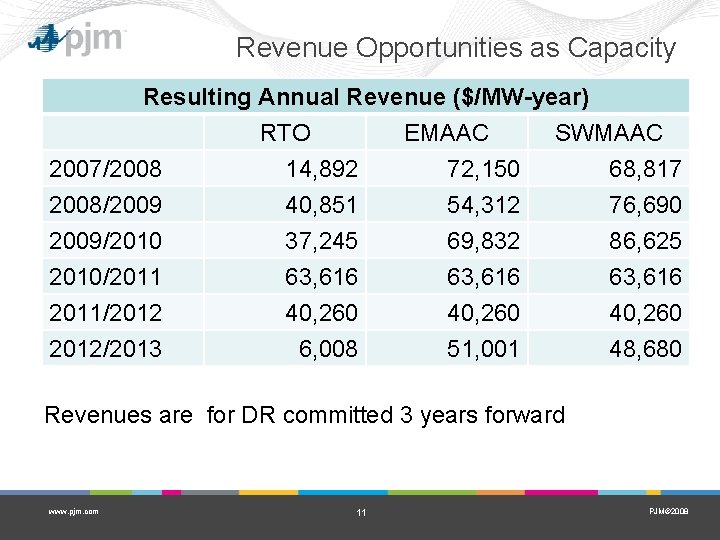
Revenue Opportunities as Capacity Resulting Annual Revenue ($/MW-year) RTO EMAAC SWMAAC 2007/2008 14, 892 72, 150 68, 817 2008/2009 40, 851 54, 312 76, 690 2009/2010/2011/2012/2013 37, 245 63, 616 40, 260 6, 008 69, 832 63, 616 40, 260 51, 001 86, 625 63, 616 40, 260 48, 680 Revenues are for DR committed 3 years forward www. pjm. com 11 PJM© 2008
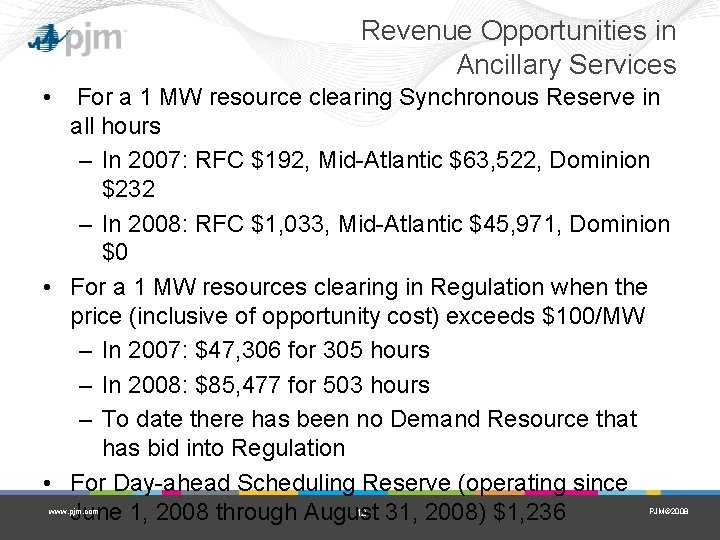
Revenue Opportunities in Ancillary Services • For a 1 MW resource clearing Synchronous Reserve in all hours – In 2007: RFC $192, Mid-Atlantic $63, 522, Dominion $232 – In 2008: RFC $1, 033, Mid-Atlantic $45, 971, Dominion $0 • For a 1 MW resources clearing in Regulation when the price (inclusive of opportunity cost) exceeds $100/MW – In 2007: $47, 306 for 305 hours – In 2008: $85, 477 for 503 hours – To date there has been no Demand Resource that has bid into Regulation • For Day-ahead Scheduling Reserve (operating since 12 June 1, 2008 through August 31, 2008) $1, 236 www. pjm. com PJM© 2008
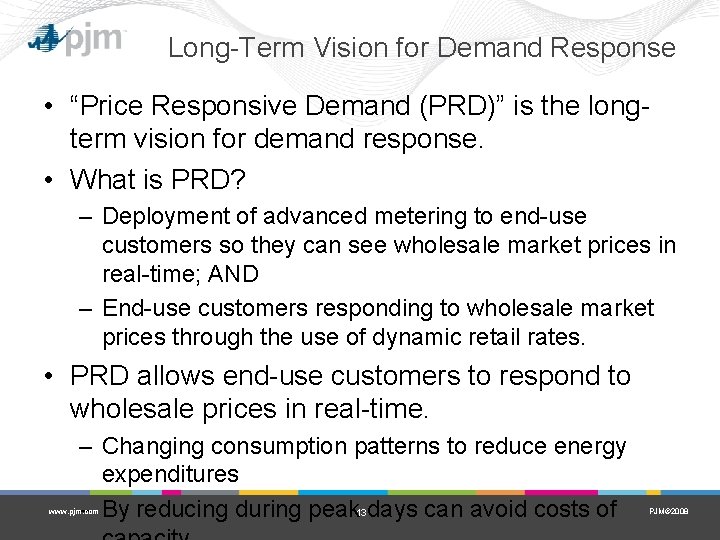
Long-Term Vision for Demand Response • “Price Responsive Demand (PRD)” is the longterm vision for demand response. • What is PRD? – Deployment of advanced metering to end-use customers so they can see wholesale market prices in real-time; AND – End-use customers responding to wholesale market prices through the use of dynamic retail rates. • PRD allows end-use customers to respond to wholesale prices in real-time. – Changing consumption patterns to reduce energy expenditures – By reducing during peak 13 days can avoid costs of www. pjm. com PJM© 2008
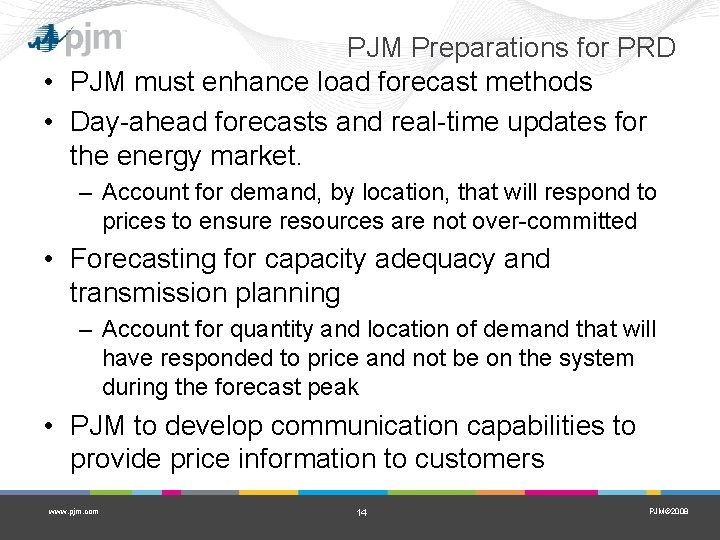
PJM Preparations for PRD • PJM must enhance load forecast methods • Day-ahead forecasts and real-time updates for the energy market. – Account for demand, by location, that will respond to prices to ensure resources are not over-committed • Forecasting for capacity adequacy and transmission planning – Account for quantity and location of demand that will have responded to price and not be on the system during the forecast peak • PJM to develop communication capabilities to provide price information to customers www. pjm. com 14 PJM© 2008
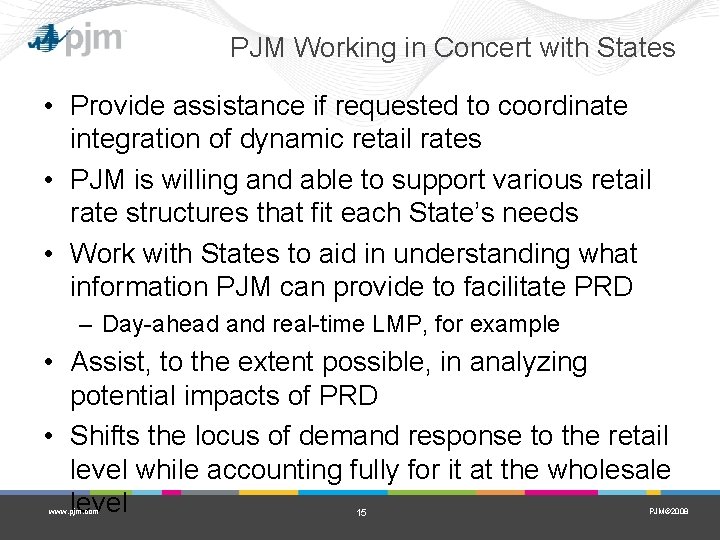
PJM Working in Concert with States • Provide assistance if requested to coordinate integration of dynamic retail rates • PJM is willing and able to support various retail rate structures that fit each State’s needs • Work with States to aid in understanding what information PJM can provide to facilitate PRD – Day-ahead and real-time LMP, for example • Assist, to the extent possible, in analyzing potential impacts of PRD • Shifts the locus of demand response to the retail level while accounting fully for it at the wholesale level www. pjm. com 15 PJM© 2008
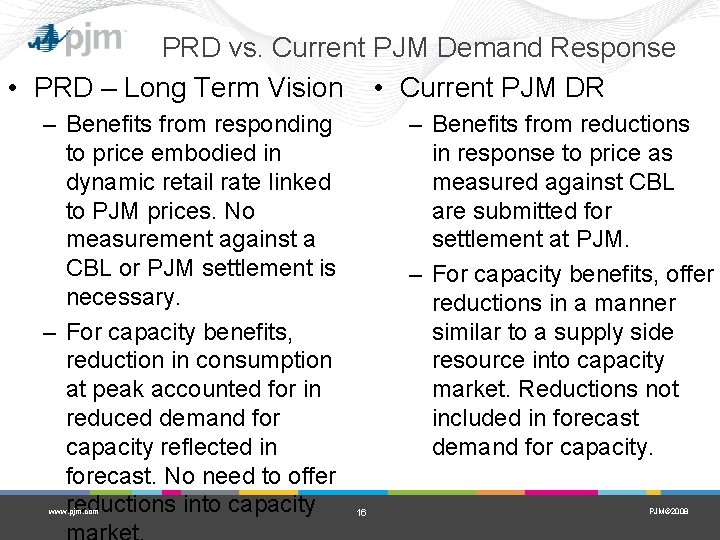
PRD vs. Current PJM Demand Response • PRD – Long Term Vision • Current PJM DR – Benefits from responding to price embodied in dynamic retail rate linked to PJM prices. No measurement against a CBL or PJM settlement is necessary. – For capacity benefits, reduction in consumption at peak accounted for in reduced demand for capacity reflected in forecast. No need to offer reductions into capacity www. pjm. com – Benefits from reductions in response to price as measured against CBL are submitted for settlement at PJM. – For capacity benefits, offer reductions in a manner similar to a supply side resource into capacity market. Reductions not included in forecast demand for capacity. 16 PJM© 2008