
Demand for and Assessment of Audit Quality in
- Slides: 29
Demand for and Assessment of Audit Quality in the Market for Private Capital: A Field Study Adam Esplin and Karim Jamal (University of Alberta) and Shyam Sunder (Yale University) Accounting Research Workshop, Temple University November 4, 2016
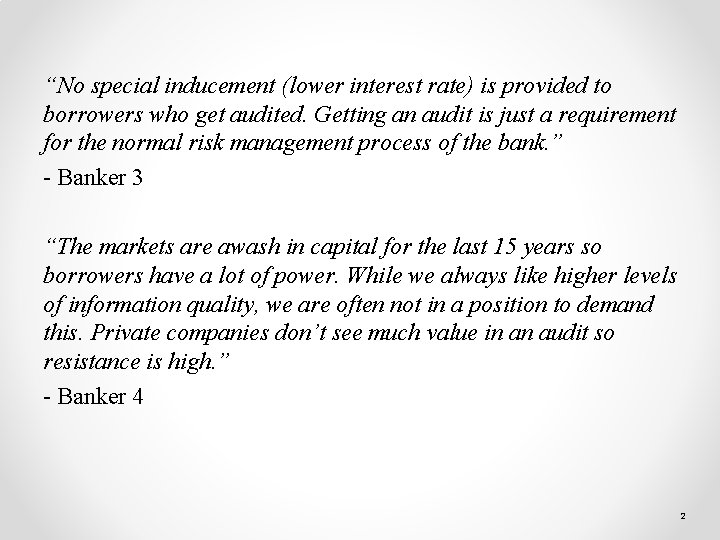
“No special inducement (lower interest rate) is provided to borrowers who get audited. Getting an audit is just a requirement for the normal risk management process of the bank. ” - Banker 3 “The markets are awash in capital for the last 15 years so borrowers have a lot of power. While we always like higher levels of information quality, we are often not in a position to demand this. Private companies don’t see much value in an audit so resistance is high. ” - Banker 4 2
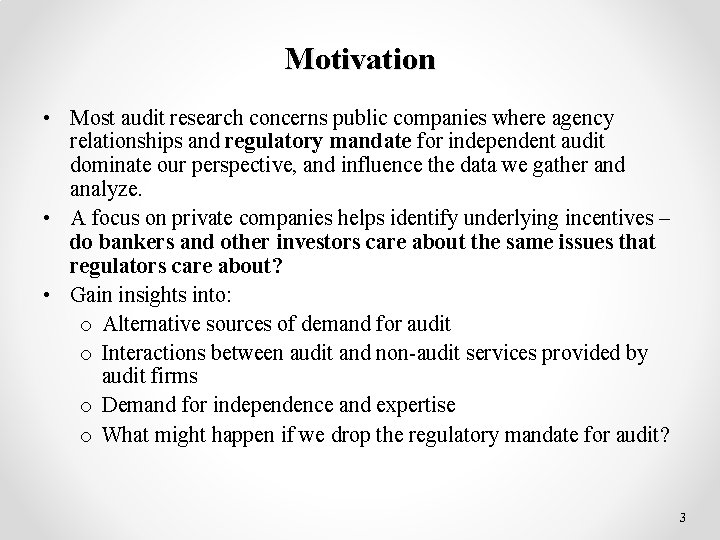
Motivation • Most audit research concerns public companies where agency relationships and regulatory mandate for independent audit dominate our perspective, and influence the data we gather and analyze. • A focus on private companies helps identify underlying incentives – do bankers and other investors care about the same issues that regulators care about? • Gain insights into: o Alternative sources of demand for audit o Interactions between audit and non-audit services provided by audit firms o Demand for independence and expertise o What might happen if we drop the regulatory mandate for audit? 3
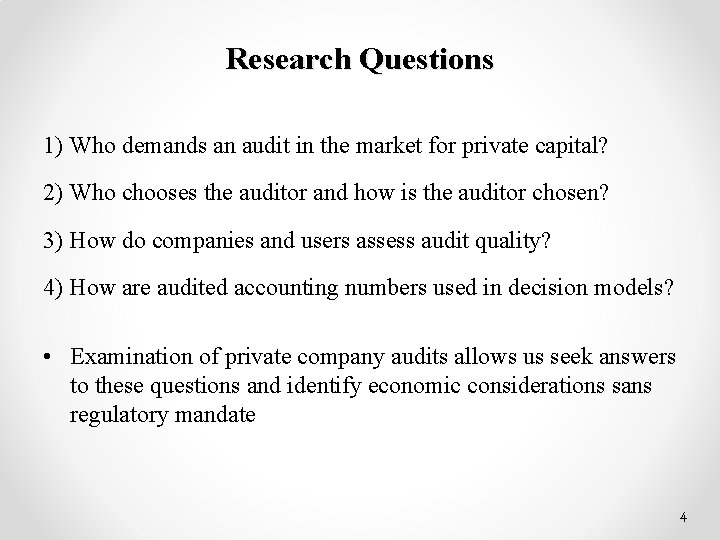
Research Questions 1) Who demands an audit in the market for private capital? 2) Who chooses the auditor and how is the auditor chosen? 3) How do companies and users assess audit quality? 4) How are audited accounting numbers used in decision models? • Examination of private company audits allows us seek answers to these questions and identify economic considerations sans regulatory mandate 4
Theories of Demand for Audit • Agency Theory: o The need for an audit arises from the conflict of interest between management of the firm and all other agents (shareholders, creditors, suppliers, customers, employees) who contract with the firm (Jensen and Meckling 1976). o An auditor facilitates contracting by verifying management’s financial representations. • Institutional Theory: o Organizations adopt practices which make them look appropriate and legitimate, regardless of whether they increase economic efficiency (Meyer and Rowan 1977; Di. Maggio and Powell 1983). o Audits are ritualized and ceremonial (i. e. , rain dance) rather than detailed examinations looking for fraud (Pentland 1993).
A Historical Note on Auditing in North America • North American audit profession developed in the late 1800 s as Scottish and English Chartered Accountants followed the capital investments of their British clients across the Atlantic (Allen 1993). • In the decades preceding the enactment of the U. S. federal securities laws in 1932 and 1933, accounting firms provided accounting, tax and other business advisory services in addition to auditing (Zeff 2003). • About 82 % of publicly traded companies on the NYSE had engaged an auditor and issued audited financial statements to the public prior to the legal mandate for auditing (Benston 1969). 6
Private Company Audit • Currently 40% of private companies choose to be audited (Lisowsky and Minnis 2013). • Prior research focuses on bank and debt related reasons for hiring auditors (Leftwich 1980; Allee and Yohn 2009; Minnis 2011; Lennox and Pittman 2011) • Our field observations suggest a larger set of agents (especially suppliers of equity capital, not just debt capital) demand audited financial statements to support their contracts, decisions, and transactions with private companies.
An Overview of Findings • Desire to access debt and/or equity capital dominate the demand for audit for private companies. Other sources of demand are: o Customers, suppliers, internal governance demands, and other regulators. • Management selects the auditor o Companies seeking access to equity markets prefer Big-4 auditors o Companies seeking access to debt capital are indifferent to audit firm size • Banks who ask for an audit report face resistance from client companies – relax demand for audit at certain times in the credit cycle. • Companies are extremely reluctant to provide audited financial reports to their vendors.
An Overview of Findings (Contd. ) • Management and all users want the auditor to be their business advisor o Provide tax, internal control, and business services to help the client operate more efficiently and earn more profits • CFOs and corporate directors treat external auditors as part of their (personal) internal control system –not a ritual (check box) audit. • Almost all elements of audit planning (audit hours, risk assessments, staffing, timing, and location of procedures) are subject to discussion with the CFO and need to meet the expectations of CFOs and corporate directors as to proper focus and scope of the audit. • There is almost no randomness/unpredictability in the auditor’s work (most everything follows the pre-negotiated path). • Users of audited financial statements in private markets have access to extensive private information about the quality of internal control, governance processes of companies, capabilities of management and the audit partner/management
An Overview of Findings (Contd. ) • Users hire additional experts to verify key numbers they intend to rely on and make adjustments for known deficiencies of accounting and audited financial statements (limited reliance on audited numbers, no functional fixation; earnings management is much more difficult to carry out). • Bundling of audit and non-audit services is the norm. The portfolio of services provided by firms to their audit clients often includes a broad range of non-audit services.
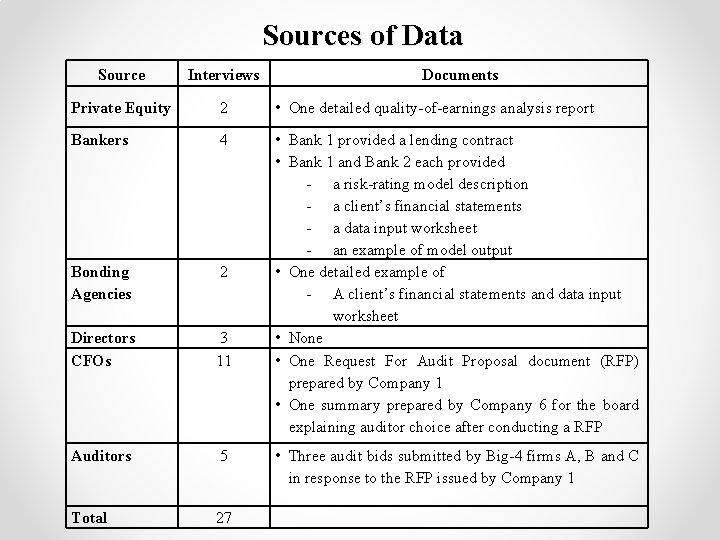
Interview Sample (N=27) • Private company CFOs (11) o 6 engaged Big-4 auditors o 5 engaged non-Big-4 auditors • Auditors (5) o 3 Big-4 auditors o 2 non-Big 4 auditors • • Bankers (4) Private equity firms (2) Bonding [surety] agencies (2) Corporate directors (3)
Research Methods • Collected data by interviewing participants (for about an hour each) and requesting primary documents. • Most interviews took place over phone with two members of the research team present. • Both research team members took extensive notes during the interviews. • After each interview, one of the researchers summarized the interview, while the second researcher edited and reviewed the summary. • Any discrepancies were resolved by discussion between the two researchers and a final summary was agreed on. • In some cases a short follow-up phone call was made to the participant to clarify discrepancies in understanding between the two researchers
Sources of Data Source Interviews Documents Private Equity 2 • One detailed quality-of-earnings analysis report Bankers 4 Bonding Agencies 2 Directors CFOs 3 11 • Bank 1 provided a lending contract • Bank 1 and Bank 2 each provided - a risk-rating model description - a client’s financial statements - a data input worksheet - an example of model output • One detailed example of - A client’s financial statements and data input worksheet • None • One Request For Audit Proposal document (RFP) prepared by Company 1 • One summary prepared by Company 6 for the board explaining auditor choice after conducting a RFP Auditors 5 • Three audit bids submitted by Big-4 firms A, B and C in response to the RFP issued by Company 1 Total 27
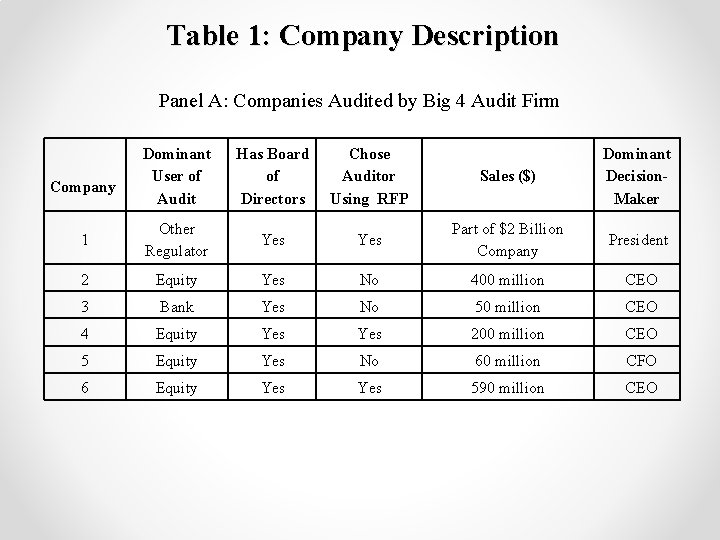
Table 1: Company Description Panel A: Companies Audited by Big 4 Audit Firm Company Dominant User of Audit Has Board of Directors Chose Auditor Using RFP Sales ($) Dominant Decision. Maker 1 Other Regulator Yes Part of $2 Billion Company President 2 Equity Yes No 400 million CEO 3 Bank Yes No 50 million CEO 4 Equity Yes 200 million CEO 5 Equity Yes No 60 million CFO 6 Equity Yes 590 million CEO
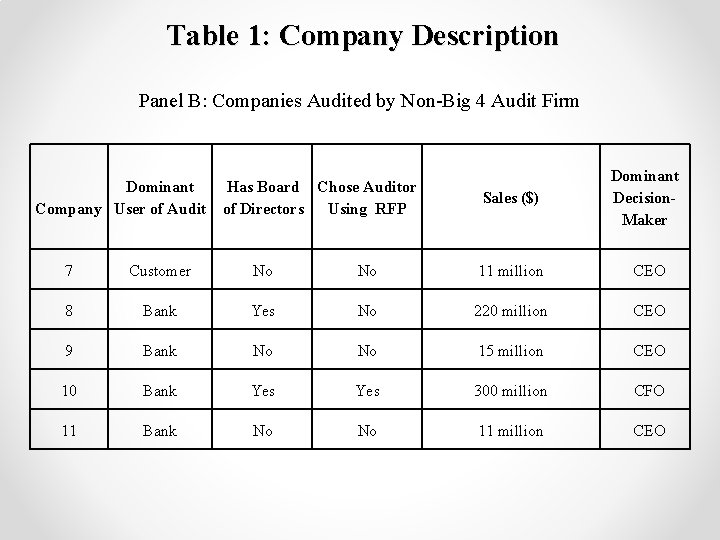
Table 1: Company Description Panel B: Companies Audited by Non-Big 4 Audit Firm Dominant Company User of Audit Has Board Chose Auditor of Directors Using RFP Sales ($) Dominant Decision. Maker 7 Customer No No 11 million CEO 8 Bank Yes No 220 million CEO 9 Bank No No 15 million CEO 10 Bank Yes 300 million CFO 11 Bank No No 11 million CEO
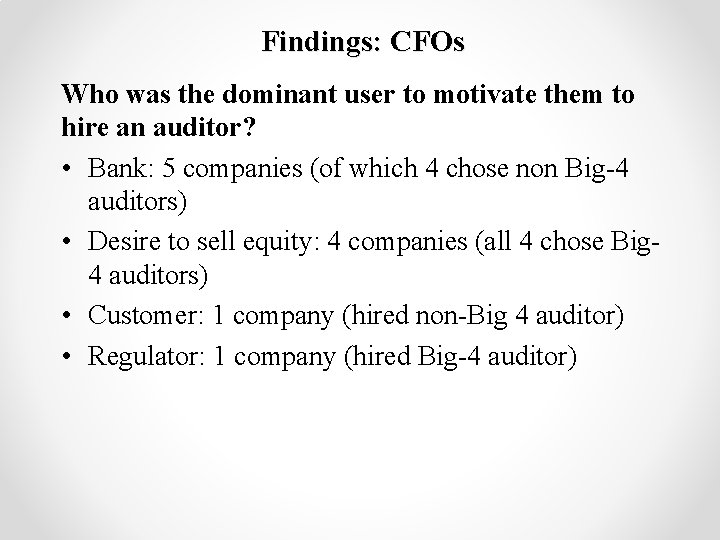
Findings: CFOs Who was the dominant user to motivate them to hire an auditor? • Bank: 5 companies (of which 4 chose non Big-4 auditors) • Desire to sell equity: 4 companies (all 4 chose Big 4 auditors) • Customer: 1 company (hired non-Big 4 auditor) • Regulator: 1 company (hired Big-4 auditor)
Findings: Users • • Preference for Big-4 versus non-Big-4 auditors: Bankers (4): No preference between Big-4 and others Bonding companies (2): No preference between Big-4 and others Private equity firm (2): Big-4 preference Corporate directors (3): Big-4 preference • All respondents believed there is high variance within audit firms and that the specific partner matters in determining the quality of service received.
Findings: Who Chose the Auditor and How? Management selected the auditor (11 companies) • Usually the CEO • Personal relationship with partner was the key variable Users’ views: • Low concerns about independence • Private equity firms wanted management to choose an auditor they respect and will listen to • Directors, private equity firms and bankers communicate directly (in private) with the auditor.
Management’s Expectations of the Auditors • Accounting experts who understand the industry. • Proofread disclosures. • Accounting assistance and some accounting work done by the auditor. • Suggestions to improve internal controls. • Business advice as well as connections to business networks. • Wanted to buy consulting services from the best service provider (regardless of location)
Users’ Expectations of the Auditor • High overlap with management’s expectations. • Directors, private equity firms and bankers communicated in private with the auditor. • Expect the auditor to be candid about accounting, internal control, or governance issues. • Directors wanted the auditor’s assessment of management’s capabilities.
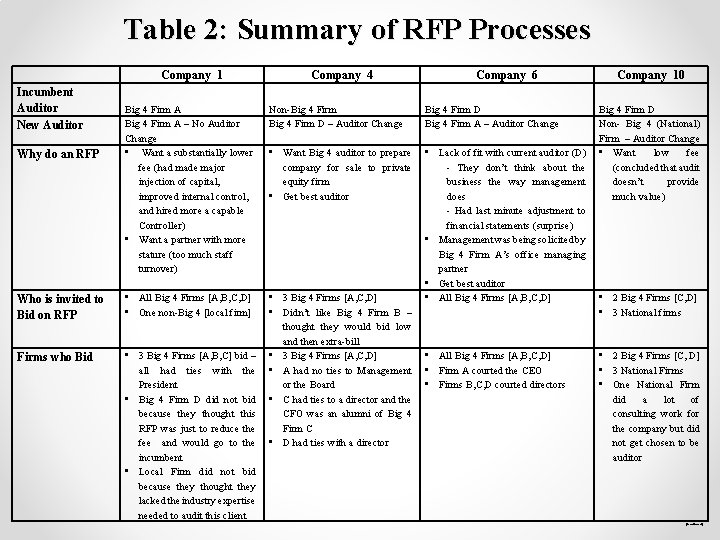
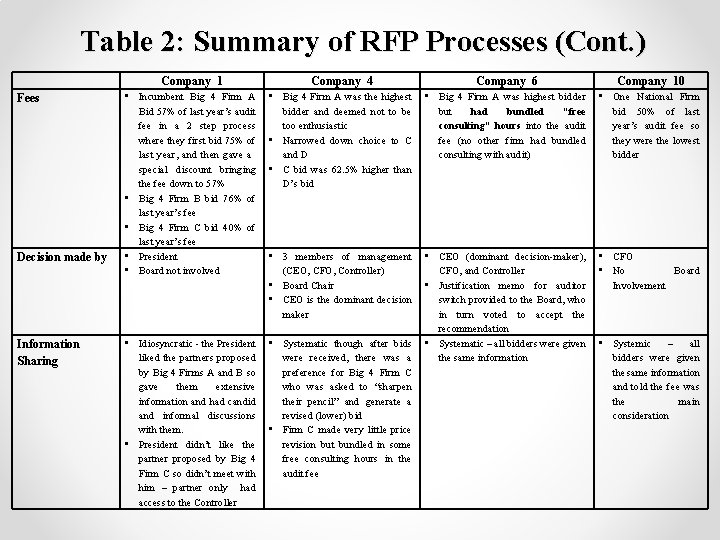
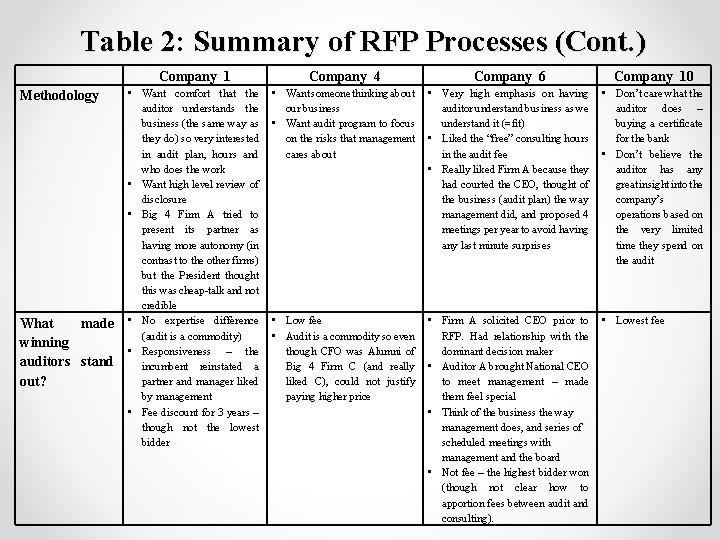
RFP Process in Private Companies • Commoditization of auditing combined with a recession created downward pressure on audit pricing. • RFP viewed as an effective device for lowering the audit fee… Auditors don’t like RFP (prefer to have “relationships”) • Directors view periodic tendering of the audit as a good governance practice (Public company practices seeping into private companies).
Table 2: Summary of RFP Processes Incumbent Auditor New Auditor Why do an RFP Company 1 Big 4 Firm A – No Auditor Change • Want a substantially lower fee (had made major injection of capital, improved internal control, and hired more a capable Controller) • Want a partner with more stature (too much staff turnover) Who is invited to Bid on RFP • All Big 4 Firms [A, B, C, D] • One non-Big 4 [local firm] Firms who Bid • 3 Big 4 Firms [A, B, C] bid – all had ties with the President • Big 4 Firm D did not bid because they thought this RFP was just to reduce the fee and would go to the incumbent • Local Firm did not bid because they thought they lacked the industry expertise needed to audit this client Company 4 Non-Big 4 Firm D – Auditor Change Company 6 Company 10 Big 4 Firm D Big 4 Firm A – Auditor Change • Want Big 4 auditor to prepare • company for sale to private equity firm • Get best auditor • • • Big 4 Firm D Non- Big 4 (National) Firm – Auditor Change Lack of fit with current auditor (D) • Want low fee - They don’t think about the (concluded that audit business the way management doesn’t provide does much value) - Had last minute adjustment to financial statements (surprise) Management was being solicited by Big 4 Firm A’s office managing partner Get best auditor All Big 4 Firms [A, B, C, D] • 2 Big 4 Firms [C, D] • 3 National firms • 3 Big 4 Firms [A, C, D] • Didn’t like Big 4 Firm B – thought they would bid low and then extra-bill • 3 Big 4 Firms [A, C, D] • All Big 4 Firms [A, B, C, D] • A had no ties to Management • Firm A courted the CEO or the Board • Firms B, C, D courted directors • C had ties to a director and the CFO was an alumni of Big 4 Firm C • D had ties with a director • 2 Big 4 Firms [C, D] • 3 National Firms • One National Firm did a lot of consulting work for the company but did not get chosen to be auditor (Continued)
Table 2: Summary of RFP Processes (Cont. ) Fees Decision made by Information Sharing Company 1 • Incumbent Big 4 Firm A Bid 57% of last year’s audit fee in a 2 step process where they first bid 75% of last year, and then gave a special discount bringing the fee down to 57% • Big 4 Firm B bid 76% of last year’s fee • Big 4 Firm C bid 40% of last year’s fee • President • Board not involved • Idiosyncratic - the President liked the partners proposed by Big 4 Firms A and B so gave them extensive information and had candid and informal discussions with them. • President didn’t like the partner proposed by Big 4 Firm C so didn’t meet with him – partner only had access to the Controller Company 4 Company 6 Company 10 • Big 4 Firm A was the highest • Big 4 Firm A was highest bidder • One National Firm bidder and deemed not to be but had bundled “free bid 50% of last too enthusiastic consulting” hours into the audit year’s audit fee so • Narrowed down choice to C fee (no other firm had bundled they were the lowest and D consulting with audit) bidder • C bid was 62. 5% higher than D’s bid • 3 members of management • CEO (dominant decision-maker), • CFO (CEO, CFO, Controller) CFO, and Controller • No Board • Board Chair • Justification memo for auditor Involvement • CEO is the dominant decision switch provided to the Board, who maker in turn voted to accept the recommendation • Systematic though after bids • Systematic – all bidders were given • Systemic – all were received, there was a the same information bidders were given preference for Big 4 Firm C the same information who was asked to “sharpen and told the fee was their pencil” and generate a the main revised (lower) bid consideration • Firm C made very little price revision but bundled in some free consulting hours in the audit fee
Table 2: Summary of RFP Processes (Cont. ) Methodology What made winning auditors stand out? Company 1 • Want comfort that the auditor understands the business (the same way as they do) so very interested in audit plan, hours and who does the work • Want high level review of disclosure • Big 4 Firm A tried to present its partner as having more autonomy (in contrast to the other firms) but the President thought this was cheap-talk and not credible • No expertise difference (audit is a commodity) • Responsiveness – the incumbent reinstated a partner and manager liked by management • Fee discount for 3 years – though not the lowest bidder Company 4 Company 6 • Want someone thinking about • Very high emphasis on having • our business auditor understand business as we • Want audit program to focus understand it (=fit) on the risks that management • Liked the “free” consulting hours cares about in the audit fee • • Really liked Firm A because they had courted the CEO, thought of the business (audit plan) the way management did, and proposed 4 meetings per year to avoid having any last minute surprises Company 10 Don’t care what the auditor does – buying a certificate for the bank Don’t believe the auditor has any great insight into the company’s operations based on the very limited time they spend on the audit • Low fee • Firm A solicited CEO prior to • Lowest fee • Audit is a commodity so even RFP. Had relationship with the though CFO was Alumni of dominant decision maker Big 4 Firm C (and really • Auditor A brought National CEO liked C), could not justify to meet management – made paying higher price them feel special • Think of the business the way management does, and series of scheduled meetings with management and the board • Not fee – the highest bidder won (though not clear how to apportion fees between audit and consulting).
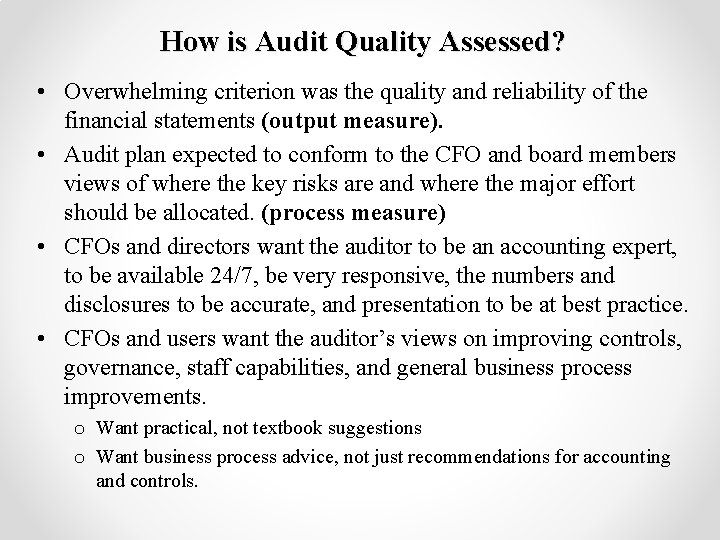
How is Audit Quality Assessed? • Overwhelming criterion was the quality and reliability of the financial statements (output measure). • Audit plan expected to conform to the CFO and board members views of where the key risks are and where the major effort should be allocated. (process measure) • CFOs and directors want the auditor to be an accounting expert, to be available 24/7, be very responsive, the numbers and disclosures to be accurate, and presentation to be at best practice. • CFOs and users want the auditor’s views on improving controls, governance, staff capabilities, and general business process improvements. o Want practical, not textbook suggestions o Want business process advice, not just recommendations for accounting and controls.
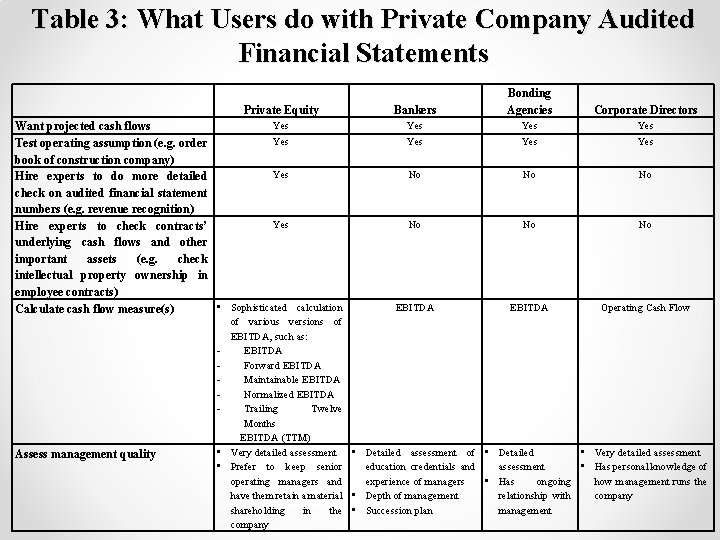
Table 3: What Users do with Private Company Audited Financial Statements Private Equity Yes Want projected cash flows Yes Test operating assumption (e. g. order book of construction company) Yes Hire experts to do more detailed check on audited financial statement numbers (e. g. revenue recognition) Yes Hire experts to check contracts’ underlying cash flows and other important assets (e. g. check intellectual property ownership in employee contracts) • Sophisticated calculation Calculate cash flow measure(s) - Assess management quality • • Bankers Bonding Agencies Corporate Directors Yes Yes Yes No No No EBITDA Operating Cash Flow of various versions of EBITDA, such as: EBITDA Forward EBITDA Maintainable EBITDA Normalized EBITDA Trailing Twelve Months EBITDA (TTM) Very detailed assessment • Detailed assessment of • Detailed • Very detailed assessment Prefer to keep senior education credentials and assessment • Has personal knowledge of operating managers and experience of managers • Has ongoing how management runs the have them retain a material • Depth of management relationship with company shareholding in the • Succession plan management company
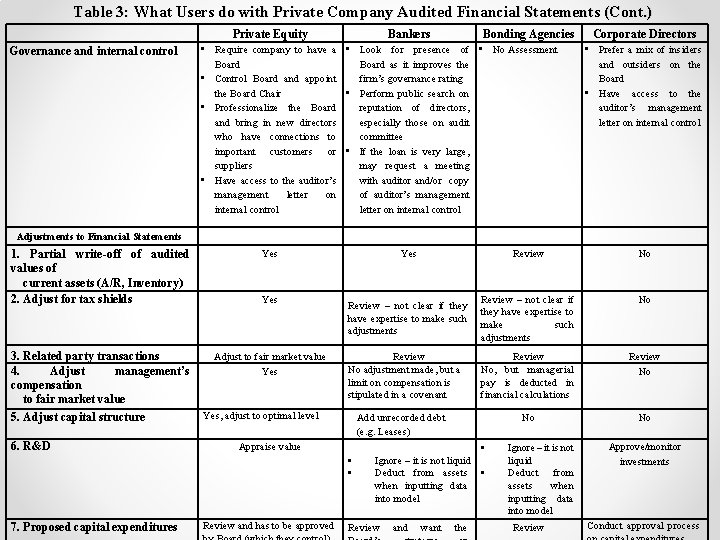
Table 3: What Users do with Private Company Audited Financial Statements (Cont. ) Governance and internal control Private Equity Bankers Bonding Agencies • Require company to have a • Look for presence of • No Assessment Board as it improves the • Control Board and appoint firm’s governance rating the Board Chair • Perform public search on • Professionalize the Board reputation of directors, and bring in new directors especially those on audit who have connections to committee important customers or • If the loan is very large, suppliers may request a meeting • Have access to the auditor’s with auditor and/or copy management letter on of auditor’s management internal control letter on internal control Corporate Directors • Prefer a mix of insiders and outsiders on the Board • Have access to the auditor’s management letter on internal control Adjustments to Financial Statements 1. Partial write-off of audited values of current assets (A/R, Inventory) 2. Adjust for tax shields Yes Adjust to fair market value 3. Related party transactions 4. Adjust management’s Yes compensation to fair market value Yes, adjust to optimal level 5. Adjust capital structure 6. R&D Yes Review No Review – not clear if they have expertise to make such adjustments No Review No adjustment made, but a limit on compensation is stipulated in a covenant Review No, but managerial pay is deducted in financial calculations Review No No No Add unrecorded debt (e. g. Leases) Appraise value • • 7. Proposed capital expenditures Review and has to be approved • Ignore – it is not liquid Deduct from assets • when inputting data into model Review and want the Ignore – it is not liquid Deduct from assets when inputting data into model Review Approve/monitor investments Conduct approval process
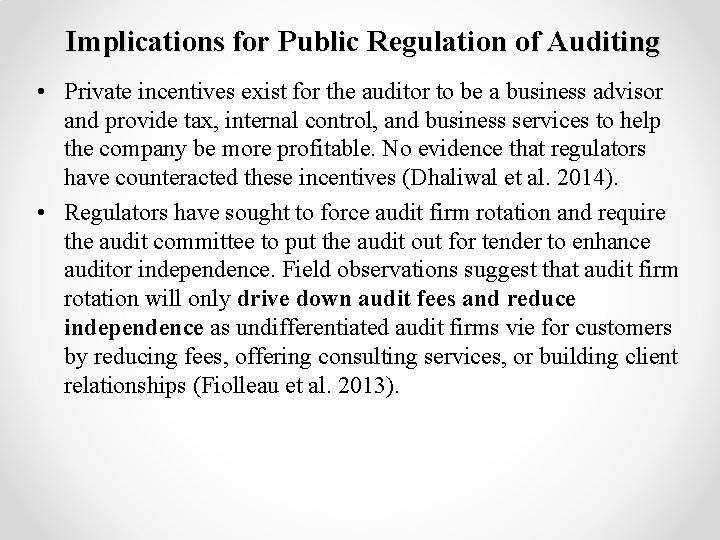
Implications for Public Regulation of Auditing • Private incentives exist for the auditor to be a business advisor and provide tax, internal control, and business services to help the company be more profitable. No evidence that regulators have counteracted these incentives (Dhaliwal et al. 2014). • Regulators have sought to force audit firm rotation and require the audit committee to put the audit out for tender to enhance auditor independence. Field observations suggest that audit firm rotation will only drive down audit fees and reduce independence as undifferentiated audit firms vie for customers by reducing fees, offering consulting services, or building client relationships (Fiolleau et al. 2013).
Implications for Public Regulation of Auditing • In private markets, managers are heavily involved in the audit plan. This system of auditing is oriented to detecting error, not fraud. • Regulators have carried over this feature of private auditing into the public market. External auditors are required to submit their detailed audit plans for review and approval of the audit committee. External auditors are seldom the agent who detects a fraud (Dyck, Morse and Zingales 2010). • Concerns about earnings management, and known deficiencies of accounting (off balance sheet leases) are overstated – users correct easily for these “known” deficiencies of accounting • Not clear what we gain from 80+ years of Audit Regulation