
DEMAND Demand is the desire to own something
- Slides: 4
DEMAND Demand – is the desire to own something and the ability to pay for it Demand schedules and demand curves illustrate how people react to different prices Law of Demand- consumers buy more of a good or service when its price decreases and less when its price increases Substitution effect- consumers react to an increase by buying less of a good and more of another good Income effect- change in consumption based on change in income
Reasons for Change in Demand • Preference / consumer taste / trends • Substitute- Can use one in place of another. i. e. Coke and Pepsi. • Compliment- Items go together. i. e. Peanut Butter and Jelly. • Change in population/consumer numbers. • Expectations- Think price will change in future. Perhaps a sale, or change in supply. • Income Effect: Changes in your income may do the following: a. Neutral Goods- demand remains constant with income changes (food, toilet paper) b. Normal Goods- You buy more as your income increases. Vacations, eating out, luxury goods. c. Inferior goods- Good you buy less as your income increases. Used items, generic brands, discount stores.
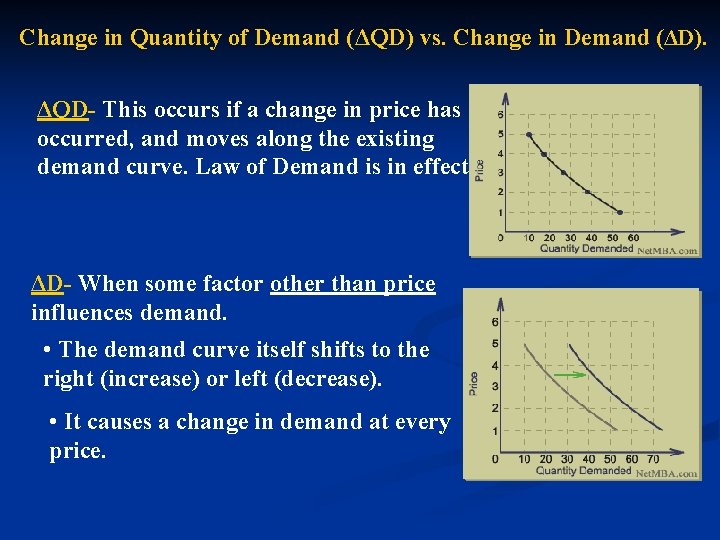
Change in Quantity of Demand (ΔQD) vs. Change in Demand (ΔD). ΔQD- This occurs if a change in price has occurred, and moves along the existing demand curve. Law of Demand is in effect. ΔD- When some factor other than price influences demand. • The demand curve itself shifts to the right (increase) or left (decrease). • It causes a change in demand at every price.
Checklist for graphing demand problems. ALWAYS DO IT EXACTLY IN THIS ORDER! 1. Read the problem, then look at graph and underline the item to be graphed. 2. Ask yourself, “Has there been a change in price of the item being graphed? ” • If the answer is yes, then it is ΔQD. Movement will be along the demand curve. Reason is Law of Demand. • If the answer is no, then it must be ΔD. The curve itself will shift either left or right. Then you must figure out the reason. (see list on previous slide).