
Delta undulator magnet concept and project status Part
- Slides: 19
Delta undulator magnet: concept and project status Part – I: concept and model construction* Alexander Temnykh, CLASSE, Cornell University, Ithaca, New York, USA Part - II: beam test at ATF in BNL+ M. Babzien, D. Davis, M. Fedurin, K. Kusche, J. Park, V. Yakimenko, Brookhaven National Laboratory, Upton, USA Alexander Temnykh, CLASSE, Cornell University, Ithaca, New York, USA *Work has been supported by NSF grant DMR 0225180 and PHY-013150 + Supported by DOE Office of Science FLS 2010, SLAC March 1 -5, 2010
Outline • Delta undulator magnet concept. – Two considerations • On-axis vacuum • Radiation damage • Model construction – Magnetic field properties – Vacuum • Beam test at ATF BNL • Conclusion FLS 2010, SLAC March 1 -5, 2010 2
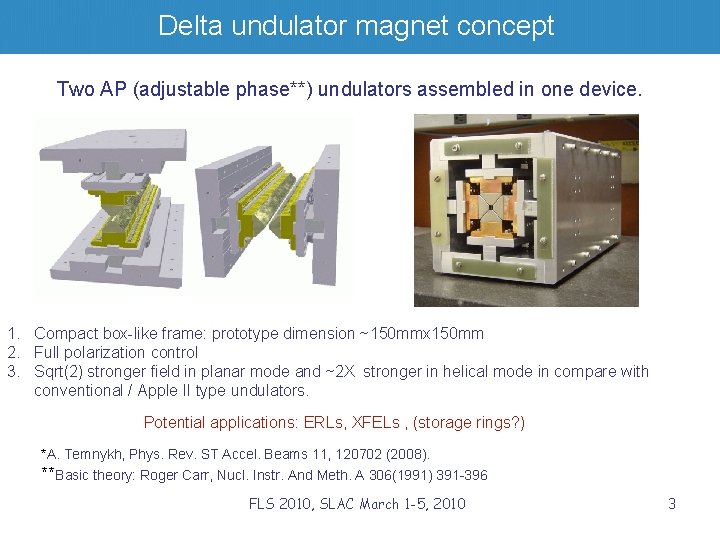
Delta undulator magnet concept Two AP (adjustable phase**) undulators assembled in one device. 1. Compact box-like frame: prototype dimension ~150 mmx 150 mm 2. Full polarization control 3. Sqrt(2) stronger field in planar mode and ~2 X stronger in helical mode in compare with conventional / Apple II type undulators. Potential applications: ERLs, XFELs , (storage rings? ) *A. Temnykh, Phys. Rev. ST Accel. Beams 11, 120702 (2008). **Basic theory: Roger Carr, Nucl. Instr. And Meth. A 306(1991) 391 -396 FLS 2010, SLAC March 1 -5, 2010 3
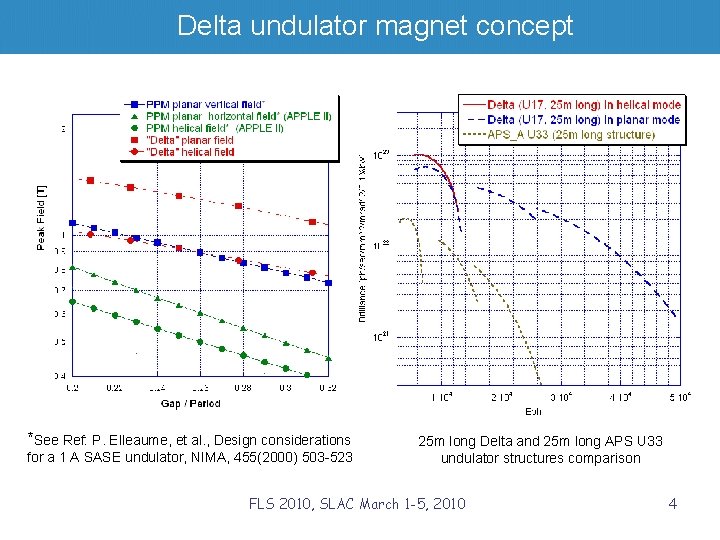
Delta undulator magnet concept *See Ref: P. Elleaume, et al. , Design considerations for a 1 A SASE undulator, NIMA, 455(2000) 503 -523 25 m long Delta and 25 m long APS U 33 undulator structures comparison FLS 2010, SLAC March 1 -5, 2010 4
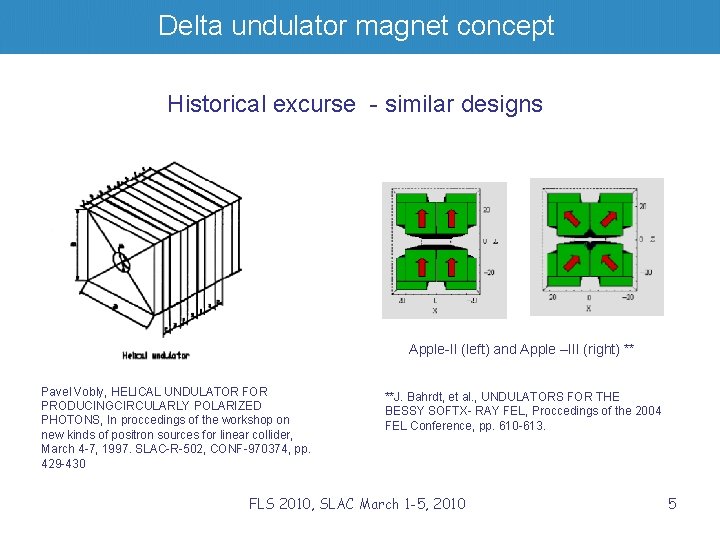
Delta undulator magnet concept Historical excurse - similar designs Apple-II (left) and Apple –III (right) ** Pavel Vobly, HELICAL UNDULATOR FOR PRODUCINGCIRCULARLY POLARIZED PHOTONS, In proccedings of the workshop on new kinds of positron sources for linear collider, March 4 -7, 1997. SLAC-R-502, CONF-970374, pp. 429 -430 **J. Bahrdt, et al. , UNDULATORS FOR THE BESSY SOFTX- RAY FEL, Proccedings of the 2004 FEL Conference, pp. 610 -613. FLS 2010, SLAC March 1 -5, 2010 5
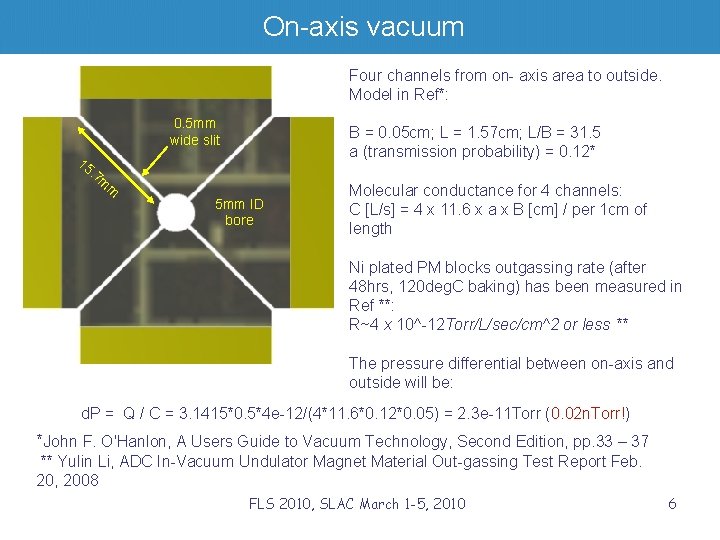
On-axis vacuum Four channels from on- axis area to outside. Model in Ref*: 0. 5 mm wide slit 15 . 7 B = 0. 05 cm; L = 1. 57 cm; L/B = 31. 5 a (transmission probability) = 0. 12* m m 5 mm ID bore Molecular conductance for 4 channels: C [L/s] = 4 x 11. 6 x a x B [cm] / per 1 cm of length Ni plated PM blocks outgassing rate (after 48 hrs, 120 deg. C baking) has been measured in Ref **: R~4 x 10^-12 Torr/L/sec/cm^2 or less ** The pressure differential between on-axis and outside will be: d. P = Q / C = 3. 1415*0. 5*4 e-12/(4*11. 6*0. 12*0. 05) = 2. 3 e-11 Torr (0. 02 n. Torr!) *John F. O'Hanlon, A Users Guide to Vacuum Technology, Second Edition, pp. 33 – 37 ** Yulin Li, ADC In-Vacuum Undulator Magnet Material Out-gassing Test Report Feb. 20, 2008 FLS 2010, SLAC March 1 -5, 2010 6
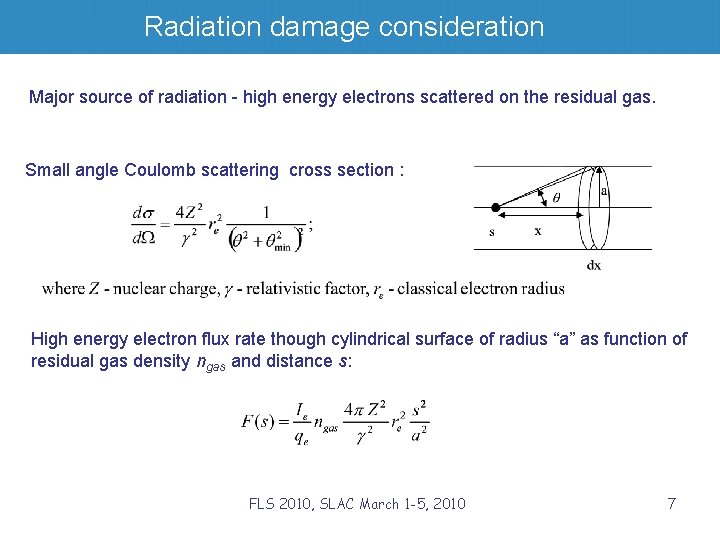
Radiation damage consideration Major source of radiation - high energy electrons scattered on the residual gas. Small angle Coulomb scattering cross section : High energy electron flux rate though cylindrical surface of radius “a” as function of residual gas density ngas and distance s: FLS 2010, SLAC March 1 -5, 2010 7
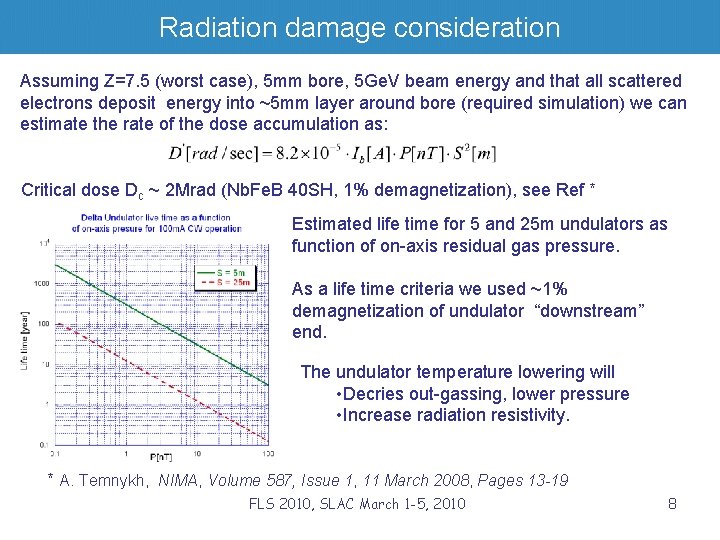
Radiation damage consideration Assuming Z=7. 5 (worst case), 5 mm bore, 5 Ge. V beam energy and that all scattered electrons deposit energy into ~5 mm layer around bore (required simulation) we can estimate the rate of the dose accumulation as: Critical dose Dc ~ 2 Mrad (Nb. Fe. B 40 SH, 1% demagnetization), see Ref * Estimated life time for 5 and 25 m undulators as function of on-axis residual gas pressure. As a life time criteria we used ~1% demagnetization of undulator “downstream” end. The undulator temperature lowering will • Decries out-gassing, lower pressure • Increase radiation resistivity. * A. Temnykh, NIMA, Volume 587, Issue 1, 11 March 2008, Pages 13 -19 FLS 2010, SLAC March 1 -5, 2010 8
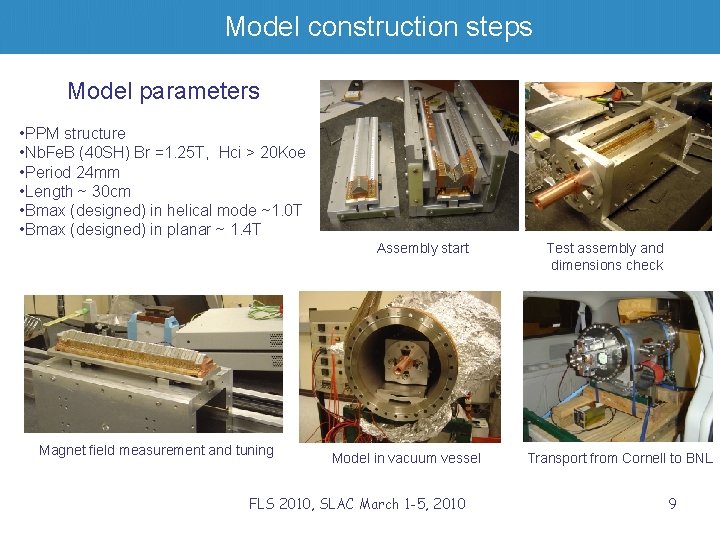
Model construction steps Model parameters • PPM structure • Nb. Fe. B (40 SH) Br =1. 25 T, Hci > 20 Koe • Period 24 mm • Length ~ 30 cm • Bmax (designed) in helical mode ~1. 0 T • Bmax (designed) in planar ~ 1. 4 T Assembly start Magnet field measurement and tuning Model in vacuum vessel FLS 2010, SLAC March 1 -5, 2010 Test assembly and dimensions check Transport from Cornell to BNL 9
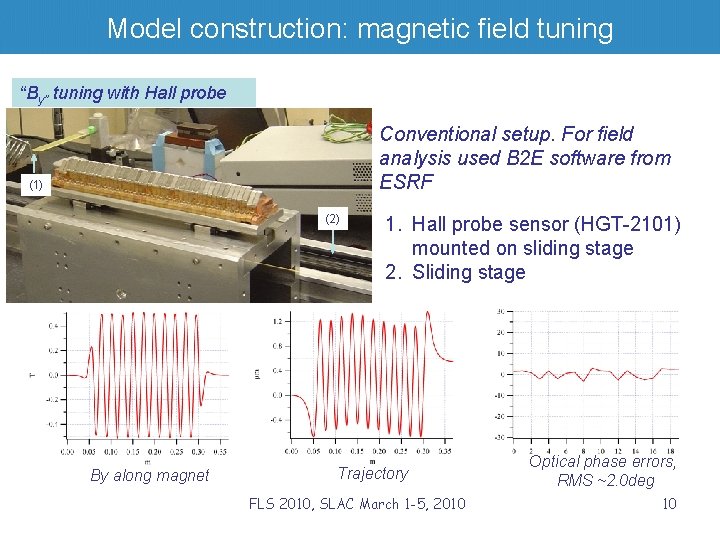
Model construction: magnetic field tuning “By” tuning with Hall probe Conventional setup. For field analysis used B 2 E software from ESRF (1) (2) By along magnet 1. Hall probe sensor (HGT-2101) mounted on sliding stage 2. Sliding stage Trajectory FLS 2010, SLAC March 1 -5, 2010 Optical phase errors, RMS ~2. 0 deg 10
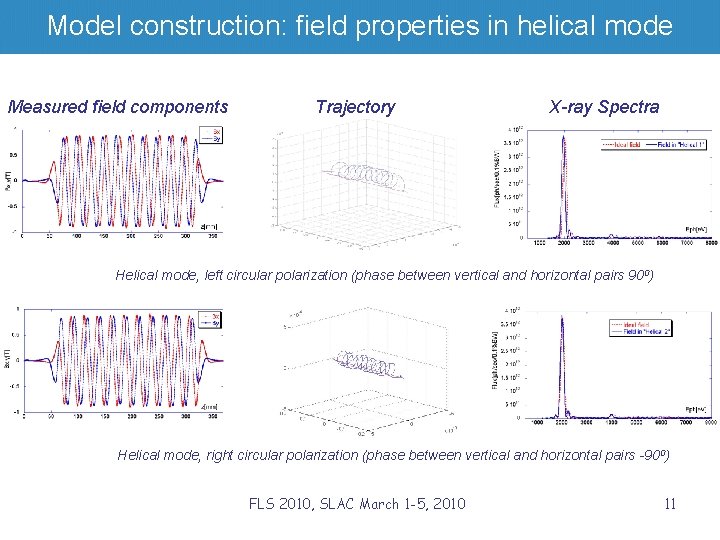
Model construction: field properties in helical mode Measured field components Trajectory X-ray Spectra Helical mode, left circular polarization (phase between vertical and horizontal pairs 900) Helical mode, right circular polarization (phase between vertical and horizontal pairs -900) FLS 2010, SLAC March 1 -5, 2010 11
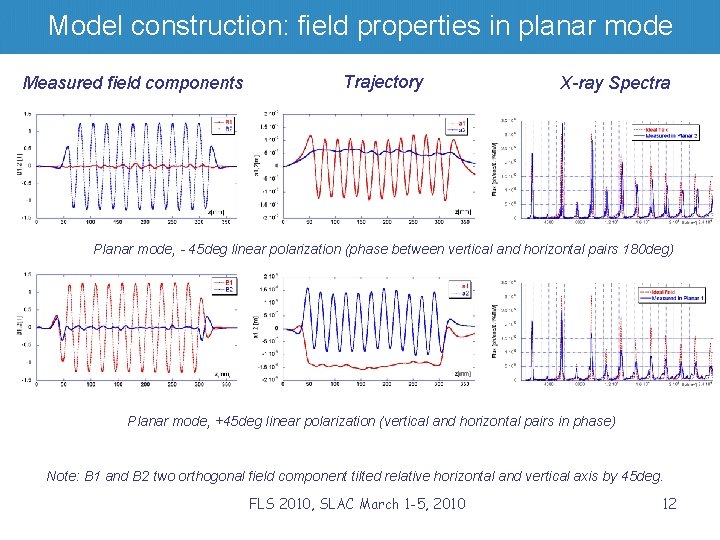
Model construction: field properties in planar mode Measured field components Trajectory X-ray Spectra Planar mode, - 45 deg linear polarization (phase between vertical and horizontal pairs 180 deg) Planar mode, +45 deg linear polarization (vertical and horizontal pairs in phase) Note: B 1 and B 2 two orthogonal field component tilted relative horizontal and vertical axis by 45 deg. FLS 2010, SLAC March 1 -5, 2010 12
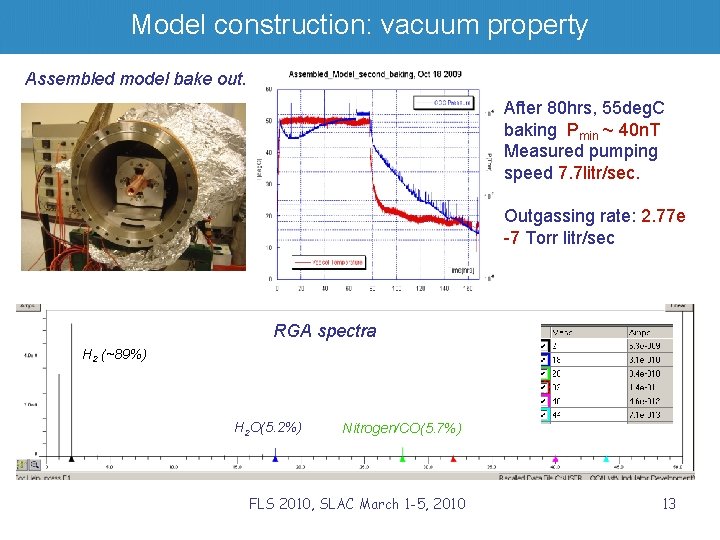
Model construction: vacuum property Assembled model bake out. After 80 hrs, 55 deg. C baking Pmin ~ 40 n. T Measured pumping speed 7. 7 litr/sec. Outgassing rate: 2. 77 e -7 Torr litr/sec RGA spectra H 2 (~89%) H 2 O(5. 2%) Nitrogen/CO(5. 7%) FLS 2010, SLAC March 1 -5, 2010 13
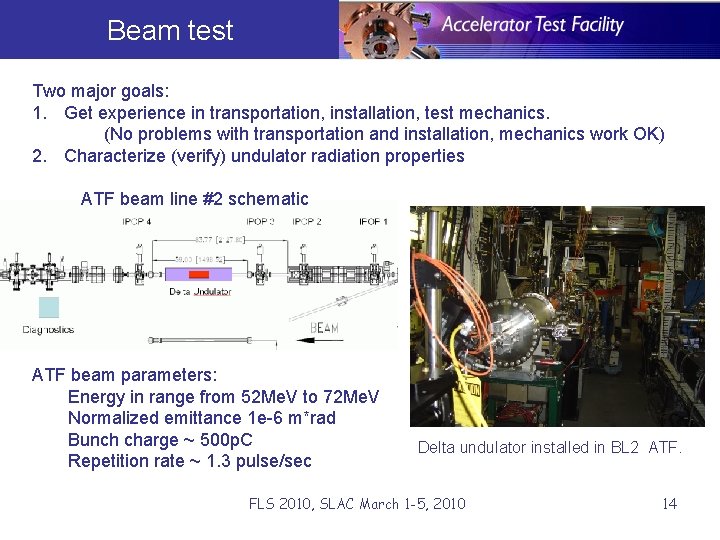
Beam test Two major goals: 1. Get experience in transportation, installation, test mechanics. (No problems with transportation and installation, mechanics work OK) 2. Characterize (verify) undulator radiation properties ATF beam line #2 schematic ATF beam parameters: Energy in range from 52 Me. V to 72 Me. V Normalized emittance 1 e-6 m*rad Bunch charge ~ 500 p. C Repetition rate ~ 1. 3 pulse/sec Delta undulator installed in BL 2 ATF. FLS 2010, SLAC March 1 -5, 2010 14
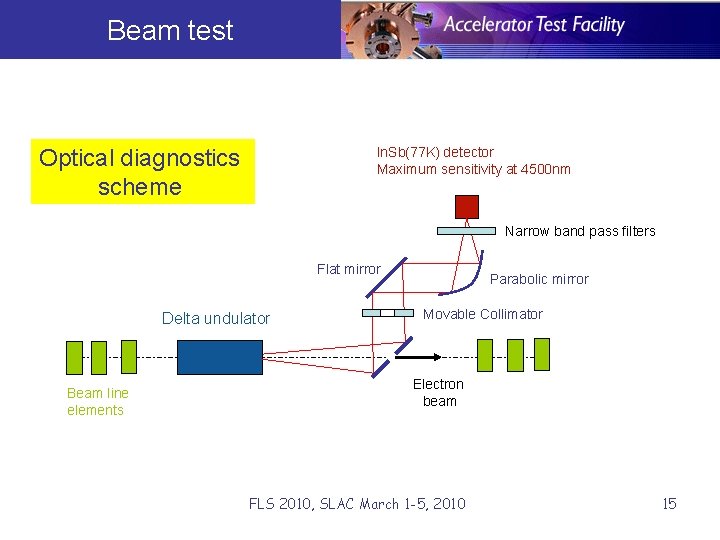
Beam test Optical diagnostics scheme In. Sb(77 K) detector Maximum sensitivity at 4500 nm Narrow band pass filters Flat mirror Delta undulator Beam line elements Parabolic mirror Movable Collimator Electron beam FLS 2010, SLAC March 1 -5, 2010 15
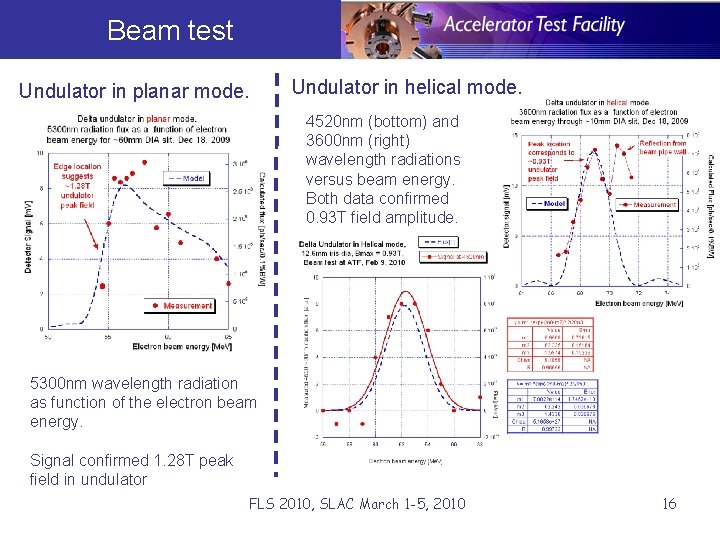
Beam test Undulator in planar mode. Undulator in helical mode. 4520 nm (bottom) and 3600 nm (right) wavelength radiations versus beam energy. Both data confirmed 0. 93 T field amplitude. 5300 nm wavelength radiation as function of the electron beam energy. Signal confirmed 1. 28 T peak field in undulator FLS 2010, SLAC March 1 -5, 2010 16
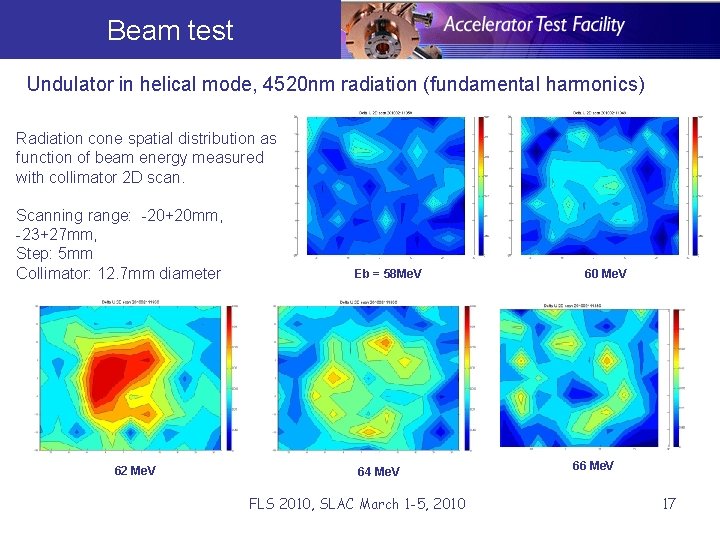
Beam test Undulator in helical mode, 4520 nm radiation (fundamental harmonics) Radiation cone spatial distribution as function of beam energy measured with collimator 2 D scan. Scanning range: -20+20 mm, -23+27 mm, Step: 5 mm Collimator: 12. 7 mm diameter 62 Me. V Eb = 58 Me. V 64 Me. V FLS 2010, SLAC March 1 -5, 2010 60 Me. V 66 Me. V 17
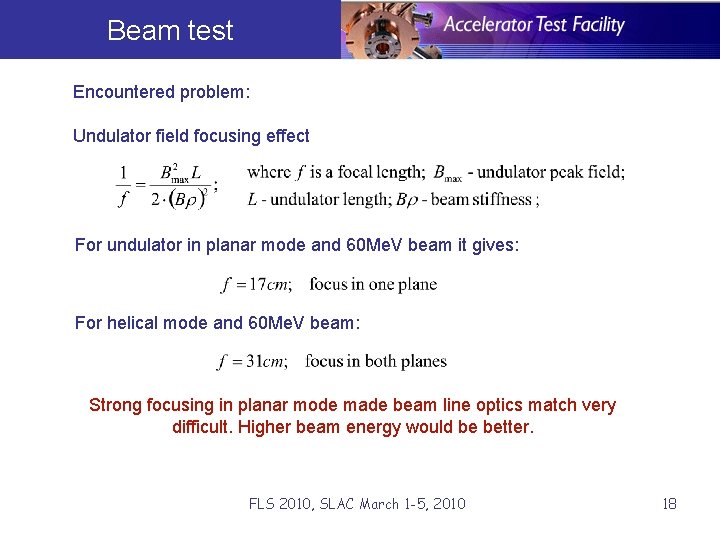
Beam test Encountered problem: Undulator field focusing effect For undulator in planar mode and 60 Me. V beam it gives: For helical mode and 60 Me. V beam: Strong focusing in planar mode made beam line optics match very difficult. Higher beam energy would be better. FLS 2010, SLAC March 1 -5, 2010 18
Conclusion 1. We developed concept and built short model of “Delta” undulator magnet. 2. Mechanical, magnetic and vacuum properties of the magnet have been tested. 3. The beam test confirmed the basic characteristics of the magnetic field: 0. 93 T in helical mode and 1. 27 T in planar. 4. Future plans – under consideration. Acknowledge I would like to thank David Rice, Sol Gruner, Donald Bilderback and Maury Tigner for support. My special thanks to Yulin Li and Karl Smolensky as well as vacuum group for useful discussions and help in the model construction. FLS 2010, SLAC March 1 -5, 2010 19