
Delphi Technique The objective of most Delphi applications

Delphi Technique
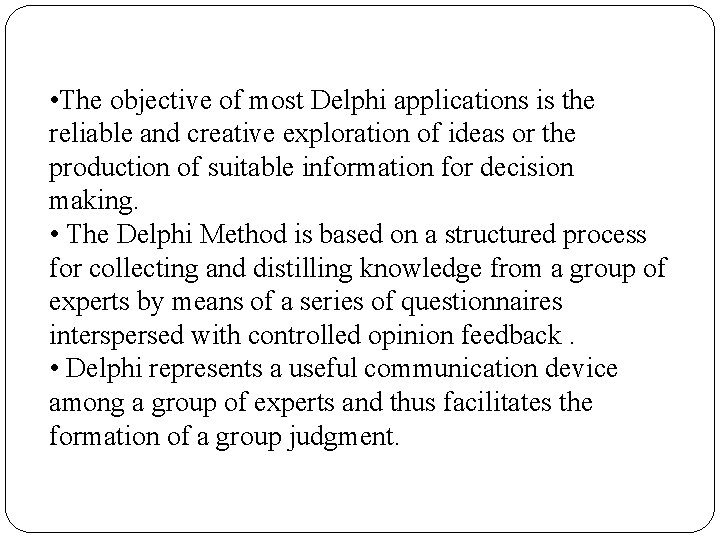
• The objective of most Delphi applications is the reliable and creative exploration of ideas or the production of suitable information for decision making. • The Delphi Method is based on a structured process for collecting and distilling knowledge from a group of experts by means of a series of questionnaires interspersed with controlled opinion feedback. • Delphi represents a useful communication device among a group of experts and thus facilitates the formation of a group judgment.
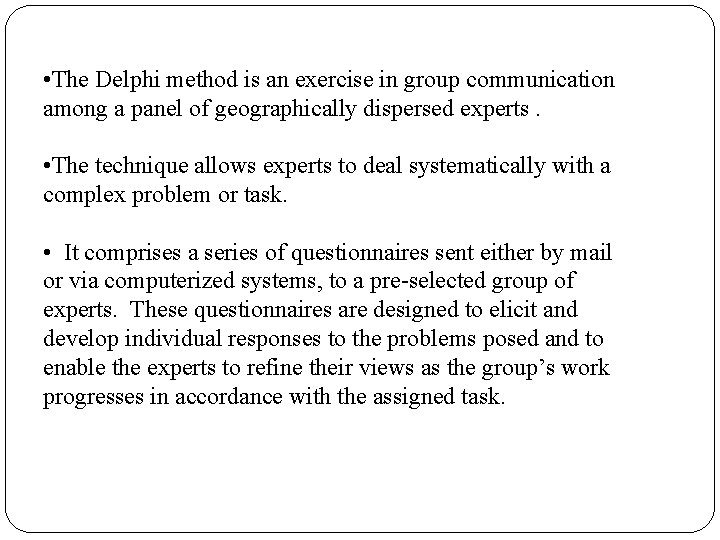
• The Delphi method is an exercise in group communication among a panel of geographically dispersed experts. • The technique allows experts to deal systematically with a complex problem or task. • It comprises a series of questionnaires sent either by mail or via computerized systems, to a pre-selected group of experts. These questionnaires are designed to elicit and develop individual responses to the problems posed and to enable the experts to refine their views as the group’s work progresses in accordance with the assigned task.
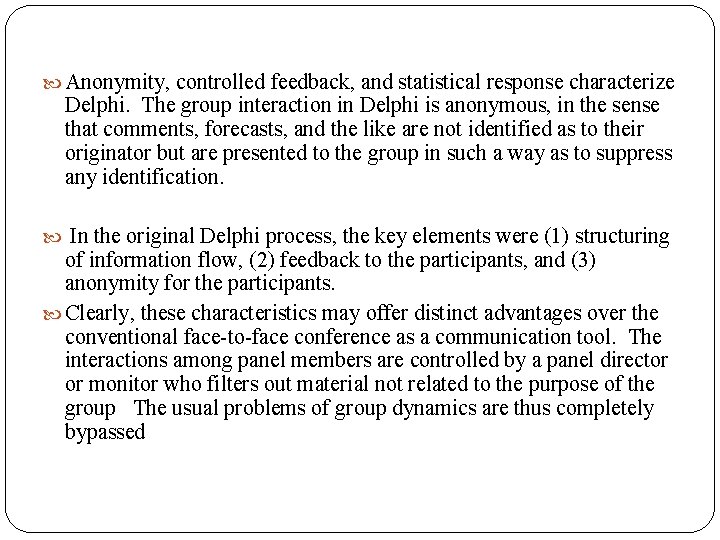
Anonymity, controlled feedback, and statistical response characterize Delphi. The group interaction in Delphi is anonymous, in the sense that comments, forecasts, and the like are not identified as to their originator but are presented to the group in such a way as to suppress any identification. In the original Delphi process, the key elements were (1) structuring of information flow, (2) feedback to the participants, and (3) anonymity for the participants. Clearly, these characteristics may offer distinct advantages over the conventional face-to-face conference as a communication tool. The interactions among panel members are controlled by a panel director or monitor who filters out material not related to the purpose of the group The usual problems of group dynamics are thus completely bypassed
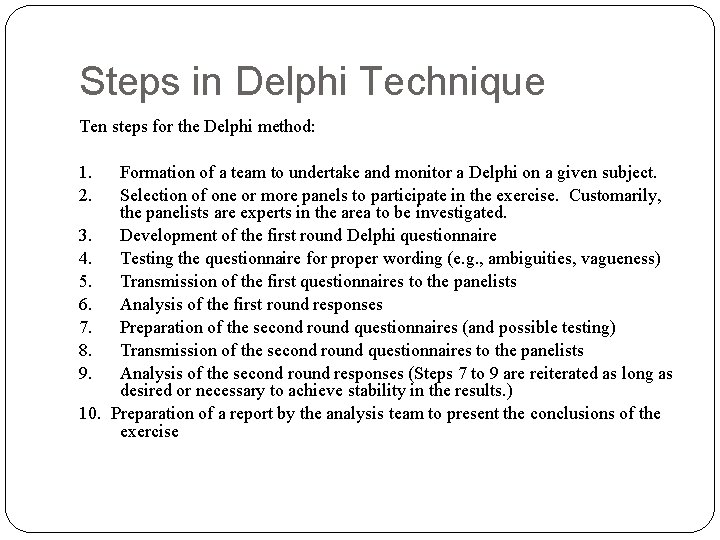
Steps in Delphi Technique Ten steps for the Delphi method: 1. 2. Formation of a team to undertake and monitor a Delphi on a given subject. Selection of one or more panels to participate in the exercise. Customarily, the panelists are experts in the area to be investigated. 3. Development of the first round Delphi questionnaire 4. Testing the questionnaire for proper wording (e. g. , ambiguities, vagueness) 5. Transmission of the first questionnaires to the panelists 6. Analysis of the first round responses 7. Preparation of the second round questionnaires (and possible testing) 8. Transmission of the second round questionnaires to the panelists 9. Analysis of the second round responses (Steps 7 to 9 are reiterated as long as desired or necessary to achieve stability in the results. ) 10. Preparation of a report by the analysis team to present the conclusions of the exercise
A number of questions need to be asked before making the decision of selecting or ruling out the Delphi technique: What kind of group communication process is desirable in order to explore the problem at hand? Who are the people with expertise on the problem and where are they located? What are the alternative techniques available and what results can reasonably be expected from their application? Only when the above questions are answered can one decide whether the Delphi method is appropriate to the context in which it will be applied.
The outcome of a Delphi sequence is nothing but opinion. The Delphi method has got criticism as well as support. The most extensive critique of the Delphi method : unscientific · Discounting the future: Future (and past) happenings are not as important as the current ones, therefore one may have a tendency to discount the future events. The simplification urge: Experts tend to judge the future of events in isolation from other developments. A holistic view of future events where change has had a pervasive influence cannot be visualized easily. Illusory expertise: some of the experts may be poor forecasters. Sloppy execution: there are many ways to do a poor job. Execution of the Delphi process may loose the required attention easily. Format bias: it should be recognized that the format of the questionnaire may be unsuitable. Manipulation of Delphi: The responses can be altered by the monitors in the hope of moving the next round responses in a desired direction.
- Slides: 7