
Delivery Tips and Tricks Nonverbal symbols All of
Delivery Tips and Tricks
Nonverbal symbols • All of the ways you communicate ideas without words • Kinesics: the study of the use of body motions to communicate • Rolling one’s eyes • Frowning • Staring • Laughing • Gesturing • Crossing one’s legs
Kinesics • Body movement can communicate • nervousness or calmness • Intensity or relaxation • Sincerity or hypocrisy
Proxemics • The study of the use of space to communicate • Closeness often equals the amount of comfort or ease a person feels in a communication situation, as well as the level of formality
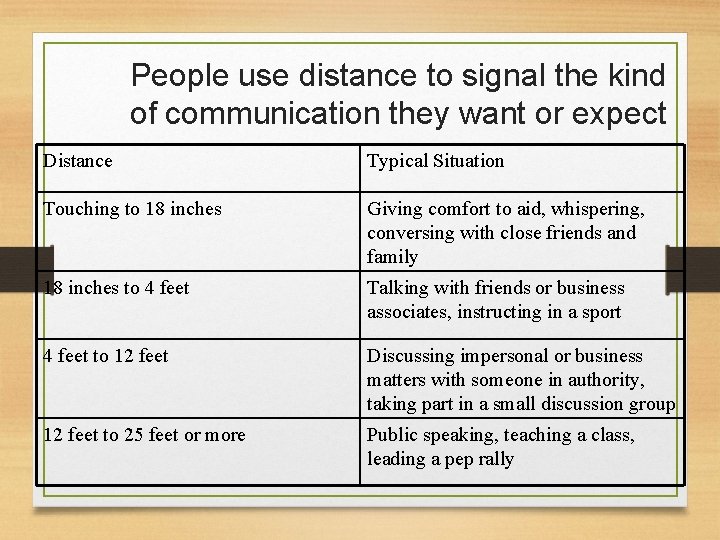
People use distance to signal the kind of communication they want or expect Distance Typical Situation Touching to 18 inches Giving comfort to aid, whispering, conversing with close friends and family 18 inches to 4 feet Talking with friends or business associates, instructing in a sport 4 feet to 12 feet Discussing impersonal or business matters with someone in authority, taking part in a small discussion group 12 feet to 25 feet or more Public speaking, teaching a class, leading a pep rally
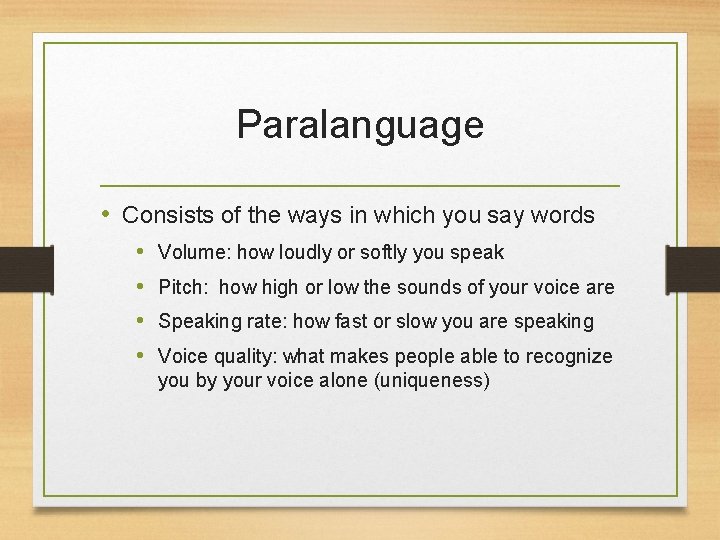
Paralanguage • Consists of the ways in which you say words • • Volume: how loudly or softly you speak Pitch: how high or low the sounds of your voice are Speaking rate: how fast or slow you are speaking Voice quality: what makes people able to recognize you by your voice alone (uniqueness)
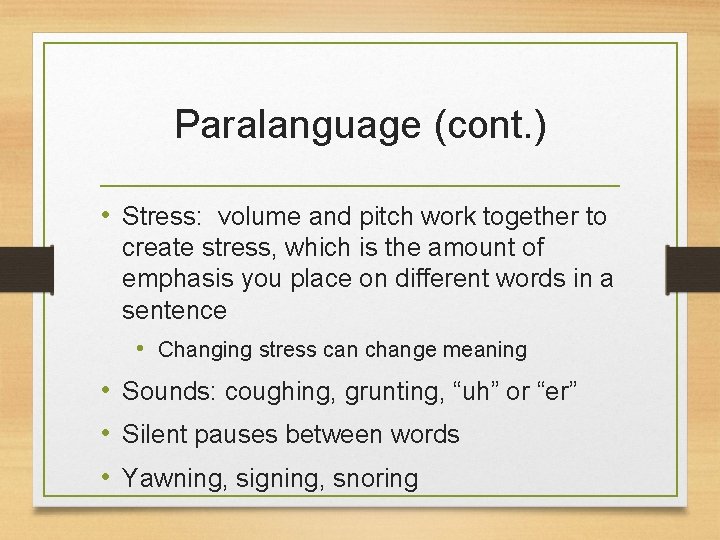
Paralanguage (cont. ) • Stress: volume and pitch work together to create stress, which is the amount of emphasis you place on different words in a sentence • Changing stress can change meaning • Sounds: coughing, grunting, “uh” or “er” • Silent pauses between words • Yawning, signing, snoring
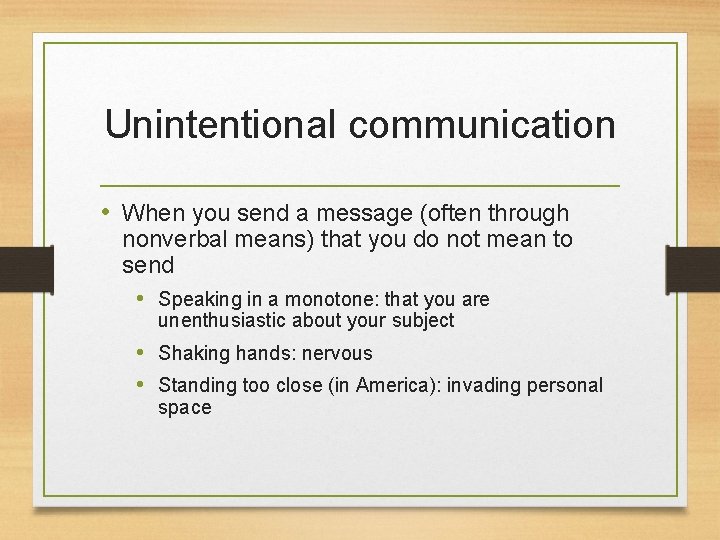
Unintentional communication • When you send a message (often through nonverbal means) that you do not mean to send • Speaking in a monotone: that you are unenthusiastic about your subject • Shaking hands: nervous • Standing too close (in America): invading personal space
Using Body Movement • Platform movement: the movement of the entire body while speaking • Why it can be helpful: • Making transitions between thoughts/major ideas • Moving closer to audience when attention is flagging • Providing variety
Using Body Movement • Too much body movement can make your audience think they are watching a Ping Pong match
Gestures • Beginning speakers tend to be too quiet with their arms and hands • However, practicing gestures for a particular point in a speech will look too rehearsed • Tip: During rehearsal, use general arm and hand movements. This will loosen you up and lead to similar movements during the speech.
Gestures • Gestures can also include movements of the head and face. • Move head frequently to look from one part of the audience to the other • Vary facial expression to correspond with thought patterns of your speech
Gestures • Transitional gestures: show you that you are moving from one part of your speech to another • Using your fingers to enumerate points • Placing both palms on the podium • Moving both hands, with palms facing each other, from one side to the other in front of you • Emphatic gestures: help the speaker stress what he or she is saying. • Making a fist • Raising one hand with the palm up • Pointing with the index finger at your audience
Gestures • Locative gestures: direct the listeners’ attention to some place, object, or person. They are usually made with the index finger or the entire hand • Descriptive gestures: hand arm movements used by a speaker to indicate characteristics of an object such as size or shape • Drawing pictures in the air
Gestures • Do not force gestures-do what feels natural • What to do with your arms and hands when not gesturing: • One or both arms hanging naturally at your side • One or both hands resting on (not grasping) the speaker’s stand • One or both hands held several inches in front of you
Gestures • Head and facial gestures • Smiles, frowns, nods, and any other movements of the head, eyebrows, chin, lips, or brow can create an impression of a dynamic and enthusiastic speaker (as long as they are appropriate to the message)
Eye Contact • May be most effective means of body- motion communication • Allows you to read your listeners’ feedback and adjust your approach • Gives each audience member that you are speaking to him or her personally • Start by looking at your audience as a whole • Aim to eventually look directly into the eyes of several of your listeners
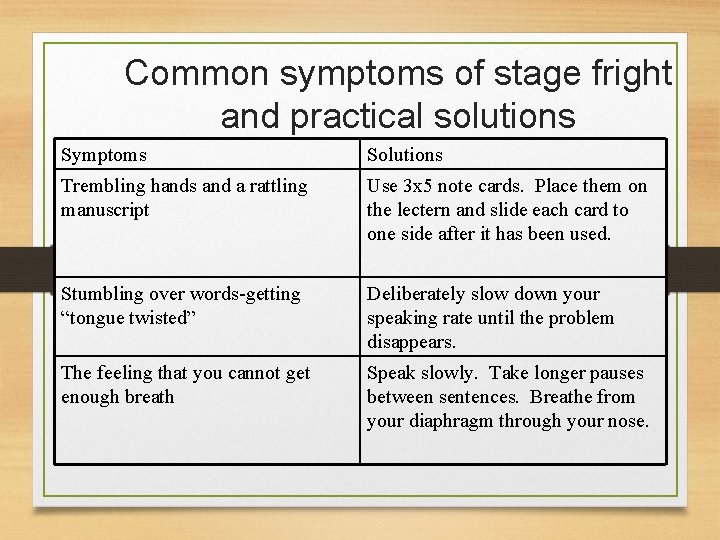
Common symptoms of stage fright and practical solutions Symptoms Solutions Trembling hands and a rattling manuscript Use 3 x 5 note cards. Place them on the lectern and slide each card to one side after it has been used. Stumbling over words-getting “tongue twisted” Deliberately slow down your speaking rate until the problem disappears. The feeling that you cannot get enough breath Speak slowly. Take longer pauses between sentences. Breathe from your diaphragm through your nose.
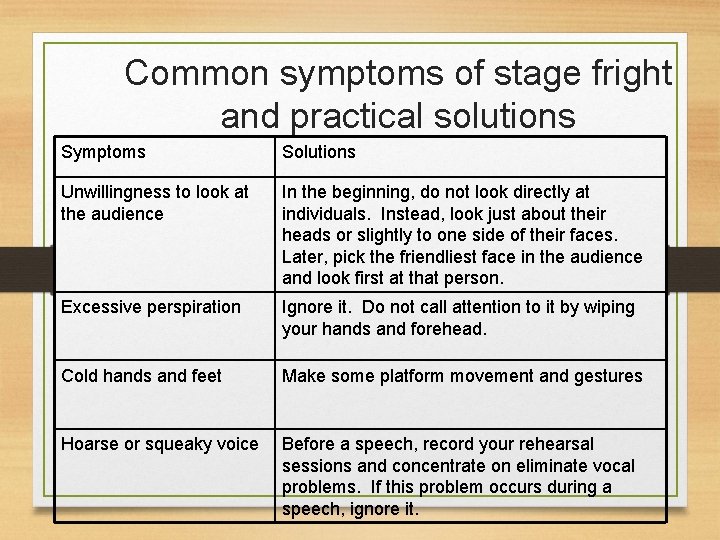
Common symptoms of stage fright and practical solutions Symptoms Solutions Unwillingness to look at the audience In the beginning, do not look directly at individuals. Instead, look just about their heads or slightly to one side of their faces. Later, pick the friendliest face in the audience and look first at that person. Excessive perspiration Ignore it. Do not call attention to it by wiping your hands and forehead. Cold hands and feet Make some platform movement and gestures Hoarse or squeaky voice Before a speech, record your rehearsal sessions and concentrate on eliminate vocal problems. If this problem occurs during a speech, ignore it.
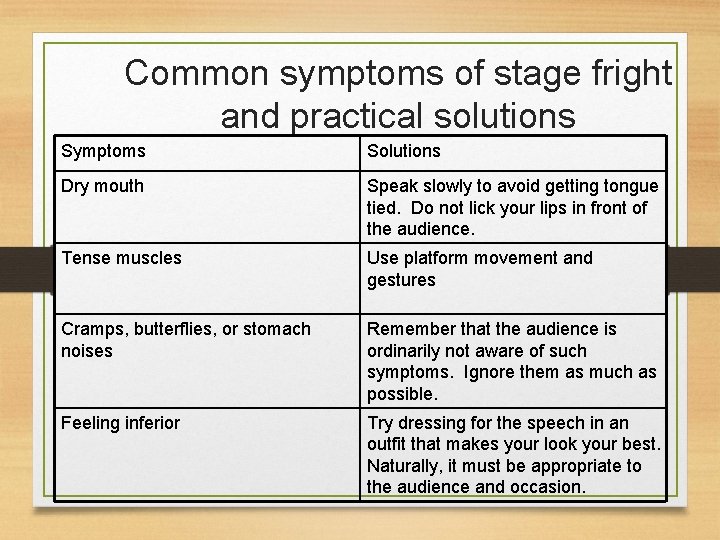
Common symptoms of stage fright and practical solutions Symptoms Solutions Dry mouth Speak slowly to avoid getting tongue tied. Do not lick your lips in front of the audience. Tense muscles Use platform movement and gestures Cramps, butterflies, or stomach noises Remember that the audience is ordinarily not aware of such symptoms. Ignore them as much as possible. Feeling inferior Try dressing for the speech in an outfit that makes your look your best. Naturally, it must be appropriate to the audience and occasion.
Using your voice effectively • Volume-controlled primarily by the amount of air a person forces through the vocal cords • Inhale deeply through the nose, sucking in air by expanding your diaphragm • Exhaling is also important for sustaining volume • Don’t let all of your air out after your first few words • Longer sentences will be too soft to be heard • Need to inhale so often you will hear like an air compressor at work
Using your voice effectively • Volume • Variety • Too loud-everything sounds important, then eventually nothing sounds important • Too soft-listeners will give up straining to hear • Parts to vary (either up or down in volume): transitions to new sections, the start of the conclusion, and the parts you wish to be dramatic
Pitch • The tone of the voice on the musical scale • Words or syllables to be emphasized are usually spoken in a higher key • Changing pitch comes naturally in conversation, but is difficult for beginning speakers • Avoid speaking in a monotone, which has no ups and downs in pitch. This makes your audience feel that you are not enthusiastic • Tip: try to find your pitch that can be used most comfortably without strain for extended periods of time. Most comfortable is usually in the lower half of the range.
Watch your speaking rate • Normal speaking rate varies from 120 -150 words per minute • How to slow down • Varying the number and length of pauses between words • Varying the length of time it takes to pronounce each syllable **Best place to start correction is with pauses
Watch your speaking rate • Vocalized pause: the habit of filling in time between words or sentences with “uh, ” “er, ” “like, ” “you know” or similar sounds. • Two methods for limiting vocalized pauses: • Make a list of transition words to use between sentences and vary them regularly during the speech • Rehearse your speeches with a tape recorder and listen to yourself
Use Crisp Articulation and Correct Pronunciation • Articulation: the way in which the tongue, teeth, palate, and lips are moved and used to produce the crisp, clear sounds of good speech • Examples of bad articulation: • • “Watcha doin? ” “Madder” instead of matter “Pacific” instead of “specific” “Gonna” instead of “Going to”
Use Crisp Articulation and Correct Pronunciation • Pronunciation: selecting the correct sounds and the proper syllable stresses • What makes a certain pronunciation correct is usage. Sources of correct pronunciation: • The dictionary • Prominent speakers of the day **Look up and then practice correct pronunciation during rehearsal
Pause Effectively • “The right word may be effective, but no word was ever as effective as a rightly timed pause. ” --Mark Twain • Two common pausing problems: • Rushing ahead without pause • Using vocalized pauses such as “Um”
Rehearsing your speech • Allow for several rehearsal sessions-do not cram into one evening • Your brain will work subconsciously on cementing the ideas between sessions so you need to spread them out
Rehearsing your speech • In addition to learning the ideas, you need to also practice: • Proper breathing • Voice projection • Clear articulation • Good timing
Rehearsing your speechextemporaneous • Plant the pattern of ideas in your mind • Start by reading the outline over silently to yourself several times • Once the ideas are firmly planted, stand up and say the words aloud to an imaginary audience • Speak the ideas in whatever words come to mind as you are rehearsing
Rehearsing your speechextemporaneous • Try to go completely through, filling in details of the outline without starting over • Note: Your speech will be halting at first with long pauses in places, but it will begin to smooth out with repeated practice • The second, third, and fourth times you practice, do not try to say the ideas in the same words you used the first time. Remember, you are planting the pattern of ideas, not a memorized pattern of words
Time Rehearsals • Time yourself as your practice • Timing will not be precise the first few times • By the final practice session, you should be able to conclude within 30 seconds of your time limit
- Slides: 33