
Delivery Report Services and Components Based Architectures SCBA
Delivery Report Services and Components Based Architectures (SCBA) A Strategic Guide for Implementing Distributed and Reusable Services and Components in Government Washington, DC January 26, 2006 This document is confidential and is intended solely for the use and information of the client to whom it is addressed. Services and Components Based Architectures - Presentation to CAF
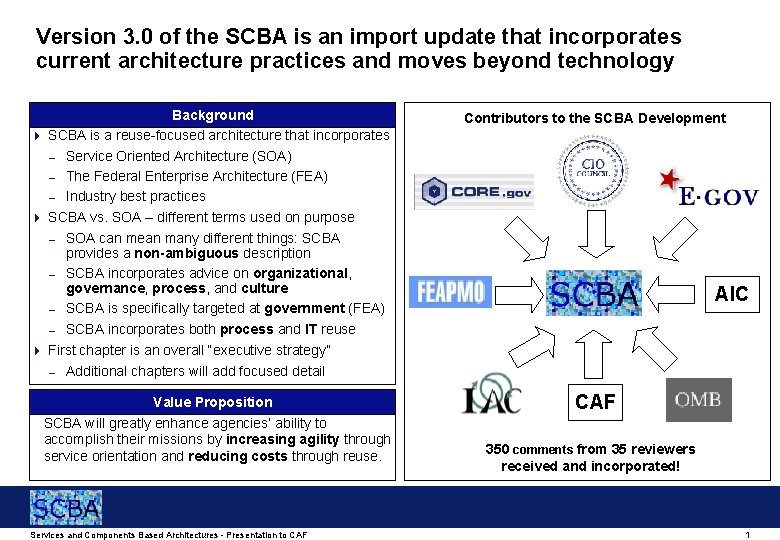
Version 3. 0 of the SCBA is an import update that incorporates current architecture practices and moves beyond technology Background 4 SCBA is a reuse-focused architecture that incorporates – Service Oriented Architecture (SOA) – The Federal Enterprise Architecture (FEA) – Industry best practices Contributors to the SCBA Development 4 SCBA vs. SOA – different terms used on purpose – SOA can mean many different things: SCBA provides a non-ambiguous description – SCBA incorporates advice on organizational, governance, process, and culture – SCBA is specifically targeted at government (FEA) – SCBA incorporates both process and IT reuse 4 First chapter is an overall “executive strategy” – Additional chapters will add focused detail Value Proposition SCBA will greatly enhance agencies’ ability to accomplish their missions by increasing agility through service orientation and reducing costs through reuse. Services and Components Based Architectures - Presentation to CAF AIC CAF 350 comments from 35 reviewers received and incorporated! 1
Agenda 4 Background and Value Proposition 4 Summary of Major Points in Paper 4 Next Steps 4 Appendix Services and Components Based Architectures - Presentation to CAFMarch 30, 2005 ET. gov Presentation---Gov. Con 05
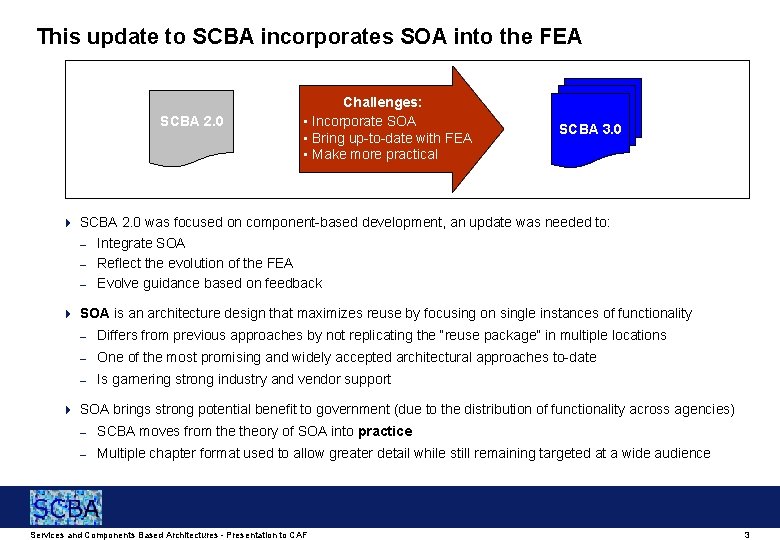
This update to SCBA incorporates SOA into the FEA SCBA 2. 0 Challenges: • Incorporate SOA • Bring up-to-date with FEA • Make more practical SCBA 3. 0 4 SCBA 2. 0 was focused on component-based development, an update was needed to: – Integrate SOA – Reflect the evolution of the FEA – Evolve guidance based on feedback 4 SOA is an architecture design that maximizes reuse by focusing on single instances of functionality – Differs from previous approaches by not replicating the “reuse package” in multiple locations – One of the most promising and widely accepted architectural approaches to-date – Is garnering strong industry and vendor support 4 SOA brings strong potential benefit to government (due to the distribution of functionality across agencies) – SCBA moves from theory of SOA into practice – Multiple chapter format used to allow greater detail while still remaining targeted at a wide audience Services and Components Based Architectures - Presentation to CAF 3
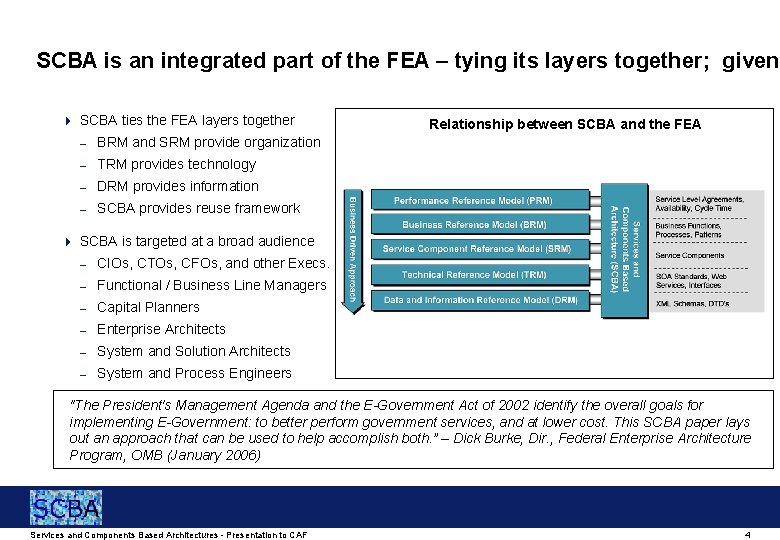
SCBA is an integrated part of the FEA – tying its layers together; given 4 SCBA ties the FEA layers together – BRM and SRM provide organization – TRM provides technology – DRM provides information – SCBA provides reuse framework Relationship between SCBA and the FEA 4 SCBA is targeted at a broad audience – CIOs, CTOs, CFOs, and other Execs. – Functional / Business Line Managers – Capital Planners – Enterprise Architects – System and Solution Architects – System and Process Engineers "The President's Management Agenda and the E-Government Act of 2002 identify the overall goals for implementing E-Government: to better perform government services, and at lower cost. This SCBA paper lays out an approach that can be used to help accomplish both. ” – Dick Burke, Dir. , Federal Enterprise Architecture Program, OMB (January 2006) Services and Components Based Architectures - Presentation to CAF 4
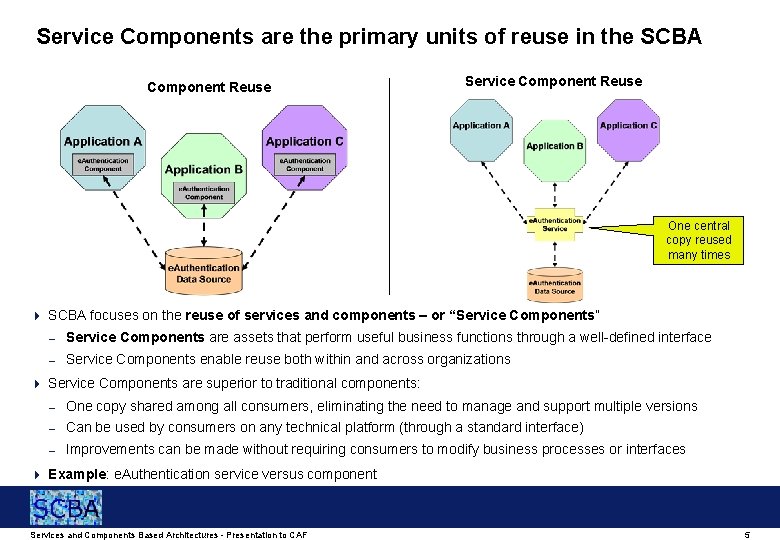
Service Components are the primary units of reuse in the SCBA Component Reuse Service Component Reuse One central copy reused many times 4 SCBA focuses on the reuse of services and components – or “Service Components” – Service Components are assets that perform useful business functions through a well-defined interface – Service Components enable reuse both within and across organizations 4 Service Components are superior to traditional components: – One copy shared among all consumers, eliminating the need to manage and support multiple versions – Can be used by consumers on any technical platform (through a standard interface) – Improvements can be made without requiring consumers to modify business processes or interfaces 4 Example: e. Authentication service versus component Services and Components Based Architectures - Presentation to CAF 5
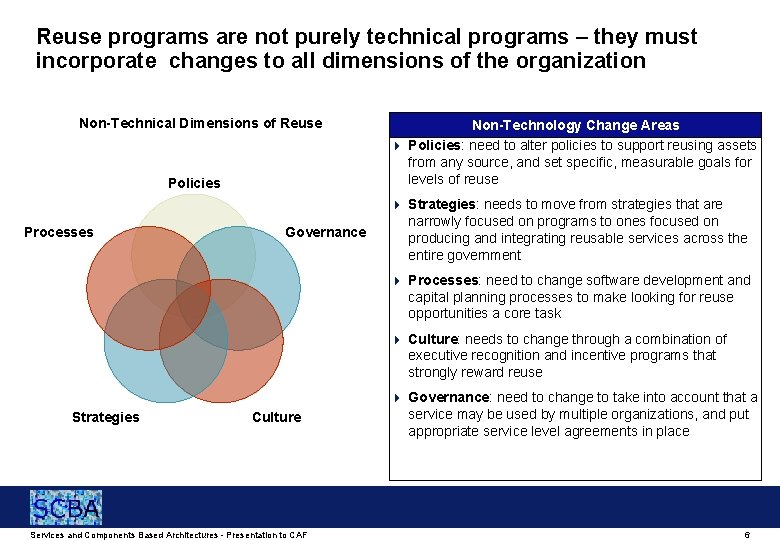
Reuse programs are not purely technical programs – they must incorporate changes to all dimensions of the organization Non-Technical Dimensions of Reuse Policies Processes Governance Non-Technology Change Areas 4 Policies: need to alter policies to support reusing assets from any source, and set specific, measurable goals for levels of reuse 4 Strategies: needs to move from strategies that are narrowly focused on programs to ones focused on producing and integrating reusable services across the entire government 4 Processes: need to change software development and capital planning processes to make looking for reuse opportunities a core task 4 Culture: needs to change through a combination of executive recognition and incentive programs that strongly reward reuse Strategies Culture Services and Components Based Architectures - Presentation to CAF 4 Governance: need to change to take into account that a service may be used by multiple organizations, and put appropriate service level agreements in place 6
Of course, reuse of software Service Components is also enabled through a combination of technical techniques 4 Design for Reuse: focus on interfaces, configurability, good documentation, and white-boxing 4 Tools for Reuse: tools enable publication and discovery of Service Components – Registries (such as Core. gov) provide directories of Service Components – Repositories provide the actual Service Components themselves 4 Reuse Infrastructure: – Internal systems can reflect available services, their interfaces, and monitor their quality – Modern shared middleware can be used to create an Enterprise Service Bus (ESB) – ESB allows services to discovery each other and communicate 4 Security: an import aspect of design, tools, and infrastructure – cuts across all aspects Services and Components Based Architectures - Presentation to CAF 7
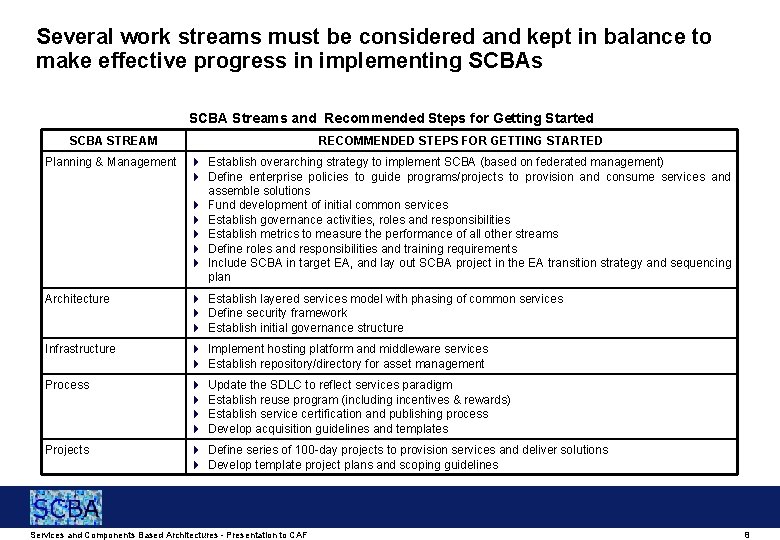
Several work streams must be considered and kept in balance to make effective progress in implementing SCBAs SCBA Streams and Recommended Steps for Getting Started SCBA STREAM RECOMMENDED STEPS FOR GETTING STARTED Planning & Management 4 Establish overarching strategy to implement SCBA (based on federated management) 4 Define enterprise policies to guide programs/projects to provision and consume services and assemble solutions 4 Fund development of initial common services 4 Establish governance activities, roles and responsibilities 4 Establish metrics to measure the performance of all other streams 4 Define roles and responsibilities and training requirements 4 Include SCBA in target EA, and lay out SCBA project in the EA transition strategy and sequencing plan Architecture 4 Establish layered services model with phasing of common services 4 Define security framework 4 Establish initial governance structure Infrastructure 4 Implement hosting platform and middleware services 4 Establish repository/directory for asset management Process 4 4 Projects 4 Define series of 100 -day projects to provision services and deliver solutions 4 Develop template project plans and scoping guidelines Update the SDLC to reflect services paradigm Establish reuse program (including incentives & rewards) Establish service certification and publishing process Develop acquisition guidelines and templates Services and Components Based Architectures - Presentation to CAF 8
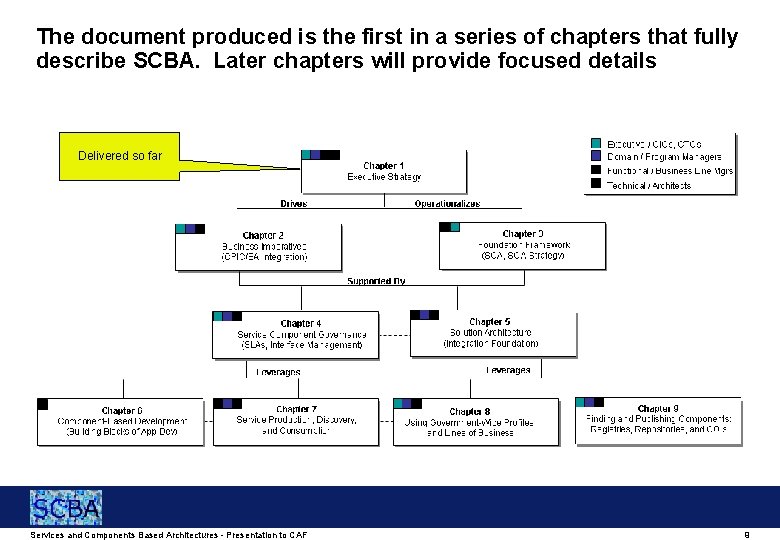
The document produced is the first in a series of chapters that fully describe SCBA. Later chapters will provide focused details Delivered so far Services and Components Based Architectures - Presentation to CAF 9
Agenda 4 Background and Value Proposition 4 Summary of Major Points in Paper 4 Summary and Next Steps 4 Appendix Services and Components Based Architectures - Presentation to CAFMarch 30, 2005 ET. gov Presentation---Gov. Con 05
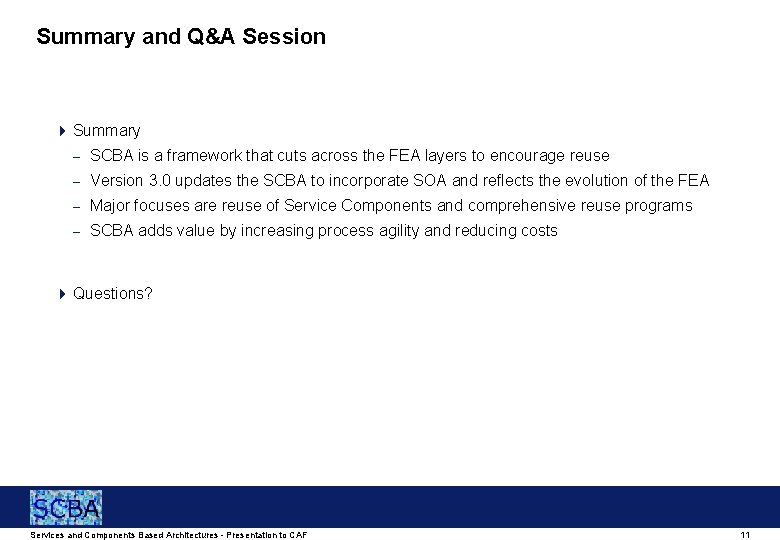
Summary and Q&A Session 4 Summary – SCBA is a framework that cuts across the FEA layers to encourage reuse – Version 3. 0 updates the SCBA to incorporate SOA and reflects the evolution of the FEA – Major focuses are reuse of Service Components and comprehensive reuse programs – SCBA adds value by increasing process agility and reducing costs 4 Questions? Services and Components Based Architectures - Presentation to CAF 11

Next Steps 4 Next Steps – Seeking AIC endorsement of Chapter 1 – Discuss strategy for completing Chapters 2 through 9 – Commence work on Chapters 2 through 9 Services and Components Based Architectures - Presentation to CAF 12
Agenda 4 Background 4 Paper Content 4 Next Steps 4 Appendix Services and Components Based Architectures - Presentation to CAFMarch 30, 2005 ET. gov Presentation---Gov. Con 05
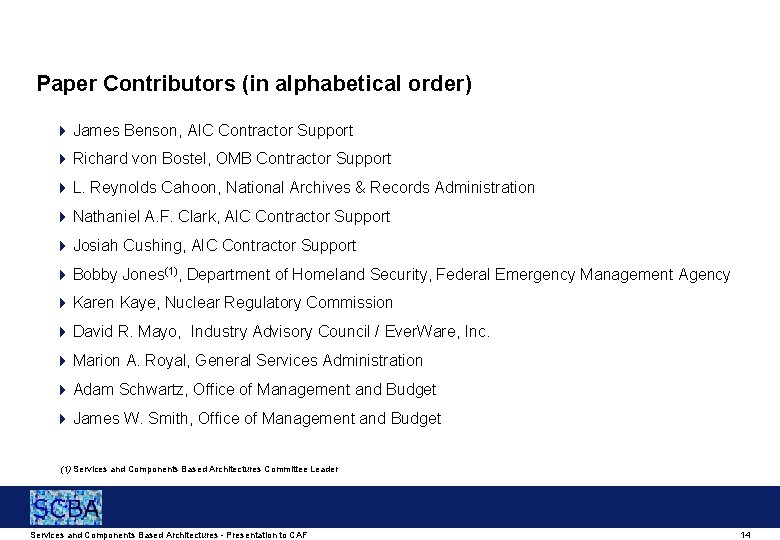
Paper Contributors (in alphabetical order) 4 James Benson, AIC Contractor Support 4 Richard von Bostel, OMB Contractor Support 4 L. Reynolds Cahoon, National Archives & Records Administration 4 Nathaniel A. F. Clark, AIC Contractor Support 4 Josiah Cushing, AIC Contractor Support 4 Bobby Jones(1), Department of Homeland Security, Federal Emergency Management Agency 4 Karen Kaye, Nuclear Regulatory Commission 4 David R. Mayo, Industry Advisory Council / Ever. Ware, Inc. 4 Marion A. Royal, General Services Administration 4 Adam Schwartz, Office of Management and Budget 4 James W. Smith, Office of Management and Budget (1) Services and Components Based Architectures Committee Leader Services and Components Based Architectures - Presentation to CAF 14
Discussion Topics for Breakout Session Note: This session is intended to be highly interactive and the only participation pre-requisite is that you have read SCBA v 3. 4 4 Are there any concepts or information from the SCBA Paper or today’s presentation you would like further explained? 4 Have you had experience in your Department or Agency in implementing a service component based architecture? 4 Are you aware of any leading edge implementations of service component based architecture within the federal government or the private sectors? 4 What key messages or points did you glean from the document? 4 Is the document too technical, not technical enough or just right? (please keep in mind that this chapter is targeted at the broadest audience of all the chapters) 4 Are there any future chapters that you would like to see added/removed/combined/modified in the document? 4 Can you recommend any subject matter experts to contribute to the future chapters? Services and Components Based Architectures - Presentation to CAF 15
- Slides: 16