
Delivery of goods Delivery of goods means voluntary
- Slides: 5
Delivery of goods • Delivery of goods means voluntary transfer of possession of goods from one person to another. • Modes of Delivery Ø Actual Delivery Ø Symbolic Delivery Ø Constructive Delivery or Delivery By Attornment
Rules as to delivery of goods 1. Delivery may be either actual or symbolic or constructive 2. Delivery and Payment are Concurrent condition 3. Effect of part delivery, when property in goods is to pass on delivery. 4. Buyer To Apply For Delivery 5. Time Of Delivery 6. Place Of Delivery 7. Delivery Of Goods When They Are In Possession Of A Third Party 8. Expenses Of Delivery 9. Delivery Of Wrong Quantity Or Different Quality 10. Instalment Deliveries
Rules as to delivery of goods Acceptance of Delivery does not amount to acceptance of goods. It is the final assent of buyer. Buyer is deemed to have accepted the goods under following conditions 1. When he intimates the seller that he has accepted the goods. 2. When the goods have been delivered to him and he does any act in relation to them which shows that he has accepted them. 3. When he does not inform the seller that he has rejected the goods and retains the goods beyond a reasonable time.
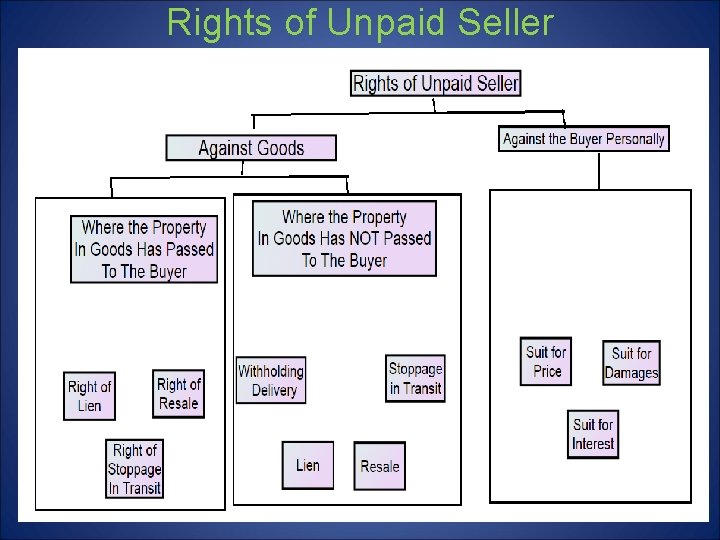
Rights of Unpaid Seller The Seller of goods deemed to be an ‘unpaid seller’ – 1. When the whole of the price has not been paid or tendered 2. When a bill of exchange or other negotiable instrument has been received as conditional payment, and it has been dishonoured. Notes: a)The seller shall be called an unpaid seller even when a small portion of the price remains to be paid. b)It is the for the non-payment for price and not for other expenses. c)Where the goods have been sold on credit, seller cannot be called as unpaid seller during the credit period. d)Where the full price has been tendered by the buyer and the seller has refused to accept it, the seller cannot be called as unpaid seller.
Rights of Unpaid Seller