
Delivering Your Message Essentials of Public Speaking Cheryl
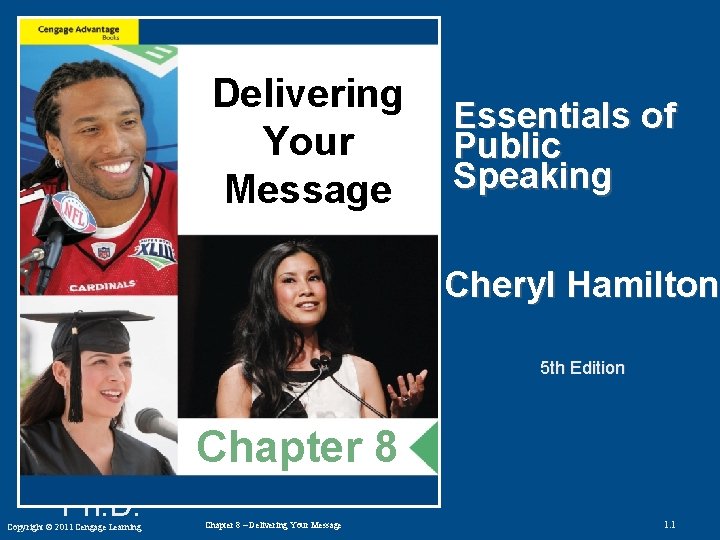
Delivering Your Message Essentials of Public Speaking Cheryl Hamilton 5 th Edition Chapter 8 Cheryl Hamilton, Ph. D. Copyright © 2011 Cengage Learning Chapter 8 – Delivering Your Message 1. 1
Flashback. . . Quintilian, a noted Roman rhetorician, gave his students detailed suggestions on gestures and facial expressions in De Institutione Oratoria. Some of his suggestions included: – Use the head to indicate humility/haughtiness. – Use the face to show sadness/cheerfulness/pride. – Strike thigh to show indignation. – Use the fingers to indicate specific ideas. Copyright © 2011 Cengage Learning Chapter 8 – Delivering Your Message 1. 2
Key Ideas q q Methods of speech delivery Improving verbal delivery Improving vocal delivery Improving visual delivery Copyright © 2011 Cengage Learning Chapter 8 – Delivering Your Message 1. 3
Methods of Speech Delivery q q q Extemporaneous Speaking from brief notes Extemporaneous Speaking from visual aids Impromptu Speaking from a Manuscript Speaking from Memory Copyright © 2011 Cengage Learning Chapter 8 – Delivering Your Message 1. 4
Extemporaneous Speaking Using Notes q The speech is delivered using a brief set of speaking notes – The speaking notes are prepared by turning selecting keywords from your preparation outline – Quotes are written out completely on separate cards q Speaking from keyword notes help you to sound conversational and make good eye contact with listeners Copyright © 2011 Cengage Learning Chapter 8 – Delivering Your Message 1. 5
Extemporaneous Speaking: Using Visual Aids q This is a form of extemporaneous speaking that uses visual aids rather than a set of notes q Speakers use the slides as a memory device Copyright © 2011 Cengage Learning Chapter 8 – Delivering Your Message 1. 6
Speaking Impromptu q An impromptu speech is given without prior knowledge or preparation q Try the following plan for your next Impromptu speech – Appear confident – Decide on a conclusion or objective first – Begin with a general statement or background information – Introduce supporting reasons with the word because (Stone & Bachner, 1994) Copyright © 2011 Cengage Learning Chapter 8 – Delivering Your Message 1. 7
Speaking from a Manuscript q Manuscript speaking is harder than speaking from notes q It’s difficult to use good vocal variety and maintain good eye contact q To ensure manuscript is readable use 14 or 16 point type and double or triple space q Practice reading your manuscript until you sound authoritative yet conversational and can maintain good eye contact Copyright © 2011 Cengage Learning Chapter 8 – Delivering Your Message 1. 8
Speaking From Memory q It takes a good deal of time to memorize a speech q Speaking from memory makes it difficult to react to audience feedback because you could forget what you were going to say next q Delivery may not be relaxed because you’re trying to recall words q Memorizing segments of a speech such as the introduction and conclusion do not usually cause problems Copyright © 2011 Cengage Learning Chapter 8 – Delivering Your Message 1. 9
Improving Verbal Delivery q Verbal delivery involves your overall speaking style – Word choice – Sentence Construction q Make sure you keep your speech simple, specific and vivid q Avoid jargon q Avoid using language that could offend audience members Copyright © 2011 Cengage Learning Chapter 8 – Delivering Your Message 1. 10
Improving Visual Delivery q Pay attention to your appearance – Appearance gives the audience a clue regarding your status and credibility – Dress conservatively for the speaking situation q Pay attention to facial expressions and eye contact – Facial expressions can affect audience judgment of your credibility – Try to make eye contact with both sides of the room Copyright © 2011 Cengage Learning Chapter 8 – Delivering Your Message 1. 11
Improving Visual Delivery q Types of gestures • Emblems – gestures that replace a word or idea • Illustrators – gestures that expand or clarify a word or idea • Regulators – gestures that control the flow of communication in small group • Adaptors – gestures that signal nervousness Copyright © 2011 Cengage Learning Chapter 8 – Delivering Your Message 1. 12
Adapting Visual Delivery to the Media q q q Be conscious of your visual image Choose your clothing color carefully Avoid shiny jewelry Wear slenderizing clothes Men generally don’t need makeup Look directly into the camera Copyright © 2011 Cengage Learning Chapter 8 – Delivering Your Message 1. 13
Vocal Delivery q Elements of Vocal Delivery – Tone, Volume and pitch – Emphasis, speaking rate, and pauses – Articulation and pronunciation q The goal of good vocal delivery is vocal variety Copyright © 2011 Cengage Learning Chapter 8 – Delivering Your Message 1. 14
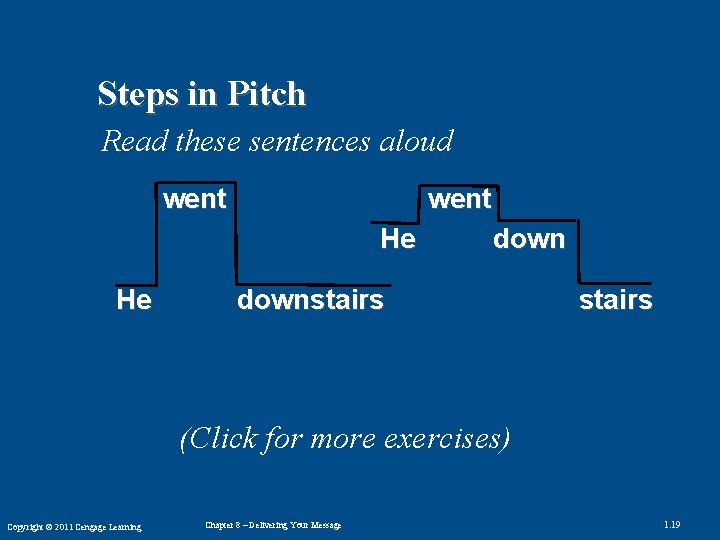
Volume and Pitch q Volume – the loudness or softness of your voice – Raise the volume of your voice for emphasis – Lower the volume of your voice to help listeners focus on a point q Pitch – the highness or lowness of vocal tones – Pitch changes include steps in pitch and inflection – Pitch changes add interest, energy and communicate subtle meanings Copyright © 2011 Cengage Learning Chapter 8 – Delivering Your Message 1. 15
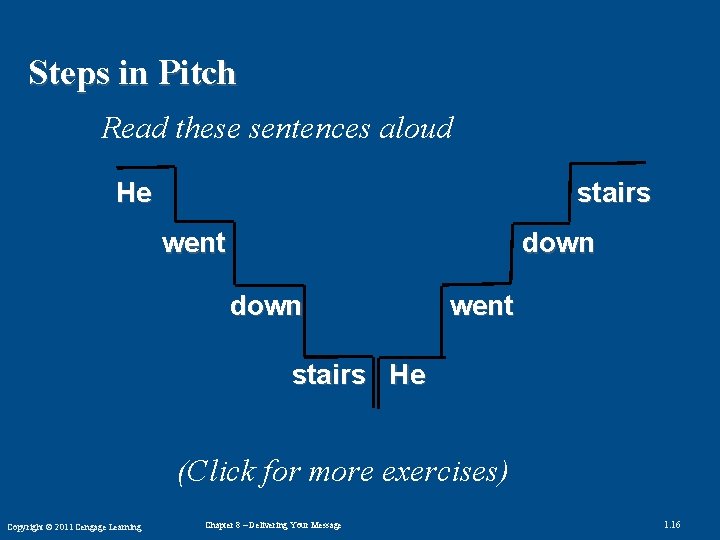
Steps in Pitch Read these sentences aloud He stairs went down went stairs He (Click for more exercises) Copyright © 2011 Cengage Learning Chapter 8 – Delivering Your Message 1. 16
Improving Verbal Delivery q Verbal delivery involves your overall speaking style – Word choice – How you construct sentences q Make sure you keep your speech simple, specific and vivid q Avoid jargon q Avoid using language that could offend audience members Copyright © 2011 Cengage Learning Chapter 8 – Delivering Your Message 1. 17
Improving Verbal Delivery q Verbal delivery involves your overall speaking style – Word choice – How you construct sentences q Make sure you keep your speech simple, specific and vivid q Avoid jargon q Avoid using language that could offend audience members Copyright © 2011 Cengage Learning Chapter 8 – Delivering Your Message 1. 18
Steps in Pitch Read these sentences aloud went He He downstairs (Click for more exercises) Copyright © 2011 Cengage Learning Chapter 8 – Delivering Your Message 1. 19
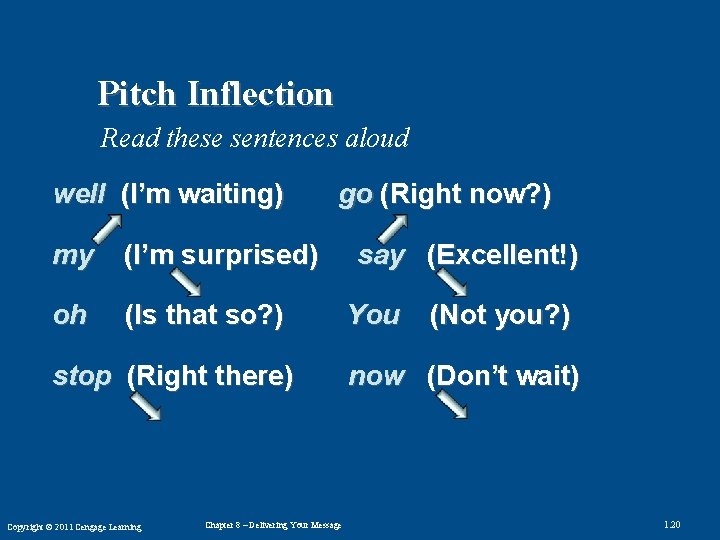
Pitch Inflection Read these sentences aloud well (I’m waiting) my (I’m surprised) oh (Is that so? ) go (Right now? ) stop (Right there) Copyright © 2011 Cengage Learning Chapter 8 – Delivering Your Message say (Excellent!) You (Not you? ) now (Don’t wait) 1. 20
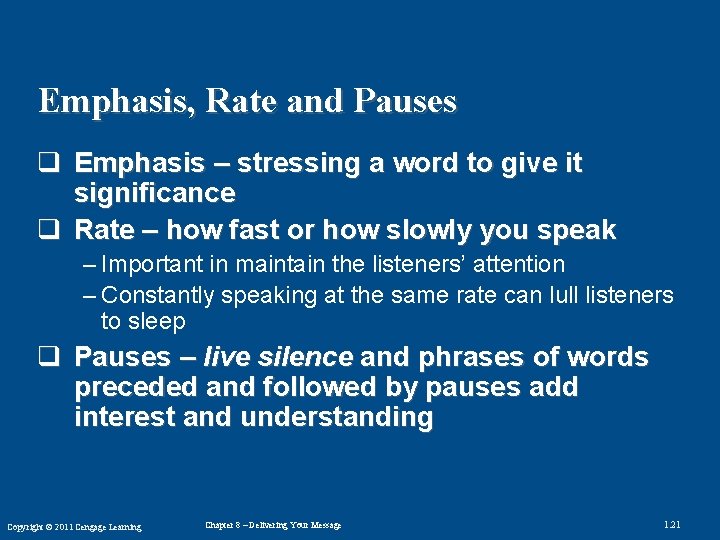
Emphasis, Rate and Pauses q Emphasis – stressing a word to give it significance q Rate – how fast or how slowly you speak – Important in maintain the listeners’ attention – Constantly speaking at the same rate can lull listeners to sleep q Pauses – live silence and phrases of words preceded and followed by pauses add interest and understanding Copyright © 2011 Cengage Learning Chapter 8 – Delivering Your Message 1. 21
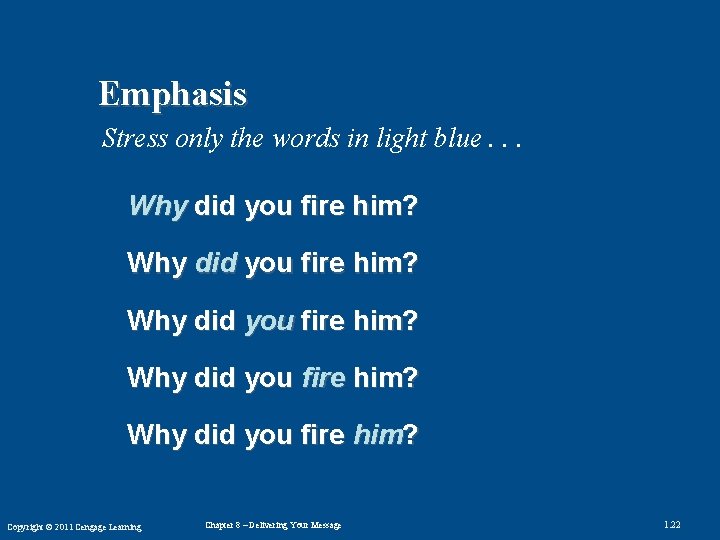
Emphasis Stress only the words in light blue. . . Why did you fire him? Why did you fire him? Copyright © 2011 Cengage Learning Chapter 8 – Delivering Your Message 1. 22
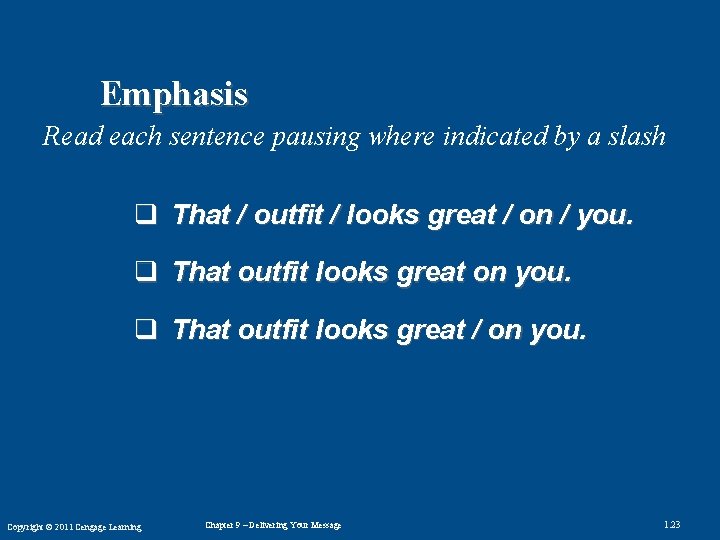
Emphasis Read each sentence pausing where indicated by a slash q That / outfit / looks great / on / you. q That outfit looks great on you. q That outfit looks great / on you. Copyright © 2011 Cengage Learning Chapter 9 – Delivering Your Message 1. 23
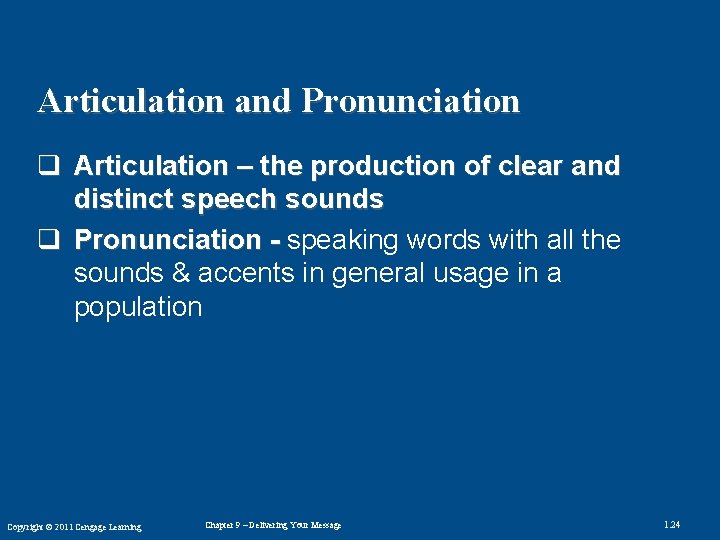
Articulation and Pronunciation q Articulation – the production of clear and distinct speech sounds q Pronunciation - speaking words with all the sounds & accents in general usage in a population Copyright © 2011 Cengage Learning Chapter 9 – Delivering Your Message 1. 24
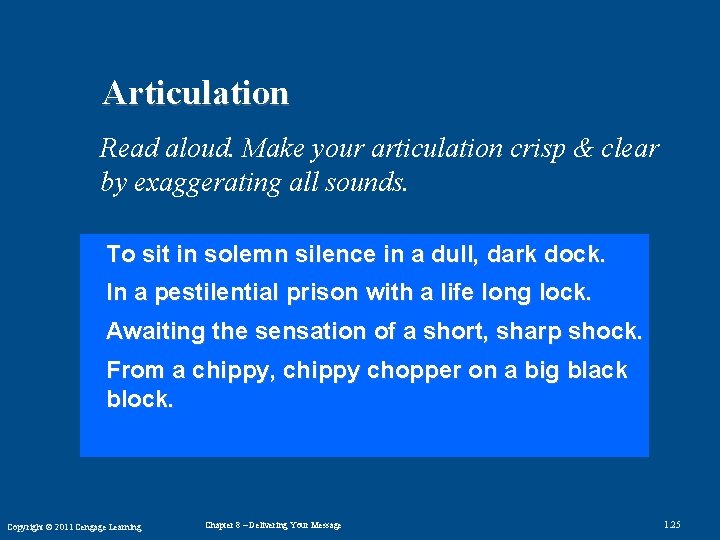
Articulation Read aloud. Make your articulation crisp & clear by exaggerating all sounds. To sit in solemn silence in a dull, dark dock. In a pestilential prison with a life long lock. Awaiting the sensation of a short, sharp shock. From a chippy, chippy chopper on a big black block. Copyright © 2011 Cengage Learning Chapter 8 – Delivering Your Message 1. 25
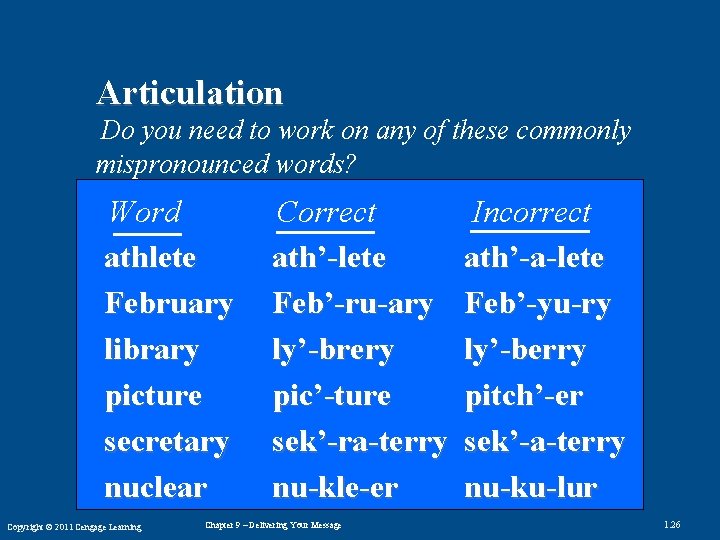
Articulation Do you need to work on any of these commonly mispronounced words? Word athlete February library picture secretary nuclear Copyright © 2011 Cengage Learning Correct ath’-lete Feb’-ru-ary ly’-brery pic’-ture sek’-ra-terry nu-kle-er Chapter 9 – Delivering Your Message Incorrect ath’-a-lete Feb’-yu-ry ly’-berry pitch’-er sek’-a-terry nu-ku-lur 1. 26
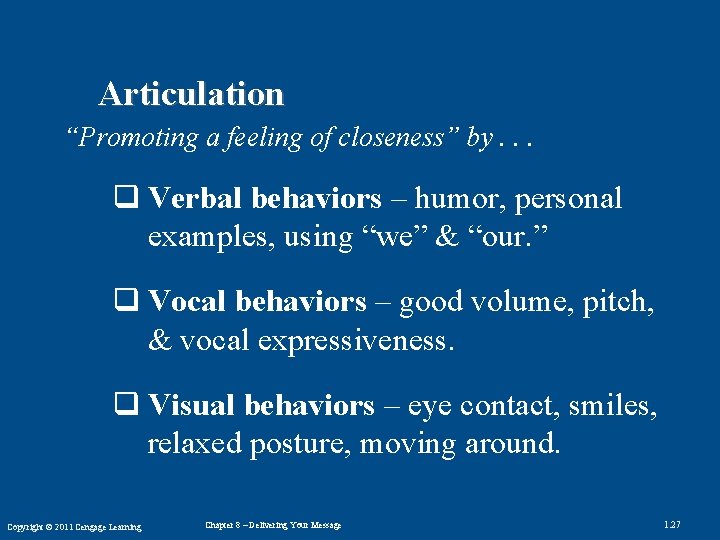
Articulation “Promoting a feeling of closeness” by. . . q Verbal behaviors – humor, personal examples, using “we” & “our. ” q Vocal behaviors – good volume, pitch, & vocal expressiveness. q Visual behaviors – eye contact, smiles, relaxed posture, moving around. Copyright © 2011 Cengage Learning Chapter 8 – Delivering Your Message 1. 27
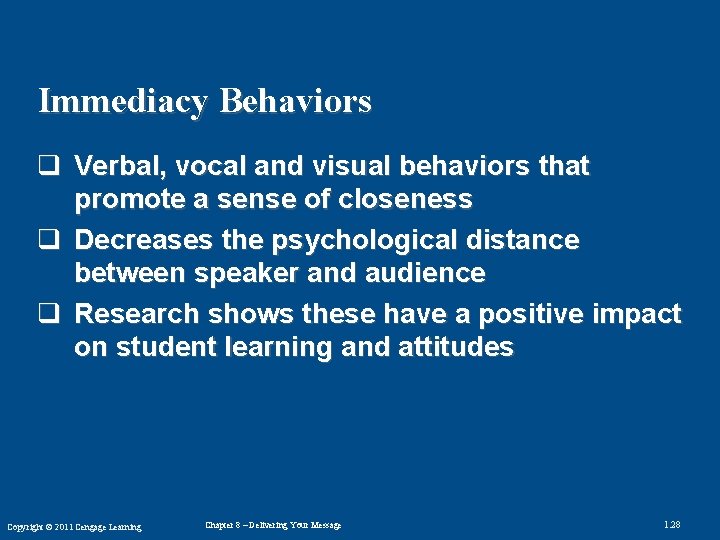
Immediacy Behaviors q Verbal, vocal and visual behaviors that promote a sense of closeness q Decreases the psychological distance between speaker and audience q Research shows these have a positive impact on student learning and attitudes Copyright © 2011 Cengage Learning Chapter 8 – Delivering Your Message 1. 28
Verbal Immediacy Behaviors q q q Using humor sensitively Citing personal instances and experience Establishing yourself as part of the group by using we, us, and Referring to people by name Conversing with audience before and after presentation Praising individuals for their work Copyright © 2011 Cengage Learning Chapter 8 – Delivering Your Message 1. 29
Vocal Immediacy Behaviors q q q Conversational tone Enthusiasm Effective use of volume and emphasis Natural-sounding pitch and variety Effective speaking rate Copyright © 2011 Cengage Learning Chapter 8 – Delivering Your Message 1. 30
Visual Immediacy Behaviors q q q Making eye contact Smiling at appropriate times Relaxed posture Gesturing naturally Moving around rather than staying behind podium Copyright © 2011 Cengage Learning Chapter 8 – Delivering Your Message 1. 31
Rehearsal Tips q Practice out loud (with notes & visuals) q Practice alone at first q Then give speech for family or friends q q q Practice with visual aids Get plenty of sleep the night before Have back-up Power. Point when using it Copyright © 2011 Cengage Learning Chapter 8 – Delivering Your Message 1. 32
Delivering Your Message Essentials of Public Speaking Cheryl Hamilton 5 th Edition Chapter 8 Cheryl Hamilton, Ph. D. Copyright © 2011 Cengage Learning Chapter 8 – Delivering Your Message 1. 33
- Slides: 33