
Delivering The Forensic Matrix Low Intensity Psychological Interventions
- Slides: 28
Delivering The Forensic Matrix & Low Intensity Psychological Interventions in Forensic Services in Scotland Dr Sarah Weldon Clinical Psychologist & Principal Educator NES and NHS & Ms Patricia Cawthorne Consultant Nurse So. FMH
Introduction • In keeping with Scottish Parliamentary Paper and Key Government Drivers, the Forensic Matrix Working Group was formed in Scotland with a National Remit. • This allowed for the Forensic Match Stepped Care Model to be developed • Psychological Therapy Protocols, devised to meet specific needs of population and allow for a treatment pathway, were developed and implemented • NES & So. FMH developed Low Intensity Training to meet clinical need and increase access to psychological therapy in forensic settings. Forensic Network & school of Forensic Mental Health www. forensicnetwork. scot. nhs. uk @FN_So. FMH
Forensic Network & school of Forensic Mental Health www. forensicnetwork. scot. nhs. uk @FN_So. FMH
Key Drivers • Mental Health in Scotland: A Guide to delivering evidence-based Psychological Therapies in Scotland – The Matrix, 2011 (NHS Education for Scotland The Scottish Government, 2011 and 2015). IAPT and implementation of ‘matched stepped care’ model • Mental Health Strategy for Scotland 2017 – 2027 – a 10 year vision (Scottish Government) • Rights, Relationships and Recovery: Refreshed: The Report of the National Review of Mental Health Nursing in Scotland action plan (The Scottish Government, 2010) • Realising Potential (The Scottish Government, 2010) Forensic Network & school of Forensic Mental Health www. forensicnetwork. scot. nhs. uk @FN_So. FMH
Forensic Network & school of Forensic Mental Health www. forensicnetwork. scot. nhs. uk @FN_So. FMH
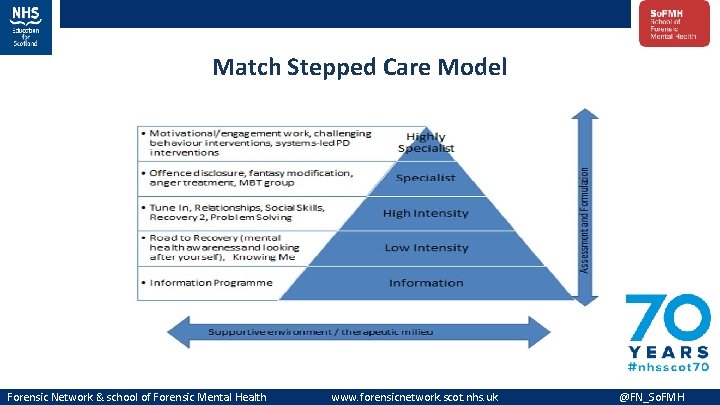
Match Stepped Care Model Forensic Network & school of Forensic Mental Health www. forensicnetwork. scot. nhs. uk @FN_So. FMH
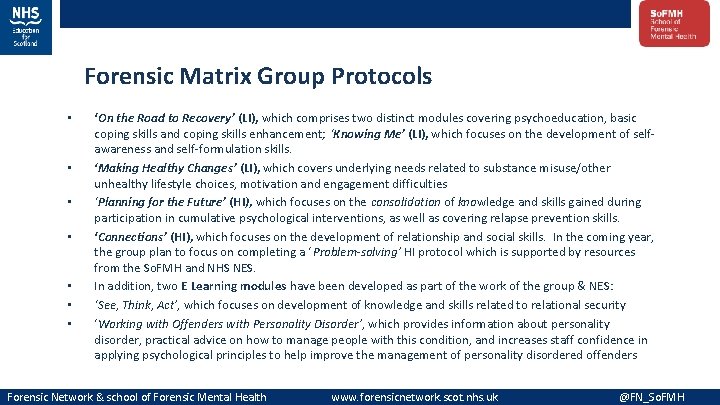
Forensic Matrix Group Protocols • • ‘On the Road to Recovery’ (LI), which comprises two distinct modules covering psychoeducation, basic coping skills and coping skills enhancement; ‘Knowing Me’ (LI), which focuses on the development of selfawareness and self-formulation skills. ‘Making Healthy Changes’ (LI), which covers underlying needs related to substance misuse/other unhealthy lifestyle choices, motivation and engagement difficulties ‘Planning for the Future’ (HI), which focuses on the consolidation of knowledge and skills gained during participation in cumulative psychological interventions, as well as covering relapse prevention skills. ‘Connections’ (HI), which focuses on the development of relationship and social skills. In the coming year, the group plan to focus on completing a ‘ Problem-solving’ HI protocol which is supported by resources from the So. FMH and NHS NES. In addition, two E Learning modules have been developed as part of the work of the group & NES: ‘See, Think, Act’, which focuses on development of knowledge and skills related to relational security ‘Working with Offenders with Personality Disorder’, which provides information about personality disorder, practical advice on how to manage people with this condition, and increases staff confidence in applying psychological principles to help improve the management of personality disordered offenders Forensic Network & school of Forensic Mental Health www. forensicnetwork. scot. nhs. uk @FN_So. FMH
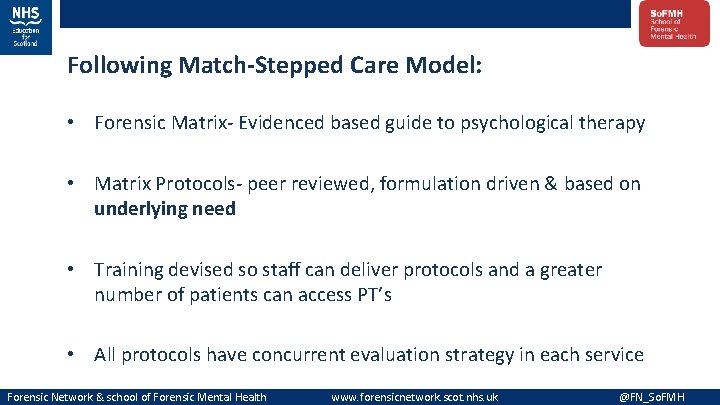
Following Match-Stepped Care Model: • Forensic Matrix- Evidenced based guide to psychological therapy • Matrix Protocols- peer reviewed, formulation driven & based on underlying need • Training devised so staff can deliver protocols and a greater number of patients can access PT’s • All protocols have concurrent evaluation strategy in each service Forensic Network & school of Forensic Mental Health www. forensicnetwork. scot. nhs. uk @FN_So. FMH
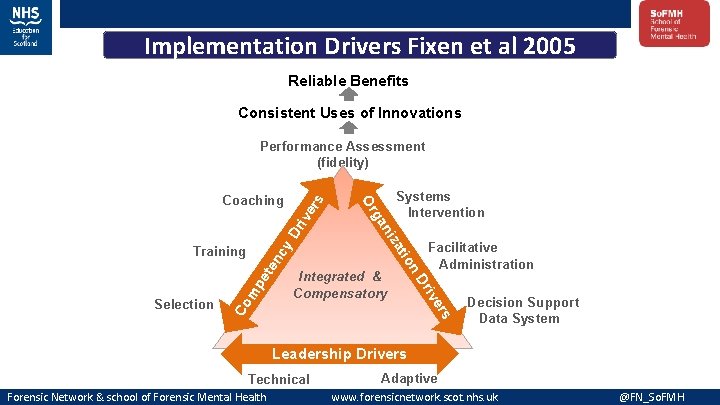
Implementation Drivers Fixen et al 2005 Reliable Benefits Consistent Uses of Innovations er riv y. D pe te nc m Facilitative Administration rs ive Dr Co n Integrated && Compensatory tio za Selection Systems Intervention ni Training ga Or Coaching s Performance Assessment (fidelity) Decision Support Data System Leadership Drivers Technical Forensic Network & school of Forensic Mental Health Adaptive www. forensicnetwork. scot. nhs. uk @FN_So. FMH
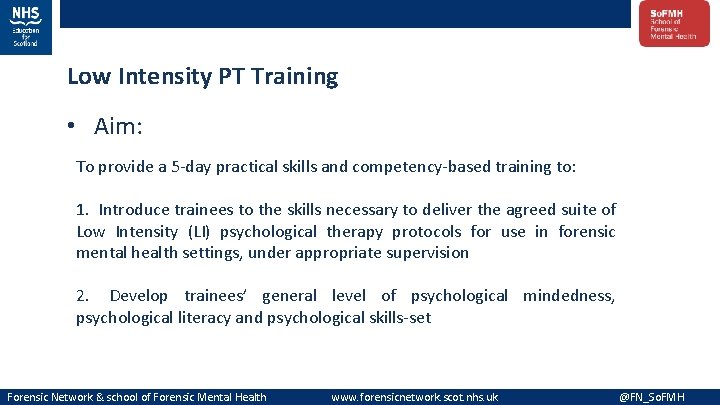
Low Intensity PT Training • Aim: To provide a 5 -day practical skills and competency-based training to: 1. Introduce trainees to the skills necessary to deliver the agreed suite of Low Intensity (LI) psychological therapy protocols for use in forensic mental health settings, under appropriate supervision 2. Develop trainees’ general level of psychological mindedness, psychological literacy and psychological skills-set Forensic Network & school of Forensic Mental Health www. forensicnetwork. scot. nhs. uk @FN_So. FMH
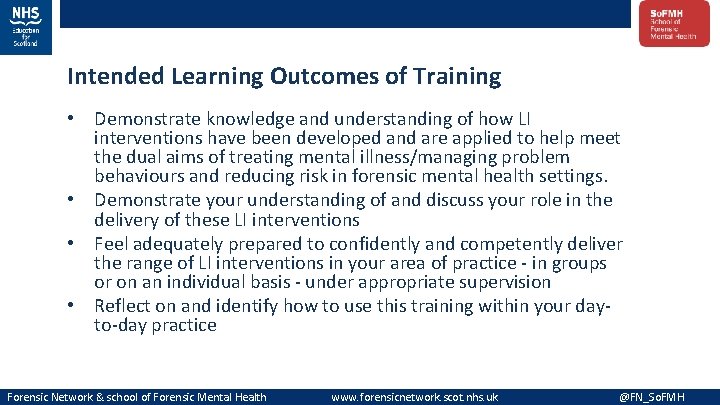
Intended Learning Outcomes of Training • Demonstrate knowledge and understanding of how LI interventions have been developed and are applied to help meet the dual aims of treating mental illness/managing problem behaviours and reducing risk in forensic mental health settings. • Demonstrate your understanding of and discuss your role in the delivery of these LI interventions • Feel adequately prepared to confidently and competently deliver the range of LI interventions in your area of practice - in groups or on an individual basis - under appropriate supervision • Reflect on and identify how to use this training within your dayto-day practice Forensic Network & school of Forensic Mental Health www. forensicnetwork. scot. nhs. uk @FN_So. FMH
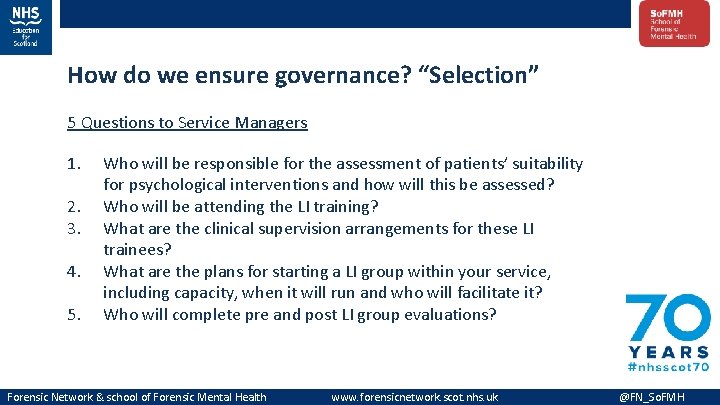
How do we ensure governance? “Selection” 5 Questions to Service Managers 1. 2. 3. 4. 5. Who will be responsible for the assessment of patients’ suitability for psychological interventions and how will this be assessed? Who will be attending the LI training? What are the clinical supervision arrangements for these LI trainees? What are the plans for starting a LI group within your service, including capacity, when it will run and who will facilitate it? Who will complete pre and post LI group evaluations? Forensic Network & school of Forensic Mental Health www. forensicnetwork. scot. nhs. uk @FN_So. FMH
Governance • Matrix Protocols & LI Training are supported by Governance Manual • Competency Framework • Training includes written & skills assessment that must be passed before practitioners can deliver Forensic Network & school of Forensic Mental Health www. forensicnetwork. scot. nhs. uk @FN_So. FMH
Subsequent to training- “Coaching” • Regular supervision with Highly Specialist Practitioner • CPD Day- consolidation of skills • New to Forensics Essentials of Psychological Care • Other relevant training e. g. Safety and Stabilisation, CBT for Anxiety & Core Skills Forensic Network & school of Forensic Mental Health www. forensicnetwork. scot. nhs. uk @FN_So. FMH
So far…. • Almost 300 staff trained in LI across 12 major health boards in Scotland • 141 Completed TARS 2017 -2019 • This approach would be appropriate for a variety of staff: Average “Moderately Agree” • The training will be beneficial for staff: Average “Strongly agree” Forensic Network & school of Forensic Mental Health www. forensicnetwork. scot. nhs. uk @FN_So. FMH
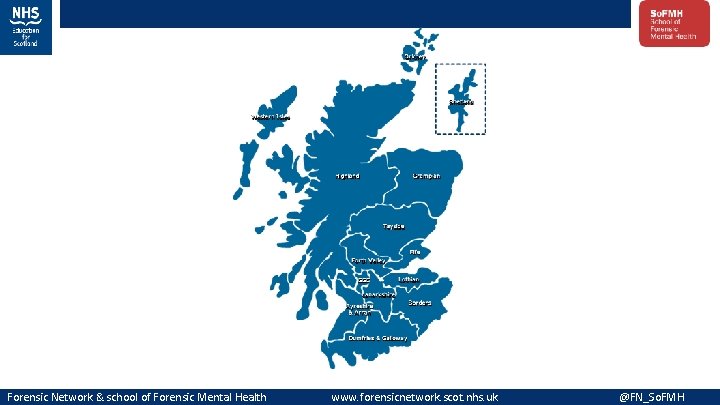
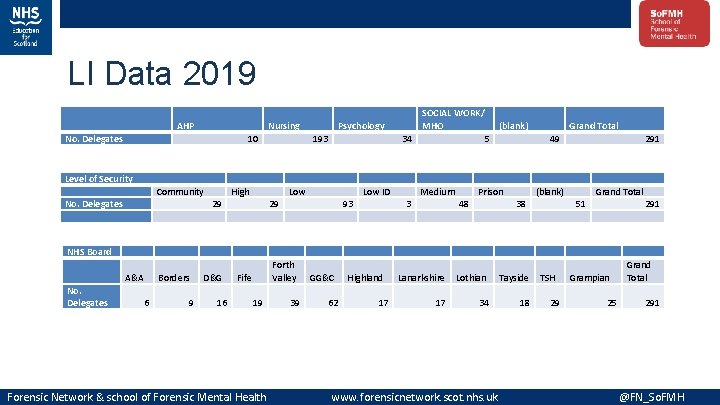
LI Data 2019 AHP Nursing No. Delegates 10 Psychology 193 SOCIAL WORK/ MHO (blank) 34 5 Grand Total 49 291 Level of Security Community No. Delegates High Low 29 Low ID 29 93 Medium 3 Prison 48 (blank) 38 Grand Total 51 291 NHS Board A&A No. Delegates Borders 6 9 D&G 16 Forth Valley Fife 19 Forensic Network & school of Forensic Mental Health 39 GG&C 62 Highland 17 Lanarkshire Lothian Tayside 17 34 18 www. forensicnetwork. scot. nhs. uk TSH 29 Grampian 25 Grand Total 291 @FN_So. FMH
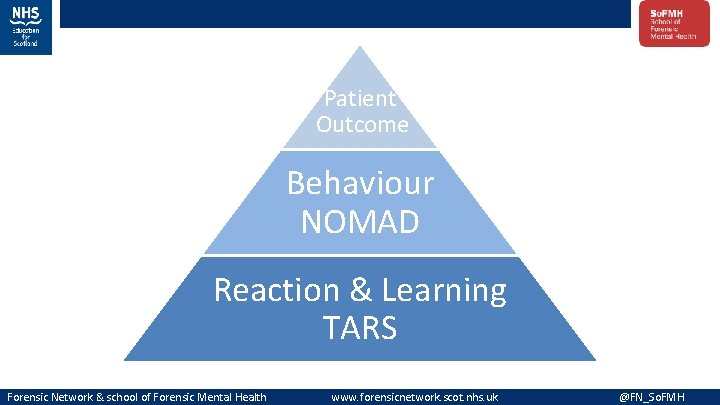
Patient Outcome Behaviour NOMAD Reaction & Learning TARS Forensic Network & school of Forensic Mental Health www. forensicnetwork. scot. nhs. uk @FN_So. FMH
NOMAD • The No. MAD is a 23 item instrument for measuring implementation processes from the perspective of professionals directly involved in the work of implementing complex interventions in healthcare • Thus far… managers and supervisors consistently recognise the importance of LI Interventions and see the value • Barriers in terms of systems and logistics Forensic Network & school of Forensic Mental Health www. forensicnetwork. scot. nhs. uk @FN_So. FMH
Outcomes: is it working? • Small Scale Studies: -Evaluation of LI in Lanarkshire & 3 FV Prisons -LI Core Data in TSH -Supported feasibility, acceptability & utility of LI in these settings • RCT feasibility study- Lynsey Mc. Intosh Forensic Network & school of Forensic Mental Health www. forensicnetwork. scot. nhs. uk @FN_So. FMH
Outcomes, moving forward • Robust evaluation of recorded data & psychometrics • Review of efficacy of LI Training – TARS – NOMAD – Patient Impact Forensic Network & school of Forensic Mental Health www. forensicnetwork. scot. nhs. uk @FN_So. FMH
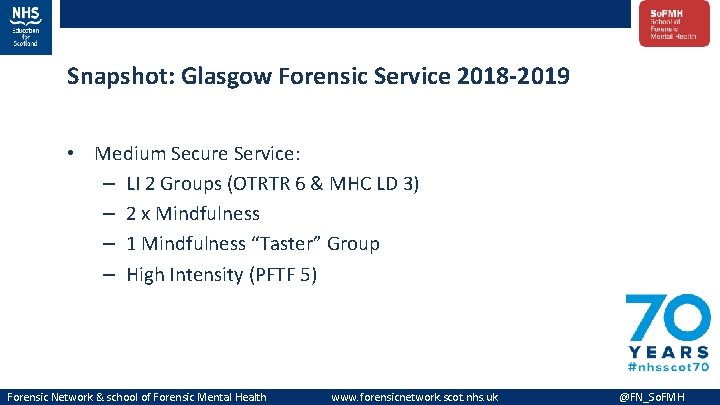
Snapshot: Glasgow Forensic Service 2018 -2019 • Medium Secure Service: – LI 2 Groups (OTRTR 6 & MHC LD 3) – 2 x Mindfulness – 1 Mindfulness “Taster” Group – High Intensity (PFTF 5) Forensic Network & school of Forensic Mental Health www. forensicnetwork. scot. nhs. uk @FN_So. FMH
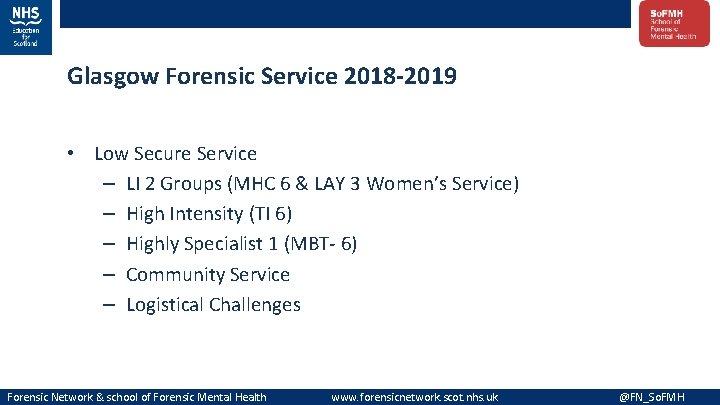
Glasgow Forensic Service 2018 -2019 • Low Secure Service – LI 2 Groups (MHC 6 & LAY 3 Women’s Service) – High Intensity (TI 6) – Highly Specialist 1 (MBT- 6) – Community Service – Logistical Challenges Forensic Network & school of Forensic Mental Health www. forensicnetwork. scot. nhs. uk @FN_So. FMH
Conclusions • The Forensic Matrix Group, Protocols and Training was developed in response to key SG Drivers • Almost 300 staff trained across 12 major health boards • Synergy of Psychology & Nursing • Underlying needs model represents paradigm shift away from diagnostically driven approaches Forensic Network & school of Forensic Mental Health www. forensicnetwork. scot. nhs. uk @FN_So. FMH
Conclusions II • Delivery underpinned by robust governance structures • Implementation Science model ensures infrastructure in place • FMHS’s much further ahead than AMH colleagues in operationalisation of Matrix, Training of Workforce & Implementation Forensic Network & school of Forensic Mental Health www. forensicnetwork. scot. nhs. uk @FN_So. FMH
Conclusions III • Staff attrition rates are problematic, being investigated in current review • Although data is collected, lack of national aggregated figures means its hard to “evidence” impact • Concern re over focus on LI and not other levels of PI Forensic Network & school of Forensic Mental Health www. forensicnetwork. scot. nhs. uk @FN_So. FMH
Next Steps • • Continue roll out of LI Training Quality Assurance of LI Training E-Learning Module Impact on patients- RCT Consider workforce training strategy Consider “rolling programmes” in prisons Trauma Informed Approach- S&S roll out Overcoming barriers Forensic Network & school of Forensic Mental Health www. forensicnetwork. scot. nhs. uk @FN_So. FMH
Next Steps II • “Step-back” to review impact and future plans • Remember “what works” • Lack of resources for ID patients, being discussed at ID Psychology Working Group Forensic Network & school of Forensic Mental Health www. forensicnetwork. scot. nhs. uk @FN_So. FMH