
Delivering Innovative Models of Clinical Education Clinical Educator

- Slides: 54
Delivering Innovative Models of Clinical Education Clinical Educator Workshop May 2016 Michele Fairbrother WORK INTEGRATED LEARNING The University of Sydney Page 1
Workshop Learning Outcomes 1. Adult Learning Principles 2. Common Models of Clinical Placements 3. Alternative Clinical Placement Models § Peer Learning § Team Teaching Model § Peer Supervision Model § Student Led Placement Model § Interprofessional Learning Model § Clinical Simulation Model 4. Workshop Evaluation The University of Sydney Page 2 2
ADULT LEARNING PRINCIPLES Adult Learners: § Have a range of prior knowledge and experience § Need to validate the information learnt according to their values and attitudes § Need to decide what is most important/relevant for their learning needs § Engagement in the learning process must be applicable to real life situations § Want to be actively involved in their learning § Are self motivated – internally driven § Goal oriented § Practical § Enjoy challenges § Have increased powers of comprehension – problem-solving, reflecting, reasoning skills Sydney Page 3 §The University Like ofto be respected 3
ADULT LEARNING PRINCIPLES Knowles 1990 Adult Learning Assumptions The need to know — adult learners need to know why they need to learn something before undertaking to learn it. Learner self-concept —adults need to be responsible for their own decisions and to be treated as capable of selfdirection Role of learners' experience —adult learners have a variety of experiences of life which represent the richest resource for learning. These experiences are however imbued with bias and presupposition. Readiness to learn —adults are ready to learn those things they need to know in order to cope effectively with life situations. The University of Sydney Page 4
CLINICAL PLACEMENT MODELS How do you currently conduct your placement? How many students? How do you supervise? What learning activities do you include? How do you manage your time? The University of Sydney Page 5 5
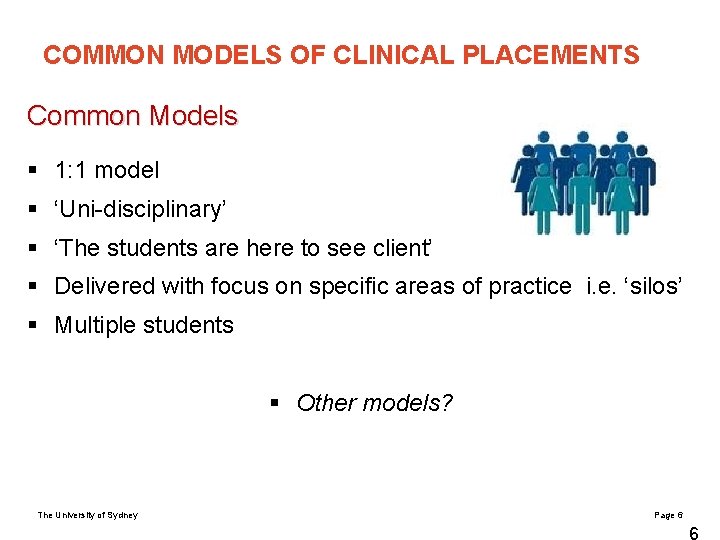
COMMON MODELS OF CLINICAL PLACEMENTS Common Models § 1: 1 model § ‘Uni-disciplinary’ § ‘The students are here to see client’ § Delivered with focus on specific areas of practice i. e. ‘silos’ § Multiple students § Other models? The University of Sydney Page 6 6
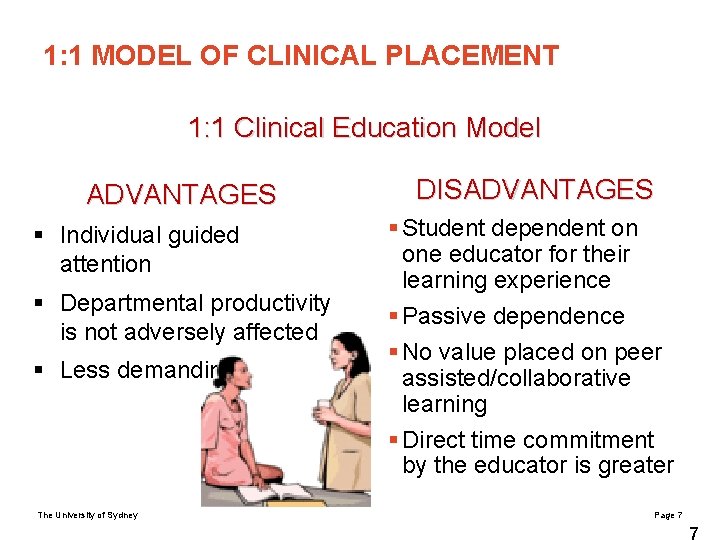
1: 1 MODEL OF CLINICAL PLACEMENT 1: 1 Clinical Education Model ADVANTAGES § Individual guided attention § Departmental productivity is not adversely affected § Less demanding The University of Sydney DISADVANTAGES § Student dependent on one educator for their learning experience § Passive dependence § No value placed on peer assisted/collaborative learning § Direct time commitment by the educator is greater Page 7 7
WORK READINESS Work readiness ‘the extent to which graduates are perceived to possess the attitudes and attributes that make them prepared or ready for success in the work environment’ - Caballero & Walker (2010) The University of Sydney Page 8 8
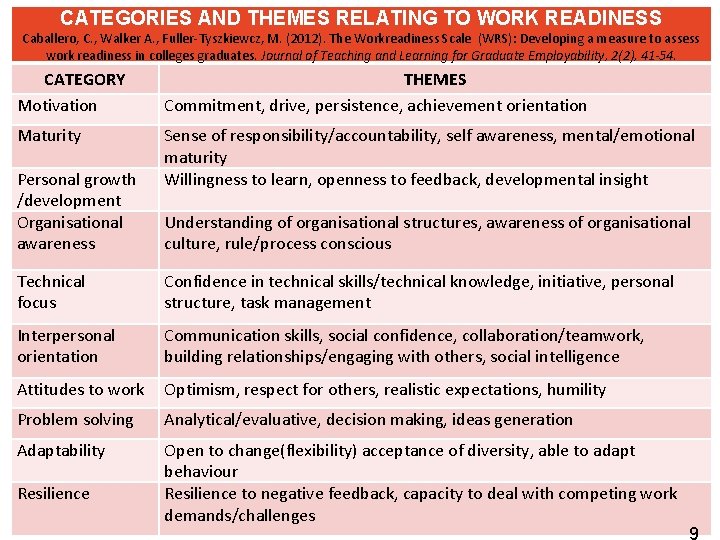
CATEGORIES AND THEMES RELATING TO WORK READINESS Caballero, C. , Walker A. , Fuller-Tyszkiewcz, M. (2012). The Workreadiness Scale (WRS): Developing a measure to assess work readiness in colleges graduates. Journal of Teaching and Learning for Graduate Employability, 2(2), 41 -54. CATEGORY Motivation THEMES Commitment, drive, persistence, achievement orientation Maturity Sense of responsibility/accountability, self awareness, mental/emotional maturity Willingness to learn, openness to feedback, developmental insight Personal growth /development Organisational awareness Understanding of organisational structures, awareness of organisational culture, rule/process conscious Technical focus Confidence in technical skills/technical knowledge, initiative, personal structure, task management Interpersonal orientation Communication skills, social confidence, collaboration/teamwork, building relationships/engaging with others, social intelligence Attitudes to work Optimism, respect for others, realistic expectations, humility Problem solving Analytical/evaluative, decision making, ideas generation Adaptability Open to change(flexibility) acceptance of diversity, able to adapt behaviour Resilience to negative feedback, capacity to deal with competing work Page 9 demands/challenges Resilience The University of Sydney 9
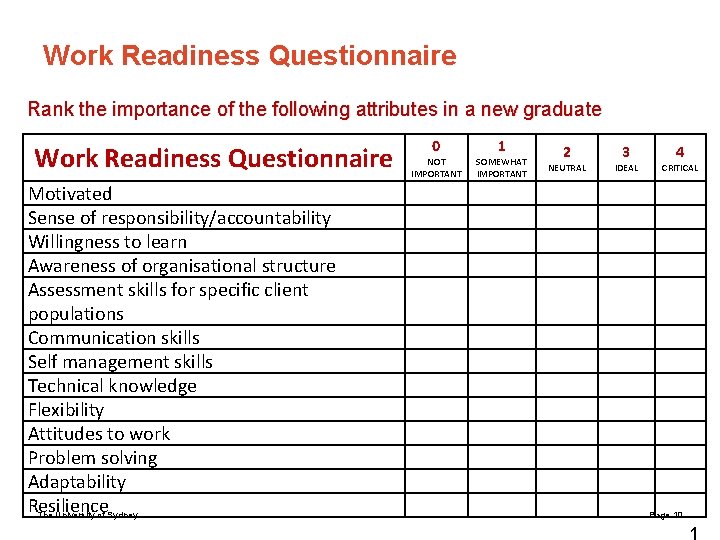
Work Readiness Questionnaire Rank the importance of the following attributes in a new graduate Work Readiness Questionnaire Motivated Sense of responsibility/accountability Willingness to learn Awareness of organisational structure Assessment skills for specific client populations Communication skills Self management skills Technical knowledge Flexibility Attitudes to work Problem solving Adaptability Resilience The University of Sydney 0 NOT IMPORTANT 1 SOMEWHAT IMPORTANT 2 NEUTRAL 3 IDEAL 4 CRITICAL Page 10 1
ALTERNATIVE CLINICAL PLACEMENT MODELS CONSIDER … § Which of the following models could you implement or remodel within in your clinical area or department § What are the § Enablers § Challenges/Barriers The University of Sydney Page 12 1
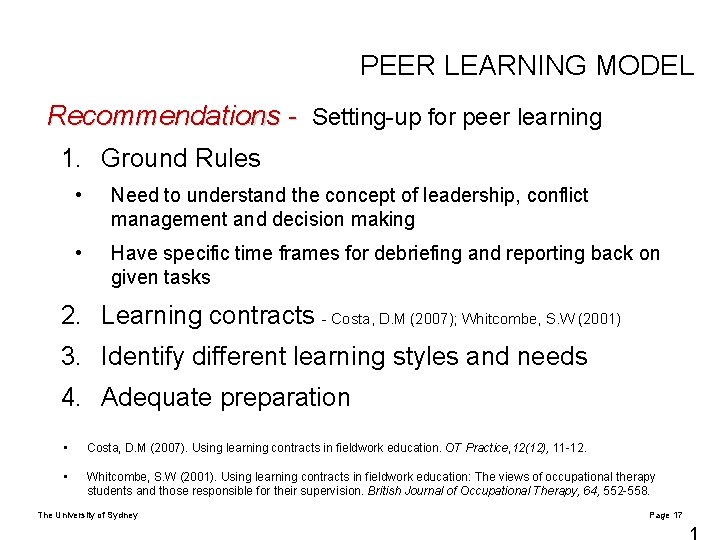
PEER LEARNING MODEL Recommendations - Setting-up for peer learning 1. Ground Rules • Need to understand the concept of leadership, conflict management and decision making • Have specific time frames for debriefing and reporting back on given tasks 2. Learning contracts - Costa, D. M (2007); Whitcombe, S. W (2001) 3. Identify different learning styles and needs 4. Adequate preparation • Costa, D. M (2007). Using learning contracts in fieldwork education. OT Practice, 12(12), 11 -12. • Whitcombe, S. W (2001). Using learning contracts in fieldwork education: The views of occupational therapy students and those responsible for their supervision. British Journal of Occupational Therapy, 64, 552 -558. The University of Sydney Page 17 1
PEER LEARNING MODEL Challenges to the peer learning model § Students become reliant on each other and possibly less likely to learn § Development of poor learning habits § Different levels of motivation and abilities § Challenges to supervision/management of multiple students (focussing on “good” or “bad” students more) § Uneven learning opportunities § Possibility of increased distraction e. g. not task focussed § Different learning styles/ harder to focus on individual needs § Conflict between peers, personality clashes (passivity vs. dominance vs. individualism) The University of Sydney Page 22 2
PEER LEARNING MODEL Challenges to the peer learning model § Conflict between supervisors when comparing student progress § Reduced individual accountability § Space confinements § Increased workload § Patient concerns § Ensuring adequate individual feedback The University of Sydney Page 23 2
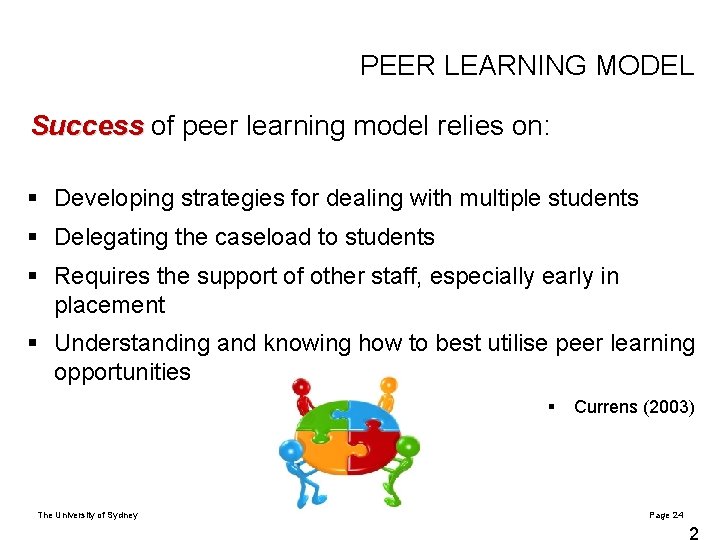
PEER LEARNING MODEL Success of peer learning model relies on: § Developing strategies for dealing with multiple students § Delegating the caseload to students § Requires the support of other staff, especially early in placement § Understanding and knowing how to best utilise peer learning opportunities § The University of Sydney Currens (2003) Page 24 2
TEAM TEACHING MODEL Role of the Educator as Manager § Organising and structuring placements in collaboration with key stakeholders § Providing supportive learning environment , ensuring the provision of adequate educational and physical resources § Understanding university requirements and learning goals, assessment § Mc. Leod, Romanini, Cihn and Higgs (1997) Brown and Kennedy Jones (2005) The University of Sydney Page 26 2
TEAM TEACHING MODEL Team Teaching Approach § The attributes most important in a physiotherapy CE were approachability, enthusiasm and good communication skills (Bennett, 2003). § Are these attributes within the capability of your more junior staff? § A senior educator takes on the manager role BUT junior staff can gain from this experience through improvement in responsibility, personal knowledge, teaching skills and peer learning. § Senior students may also take more responsibility by identifying their own learning opportunities. The University of Sydney Page 27 2
TEAM TEACHING MODEL Advantages of Team Teaching § Support/sharing the responsibility of student education. § Promotes independence/autonomy/creativity (explore different perspectives and experiences) § Learning from one another § Students exposed to multiple teaching styles § Encourages flexibility/adaptability/resilience/technical focus § Less likely to have personality clashes § More reflective of the real work environment – teamwork § Efficiency of staff time (improved time management) § Greater variety for the students (clients, caseload , clinical settings and service delivery) § Promotion of professional growth The University of Sydney Page 28 2
TEAM TEACHING MODEL Advantages of Team Teaching: § Facilitates communication, motivation and group learning § Allows for expanded roles within the department § Up-skilling of younger clinicians § Allows for continuum of care (holistic experience/perspective) The University of Sydney Page 29 2
TEAM TEACHING MODEL Challenges of Team Teaching: § Need for multiple staff -problematic if staff shortages. § Demanding § Teaching may become fragmented/inconsistent resulting in students becoming confused with different styles and techniques. § Conflicting aims/goals of the clinicians § Communication/management - if team members do not communicate with each other, student can become confused by differing feedback/ goals § Duplication The University of Sydney Page 30 3
TEAM TEACHING MODEL Challenges of Team Teaching: § Increased time required for collaboration § Reduced focus on core competency skills § Staffing of the same stream (educators lacking ownership) § Students with low motivation may slip through the cracks § Inadequate information/feedback on students especially the struggling student. § Student isolation if on placement alone The University of Sydney Page 31 3
TEAM TEACHING MODEL Recommendations for Team Teaching: § Thorough planning (ensure student numbers are appropriate to department size and number of staff available to take students) § Detailed weekly schedule § Nominate a team leader who will ensure the focus is maintained on problem solving, learning goals, professional development and team dynamics- contact person for conflict § Discussion of educator strengths/weaknesses prior to placement: tailor placement according to teaching styles § Select educators who are enthusiastic about taking students-up-skill staff The University of Sydney Page 32 3
TEAM TEACHING MODEL Recommendations for Team Teaching: § Orientation/induction with students outlining clear expectations/objectives/goals § Ensure university contact § Ensure clear paper trail e. g. communication book § Encourage peer support/learning by rotating the students during the placement § Encourage students to self reflect/evaluate § Ensure student knows who to contact if they feel out of their depth The University of Sydney Page 33 3
PEER SUPERVISION MODEL Peer Supervision Model § More experienced student paired with one or more less experienced students § The more experienced student takes on part of the role of educator § Educator remain overall manager of learning to ensure quality of knowledge and skills being transmitted § Senior students gain mentoring and leadership skills; requires them to function at a higher cognitive level § Solidifies the students knowledge and skills through teaching someone else The University of Sydney Page 35 3
PEER SUPERVISION MODEL Peer Supervision Model § Less experienced students often perceive that the senior students are more ‘in touch’ with the experience of being a student and are less intimidating, however some perceive they’re not being supervised by a ‘proper’ educator § Educator needs to balance simultaneous needs of students at different levels The University of Sydney Page 36 3
PEER SUPERVISION MODEL Advantages of Peer Supervision Model § Senior students develop supervision/teaching skills § Encourages senior students to reflect on their practiceable to identify gaps in their knowledge § Less experienced get to learn form the more experienced and see what they will be expected to do in the future § Increased exposure to various experiences § Develops communication skills and sense of responsibility § Students may find other students more approachable § Allows clinical educator ‘down’ time The University of Sydney Page 37 3
PEER SUPERVISION MODEL Challenges of Peer Supervision Model § Taking away from learning time for the more experienced student § Challenges in tailoring learning experience to the 2 levels § Placement scheduling § Confusion among supervisors about student’s levels and abilities § Bias towards the more experienced student § ? effects on patient continuity of care § Issues if senior students inappropriately mentors junior student § Could be potentially more time consuming for clinical educator 3 The University of Sydney Page 38
PEER SUPERVISION MODEL Recommendations for Peer Supervision Model § Preparation and support of senior students in the mentor role § Have a back up 1: 1 plan if peer supervision is not appropriate § Orientation/ outline expectations § Allocate time for contact with educator- who to contact if issues arise § Educate students regarding how to mentor e. g. encourage ‘what’, ‘how’, ‘when’ questions as opposed to ‘why’. § Have allocated times to teach students how to appropriately give feedback to each other § Rotate between pairings of students § Communication book: The University of Sydney § Allows educator to know what feedback students have been Page 39 giving each other 3
STUDENT LED PLACEMENT MODEL Student Led Placement Model §Teaching clinics § on university campus § traditional service model § uni-disciplinary § clinical educators manage the clinic & are consistently present §Variety of settings: § outpatient § inpatient § community based The University of Sydney Page 41 4
STUDENT LED PLACEMENT MODEL Student Led Placement Model §Entirely student-led (e. g. Dootagalla, Melbourne); § students manage the entire clinic § invite supervisors in § interprofessional, multidisciplinary. The University of Sydney Page 42 4
Clinic example STUDENT LED PLACEMENT MODEL Broken Hill Uni Dept Rural Health (Brunero and Merritt) § Context: § Schools; community engaged learning § schools set the priorities – mainly oral language and literacy development § Low risk, high volume clients (Lincoln & Causa, In press ) § Service delivery models: § Whole class work § small group work § 1: 1 withdrawal (traditional therapy) The University of Sydney Page 43 4
Clinic example STUDENT LED PLACEMENT MODEL Broken Hill Uni Dept Rural Health (Brunero and Merritt) § Supervision model: § Indirect supervision from discipline supervisor: § Reading treatment plans and reports sent by email and providing feedback correction § Email re information requests § Mobile phones, texts § Skype (students on outreach visit) The University of Sydney Page 44 4
STUDENT LED PLACEMENT MODEL Advantages of student led placement models § Allows students to become more independent resulting in increased confidence , taking responsibility for their decisions and being creative § Students get a taste of “real life work” § Promotes work readiness skills e. g. building rapport § Students develop time management , problem solving, prioritisation and teamwork skills § Enhances motivation § Permits peer learning/support opportunities The University of Sydney Page 45 4
STUDENT LED PLACEMENT MODEL Advantages of student led placement models § Provides interdisciplinary opportunities § Allows for peer discussion and learning § Improved time management § Opportunity for quality assurance activity/research § Inexpensive to run § Permits a service to run that might otherwise not be provided The University of Sydney Page 46 4
STUDENT LED PLACEMENT MODEL Challenges of student led placement models § Accountability and job security § Limited by student ability and attitude (dominant personalities taking over) § Student relationship with educators § Not always appropriate to all situations/disciplines § Students might not feel comfortable discussing feeling and difficulties in large peer group settings § Patient/ client satisfaction- being treated by students § Patient acuity The University of Sydney Page 47 4
STUDENT LED PLACEMENT MODEL Challenges of student led placement models § Lack of guidance with difficult patients- students may feel that they don’t get enough supervision and feedback § OH&S concerns- being able to ensure safe and adequate patient care § Inability to prevent “group think” § Lack of co-operation or discrimination from other staff, patients, carers § Space and resources § May not gain work readiness skills The University of Sydney Page 48 4
STUDENT LED PLACEMENT MODEL Recommendations for student led placement models § Research/resource amenable patient groups(instigators to gain experience in other clinics prior to the start) § Positive commitment from staff involved in student led placements to ensure a positive culture § Ensure clients are aware that clinic is student run § Most suitable to final year students § Strict criteria, risk assessment and selection of students and patients ( the appropriate unit/clinic/ward ) § “Fail safe” mechanism needs to be in place if students feel unsafe or out of their depth § Ensure a good orientation process § Strict online policies, protocols and procedures available for easy access and support The University of Sydney Page 49 4
STUDENT LED PLACEMENT MODEL Recommendations for student led placement models §Making indirect supervision work better by … §Greater use of critical reflection by students §Improving the rigor/challenge of peer learning §Clinical educator sampling of performance §Obtaining more feedback on student performance from more people §Nominated contact person in school or aged care setting §Teaching clinic monitor or chair The University of Sydney Page 50 5
STUDENT LED PLACEMENT MODEL Recommendations for student led placement models § Timetable reflection time with group and supervisor/s at appropriate intervals during the placement § Initially student may shadow therapist before becoming more independent § Develop protocols for liaising and debriefing with other allied health professionals § Ensure adequate funds are available The University of Sydney Page 51 5
INTERPROFESSIONAL LEARNING MODEL Interprofessional Learning § Students from different disciplines learn about, from and alongside each other in organised activities throughout the placement § e. g. joint case presentations, observation of assessment or intervention, joint projects, etc. § Overall supervision remains with each students’ discipline; interprofessional activities may be supervised by an educator from any of the disciplines § Educators can alternate supervision of the activities, providing ‘time out’ from students for the other educators § Increases capacity for student supervision The University of Sydney Page 53 5
INTERPROFESSIONAL LEARNING MODEL Interprofessional Learning - Benefits for students § Increased understanding and appreciation of other professionals’ roles- holistic approach to patient care § Improved communication skills (Nisbet, et al. , 2008) The University of Sydney Page 54 5
INTERPROFESSIONAL LEARNING MODEL Interprofessional Learning - Considerations § Disciplines involved depends on timing of placements and workplace structure § Practical organisation and planning required in advance § Guaranteed commitment from all disciplines involved § Networking opportunities fostered § Provide time to reflect and build on prior knowledge § Any discipline can assess generic competencies The University of Sydney Page 55 5
INTERPROFESSIONAL LEARNING MODEL Advantages of Interprofessional placements § Holistic focus on patient care § Increased understanding of other professions § Enhances teamwork and communication - promotes peer learning experiences § Joint assessment of patients enhance the learning experience § Use of structured observation activities of other professions § Increased efficiency having more staff involved § Broadens experience § Permits ‘down time’ for educator The University of Sydney Page 56 5
INTERPROFESSIONAL LEARNING MODEL Challenges to Interprofessional placements § Taking time away from developing ‘core’ skills § Timing of placement (more than one discipline would need to be out on clinical at the same time) § Convincing clinicians to come on board § Imposing on other professional’s time § Student reluctance/ lack of understanding why they are doing this § ? more suited to stronger students The University of Sydney Page 57 5
INTERPROFESSIONAL LEARNING MODEL Challenges to Interprofessional placements § Different assessment forms § Keeping track of the students § Student learning at university is discipline specific (no common lectures) § May shift focus too far away from own rolestruggling students might find this difficult The University of Sydney Page 58 5
INTERPROFESSIONAL LEARNING MODEL Recommendations for Interprofessional placements § Ensure students from different disciplines available § Create multi-disciplinary projects to facilitate learning § Utilise varying degrees of interprofessional practice e. g. may involve interprofessional learning full time or involve visits with other disciplines during traditional placement The University of Sydney Page 59 5
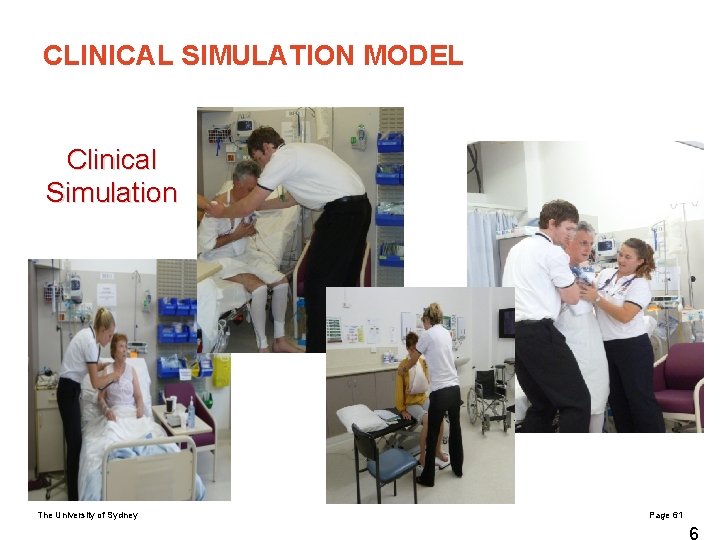
CLINICAL SIMULATION MODEL Clinical Simulation The University of Sydney Page 61 6
CLINICAL SIMULATION MODEL Clinical Simulation – The Research § A proportion of clinical time can be replaced with simulated learning experiences without compromising the attainment of learning outcomes (Watson et al, 2012) § Simulation training in health professional education is consistently associated with large effects for outcomes of knowledge, skills, and behaviours and moderate effects for patient-related outcomes (Cook et al 2011 Systematic Review and Meta analysis) The University of Sydney Page 62 6
CLINICAL SIMULATION MODEL Advantages of Clinical Simulation § students work through clinical interventions with professional actors (high fidelity). § opportunity for repeated practice in a safe environment § control of student exposure to different patient conditions & complexities § opportunities for feedback and learning from actors (‘patients’), educators and peers § timeouts during assessment/treatments § formal debrief following patient interaction § clinical educator availability (no case load of their own) The University of Sydney Page 63 6
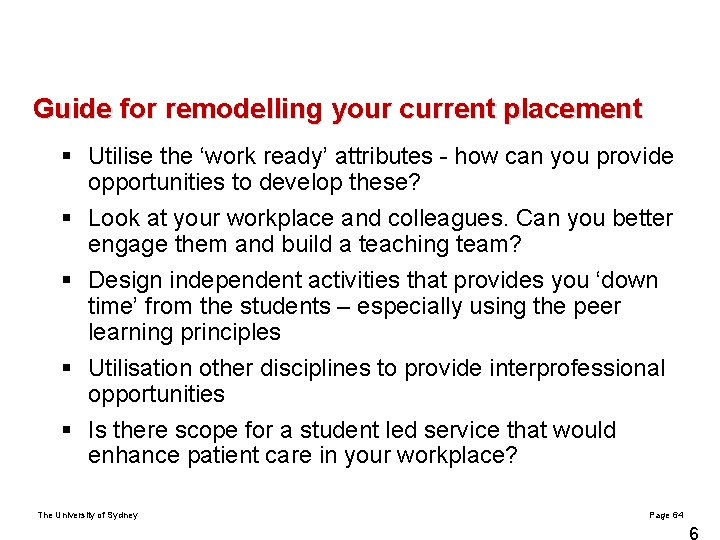
Guide for remodelling your current placement § Utilise the ‘work ready’ attributes - how can you provide opportunities to develop these? § Look at your workplace and colleagues. Can you better engage them and build a teaching team? § Design independent activities that provides you ‘down time’ from the students – especially using the peer learning principles § Utilisation other disciplines to provide interprofessional opportunities § Is there scope for a student led service that would enhance patient care in your workplace? The University of Sydney Page 64 6
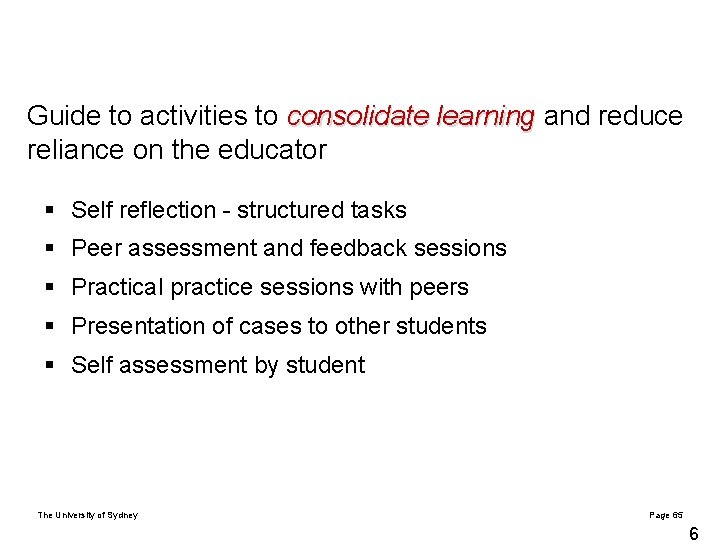
Guide to activities to consolidate learning and reduce reliance on the educator § Self reflection - structured tasks § Peer assessment and feedback sessions § Practical practice sessions with peers § Presentation of cases to other students § Self assessment by student The University of Sydney Page 65 6
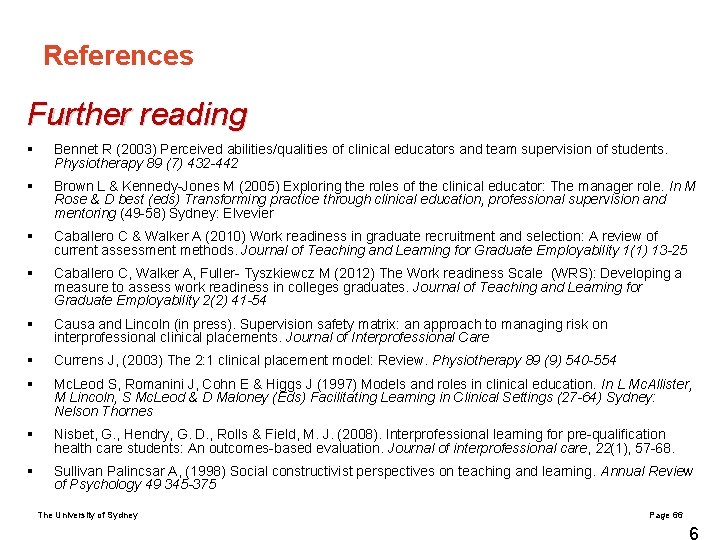
References Further reading § Bennet R (2003) Perceived abilities/qualities of clinical educators and team supervision of students. Physiotherapy 89 (7) 432 -442 § Brown L & Kennedy-Jones M (2005) Exploring the roles of the clinical educator: The manager role. In M Rose & D best (eds) Transforming practice through clinical education, professional supervision and mentoring (49 -58) Sydney: Elvevier § Caballero C & Walker A (2010) Work readiness in graduate recruitment and selection: A review of current assessment methods. Journal of Teaching and Learning for Graduate Employability 1(1) 13 -25 § Caballero C, Walker A, Fuller- Tyszkiewcz M (2012) The Work readiness Scale (WRS): Developing a measure to assess work readiness in colleges graduates. Journal of Teaching and Learning for Graduate Employability 2(2) 41 -54 § Causa and Lincoln (in press). Supervision safety matrix: an approach to managing risk on interprofessional clinical placements. Journal of Interprofessional Care § Currens J, (2003) The 2: 1 clinical placement model: Review. Physiotherapy 89 (9) 540 -554 § Mc. Leod S, Romanini J, Cohn E & Higgs J (1997) Models and roles in clinical education. In L Mc. Allister, M Lincoln, S Mc. Leod & D Maloney (Eds) Facilitating Learning in Clinical Settings (27 -64) Sydney: Nelson Thornes § Nisbet, G. , Hendry, G. D. , Rolls & Field, M. J. (2008). Interprofessional learning for pre-qualification health care students: An outcomes-based evaluation. Journal of interprofessional care, 22(1), 57 -68. § Sullivan Palincsar A, (1998) Social constructivist perspectives on teaching and learning. Annual Review of Psychology 49 345 -375 The University of Sydney Page 66 6
Slide title… 28 pt font size Sub-heading bold… 24 pt Body copy… 24 pt – Bullet point Heading 1 Heading 2 Heading 3 Body copy xxx xxx The University of Sydney Page 67
Slide title… 28 pt font size Please use this graph to ensure the colour theme is consistent. 5 4, 5 4 3, 5 Category 1 3 Category 2 Category 3 2, 5 Category 4 2 Category 5 Category 6 1, 5 1 0, 5 0 Series 1 Series 2 Series 3 Place caption here if required The University of Sydney Page 68