
Delivering Digital NOTAMs NOTAM Impact on Obstacle Clearance

Delivering Digital NOTAMs NOTAM Impact on Obstacle Clearance and Engine-Out Analysis Presented By: Heinz Conrad
Background • Operators are legally required to determine a maximum takeoff weight for each takeoff. • By regulation they have to assume that an engine fails during takeoff run and that the subsequent flight path is flown with one engine out. • The SIDs as published by the authorities assume all engine performance and thus, might require climb gradients which can’t be matched in an engine out case without unduly weight restrictions. • Operators therefore develop engine out procedures, that might significantly deviate from the SIDs and, by avoiding limiting obstacles or terrain, are optimized for takeoff weight.
Background • Unclear NOTAM or airport information about obstacles have been identified as a source of unduly restriction in takeoff weight. • To address this issue, the IATA APTF (Airplane Performance Task Force) working group has drafted a paper in 2010: “Educational Paper on Obstacle Clearance and Engine-Out Analysis – A summary for NOTAM releasing authorities” • This presentation shall serve as a short review of this paper.
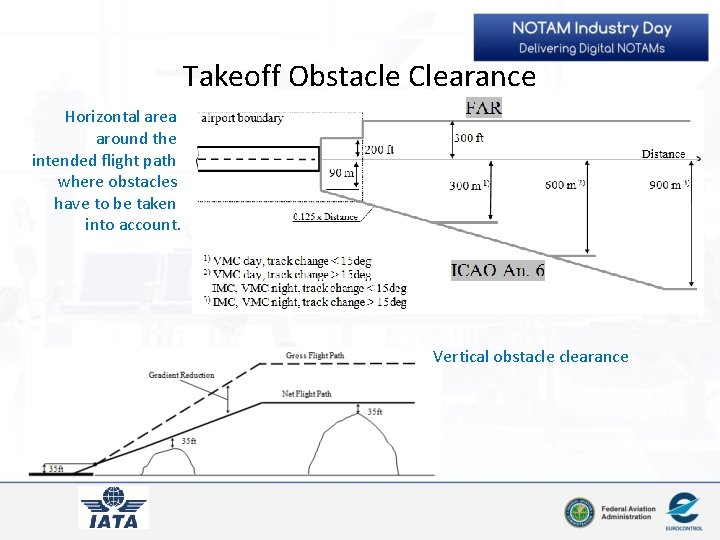
Takeoff Obstacle Clearance Horizontal area around the intended flight path where obstacles have to be taken into account. Vertical obstacle clearance
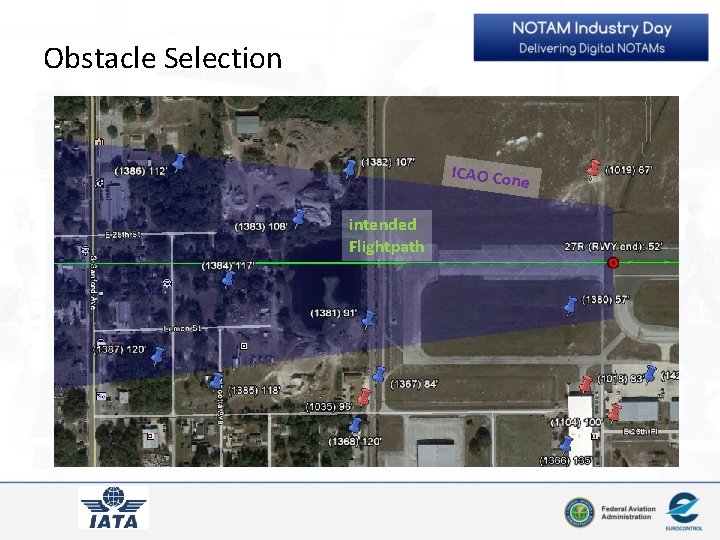
Obstacle Selection ICAO Con e intended Flightpath
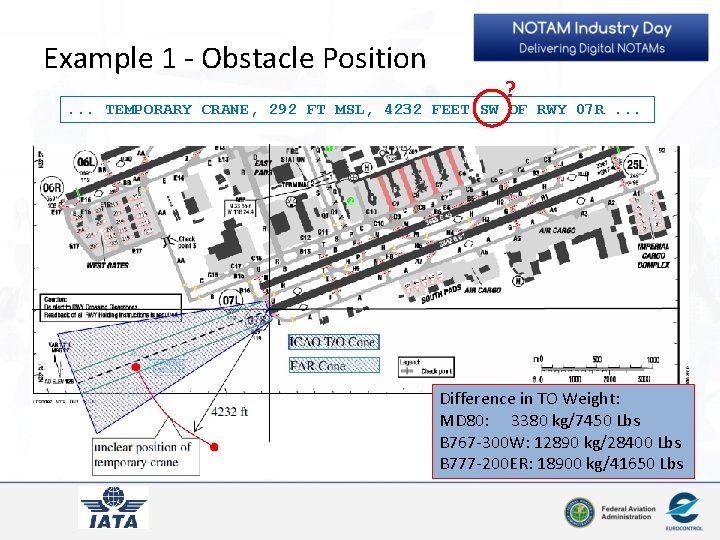
Example 1 - Obstacle Position ? . . . TEMPORARY CRANE, 292 FT MSL, 4232 FEET SW OF RWY 07 R. . . Difference in TO Weight: MD 80: 3380 kg/7450 Lbs B 767 -300 W: 12890 kg/28400 Lbs B 777 -200 ER: 18900 kg/41650 Lbs
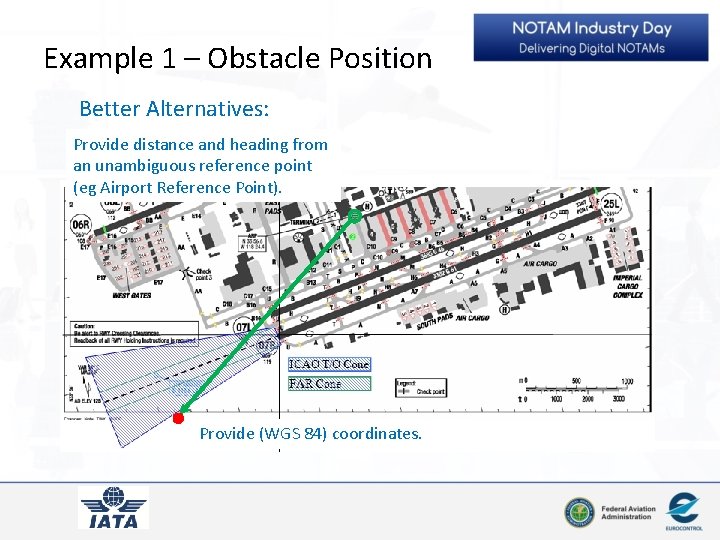
Example 1 – Obstacle Position Better Alternatives: Provide distance and heading from an unambiguous reference point (eg Airport Reference Point). Provide (WGS 84) coordinates.
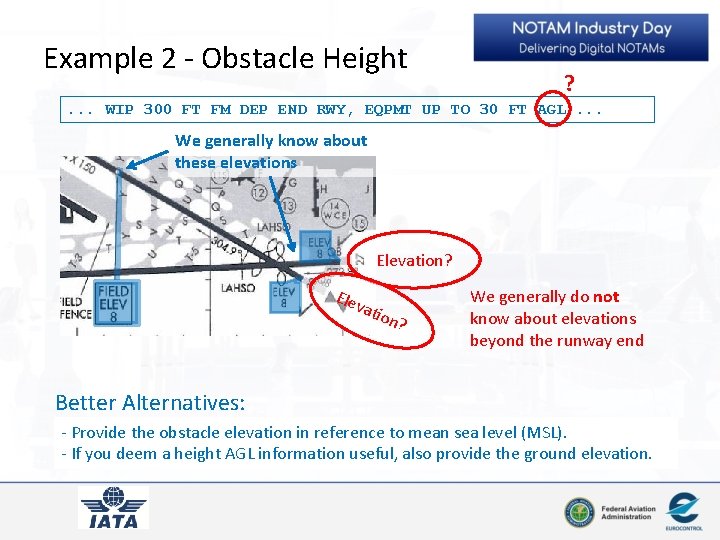
Example 2 - Obstacle Height ? . . . WIP 300 FT FM DEP END RWY, EQPMT UP TO 30 FT AGL. . . We generally know about these elevations Elevation? Elev atio n? We generally do not know about elevations beyond the runway end Better Alternatives: - Provide the obstacle elevation in reference to mean sea level (MSL). - If you deem a height AGL information useful, also provide the ground elevation.
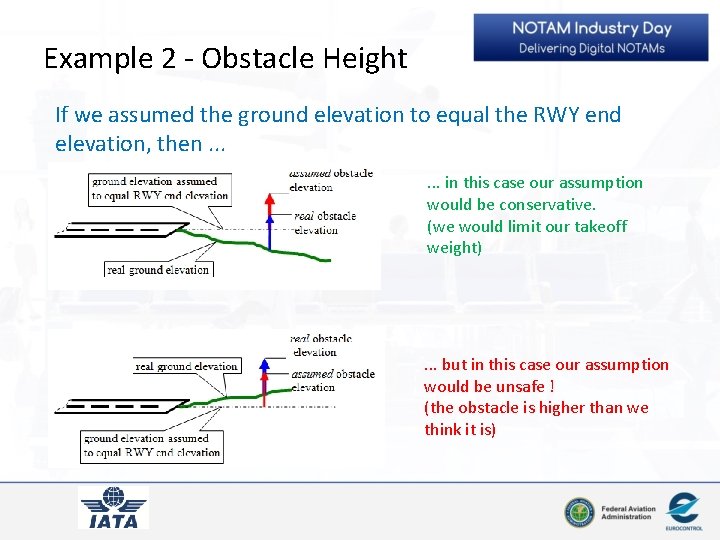
Example 2 - Obstacle Height If we assumed the ground elevation to equal the RWY end elevation, then. . . in this case our assumption would be conservative. (we would limit our takeoff weight) . . . but in this case our assumption would be unsafe ! (the obstacle is higher than we think it is)
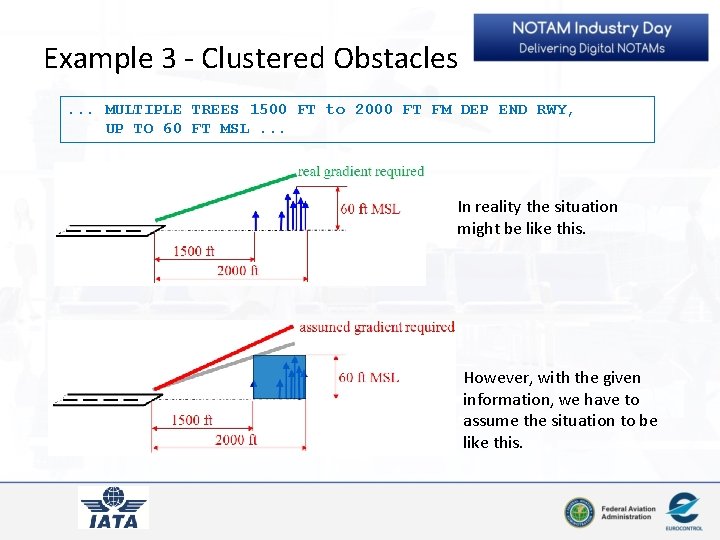
Example 3 - Clustered Obstacles. . . MULTIPLE TREES 1500 FT to 2000 FT FM DEP END RWY, UP TO 60 FT MSL. . . In reality the situation might be like this. However, with the given information, we have to assume the situation to be like this.
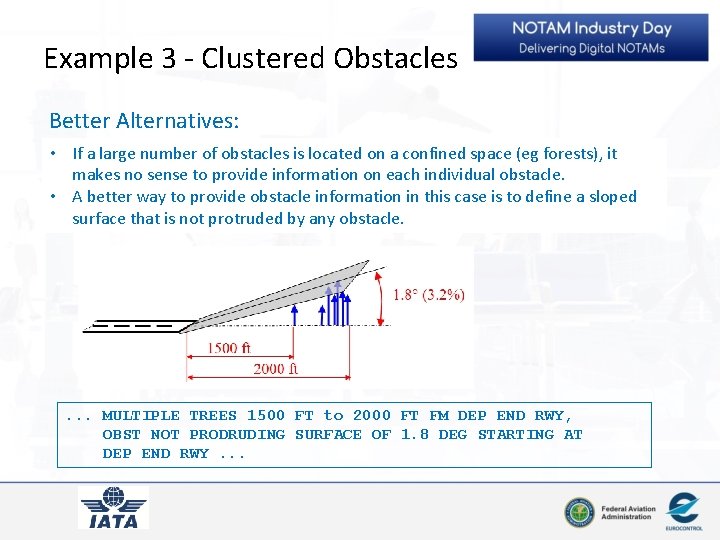
Example 3 - Clustered Obstacles Better Alternatives: • If a large number of obstacles is located on a confined space (eg forests), it makes no sense to provide information on each individual obstacle. • A better way to provide obstacle information in this case is to define a sloped surface that is not protruded by any obstacle. . MULTIPLE TREES 1500 FT to 2000 FT FM DEP END RWY, OBST NOT PRODRUDING SURFACE OF 1. 8 DEG STARTING AT DEP END RWY. . .
Contact Information John Synnott, IATA synnottj@iata. org Heinz Conrad, Lufthansa Walter Emmerling, Condor heinz. conrad@lhsystems. com walter. emmerling@condor. com

Questions ? Thank You !
- Slides: 13