
Delivering CarrierClass Telephony Using SIP Trunking International SIP

- Slides: 16
Delivering Carrier-Class Telephony Using SIP Trunking International SIP, Paris, January 2004 Frederic POTTER, CTO & Senior VP fpotter@cirpack. com © 2000 -2004 CIRPACK. All rights reserved. Reproduction without permission is prohibited.
Agenda u About Carrier-Class Telephony u About SIP Trunking u Migration Scenario to Vo. IP u Interworking SIP with the Rest of the World 2
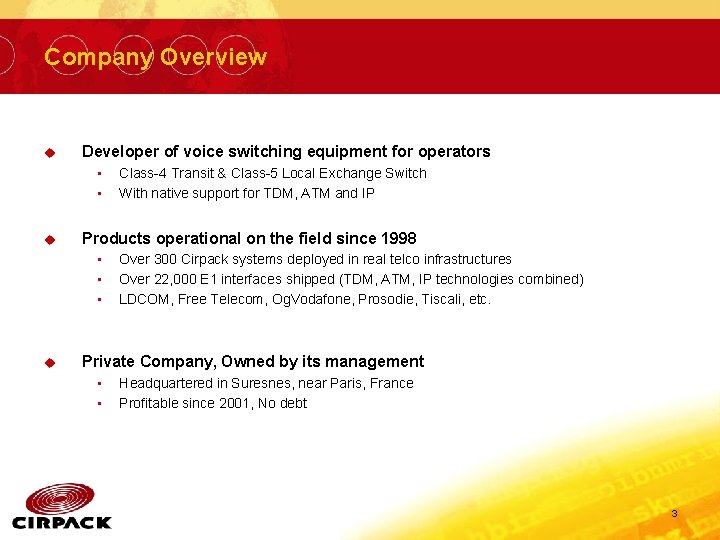
Company Overview u Developer of voice switching equipment for operators • • u Products operational on the field since 1998 • • • u Class-4 Transit & Class-5 Local Exchange Switch With native support for TDM, ATM and IP Over 300 Cirpack systems deployed in real telco infrastructures Over 22, 000 E 1 interfaces shipped (TDM, ATM, IP technologies combined) LDCOM, Free Telecom, Og. Vodafone, Prosodie, Tiscali, etc. Private Company, Owned by its management • • Headquartered in Suresnes, near Paris, France Profitable since 2001, No debt 3
What is Carrier-Class Telephony? Carrier-Class means you cannot remember when it didn’t work last time… Do you remember when your POTS line went out of order last time? Do you remember when your EMAIL did not work last time? 4
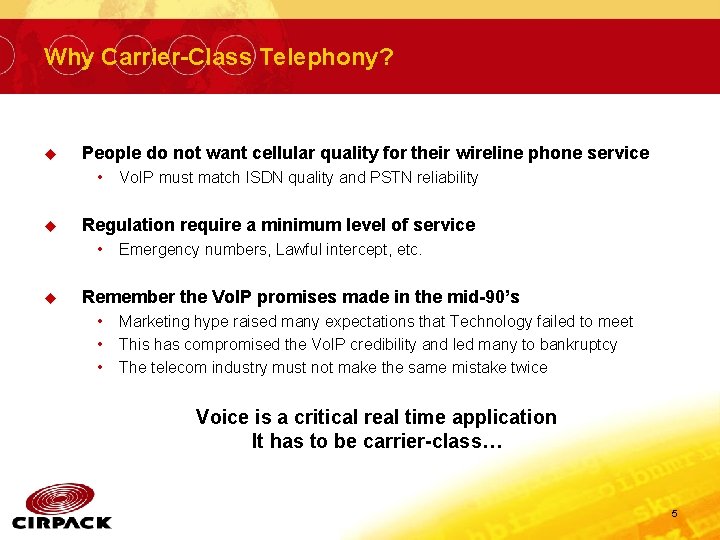
Why Carrier-Class Telephony? u People do not want cellular quality for their wireline phone service • u Regulation require a minimum level of service • u Vo. IP must match ISDN quality and PSTN reliability Emergency numbers, Lawful intercept, etc. Remember the Vo. IP promises made in the mid-90’s • • • Marketing hype raised many expectations that Technology failed to meet This has compromised the Vo. IP credibility and led many to bankruptcy The telecom industry must not make the same mistake twice Voice is a critical real time application It has to be carrier-class… 5
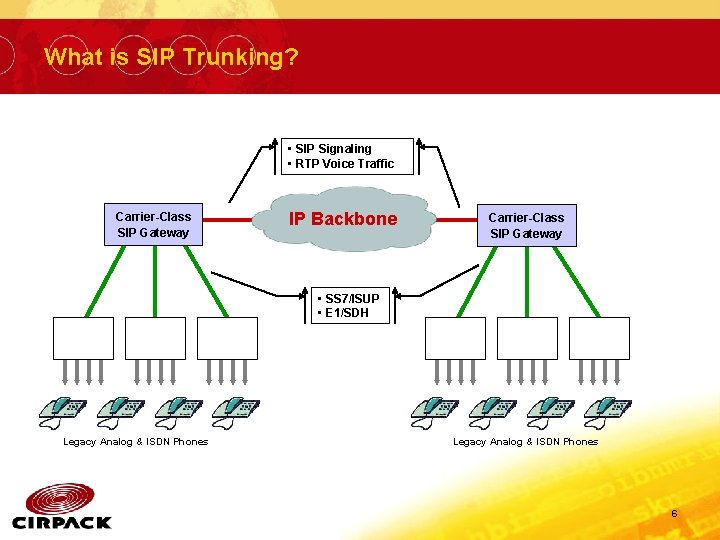
What is SIP Trunking? • SIP Signaling • RTP Voice Traffic IP Backbone Carrier-Class SIP Gateway • SS 7/ISUP • E 1/SDH Class 5 TDM Local Exchange Class 5 TDM Local Exchange Legacy Analog & ISDN Phones 6
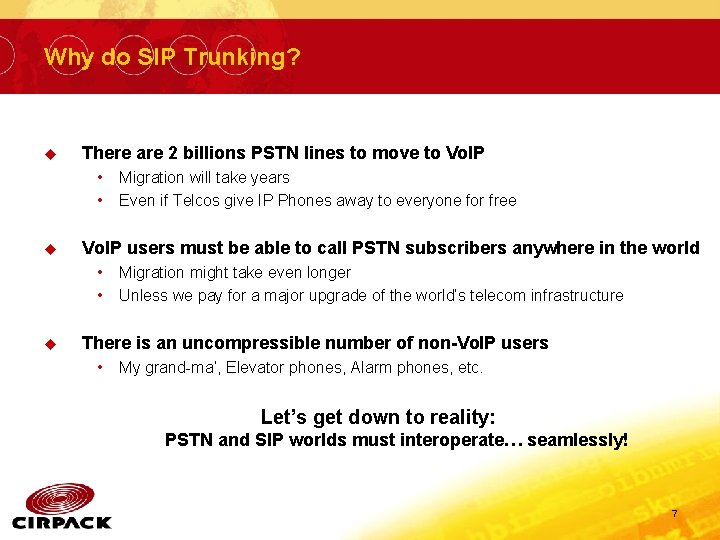
Why do SIP Trunking? u There are 2 billions PSTN lines to move to Vo. IP • • u Vo. IP users must be able to call PSTN subscribers anywhere in the world • • u Migration will take years Even if Telcos give IP Phones away to everyone for free Migration might take even longer Unless we pay for a major upgrade of the world’s telecom infrastructure There is an uncompressible number of non-Vo. IP users • My grand-ma’, Elevator phones, Alarm phones, etc. Let’s get down to reality: PSTN and SIP worlds must interoperate… seamlessly! 7
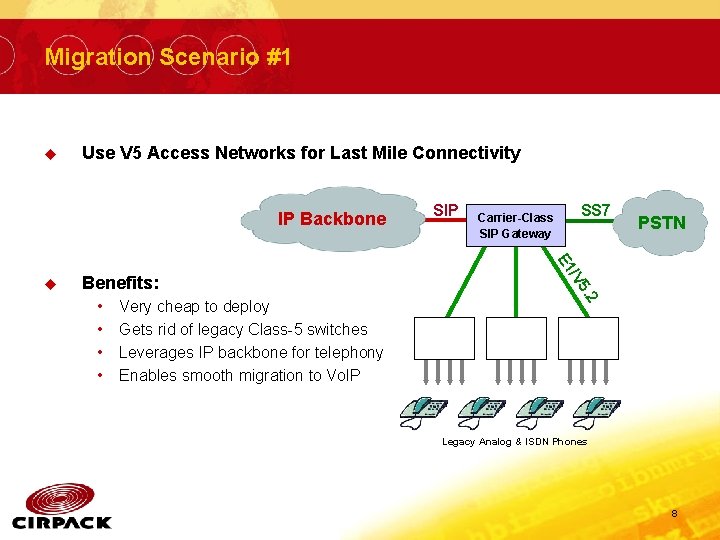
Migration Scenario #1 u Use V 5 Access Networks for Last Mile Connectivity IP Backbone Carrier-Class SIP Gateway Very cheap to deploy Gets rid of legacy Class-5 switches Leverages IP backbone for telephony Enables smooth migration to Vo. IP PSTN 2 5. Benefits: • • SS 7 /V E 1 u SIP V 5. 2 Access Node Legacy Analog & ISDN Phones 8
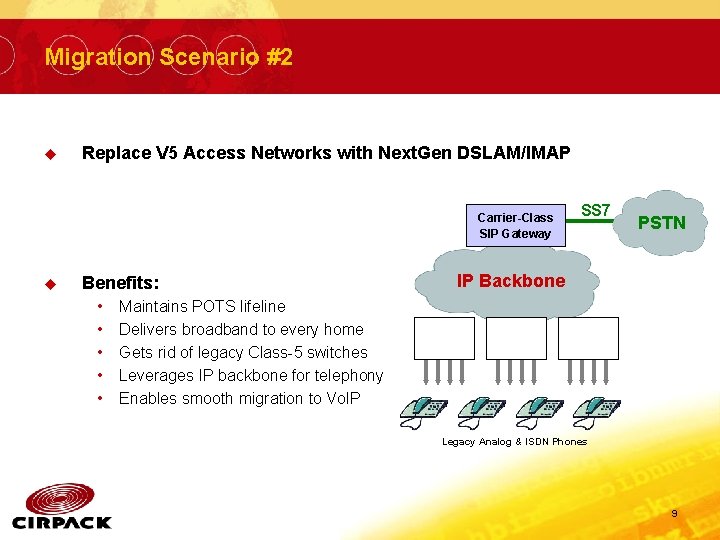
Migration Scenario #2 u Replace V 5 Access Networks with Next. Gen DSLAM/IMAP Carrier-Class SIP Gateway u Benefits: • • • Maintains POTS lifeline Delivers broadband to every home Gets rid of legacy Class-5 switches Leverages IP backbone for telephony Enables smooth migration to Vo. IP SS 7 PSTN IP Backbone DSLAM IMAP Legacy Analog & ISDN Phones 9
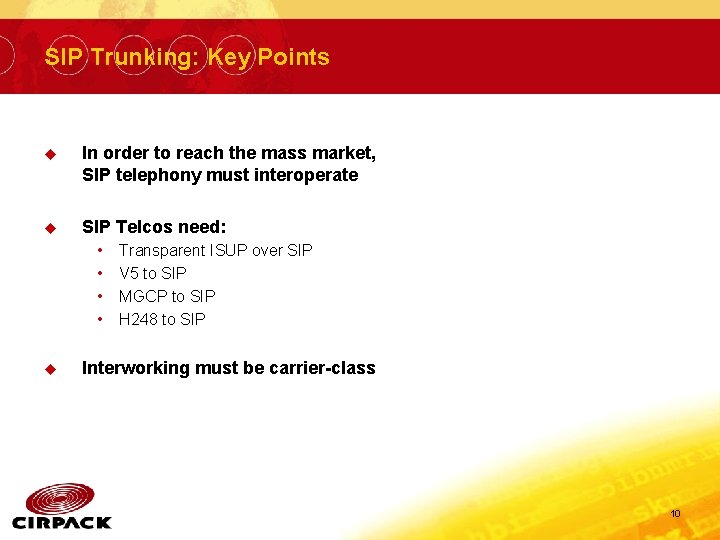
SIP Trunking: Key Points u In order to reach the mass market, SIP telephony must interoperate u SIP Telcos need: • • u Transparent ISUP over SIP V 5 to SIP MGCP to SIP H 248 to SIP Interworking must be carrier-class 10
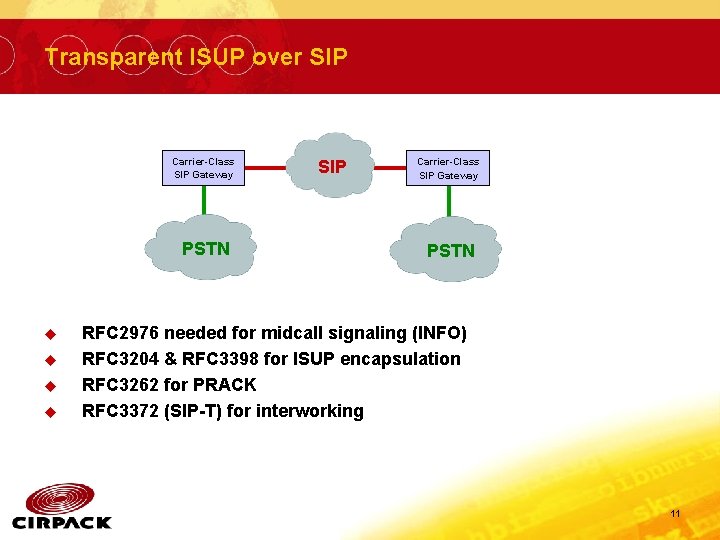
Transparent ISUP over SIP Carrier-Class SIP Gateway PSTN u u SIP Carrier-Class SIP Gateway PSTN RFC 2976 needed for midcall signaling (INFO) RFC 3204 & RFC 3398 for ISUP encapsulation RFC 3262 for PRACK RFC 3372 (SIP-T) for interworking 11
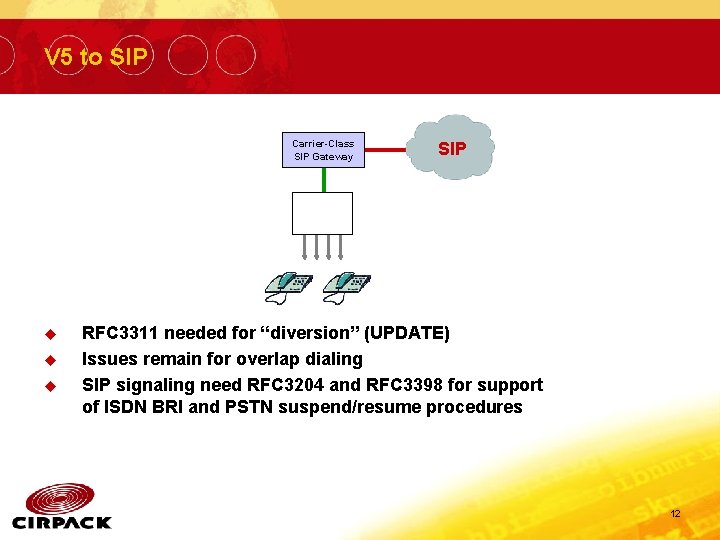
V 5 to SIP Carrier-Class SIP Gateway SIP V 5. 2 Access Node u u u RFC 3311 needed for “diversion” (UPDATE) Issues remain for overlap dialing SIP signaling need RFC 3204 and RFC 3398 for support of ISDN BRI and PSTN suspend/resume procedures 12
MGCP to SIP Media Gateway Controller SIP IP Local Loops MGCP CPE IP Router MGCP Soft. Phone Legacy Analog Phones MGCP Phones u u u Enables Vo. IP deployment with low-end, low cost, non personalized, dumb CPE RFC 3149 allows centrex display on IP Phone (line supervision, contextual menus, etc) Service deployment is centralized 13
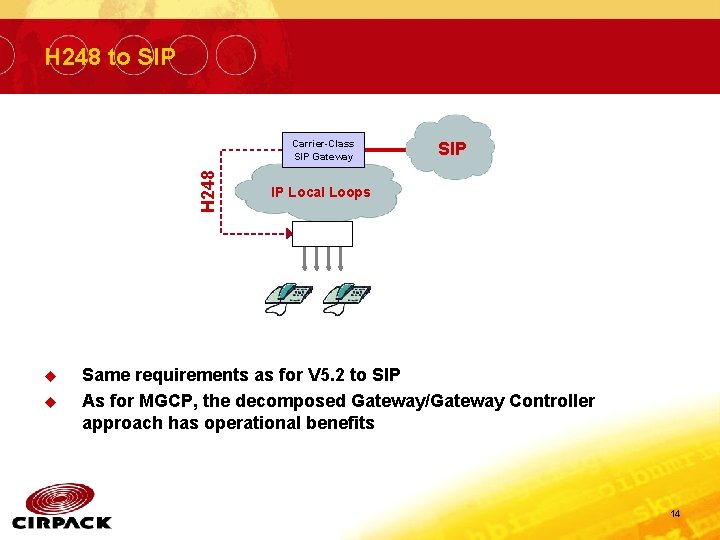
H 248 to SIP H 248 Carrier-Class SIP Gateway SIP IP Local Loops IBAN u u Same requirements as for V 5. 2 to SIP As for MGCP, the decomposed Gateway/Gateway Controller approach has operational benefits 14
Conclusion u Deploying SIP User Agent at customer premises cover a large part of the market u Other access solutions need to be supported for lower end or legacy services like POTS u This requires carrier-class equipment with support of most SIP RFCs to ensure a seamless interworking u This will also ensure smooth interworking to a 3 GPP SIP core based on TS 24. 228 15
Thank you! Questions? www. cirpack. com © 2000 -2004 CIRPACK. All rights reserved. Reproduction without permission is prohibited.