
Delivering a Net Zero NHS Nicky Philpott Deputy
- Slides: 11
Delivering a Net Zero NHS Nicky Philpott Deputy Director, Greener NHS 10 June 2021 NHS England NHS Improvement
Why a Net Zero Health Service? • Climate change poses a major threat to our health as well as our planet • The environment is changing, that change is accelerating, and this has direct and immediate consequences for our patients and the NHS • Reaching the UK’s ambitions under the Paris Climate Change Agreement could see over 5, 700 lives saved every year from improved air quality, 38, 000 lives saved every year from a more physically active population and over 100, 000 lives saved every year from healthier diets The NHS in England is responsible for an estimated 4. 6% of the country’s carbon footprint 1 | For a Greener NHS
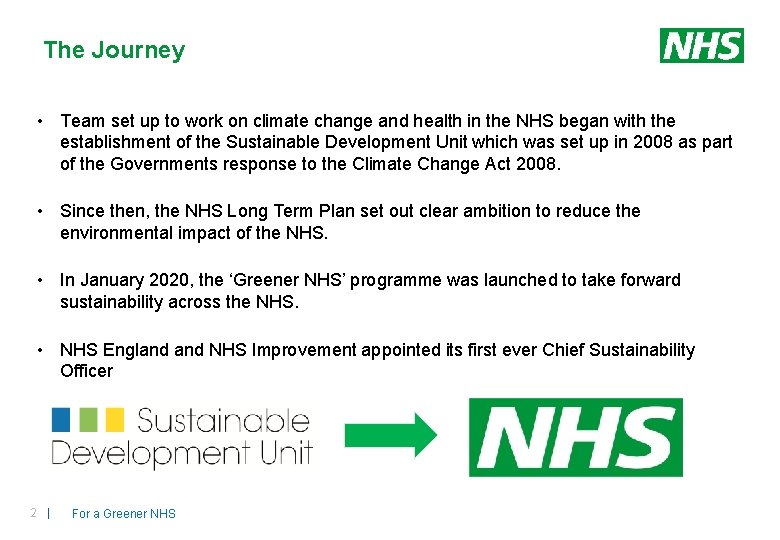
The Journey • Team set up to work on climate change and health in the NHS began with the establishment of the Sustainable Development Unit which was set up in 2008 as part of the Governments response to the Climate Change Act 2008. • Since then, the NHS Long Term Plan set out clear ambition to reduce the environmental impact of the NHS. • In January 2020, the ‘Greener NHS’ programme was launched to take forward sustainability across the NHS. • NHS England NHS Improvement appointed its first ever Chief Sustainability Officer 2 | For a Greener NHS
Our process for the Net Zero report Expert Panel Formation of the Net Zero Expert Panel with a broad membership across NHS, wider health sector and external expertise Call for Evidence Completed a system-wide call, with over 650 submissions from across the NHS, wider health sector and beyond Analytics • Review of the carbon footprint model, with amendments and re-baselining to 1990 to allow for comparison with the Climate Change Act. • Conducted workstream analysis on Estates and Facilities Management; Transport; Medicines; Non-Medicines Supply Chain; Models of Care o Initial modelling of trajectories and interventions o Ongoing review and engagement 3 | For a Greener NHS
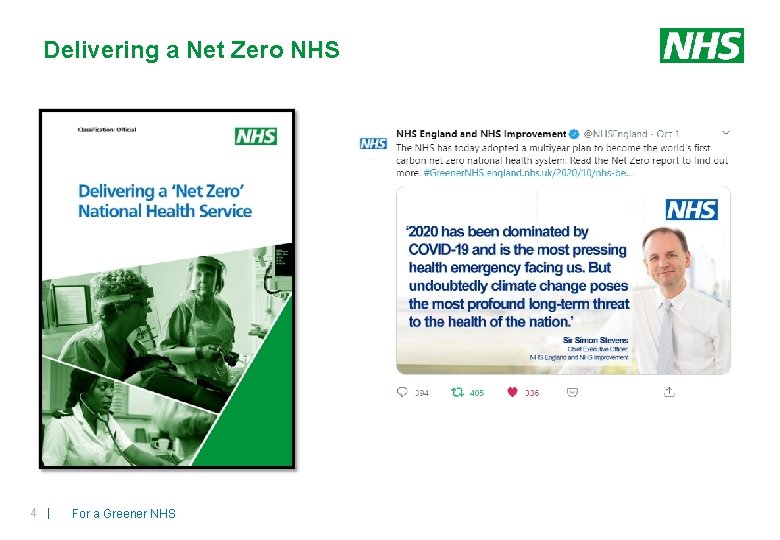
Delivering a Net Zero NHS 4 | For a Greener NHS
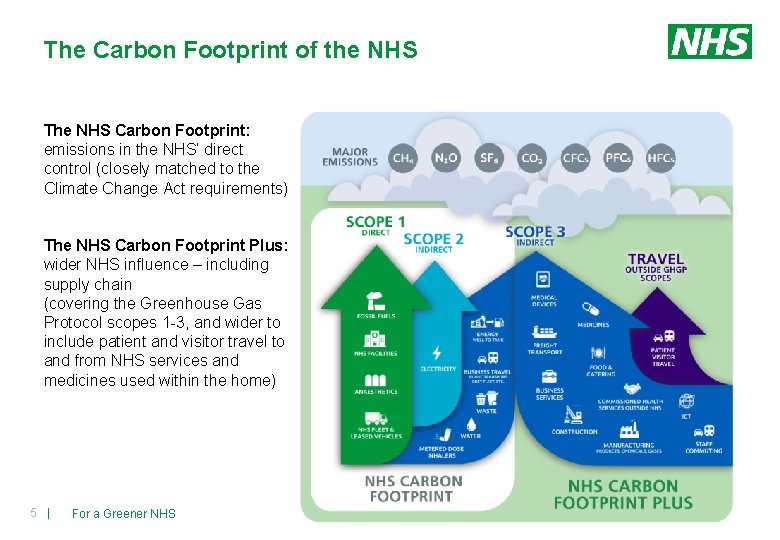
The Carbon Footprint of the NHS The NHS Carbon Footprint: emissions in the NHS’ direct control (closely matched to the Climate Change Act requirements) The NHS Carbon Footprint Plus: wider NHS influence – including supply chain (covering the Greenhouse Gas Protocol scopes 1 -3, and wider to include patient and visitor travel to and from NHS services and medicines used within the home) 5 | For a Greener NHS
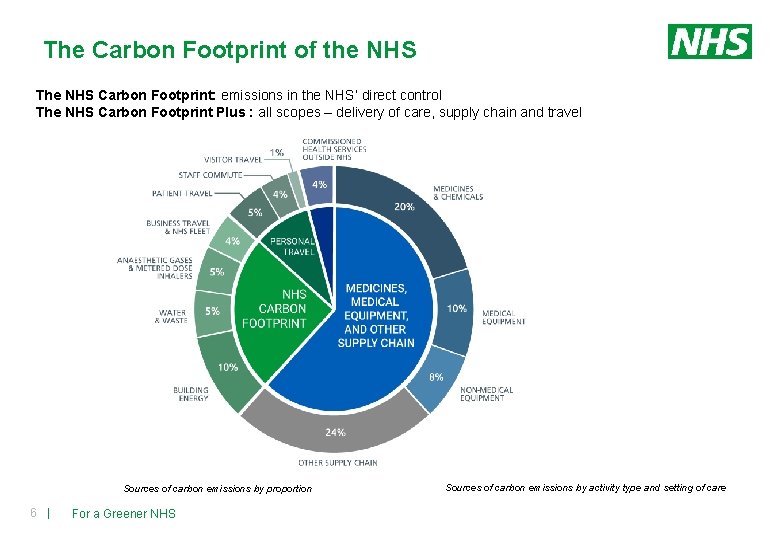
The Carbon Footprint of the NHS The NHS Carbon Footprint: emissions in the NHS’ direct control The NHS Carbon Footprint Plus : all scopes – delivery of care, supply chain and travel Sources of carbon emissions by proportion 6 | For a Greener NHS Sources of carbon emissions by activity type and setting of care
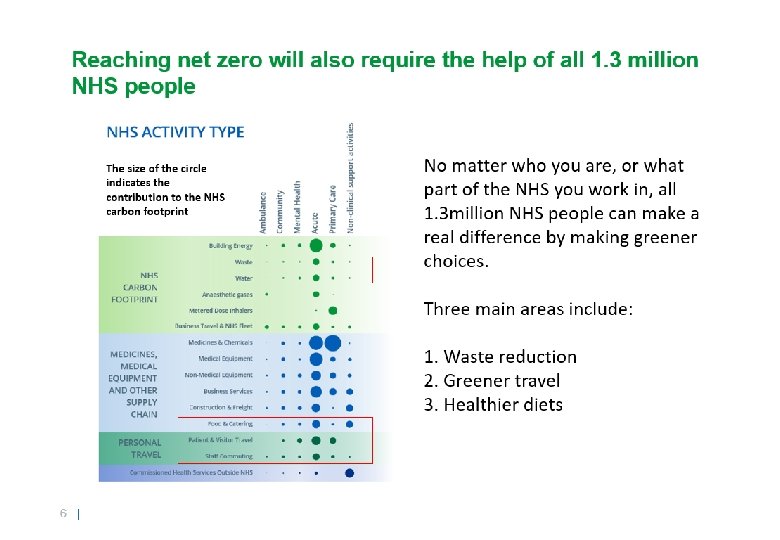
7 | For a Greener NHS
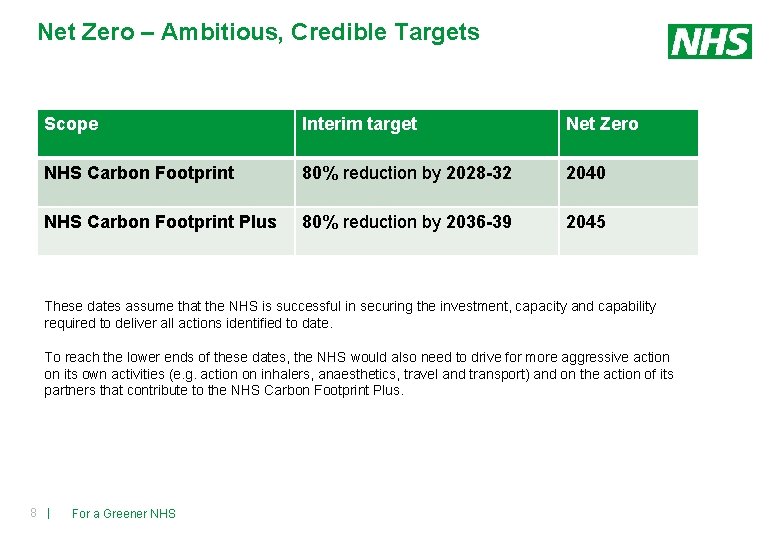
Net Zero – Ambitious, Credible Targets Scope Interim target Net Zero NHS Carbon Footprint 80% reduction by 2028 -32 2040 NHS Carbon Footprint Plus 80% reduction by 2036 -39 2045 These dates assume that the NHS is successful in securing the investment, capacity and capability required to deliver all actions identified to date. To reach the lower ends of these dates, the NHS would also need to drive for more aggressive action on its own activities (e. g. action on inhalers, anaesthetics, travel and transport) and on the action of its partners that contribute to the NHS Carbon Footprint Plus. 8 | For a Greener NHS
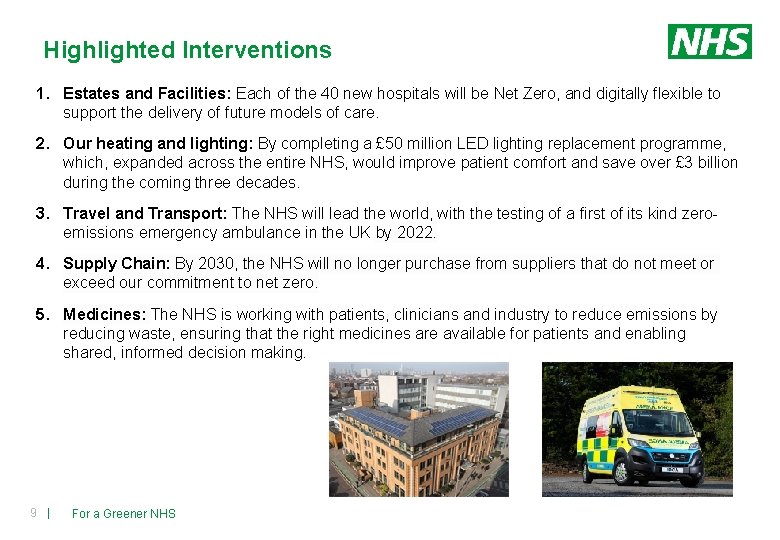
Highlighted Interventions 1. Estates and Facilities: Each of the 40 new hospitals will be Net Zero, and digitally flexible to support the delivery of future models of care. 2. Our heating and lighting: By completing a £ 50 million LED lighting replacement programme, which, expanded across the entire NHS, would improve patient comfort and save over £ 3 billion during the coming three decades. 3. Travel and Transport: The NHS will lead the world, with the testing of a first of its kind zeroemissions emergency ambulance in the UK by 2022. 4. Supply Chain: By 2030, the NHS will no longer purchase from suppliers that do not meet or exceed our commitment to net zero. 5. Medicines: The NHS is working with patients, clinicians and industry to reduce emissions by reducing waste, ensuring that the right medicines are available for patients and enabling shared, informed decision making. 9 | For a Greener NHS
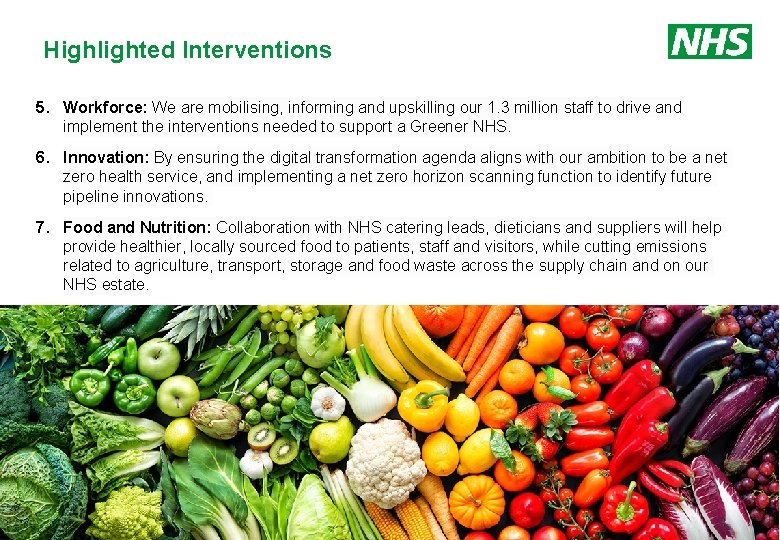
Highlighted Interventions 5. Workforce: We are mobilising, informing and upskilling our 1. 3 million staff to drive and implement the interventions needed to support a Greener NHS. 6. Innovation: By ensuring the digital transformation agenda aligns with our ambition to be a net zero health service, and implementing a net zero horizon scanning function to identify future pipeline innovations. 7. Food and Nutrition: Collaboration with NHS catering leads, dieticians and suppliers will help provide healthier, locally sourced food to patients, staff and visitors, while cutting emissions related to agriculture, transport, storage and food waste across the supply chain and on our NHS estate. 10 | For a Greener NHS