
Delegation Skills Objective Explain What is Delegation Explain
Delegation Skills

Objective • Explain What is Delegation • Explain Why People Do Not Delegate • Describe the Benefits of Delegating • List What Tasks Should We Not Delegate • Describe the Delegation Process • Explain A Simple Delegation Rule • Describe the Levels of Delegation • Describe the Types of Delegation • List the Delegating Skills • Explain the Barriers to Delegation
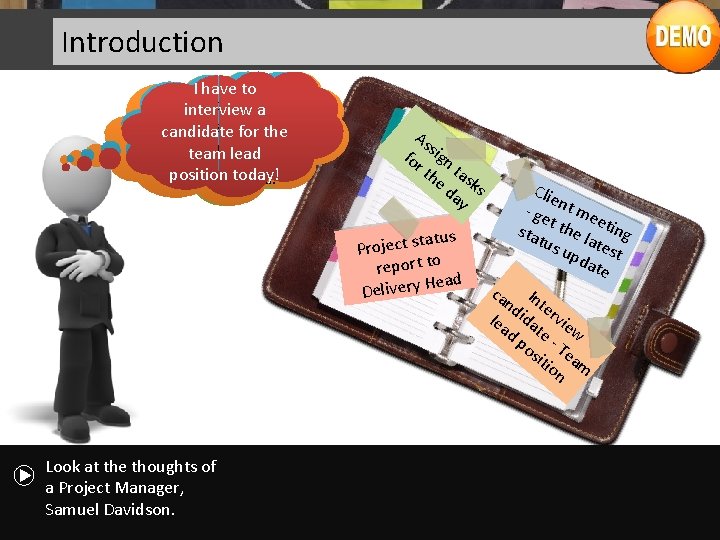
Introduction I have Oh! I have to submit a to client I have to assign interview a I meeting the project today. the tasks for the candidate status have to report getfor the tothe day to thelead team latest Delivery status. Head update position from today! teamtoday! lead. As fo sign r t ta he sk da s y atus Project st report to ead Delivery H Look at the thoughts of a Project Manager, Samuel Davidson. Clie - ge nt me e t sta the l ting tus a upd test ate ca In nd te lea ida rvie d p te - w os Te iti am on
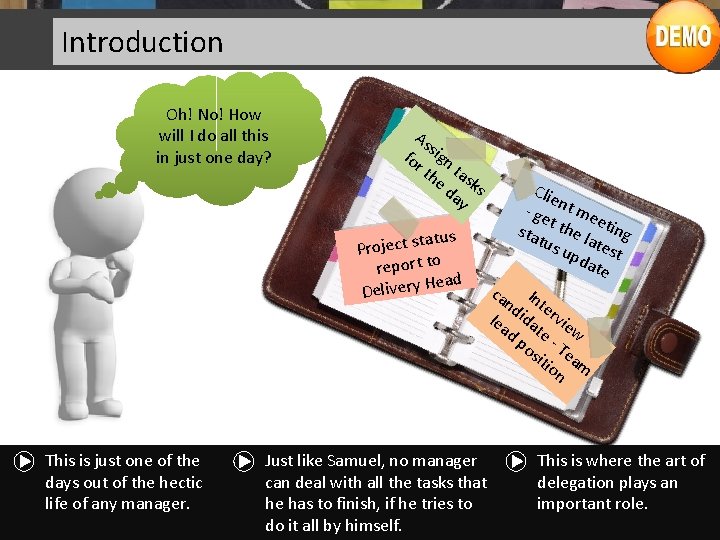
Introduction Oh! No! How will I do all this in just one day? As fo sign r t ta he sk da s y atus Project st report to ead Delivery H This is just one of the days out of the hectic life of any manager. Just like Samuel, no manager can deal with all the tasks that he has to finish, if he tries to do it all by himself. Clie - ge nt me e t sta the l ting tus a upd test ate ca In nd te lea ida rvie d p te - w os Te iti am on This is where the art of delegation plays an important role.

Introduction Let me delegate a few of my tasks! As fo sign r t ta he sk da s y Clie - ge nt me e t sta the l ting tus a upd test ate E T A G E DEL atus Project st report to ead Delivery H If Samuel decides to delegate a few of his tasks to his sub-ordinates, he can get all his day’s tasks done and accomplish much more than if he tries to do it all single handedly. ca In nd te lea ida rvie d p te - w os Te iti am on Delegating is a skill and it is important to know the nuances of delegating a task. So, let us learn about delegation skills in detail.
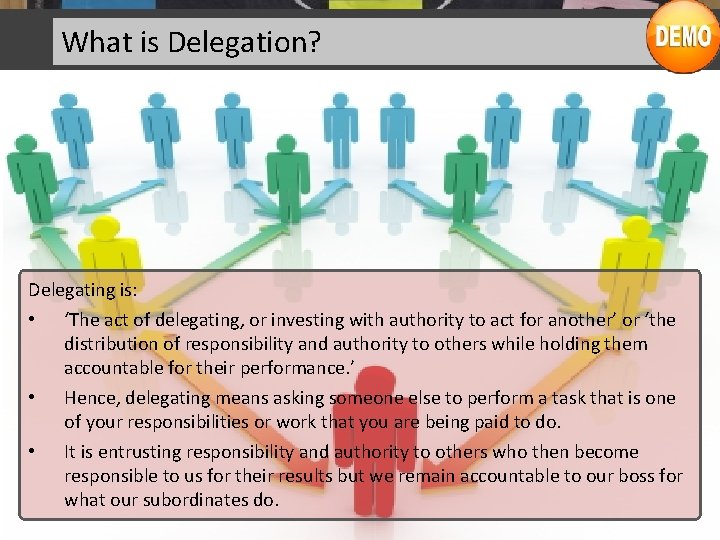
What is Delegation? Delegating is: • • • ‘The act of delegating, or investing with authority to act for another’ or ‘the distribution of responsibility and authority to others while holding them accountable for their performance. ’ Hence, delegating means asking someone else to perform a task that is one of your responsibilities or work that you are being paid to do. It is entrusting responsibility and authority to others who then become responsible to us for their results but we remain accountable to our boss for what our subordinates do.
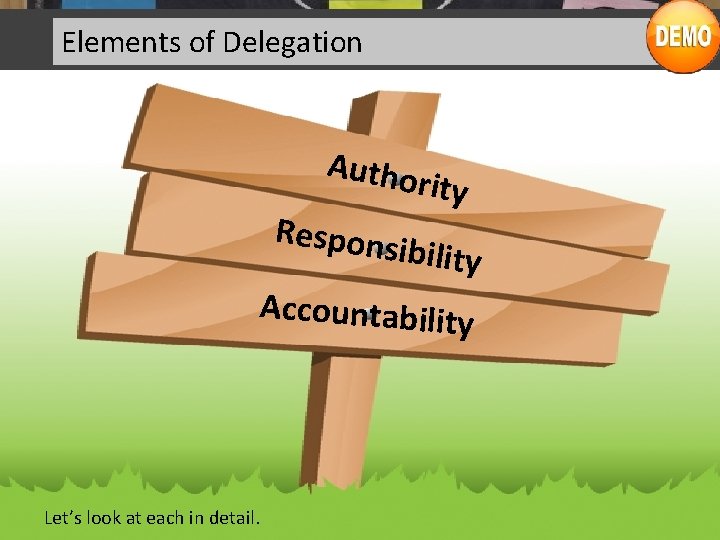
Elements of Delegation Autho Respons rity ibility Accountability Let’s look at each in detail.
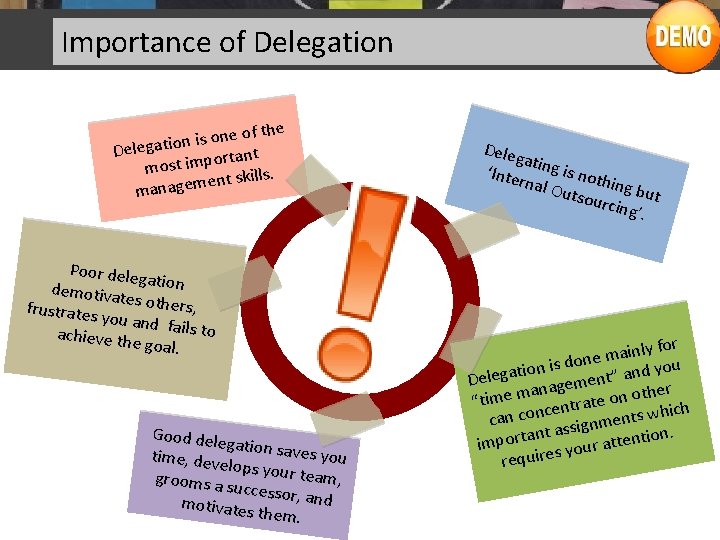
Importance of Delegation of the e n o s i n Delegatio tant r o p m i t s mo skills. t n e m e g mana Poor deleg ation demotivat es others, frustrates you and f ails to achieve th e goal. Good dele gati time, deve on saves you lops your team, grooms a successor, and motivates them. Deleg at ‘Inter ing is not hi nal O utsou ng but rcing ’. ly for n i a m e is don n you o i d t n a a g e ” l t e D gemen other a n a m “time te on a r t n e ich c can con ssignments wh n. nt a importa s your attentio require
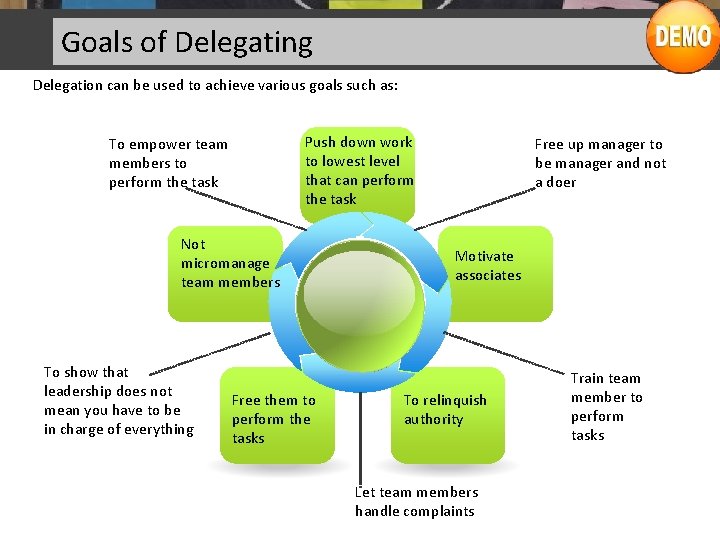
Goals of Delegating Delegation can be used to achieve various goals such as: Push down work to lowest level that can perform the task To empower team members to perform the task Not micromanage team members To show that leadership does not mean you have to be in charge of everything Free them to perform the tasks Free up manager to be manager and not a doer Motivate associates To relinquish authority Let team members handle complaints Train team member to perform tasks

Benefits of Delegating For Your T eam • Increases associate responsibility, ownership, and enjoyment • Builds team environment • Associates gain knowledge and skills • Ensures tasks are done timely • Allows for days off and flexibility in scheduling • Reduced turnover because motivated and engaged employees don’t terminate • Increased consistency as people know why we do things • Teamwork – gets all involved - no more you telling them, but them doing and motivating each other • FFo YYo orrfor u othe u next level Trains individuals • Allows to meet all deadlines as lots of us are doing • Lets things run the same way when manager is on leave as when manager is present
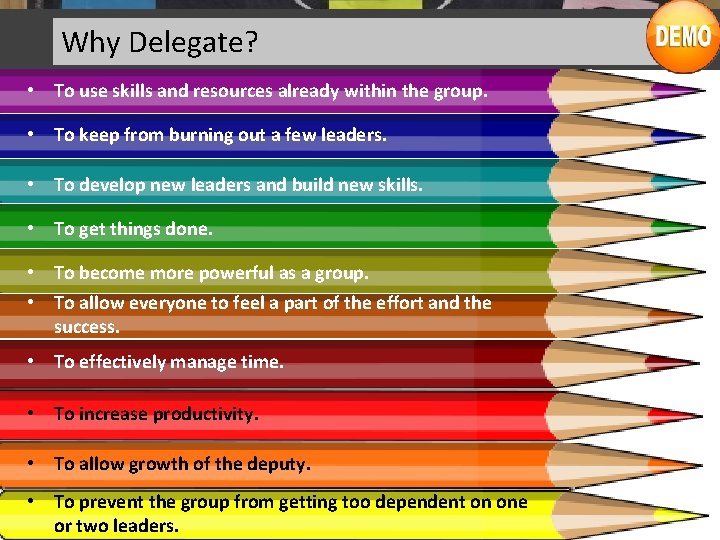
Why Delegate? • To use skills and resources already within the group. • To keep from burning out a few leaders. • To develop new leaders and build new skills. • To get things done. • To become more powerful as a group. • To allow everyone to feel a part of the effort and the success. • To effectively manage time. • To increase productivity. • To allow growth of the deputy. • To prevent the group from getting too dependent on one or two leaders.

How to Delegate The following are the steps for how to delegate: Decide What to Delegate Choose the Right Candidate Communicate Objective Relinquish Authority Monitor Progress Let Go Give Credit Let’s look at each in detail.
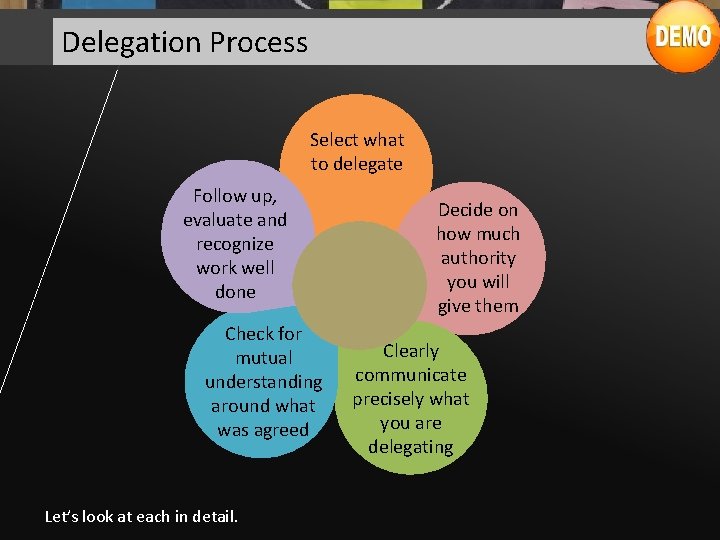
Delegation Process Select what to delegate Follow up, evaluate and recognize work well done Check for mutual understanding around what was agreed Let’s look at each in detail. Decide on how much authority you will give them Clearly communicate precisely what you are delegating
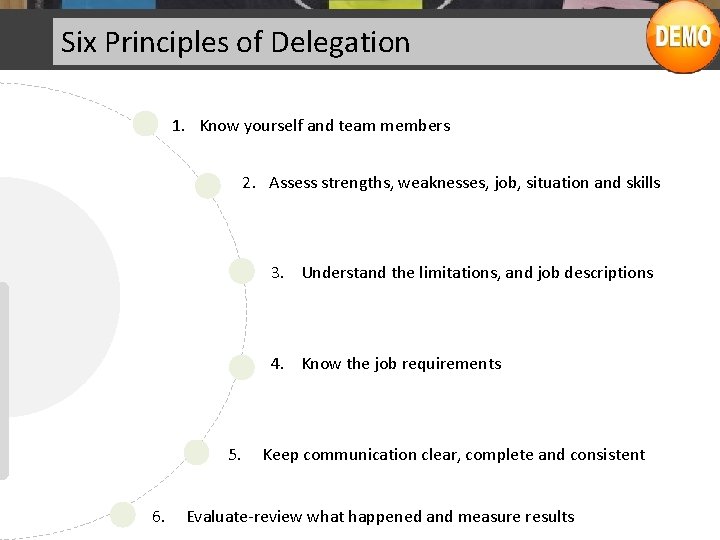
Six Principles of Delegation 1. Know yourself and team members 2. Assess strengths, weaknesses, job, situation and skills 3. Understand the limitations, and job descriptions 4. Know the job requirements 5. 6. Keep communication clear, complete and consistent Evaluate-review what happened and measure results
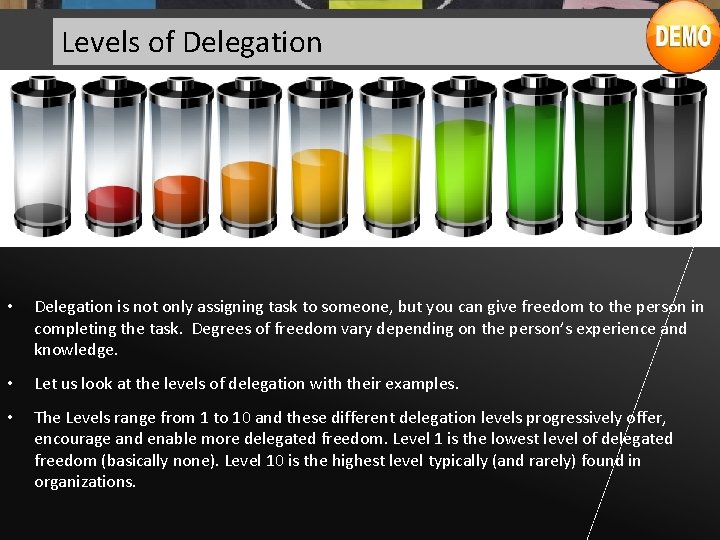
Levels of Delegation • Delegation is not only assigning task to someone, but you can give freedom to the person in completing the task. Degrees of freedom vary depending on the person’s experience and knowledge. • Let us look at the levels of delegation with their examples. • The Levels range from 1 to 10 and these different delegation levels progressively offer, encourage and enable more delegated freedom. Level 1 is the lowest level of delegated freedom (basically none). Level 10 is the highest level typically (and rarely) found in organizations.

Management. Study. Guide. com This is a DEMO Course On – Delegation of Authority. Join MSG Premium Membership and Get Access to around 120 Courses + New courses added every week. What You Get: 1. View All Courses Online. 2. Download Powerpoint Presentation for Each Course. 3. Do the Knowledge Checks for Each Course.
- Slides: 16