
Delegation Skills Objective Explain What is Delegation Explain
Delegation Skills

Objective • Explain What is Delegation • Explain Why People Do Not Delegate • Describe the Benefits of Delegating • List What Tasks Should We Not Delegate • Describe the Delegation Process • Explain A Simple Delegation Rule • Describe the Levels of Delegation • Describe the Types of Delegation • List the Delegating Skills • Explain the Barriers to Delegation
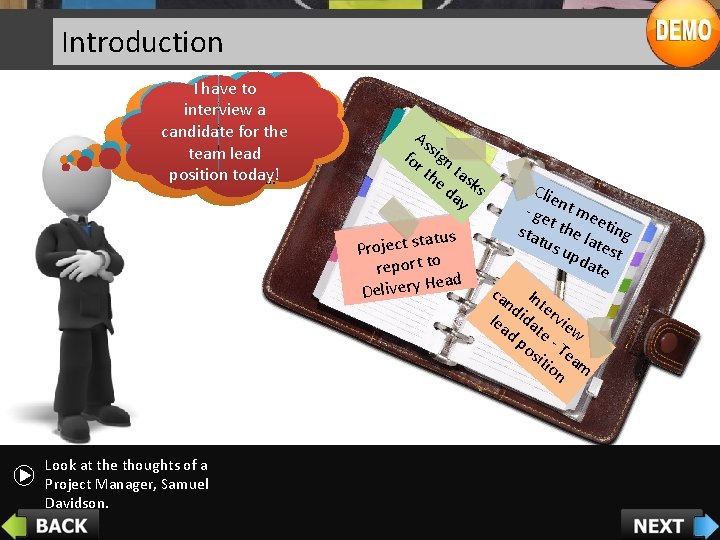
Introduction I have Oh! I have to submit a to client I have to assign interview a I meeting the project today. the tasks for the candidate status have to report getfor the tothe day to thelead team latest Delivery status. Head update position from today! teamtoday! lead. As fo sign r t ta he sk da s y atus Project st report to ead Delivery H Look at the thoughts of a Project Manager, Samuel Davidson. Clie - ge nt me e t sta the l ting tus a upd test ate ca In nd te lea ida rvie d p te - w os Te iti am on
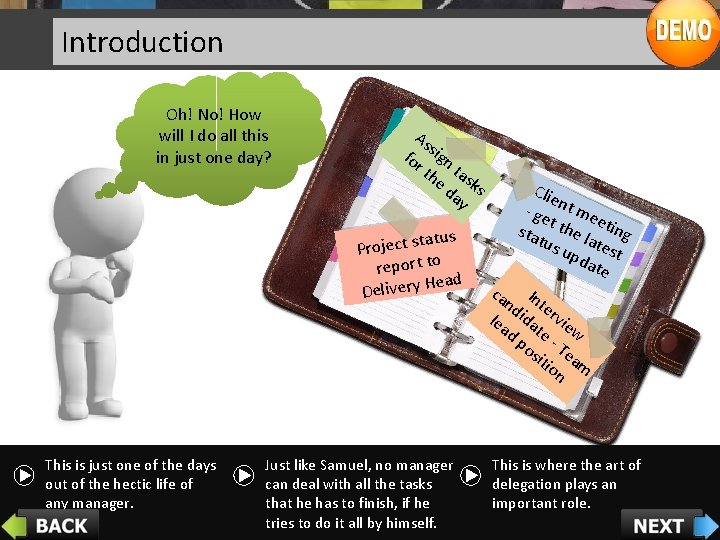
Introduction Oh! No! How will I do all this in just one day? As fo sign r t ta he sk da s y atus Project st report to ead Delivery H This is just one of the days out of the hectic life of any manager. Just like Samuel, no manager can deal with all the tasks that he has to finish, if he tries to do it all by himself. Clie - ge nt me e t sta the l ting tus a upd test ate ca In nd te lea ida rvie d p te - w os Te iti am on This is where the art of delegation plays an important role.

Introduction Let me delegate a few of my tasks! As fo sign r t ta he sk da s y Clie - ge nt me e t sta the l ting tus a upd test ate E T A G E DEL atus Project st report to ead Delivery H If Samuel decides to delegate a few of his tasks to his sub-ordinates, he can get all his day’s tasks done and accomplish much more than if he tries to do it all single handedly. ca In nd te lea ida rvie d p te - w os Te iti am on Delegating is a skill and it is important to know the nuances of delegating a task. So, let us learn about delegation skills in detail.
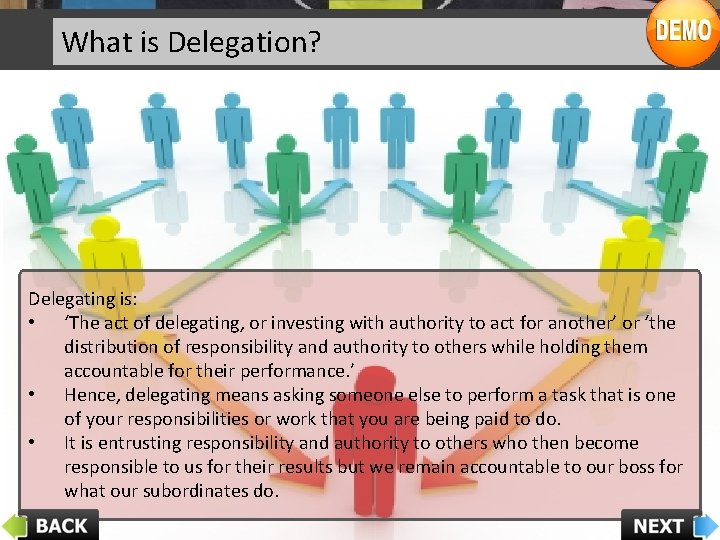
What is Delegation? Delegating is: • ‘The act of delegating, or investing with authority to act for another’ or ‘the distribution of responsibility and authority to others while holding them accountable for their performance. ’ • Hence, delegating means asking someone else to perform a task that is one of your responsibilities or work that you are being paid to do. • It is entrusting responsibility and authority to others who then become responsible to us for their results but we remain accountable to our boss for what our subordinates do.
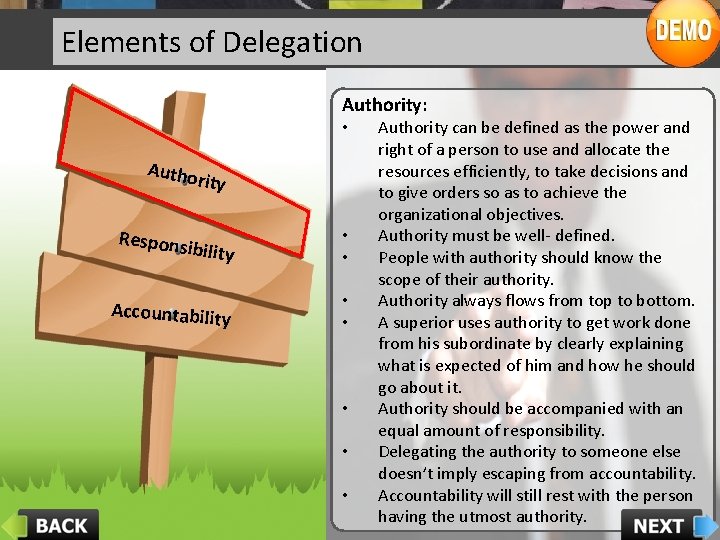
Elements of Delegation Authority: • Autho Respons rity ibility • • Accountability • • • Authority can be defined as the power and right of a person to use and allocate the resources efficiently, to take decisions and to give orders so as to achieve the organizational objectives. Authority must be well- defined. People with authority should know the scope of their authority. Authority always flows from top to bottom. A superior uses authority to get work done from his subordinate by clearly explaining what is expected of him and how he should go about it. Authority should be accompanied with an equal amount of responsibility. Delegating the authority to someone else doesn’t imply escaping from accountability. Accountability will still rest with the person having the utmost authority.
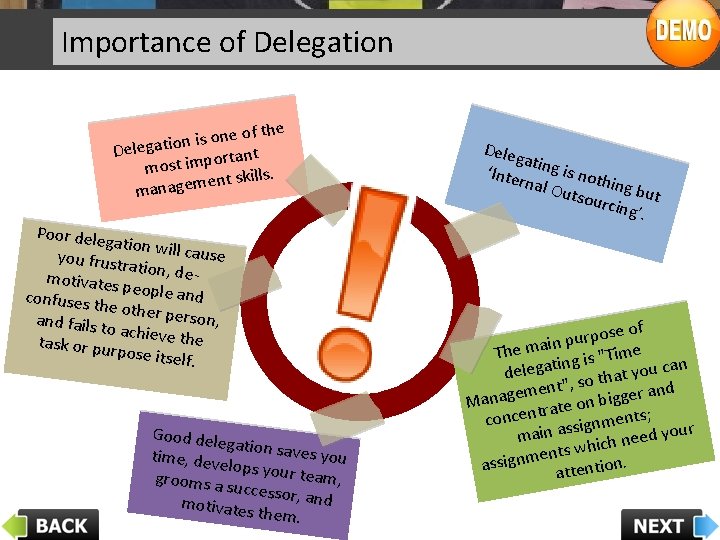
Importance of Delegation of the e n o s i n Delegatio tant r o p m i t s mo skills. t n e m e g mana Poor deleg ation will cause you frustr ation, demotivates people an d confuses t he other p erson, and fails t o achieve the task or pu rpose itse lf. Good dele gati time, deve on saves you lops your team, grooms a successor, and motivates them. Deleg at ‘Inter ing is not hi nal O utsou ng but rcing ’. se of o p r u p in The ma g is "Time in n delegat so that you ca ent", m e r and g e a g g n i b Ma ate on r t n e c n nts; e co m n g i s main as ich need your wh s t n e m n. assign attentio
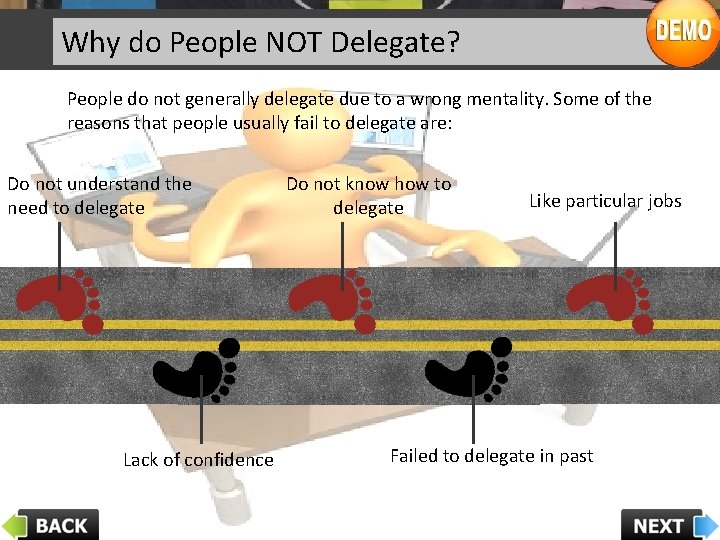
Why do People NOT Delegate? People do not generally delegate due to a wrong mentality. Some of the reasons that people usually fail to delegate are: Do not understand the need to delegate Lack of confidence Do not know how to delegate Like particular jobs Failed to delegate in past
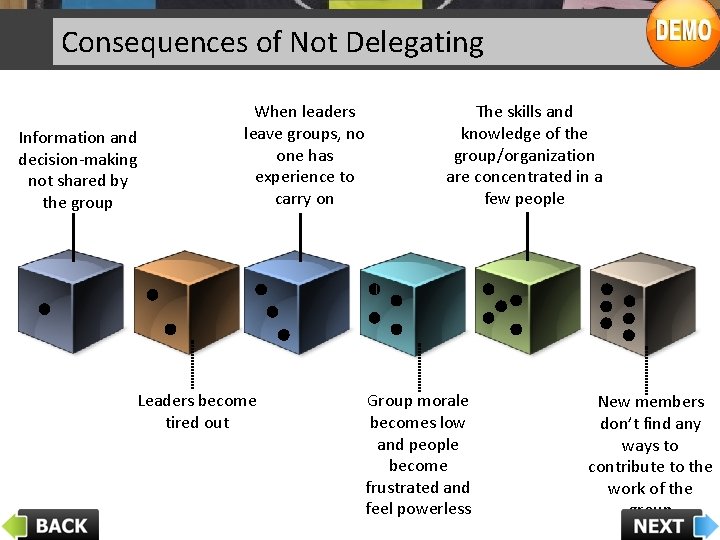
Consequences of Not Delegating Information and decision-making not shared by the group When leaders leave groups, no one has experience to carry on Leaders become tired out The skills and knowledge of the group/organization are concentrated in a few people Group morale becomes low and people become frustrated and feel powerless New members don’t find any ways to contribute to the work of the group
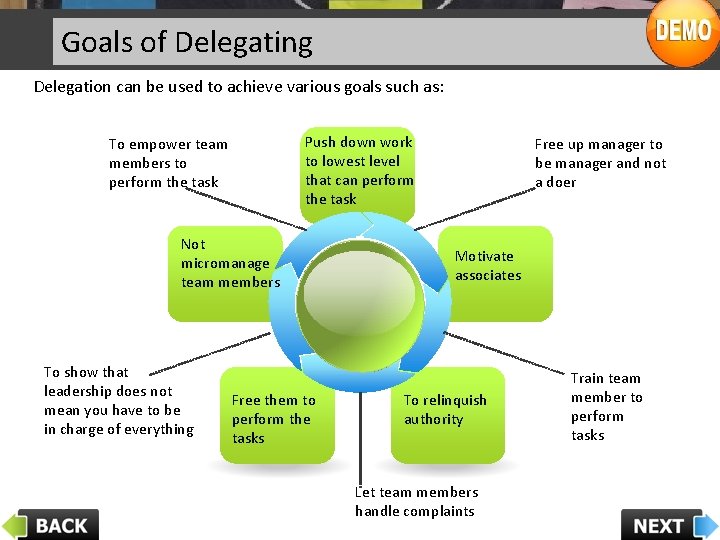
Goals of Delegating Delegation can be used to achieve various goals such as: Push down work to lowest level that can perform the task To empower team members to perform the task Not micromanage team members To show that leadership does not mean you have to be in charge of everything Free them to perform the tasks Free up manager to be manager and not a doer Motivate associates To relinquish authority Let team members handle complaints Train team member to perform tasks
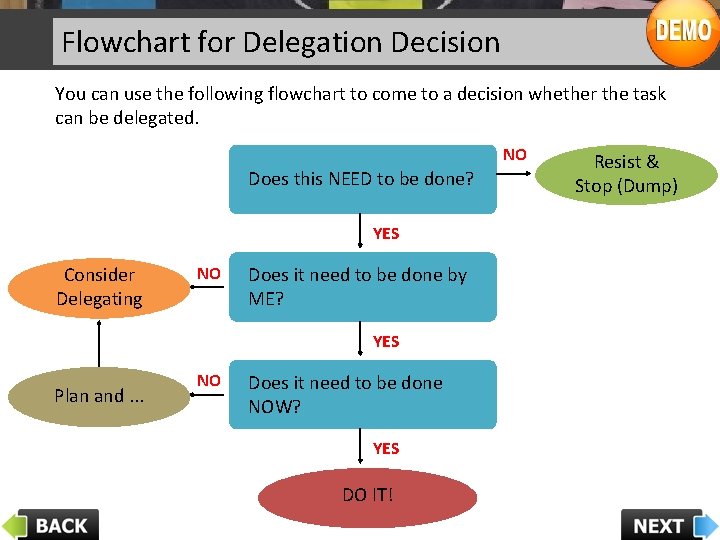
Flowchart for Delegation Decision You can use the following flowchart to come to a decision whether the task can be delegated. NO Does this NEED to be done? YES Consider Delegating NO Does it need to be done by ME? YES Plan and. . . NO Does it need to be done NOW? YES DO IT! Resist & Stop (Dump)
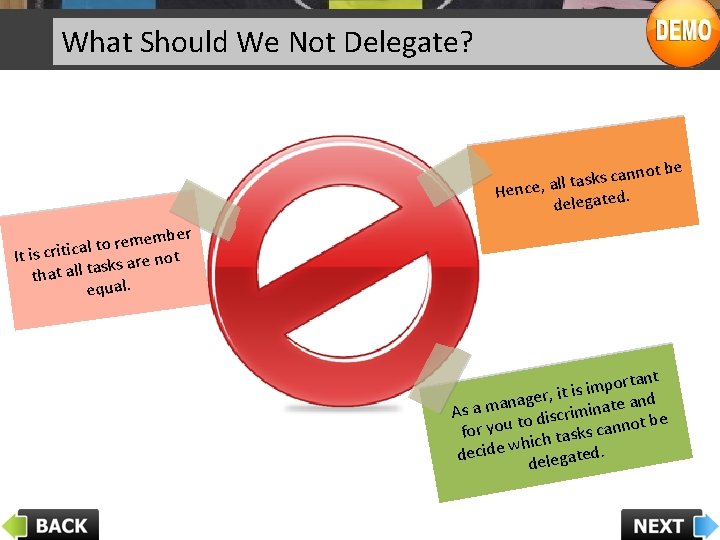
What Should We Not Delegate? not be n a c s k s a t l Hence, al. delegated mber e m e r o t l It is critica ks are not s that all ta. equal rtant o p m i s ger, it i ate and a n a m As a crimin s i d o t t be for you ch tasks canno whi e d i c e ed. d delegat

How to Delegate Decide What to Delegate Choose the Right Candidate Communicate Objective Relinquish Authority Monitor Progress Let Go Give Credit Monitor Progress • Ask for progress reports o Agree on follow up date(s) and time o Expect mistakes • Meet with the employee to make sure things are getting done • Set progress meetings in advance
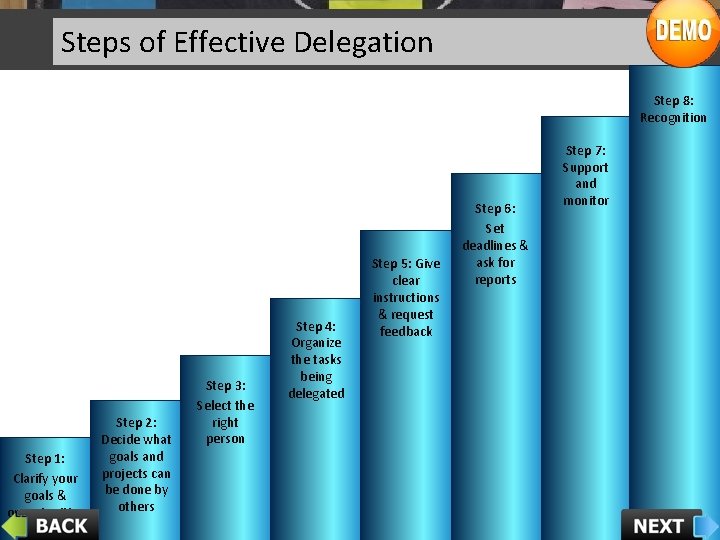
Steps of Effective Delegation Step 8: Recognition Step 1: Clarify your goals & opportunities Step 2: Decide what goals and projects can be done by others Step 3: Select the right person Step 4: Organize the tasks being delegated Step 5: Give clear instructions & request feedback Step 6: Set deadlines & ask for reports Step 7: Support and monitor
Levels of Delegation Level 8: "Decide and take action - let me know what you did (and what happened). " This level of delegation enables a degree of follow-up by the manager as to the effectiveness of the delegated responsibility, which is necessary when people are being managed from a greater distance, or more 'hands-off'.

Barriers to Delegation • Habitual: Many managers have the habit of not sharing their job and responsibility. They resent delegation as they feel that only they are responsible for their task and no one else could perform their job.

Management. Study. Guide. com Learn Management the Easy Way with the Help of Downloadable Powerpoint Presentations - Learn at Your Own Pace. This is a DEMO Course On – Delegation Skills. The Complete Course Consists of 130 Slides. Click here to Register Now & Download Complete Presentation on delegation Skills and 7 More Topics with more than 1, 000 Slides – Absolutely FREE. 100 Courses Added So far with more than 15, 000 Slides + New Courses Added Every Week. – Click here to Go to All Courses
- Slides: 18