
DELEGATION by Beverly Travis MSN MBA RN Defining

DELEGATION by Beverly Travis, MSN, MBA, RN

Defining Delegation Definition: § The transfer of responsibility for the performance of a task from one individual to another while retaining accountability for the outcome. (American Nurses Association, 2005) § “Transferring to a competent individual authority to perform a selected nursing task in a selected situation. The nurse retains accountability for the delegation. ” (National Council of State Boards of Nursing, 2005)

Responsibility The obligation involved when one accepts a task. Responsibility is retained and transferred

Accountability Definition: Accepting ownership for the results of what was delegated. Identifies who is answerable for what has been done. Accountability is shared.

Authority The right to act or to command the action of others (Kelly-Heidenthal & Marthaler, 2005, p. 9) The right to instruct others to carry out orders and the possession of power to expect compliance. Authority is transferred

Assignment Definition: The distribution of work that each staff member is responsible for during a given shift or work period. (ANA and NCSBN 2006) Authority is not transferred with an assignment.

Components of Delegation Delegator: the person delegating the task Delegatee: the person to whom the activity is delegated The task or activity to be accomplished

The Delegation Process Define the task Decide on the delegatee Determine the task Reach an agreement Monitor performance and provide feedback

Guidelines for Consistent and Effective Delegation Positive attitude Clarification of availability Consider how directions will be given during delegation Provide clear direction Be fair about undesirable activities Indicate priorities Give and receive feedback

Accepting Delegation Examine whether you have the skills and abilities for the task, or the time required to do it. If not, ask if the person is willing to train and equip you for the task. Accepting the task means you accept full responsibility for the outcome Don’t assume anything. Clarify time frame and other expectations. Repeat to the delegator what you heard and outline the task in writing. Provide constant feedback. Complete the task as agreed

Benefits of Delegation Benefits to the Delegator Benefits to the Delegatee Able to devote more time to those tasks that cannot be delegated Provides time to develop new skills and abilities for manager and subordinates Provides for career advancement Facilitates upward mobility Builds self esteem and confidence Enhances job satisfaction and motivation Improves morale Benefits to the Organization Achieves goals more efficiently Productivity improves Quality of care and patient satisfaction improve Financial position improves

Ineffective Delegation Under delegation Occurs when The delegator fails to transfer full authority to the delegate The delegator takes back responsibility for aspects of the task The delegator fails to equip and direct the delegate Reverse delegation A team member with a lower rank delegates to someone with more authority Over delegation The delegator becomes overwhelmed and loses control by delegating too much authority or responsibility to a delegate

The Five Rights of Delegation The Right task Under To the Right circumstances the Right person With the Right direction and communication Under the Right supervision and Evaluation

Do’s and Don’ts of Delegation Do’s Encourage delegatee to make own decisions Move from hands-on to hands-off Intervene when absolutely necessary Ask if delegatee feels prepared for the task Don’ts Say or hint that you doubt the ability Miss any stage in the briefing process Surreptitiously take back a task Place seniority above ability Interfere too much causing a lack of learning
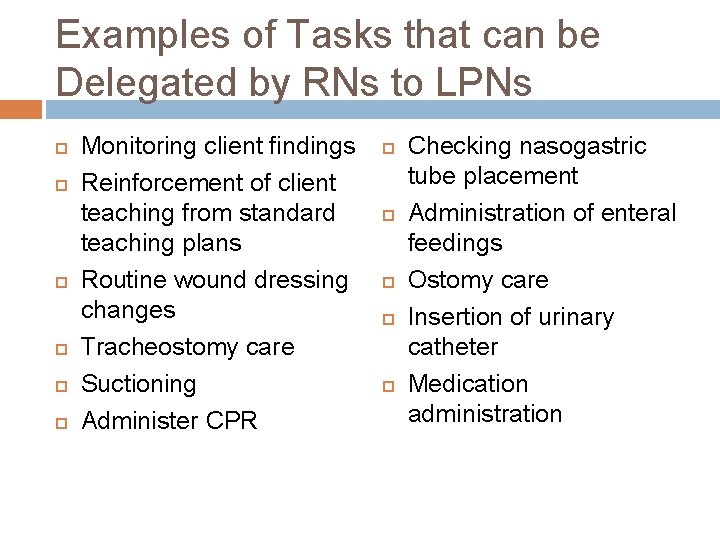
Examples of Tasks that can be Delegated by RNs to LPNs Monitoring client findings Reinforcement of client teaching from standard teaching plans Routine wound dressing changes Tracheostomy care Suctioning Administer CPR Checking nasogastric tube placement Administration of enteral feedings Ostomy care Insertion of urinary catheter Medication administration
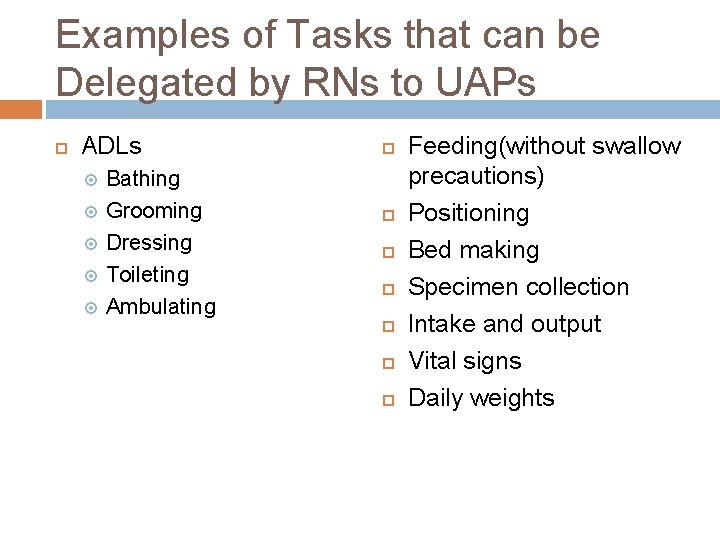
Examples of Tasks that can be Delegated by RNs to UAPs ADLs Bathing Grooming Dressing Toileting Ambulating Feeding(without swallow precautions) Positioning Bed making Specimen collection Intake and output Vital signs Daily weights
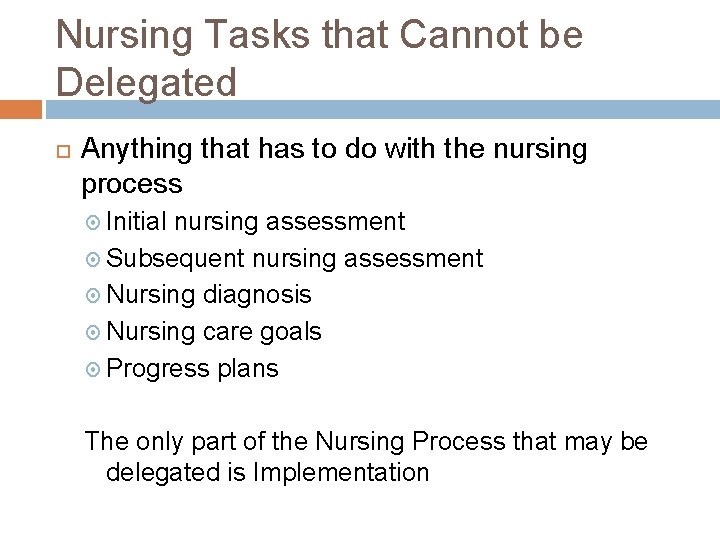
Nursing Tasks that Cannot be Delegated Anything that has to do with the nursing process Initial nursing assessment Subsequent nursing assessment Nursing diagnosis Nursing care goals Progress plans The only part of the Nursing Process that may be delegated is Implementation

Tools for Delegating Successfully Delegate only tasks for which you have responsibility Transfer authority when you delegate responsibility Be sure you follow state regulations, job descriptions, and agency policies when delegating Follow the delegation process and key behaviors for delegating Accept delegation when you are clear about the task, time frame, reporting, and other expectations Confront your fears about delegation; recognize those that are realistic and those that are not
- Slides: 18