
Deirdre Shoemaker Cornell University Numerical Relativity The role

- Slides: 13
Deirdre Shoemaker Cornell University Numerical Relativity § The role of numerical relativity in gravitational-wave astrophysics § Status of Binary Black Hole (BBH) simulations § In the absence of a complete solution to the BBH problem, what can we do today? – Introduce approximations • Sequences of quasi-circular orbits • Lazarus approach to BBH mergers – Extract info from single BH evolutions • The spectrum of highly distorted black-holes § Open Questions 07 Nov 2003 Gravitational Wave Phenomenology Workshop 1
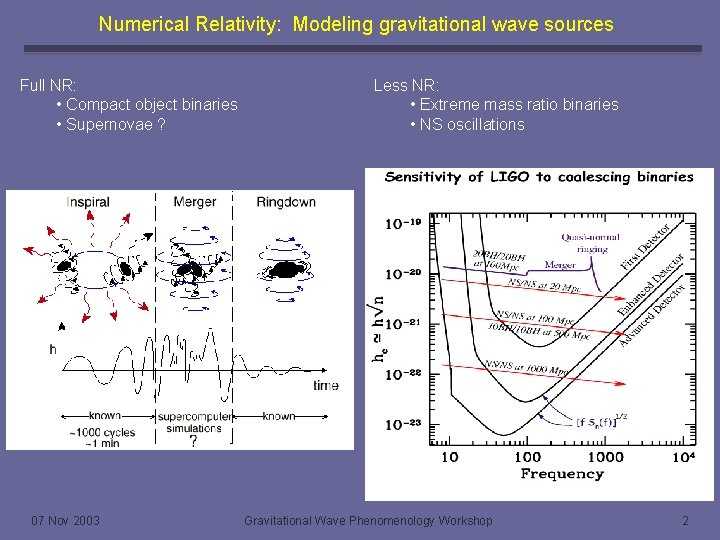
Numerical Relativity: Modeling gravitational wave sources Full NR: • Compact object binaries • Supernovae ? 07 Nov 2003 Less NR: • Extreme mass ratio binaries • NS oscillations Gravitational Wave Phenomenology Workshop 2
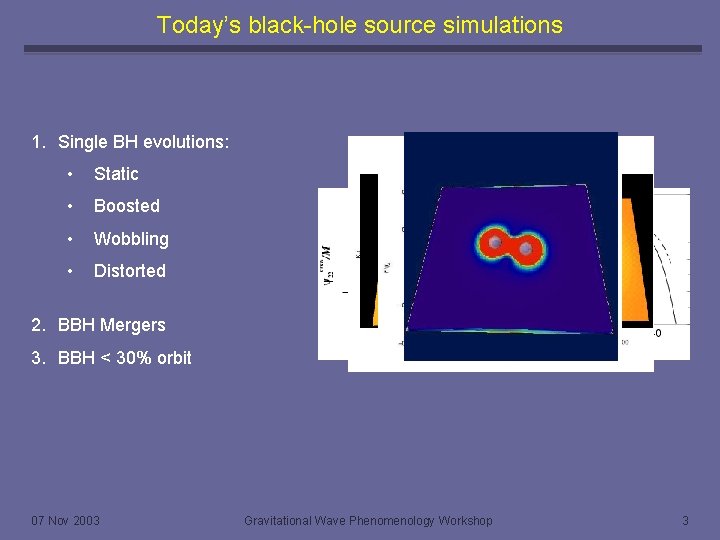
Today’s black-hole source simulations 1. Single BH evolutions: • Static • Boosted • Wobbling • Distorted 2. BBH Mergers 3. BBH < 30% orbit 07 Nov 2003 Gravitational Wave Phenomenology Workshop 3
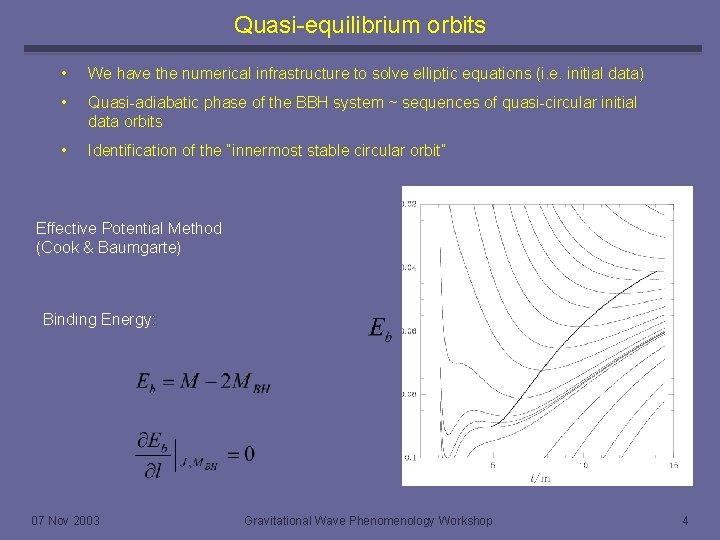
Quasi-equilibrium orbits • We have the numerical infrastructure to solve elliptic equations (i. e. initial data) • Quasi-adiabatic phase of the BBH system ~ sequences of quasi-circular initial data orbits • Identification of the “innermost stable circular orbit” Effective Potential Method (Cook & Baumgarte) Binding Energy: 07 Nov 2003 Gravitational Wave Phenomenology Workshop 4
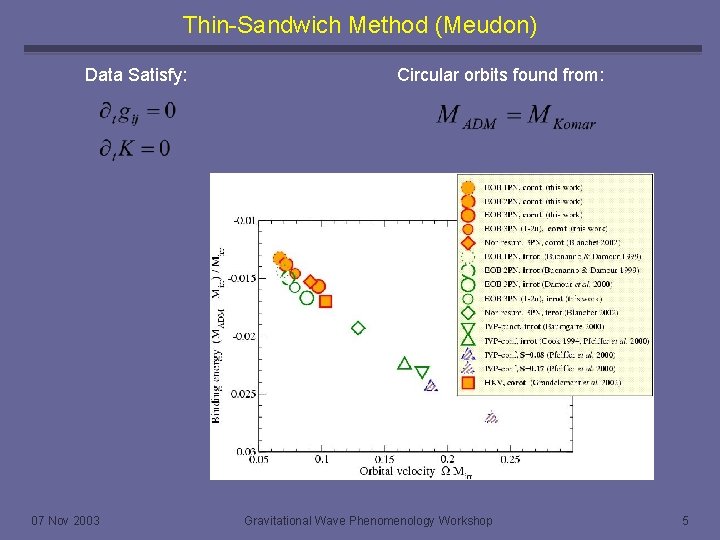
Thin-Sandwich Method (Meudon) Data Satisfy: 07 Nov 2003 Circular orbits found from: Gravitational Wave Phenomenology Workshop 5
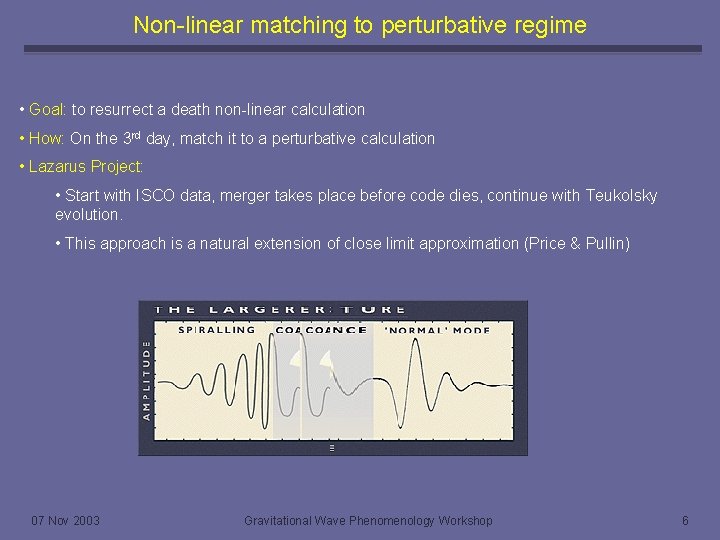
Non-linear matching to perturbative regime • Goal: to resurrect a death non-linear calculation • How: On the 3 rd day, match it to a perturbative calculation • Lazarus Project: • Start with ISCO data, merger takes place before code dies, continue with Teukolsky evolution. • This approach is a natural extension of close limit approximation (Price & Pullin) 07 Nov 2003 Gravitational Wave Phenomenology Workshop 6
07 Nov 2003 Gravitational Wave Phenomenology Workshop 7
07 Nov 2003 Gravitational Wave Phenomenology Workshop 8
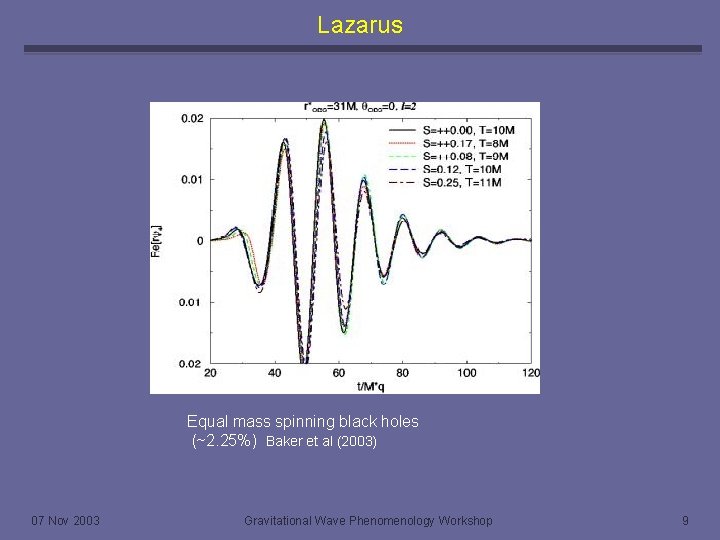
Lazarus Equal mass spinning black holes (~2. 25%) Baker et al (2003) 07 Nov 2003 Gravitational Wave Phenomenology Workshop 9
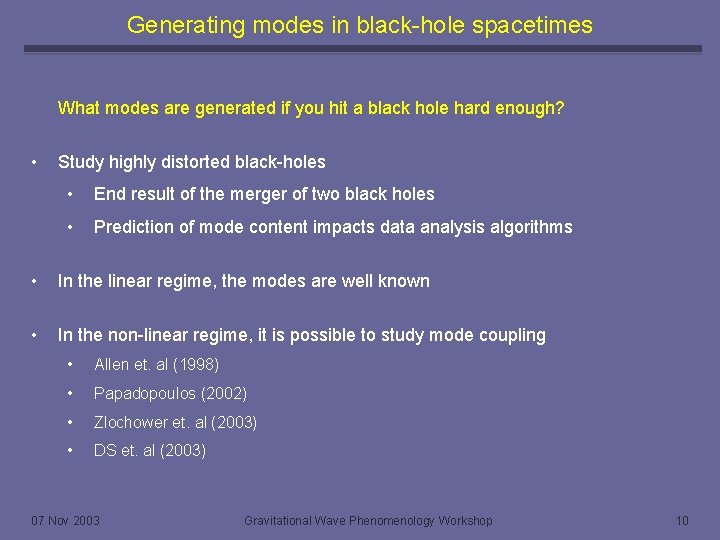
Generating modes in black-hole spacetimes What modes are generated if you hit a black hole hard enough? • Study highly distorted black-holes • End result of the merger of two black holes • Prediction of mode content impacts data analysis algorithms • In the linear regime, the modes are well known • In the non-linear regime, it is possible to study mode coupling • Allen et. al (1998) • Papadopoulos (2002) • Zlochower et. al (2003) • DS et. al (2003) 07 Nov 2003 Gravitational Wave Phenomenology Workshop 10
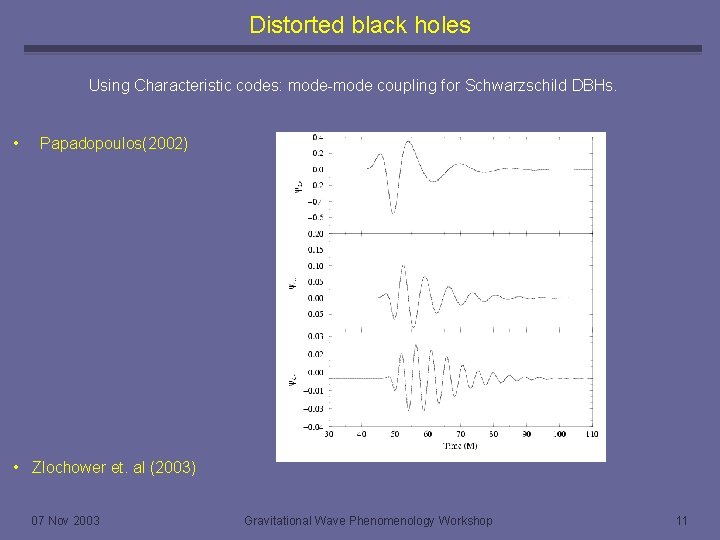
Distorted black holes Using Characteristic codes: mode-mode coupling for Schwarzschild DBHs. • Papadopoulos(2002) • Zlochower et. al (2003) 07 Nov 2003 Gravitational Wave Phenomenology Workshop 11
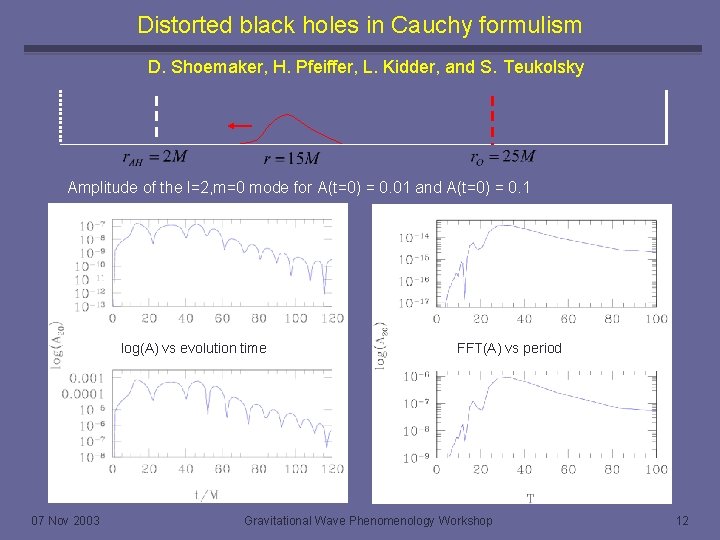
Distorted black holes in Cauchy formulism D. Shoemaker, H. Pfeiffer, L. Kidder, and S. Teukolsky Amplitude of the l=2, m=0 mode for A(t=0) = 0. 01 and A(t=0) = 0. 1 log(A) vs evolution time 07 Nov 2003 FFT(A) vs period Gravitational Wave Phenomenology Workshop 12
Numerical Relativity • We need more approaches that involve approximations. • Lower dimension calculations (i. e. axisymmetry) • Impact of numerical accuracy on data analysis tools. • More astrophysical input in initial data • And of course the usual 07 Nov 2003 Gravitational Wave Phenomenology Workshop 13