
Degree of Unsaturation How to determine the number

Degree of Unsaturation How to determine the number of rings and multiple bonds in a compound from its molecular formula
No hydrocarbon can contain a greater number of hydrogens than fits the formula Cn. H 2 n+2 The number of hydrogens is always even. All such compounds are acyclic
They may be straight (normal) chains as in n-butane (C 4 H 10) CH 3 CH 2 CH 3 or CH 3 CH(CH 3)CH 3 they may be branched as in isobutane (C 4 H 10)

If two hydrogen atoms on non-adjacent carbons of n-butane (C 4 H 10) are removed then a ring, cyclobutane (C 4 H 8), is formed with the loss of H 2 This process is not necessarily a chemical reaction but rather a conceptual device.
If two hydrogen atoms on adjacent carbons of n-butane (C 4 H 10) are removed then a double bond is formed with the loss of H 2. In this case, the alkene, 1 -butene (C 4 H 8), is formed.
A compound with the molecular formula C 4 H 8 is either an alkene (olefin) or cycloalkane. How to determine the Degree of Unsaturation (DU) of this compound? C 4 H 10 - C 4 H 8 = H 2 divided by 2 = 1 DU most saturated C 4 compound
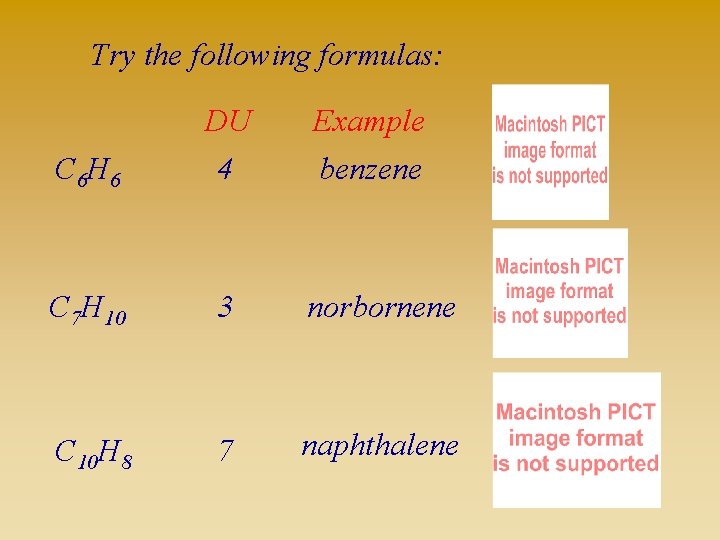
Try the following formulas: C 6 H 6 DU 4 Example benzene C 7 H 10 3 norbornene C 10 H 8 7 naphthalene

How is the Degree of Unsaturation of a hydrocarbon containing halogen, or other monovalent atom, determined? Every halogen in a hydrocarbon replaces a hydrogen.
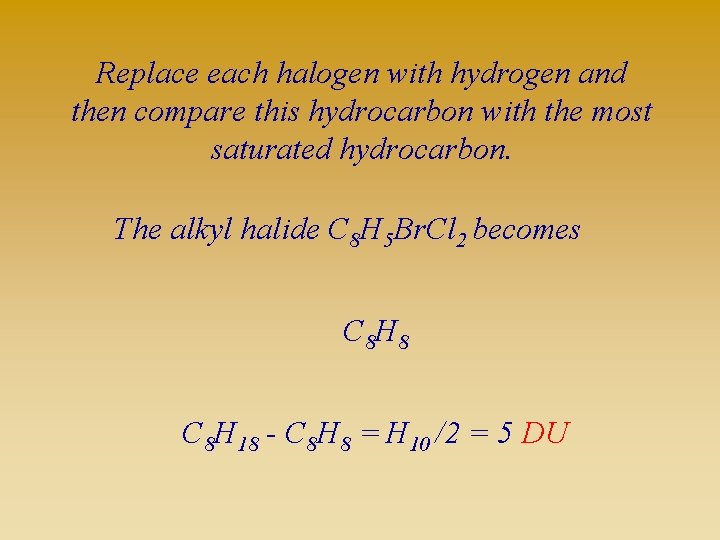
Replace each halogen with hydrogen and then compare this hydrocarbon with the most saturated hydrocarbon. The alkyl halide C 8 H 5 Br. Cl 2 becomes C 8 H 8 C 8 H 18 - C 8 H 8 = H 10 /2 = 5 DU
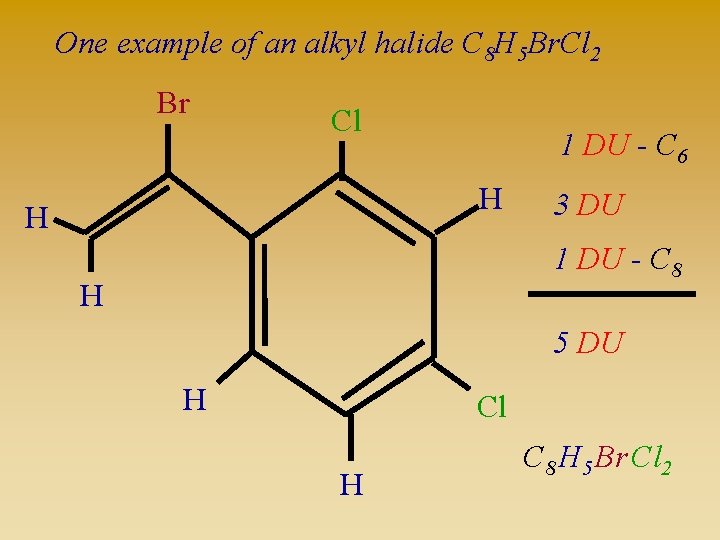
One example of an alkyl halide C 8 H 5 Br. Cl 2 Br Cl 1 DU - C 6 H H 3 DU 1 DU - C 8 H 5 DU H Cl H C 8 H 5 Br Cl 2
How is the Degree of Unsaturation of a hydrocarbon containing oxygen, or other divalent atom, determined?
Ignore divalent atoms! C 4 H 8 O C 4 H 8 1 DU
2, 4 -Dichlorophenoxyacetic acid carbonyl - 1 DU benzene ring - 4 DU
2, 4 -Dichlorophenoxyacetic acid C 8 H 6 Cl 2 O 3 C 8 H 6 Cl 2 (drop O 3) C 8 H 8 (- Cl 2 + H 2) C 8 H 18 - C 8 H 8 = H 10 / 2 = 5 DU
How is the Degree of Unsaturation of a hydrocarbon containing nitrogen, or other trivalent atom, determined? Substitute CH for every N.
(- N + CH) pyridine benzene C 5 H 5 N C 6 H 6 C 6 H 14 - C 6 H 6 = H 8 / 2 = 4 DU
Cocaine - C 17 H 21 NO 4 C 17 H 21 N C 18 H 22 C 18 H 38 - C 18 H 22 = H 16 / 2 = 8 DU 1 DU (5 -membered ring) 1 DU (6 -membered ring) 4 DU 1 DU
Degree of Unsaturation The End F. E. Ziegler 2003
- Slides: 18