
Degree of Monopoly Power Measurement of Monopoly Power
- Slides: 4
Degree of Monopoly Power Measurement of Monopoly Power • The difference between marginal cost and price: he greater the difference between the two, the larger is the monopoly power. • The difference between monopoly super-normal profits The greater the difference between the two, the larger is the degree of monopoly.
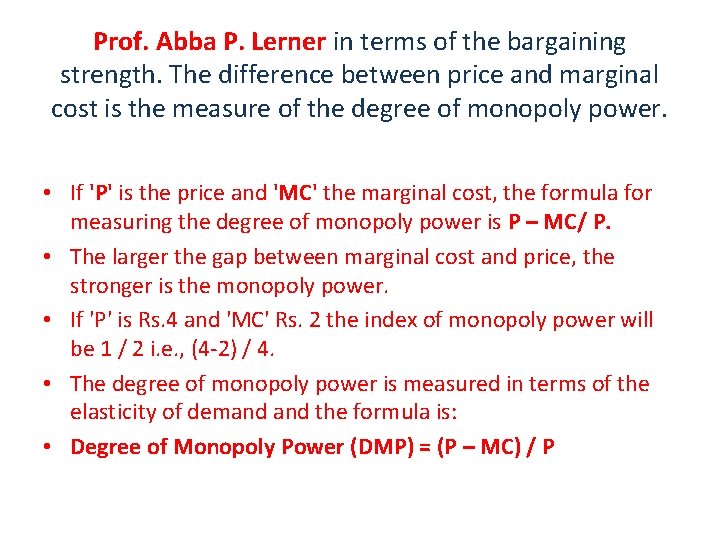
Prof. Abba P. Lerner in terms of the bargaining strength. The difference between price and marginal cost is the measure of the degree of monopoly power. • If 'P' is the price and 'MC' the marginal cost, the formula for measuring the degree of monopoly power is P – MC/ P. • The larger the gap between marginal cost and price, the stronger is the monopoly power. • If 'P' is Rs. 4 and 'MC' Rs. 2 the index of monopoly power will be 1 / 2 i. e. , (4 -2) / 4. • The degree of monopoly power is measured in terms of the elasticity of demand the formula is: • Degree of Monopoly Power (DMP) = (P – MC) / P
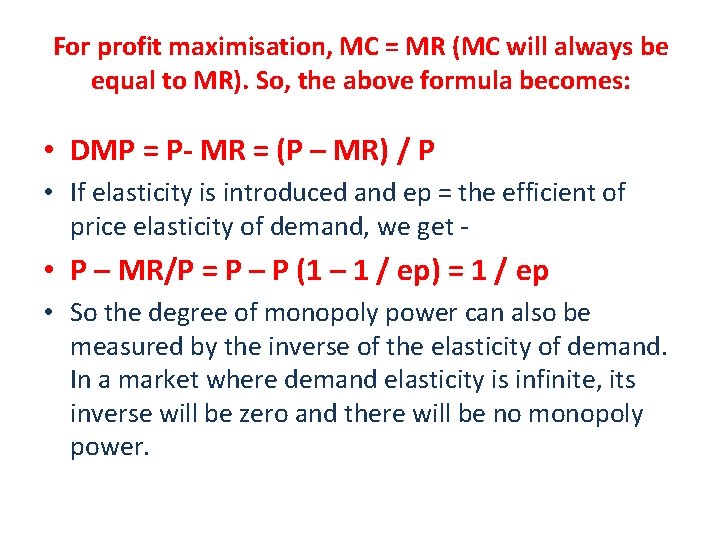
For profit maximisation, MC = MR (MC will always be equal to MR). So, the above formula becomes: • DMP = P- MR = (P – MR) / P • If elasticity is introduced and ep = the efficient of price elasticity of demand, we get - • P – MR/P = P – P (1 – 1 / ep) = 1 / ep • So the degree of monopoly power can also be measured by the inverse of the elasticity of demand. In a market where demand elasticity is infinite, its inverse will be zero and there will be no monopoly power.
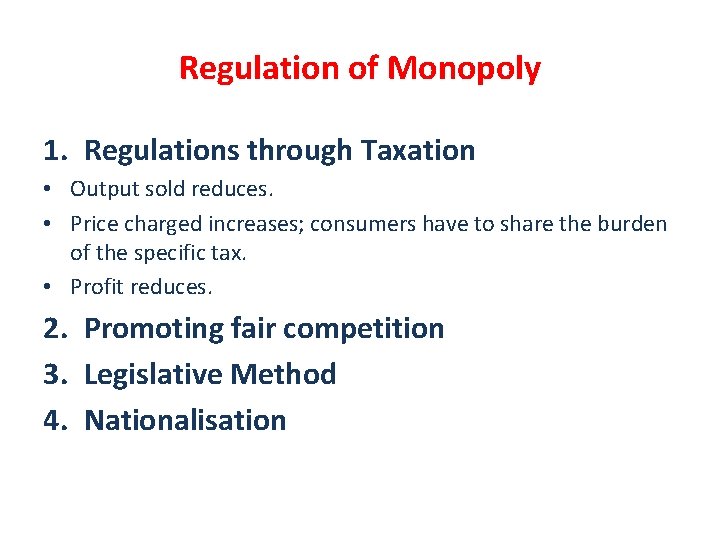
Regulation of Monopoly 1. Regulations through Taxation • Output sold reduces. • Price charged increases; consumers have to share the burden of the specific tax. • Profit reduces. 2. Promoting fair competition 3. Legislative Method 4. Nationalisation