
Degree of Collaboration Abacus Visualization Tool Representing Community
Degree of Collaboration Abacus: Visualization Tool Representing Community Partner Voice Diane M. Doberneck, Ph. D. Asst. Director, University Outreach and Engagement, Michigan State University Shari L. Dann, Ph. D. Asc. Professor, Dept. of Community Sustainability, Michigan State University Engagement Scholarship Consortium Conference Omaha, Nebraska October 16, 2016
Co-develop participate collaborate involve Co-create engage
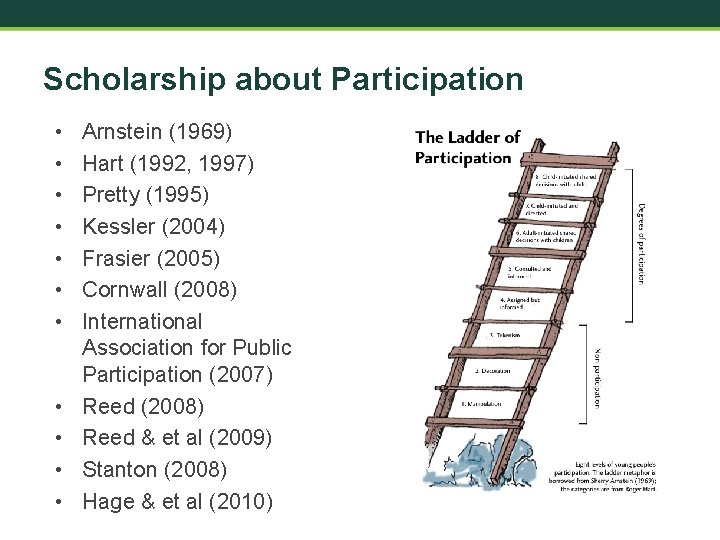
Scholarship about Participation • • • Arnstein (1969) Hart (1992, 1997) Pretty (1995) Kessler (2004) Frasier (2005) Cornwall (2008) International Association for Public Participation (2007) Reed (2008) Reed & et al (2009) Stanton (2008) Hage & et al (2010)
Community Partner Choice About Voice The goal is to make sure your community partner is invited to make choices about being as engaged as possible where it strategically counts the most—including the choice not to be involved in certain steps of the process.
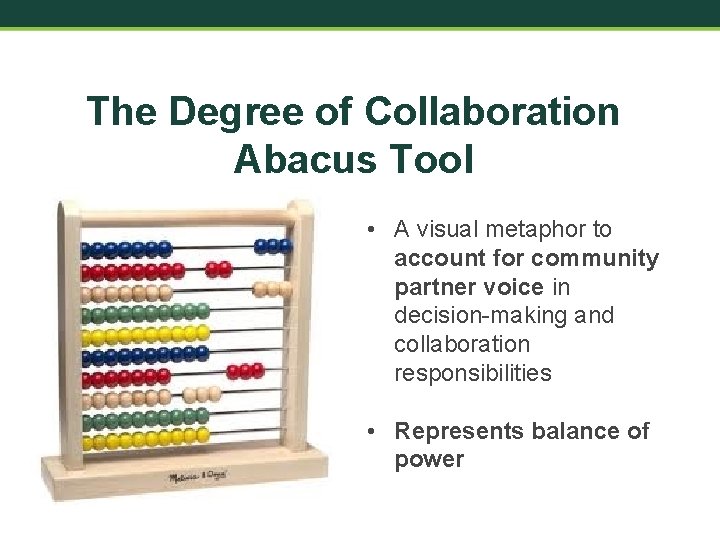
The Degree of Collaboration Abacus Tool • A visual metaphor to account for community partner voice in decision-making and collaboration responsibilities • Represents balance of power
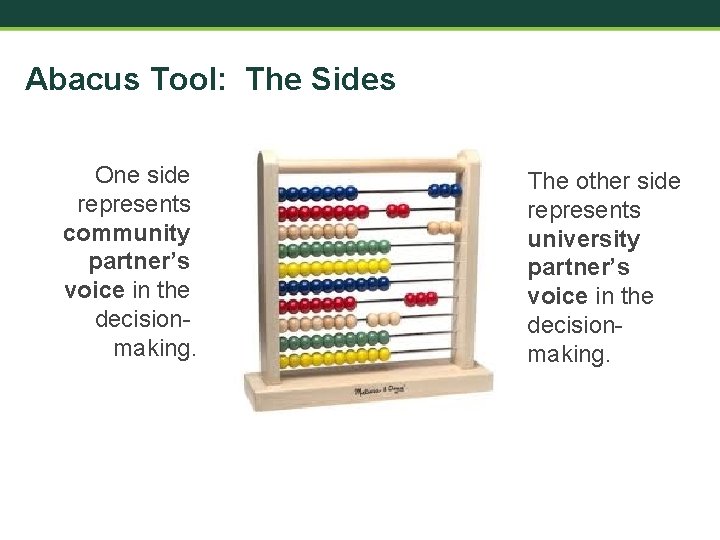
Abacus Tool: The Sides One side represents community partner’s voice in the decisionmaking. The other side represents university partner’s voice in the decisionmaking.
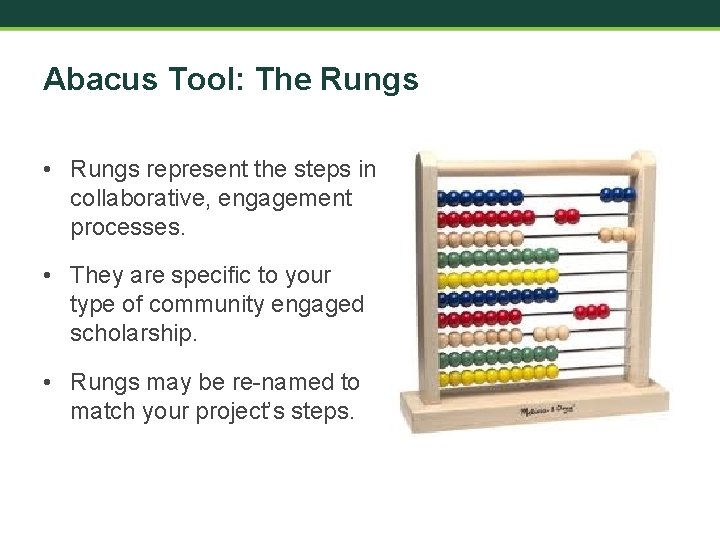
Abacus Tool: The Rungs • Rungs represent the steps in collaborative, engagement processes. • They are specific to your type of community engaged scholarship. • Rungs may be re-named to match your project’s steps.
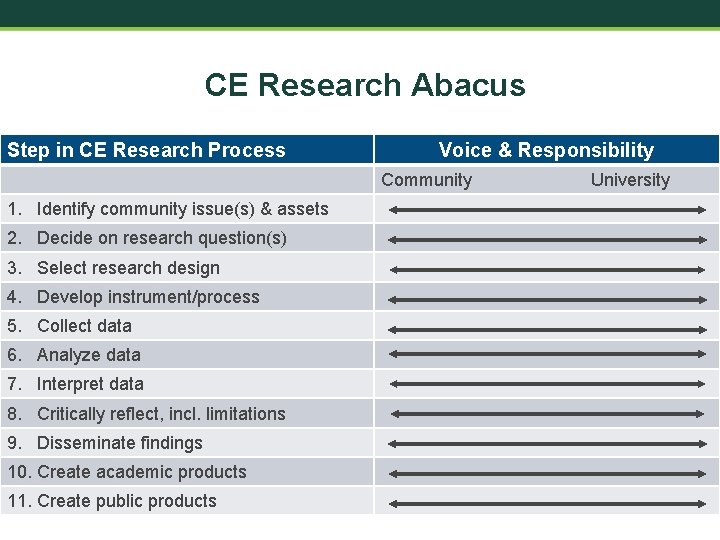
CE Research Abacus Step in CE Research Process Voice & Responsibility Community 1. Identify community issue(s) & assets 2. Decide on research question(s) 3. Select research design 4. Develop instrument/process 5. Collect data 6. Analyze data 7. Interpret data 8. Critically reflect, incl. limitations 9. Disseminate findings 10. Create academic products 11. Create public products University
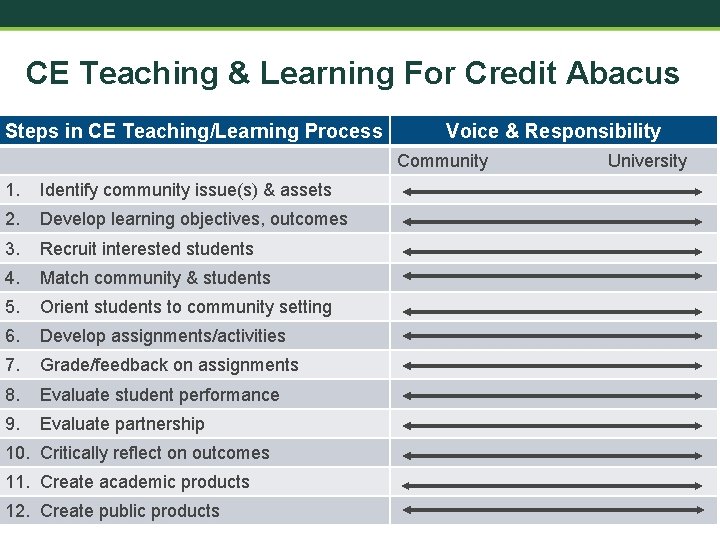
CE Teaching & Learning For Credit Abacus Steps in CE Teaching/Learning Process Voice & Responsibility Community 1. Identify community issue(s) & assets 2. Develop learning objectives, outcomes 3. Recruit interested students 4. Match community & students 5. Orient students to community setting 6. Develop assignments/activities 7. Grade/feedback on assignments 8. Evaluate student performance 9. Evaluate partnership 10. Critically reflect on outcomes 11. Create academic products 12. Create public products University
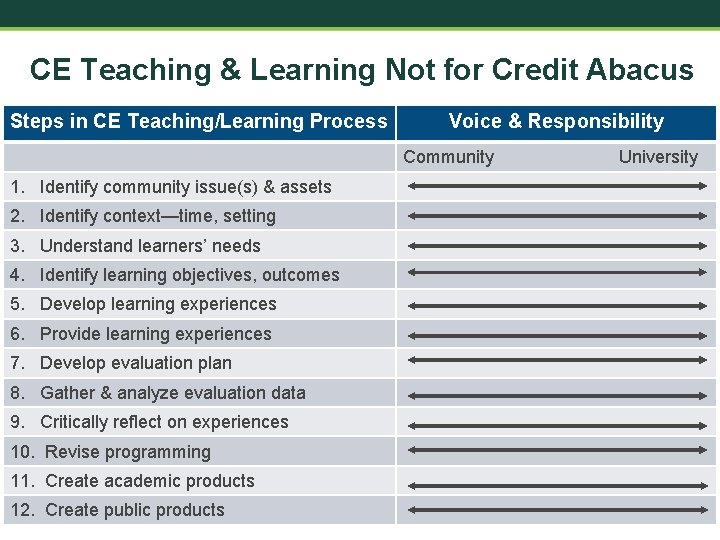
CE Teaching & Learning Not for Credit Abacus Steps in CE Teaching/Learning Process Voice & Responsibility Community 1. Identify community issue(s) & assets 2. Identify context—time, setting 3. Understand learners’ needs 4. Identify learning objectives, outcomes 5. Develop learning experiences 6. Provide learning experiences 7. Develop evaluation plan 8. Gather & analyze evaluation data 9. Critically reflect on experiences 10. Revise programming 11. Create academic products 12. Create public products University
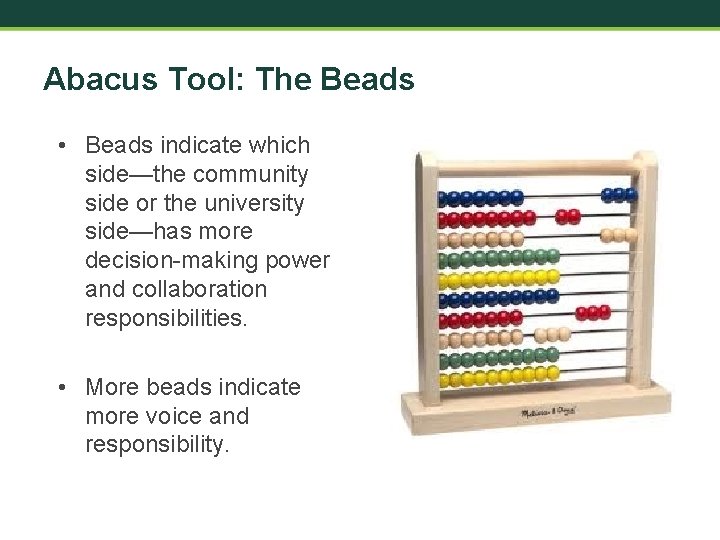
Abacus Tool: The Beads • Beads indicate which side—the community side or the university side—has more decision-making power and collaboration responsibilities. • More beads indicate more voice and responsibility.
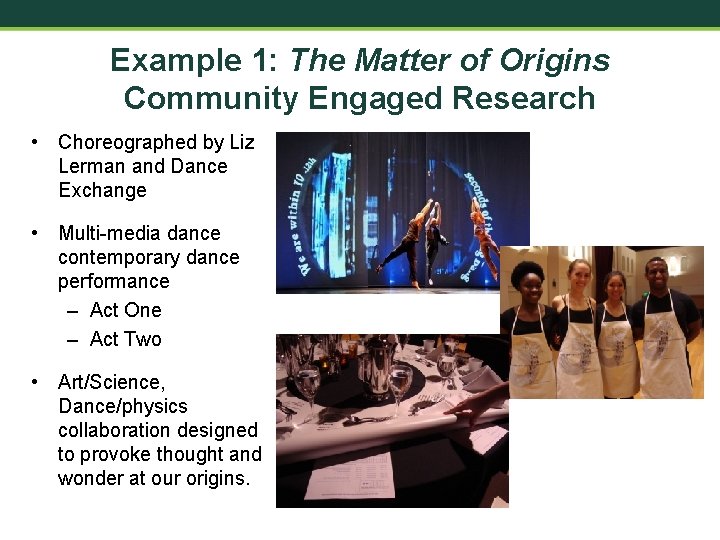
Example 1: The Matter of Origins Community Engaged Research • Choreographed by Liz Lerman and Dance Exchange • Multi-media dance contemporary dance performance – Act One – Act Two • Art/Science, Dance/physics collaboration designed to provoke thought and wonder at our origins.
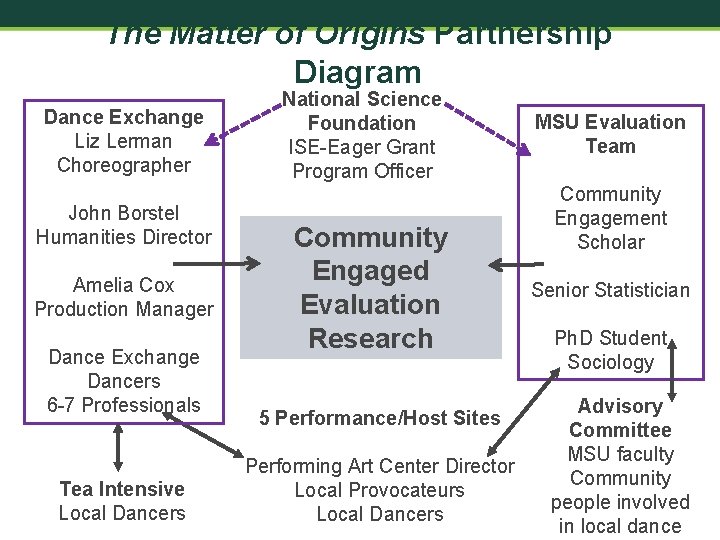
The Matter of Origins Partnership Diagram Dance Exchange Liz Lerman Choreographer John Borstel Humanities Director Amelia Cox Production Manager Dance Exchange Dancers 6 -7 Professionals Tea Intensive Local Dancers National Science Foundation ISE-Eager Grant Program Officer Community Engaged Evaluation Research 5 Performance/Host Sites Performing Art Center Director Local Provocateurs Local Dancers MSU Evaluation Team Community Engagement Scholar Senior Statistician Ph. D Student Sociology Advisory Committee MSU faculty Community people involved in local dance
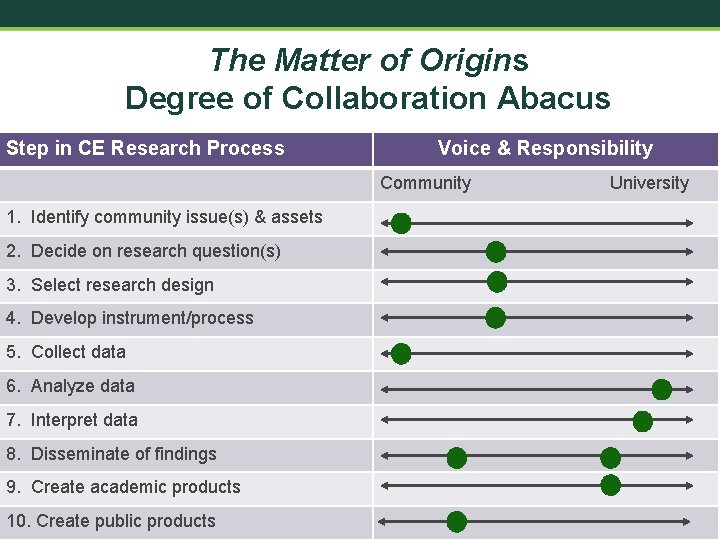
The Matter of Origins Degree of Collaboration Abacus Step in CE Research Process Voice & Responsibility Community 1. Identify community issue(s) & assets 2. Decide on research question(s) 3. Select research design 4. Develop instrument/process 5. Collect data 6. Analyze data 7. Interpret data 8. Disseminate of findings 9. Create academic products 10. Create public products University
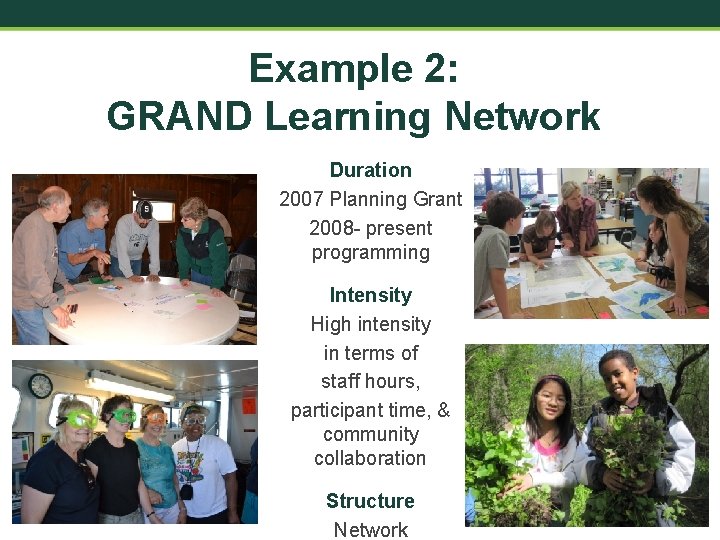
Example 2: GRAND Learning Network Duration 2007 Planning Grant 2008 - present programming Intensity High intensity in terms of staff hours, participant time, & community collaboration Structure Network
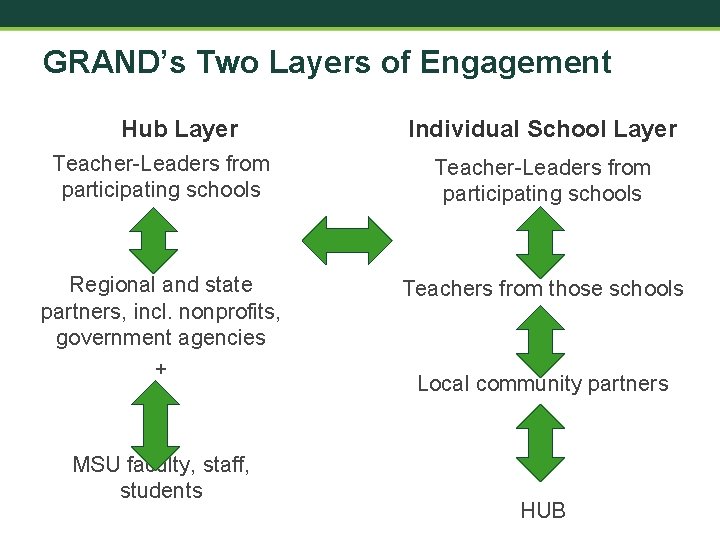
GRAND’s Two Layers of Engagement Hub Layer Individual School Layer Teacher-Leaders from participating schools + Regional and state partners, incl. nonprofits, government agencies + Teachers from those schools + MSU faculty, staff, students Local community partners + HUB
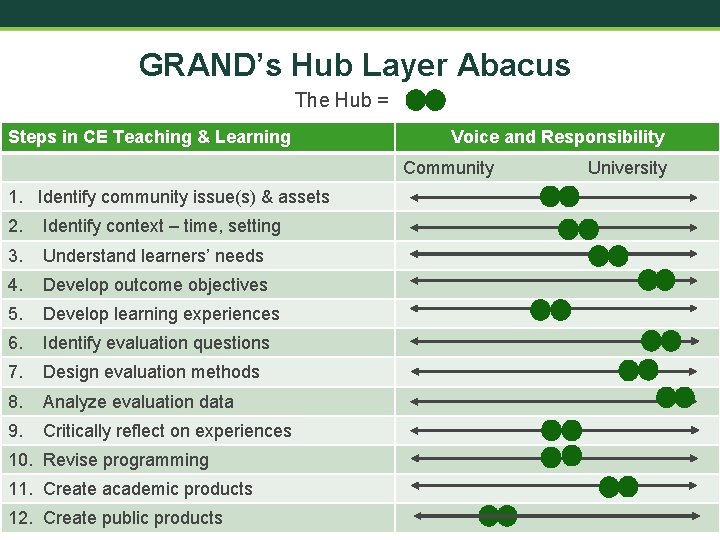
GRAND’s Hub Layer Abacus The Hub = Steps in CE Teaching & Learning Voice and Responsibility Community 1. Identify community issue(s) & assets 2. Identify context – time, setting 3. Understand learners’ needs 4. Develop outcome objectives 5. Develop learning experiences 6. Identify evaluation questions 7. Design evaluation methods 8. Analyze evaluation data 9. Critically reflect on experiences 10. Revise programming 11. Create academic products 12. Create public products University
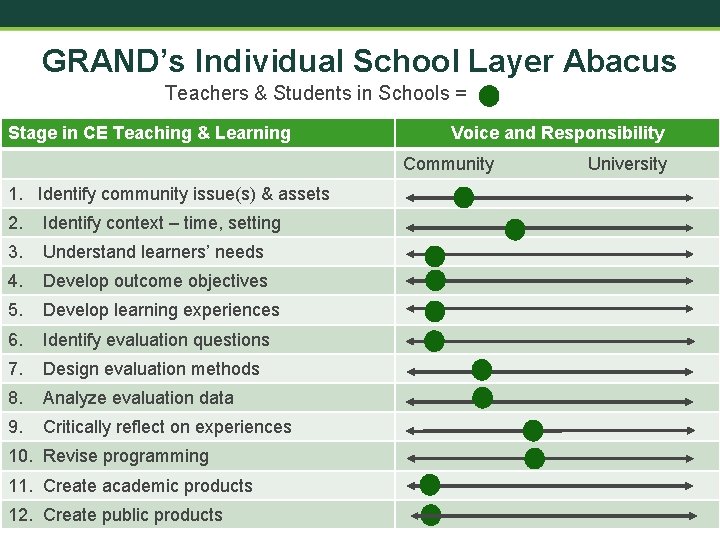
GRAND’s Individual School Layer Abacus Teachers & Students in Schools = Stage in CE Teaching & Learning Voice and Responsibility Community 1. Identify community issue(s) & assets 2. Identify context – time, setting 3. Understand learners’ needs 4. Develop outcome objectives 5. Develop learning experiences 6. Identify evaluation questions 7. Design evaluation methods 8. Analyze evaluation data 9. Critically reflect on experiences 10. Revise programming 11. Create academic products 12. Create public products University
When To Use The Abacus Tool • Initial discussions with (potential) partners—establish a basic understanding of what the steps are in the process. • Formalizing partnership agreements, including memoranda of understanding—to clarify who has decision-making power and collaboration responsibilities at each stage. • Grant-writing—to use as a visual to demonstrate proposed shared decision-making and collaboration responsibilities.
When to Use the Abacus Tool, continued • Reflective practice mid-way through a project—to clarify how the collaboration is going and ask/reflect on whether initial decision-making and responsibilities might need to be re-negotiated. • Project wrap up, final reflection and reporting—to depict how decision-making and collaboration responsibilities were actually divided (revisions may be needed). • Teaching/learning tool—to help undergraduate and graduate students understand various stages in process and visualize shared decision-making and collaboration responsibilities with the community partners.
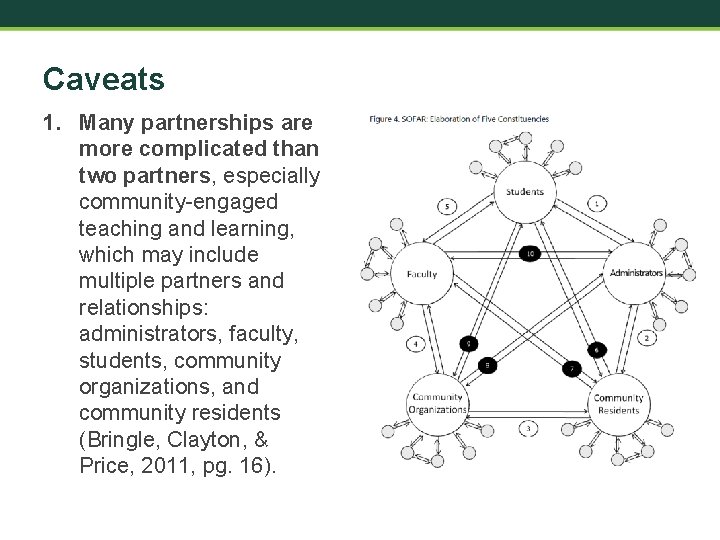
Caveats 1. Many partnerships are more complicated than two partners, especially community-engaged teaching and learning, which may include multiple partners and relationships: administrators, faculty, students, community organizations, and community residents (Bringle, Clayton, & Price, 2011, pg. 16).
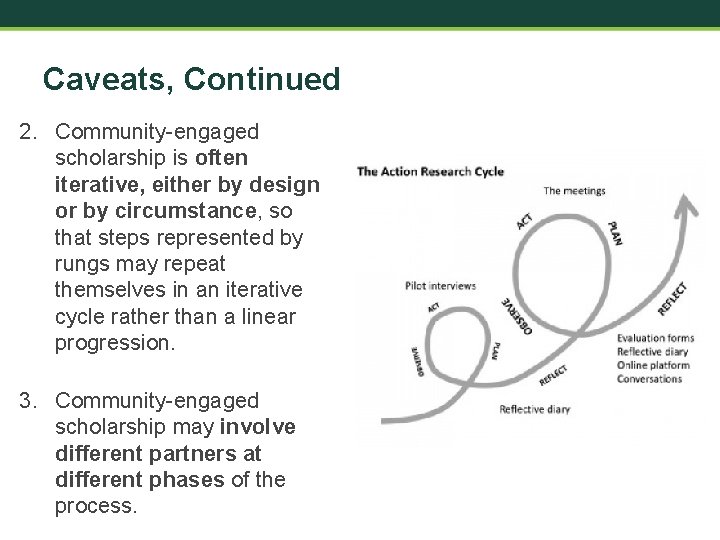
Caveats, Continued 2. Community-engaged scholarship is often iterative, either by design or by circumstance, so that steps represented by rungs may repeat themselves in an iterative cycle rather than a linear progression. 3. Community-engaged scholarship may involve different partners at different phases of the process.
Invitation You are invited to adapt the Degree of Collaboration Abacus Tool to reflect your community engagement partners and context. Be creative in making modifications that reflect your lived experience of sharing decision-making and collaboration responsibilities with your community partner(s). Let us know what your abacus looks like!
Acknowledgements We would like to thank Timothy K. Stanton, author of the 2008 New Times Demand New Scholarship: Opportunities and Challenges for Engagement at Research Universities, journal article and The Research University Community Engagement Network (TRUCEN) publication, for sparking our imagination with Figure 2: Degree of Collaboration in Research Processes (pg. 26). With his permission, we have re-imagined his figure into the Abacus Tool and extended it beyond community-engaged research to address multiple forms of community-engaged scholarship, including community -engaged teaching and learning, community-engaged service and practice, and community-engaged commercialized activities.
References Arnstein, S. (1969, July) A ladder of citizen participation. AIP Journal 26, 216– 214. Bringle, R. G. , Clayton, P. H. , & Price, M. F. (2009). Partnerships in Service Learning and Civic Engagement. Partnerships: A Journal of Service Learning and Civic Engagement 1(1), 1 -20. Cornwall, A. (2008). Unpacking “participation”: Models, meanings, and practices. Community Development Journal 43(3), 269 -283. Doberneck, D. M. , Glass, C. R. , & Schweitzer, J. H. (2012). Beyond activity, partner, and place: How publicly engaged scholarship varies by intensity of activity and degree of engagement. Journal of Community Engaged Scholarship 4(2), 18 -26. Fraser, F. (2005). Four different approaches to community participation. Community Development Journal 40, 286 -300.
References, Continued Hage, M. , Leroy, P. , & Petersen, A. C. (2009). Stakeholder participation in environmental knowledge production. Futures 42, 254 -264. Hart, R. A. (1997). Children’s Participation: Theory and Practices of Involving Young Citizens in Community Development and Environmental Care. London, UK: Earthscan. International Association for Public Participation. (2007). IAP 2’s Spectrum of public participation. Retrieved from: http: //c. ymcdn. com/sites/www. iap 2. org/resource/resmgr/imported/IAP 2% 20 Spectrum_vertical. pdf. Kessler, B. L. (2004). Stakeholder participation: A synthesis of current literature. Silver Spring, MD: National Marine Protected Areas Center, National Oceanic and Atmospheric Administration. Retrieved from: http: //marineprotectedareas. noaa. gov/pdf/publications/Stakeholder_Synt hesis. pdf.
References, Continued Pretty, J. (1995) Participatory learning for sustainable agriculture. World Development 23(8), 1247– 1263. Reed, M. S. (2008). Stakeholder participation for environmental management: A literature review. Biological Conservation 141, 24172431. Reed, M. S. , Graves, A. , Dandy, N. , Posthumus, H. , Hubacek, K. , Morris, J. , Prell, C. , Quinn, C. H. , & Stringer, L. (2009). Who’s in and why? A typology of stakeholder analysis methods for natural resource management. Journal of Environmental Management 90, 1933 -1949. Sandmann, L. R. (2006). Scholarship as architecture: Framing and enhancing community engagement. Journal of Physical Therapy 20(3), 80 -88. Stanton, T. K. (2008). New times demand new scholarship: Opportunities and challenges for engagement at research universities. Education, Citizenship, and Social Justice 3(1), 19 -24.
Contact Information Diane M. Doberneck, Ph. D. , connordm@msu. edu Shari L. Dann, Ph. D. , sldann@msu. edu University Outreach and Engagement Michigan State University Kellogg Hotel and Conference Center 219 S. Harrison Road, Suite 93 East Lansing, MI 48824 Phone: 517 -353 -8977 Fax: 517 -432 -9541 E-mail: outreach@msu. edu Web: outreach. msu. edu © Michigan State University Board of Trustees
- Slides: 28