
DEGENERATIVE SCOLIOSIS AND PHYSICAL THERAPY Amanda Hong Lauren
- Slides: 22
DEGENERATIVE SCOLIOSIS AND PHYSICAL THERAPY Amanda Hong Lauren Davidson
Introduction Amanda Hong Major: Nutrition Career Goal: Registered Dietitian Lauren Davidson Major: Health Psychology Career Goal: Public Health Educator Objective: how to prevent degenerative scoliosis through exercising and proper nutrition
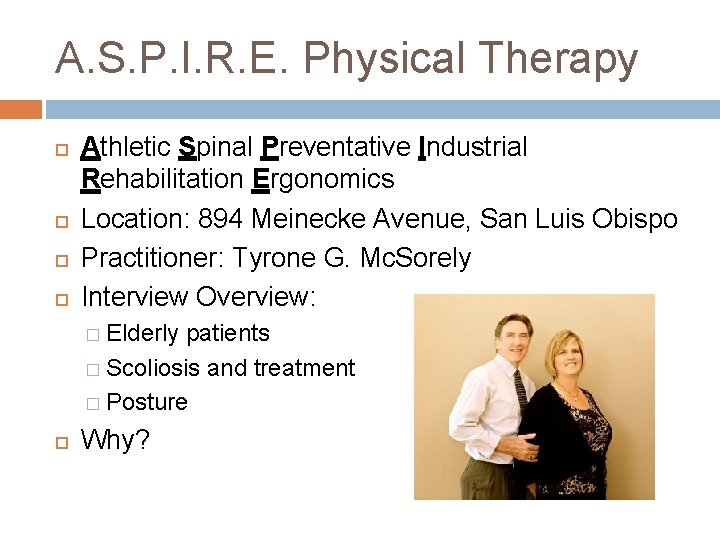
A. S. P. I. R. E. Physical Therapy Athletic Spinal Preventative Industrial Rehabilitation Ergonomics Location: 894 Meinecke Avenue, San Luis Obispo Practitioner: Tyrone G. Mc. Sorely Interview Overview: � Elderly patients � Scoliosis and treatment � Posture Why?
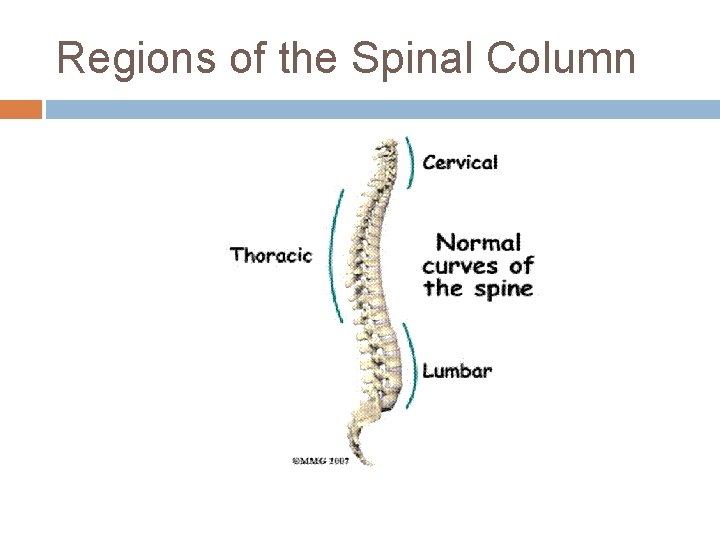
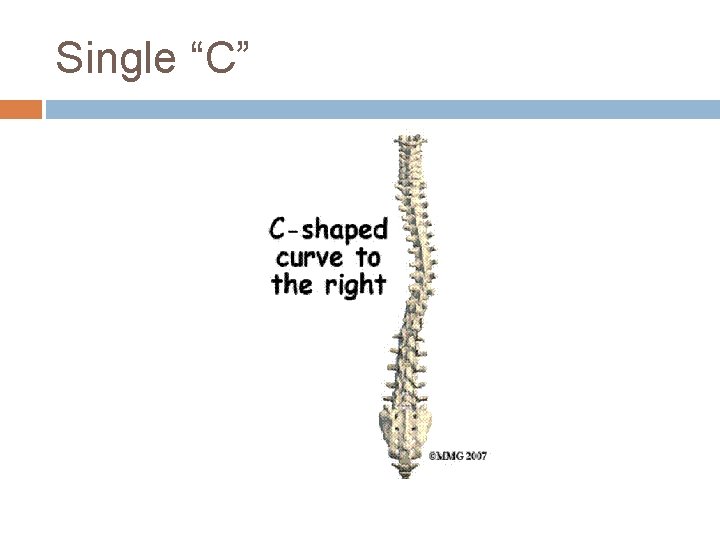
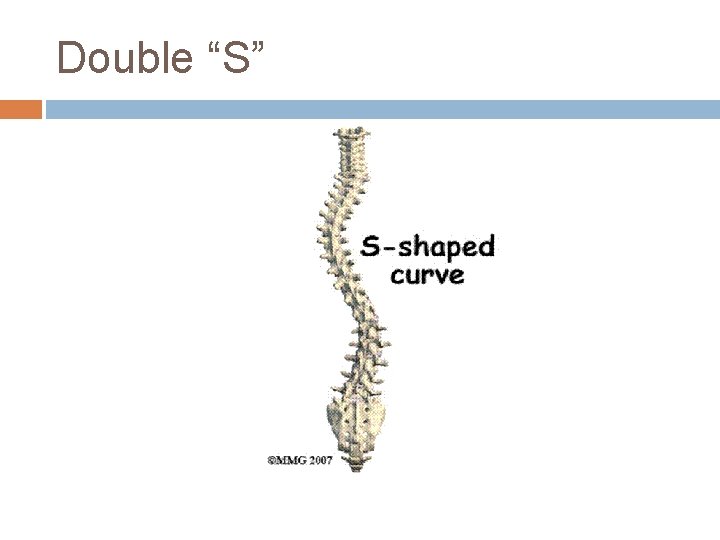
Scoliosis An abnormal, side-to-side, curvature (single “C” or double “S”) of the spine 4 Main Types: � Idiopathic � Congenital � Neuromuscular � Degenerative Prevalence: � Idiopathic is in 2% of population � More prevalent in girls than boys � Girls are 8 X more likely than boys to need treatment
Regions of the Spinal Column
Single “C”
Double “S”
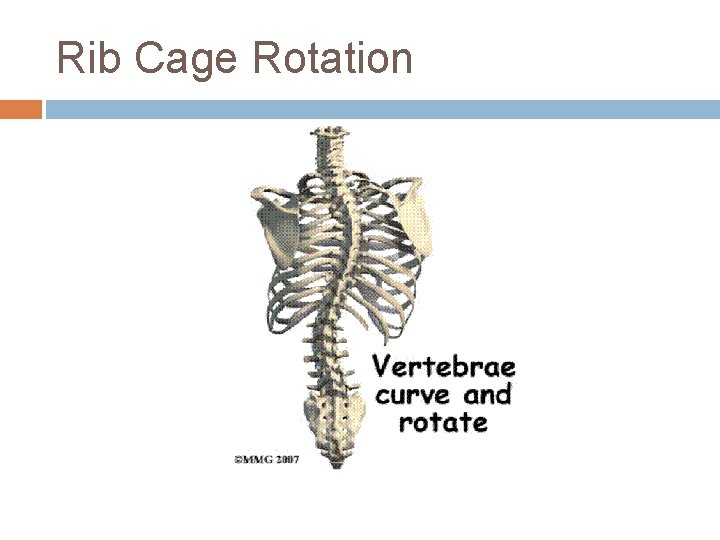
Rib Cage Rotation
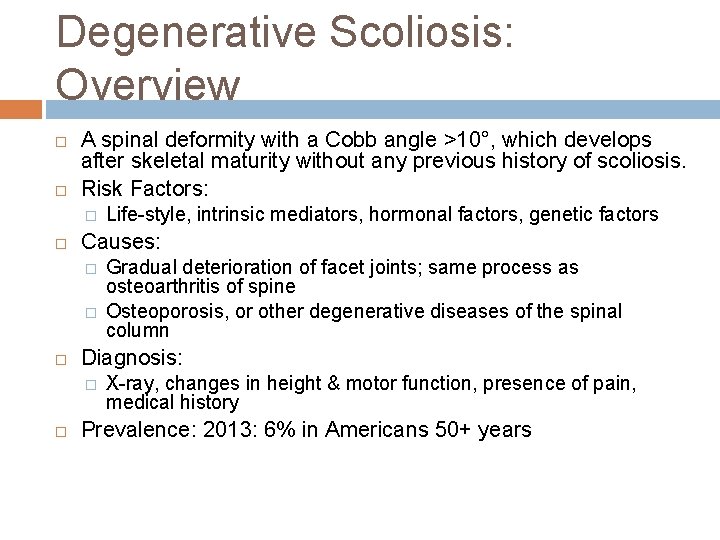
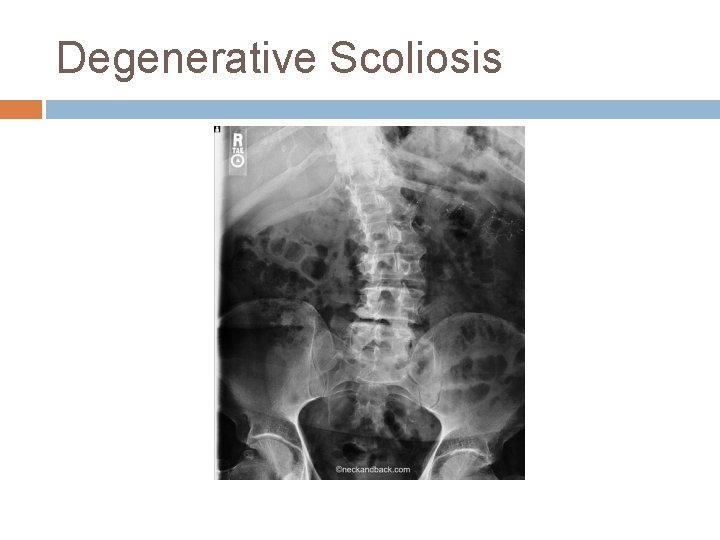
Degenerative Scoliosis: Overview A spinal deformity with a Cobb angle >10°, which develops after skeletal maturity without any previous history of scoliosis. Risk Factors: � Causes: � � Gradual deterioration of facet joints; same process as osteoarthritis of spine Osteoporosis, or other degenerative diseases of the spinal column Diagnosis: � Life-style, intrinsic mediators, hormonal factors, genetic factors X-ray, changes in height & motor function, presence of pain, medical history Prevalence: 2013: 6% in Americans 50+ years
Degenerative Scoliosis
Primary Research Article Title: Active self-correction and task- oriented exercises reduce spinal deformity and improve quality of life in subjects with mild adolescent idiopathic scoliosis. Results of a randomized controlled trial. Purpose: to see how active self-correction and task-oriented exercises affects spinal deformities and health-related quality of life
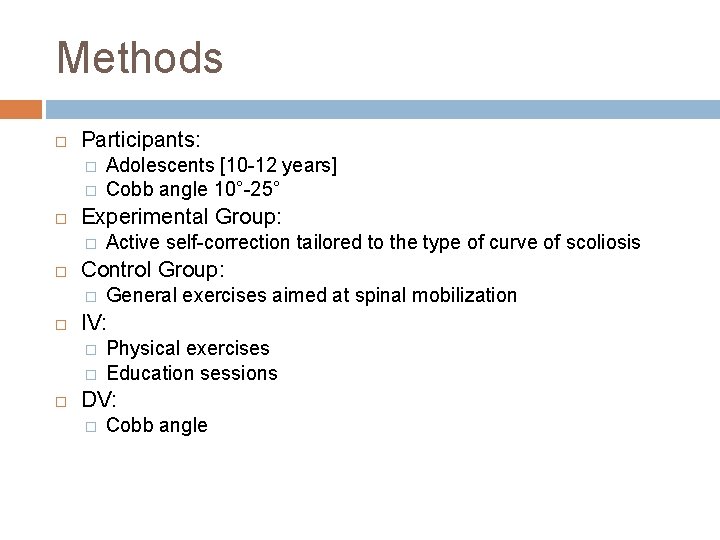
Methods Participants: � � Experimental Group: � General exercises aimed at spinal mobilization IV: � � Active self-correction tailored to the type of curve of scoliosis Control Group: � Adolescents [10 -12 years] Cobb angle 10°-25° Physical exercises Education sessions DV: � Cobb angle
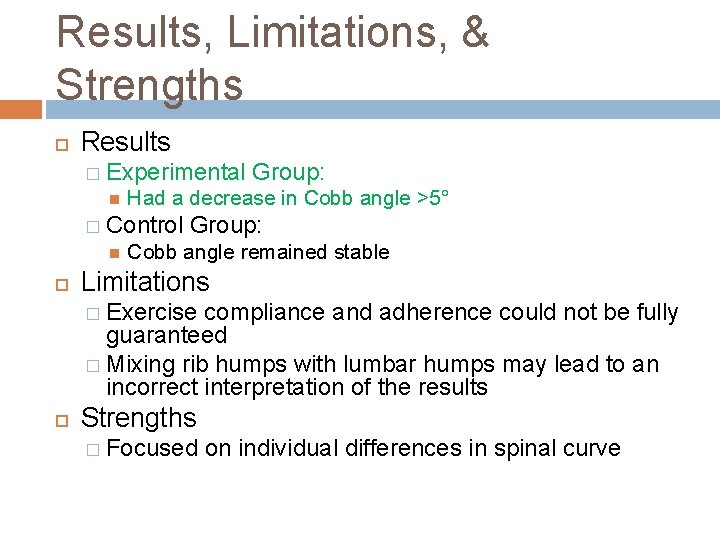
Results, Limitations, & Strengths Results � Experimental Had a decrease in Cobb angle >5° � Control Group: Cobb angle remained stable Limitations � Exercise compliance and adherence could not be fully guaranteed � Mixing rib humps with lumbar humps may lead to an incorrect interpretation of the results Strengths � Focused on individual differences in spinal curve
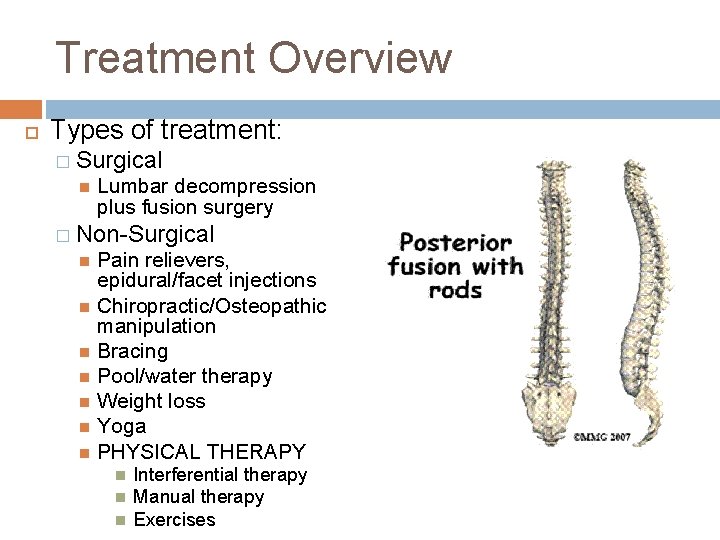
Treatment Overview Types of treatment: � Surgical Lumbar decompression plus fusion surgery � Non-Surgical Pain relievers, epidural/facet injections Chiropractic/Osteopathic manipulation Bracing Pool/water therapy Weight loss Yoga PHYSICAL THERAPY Interferential therapy Manual therapy Exercises
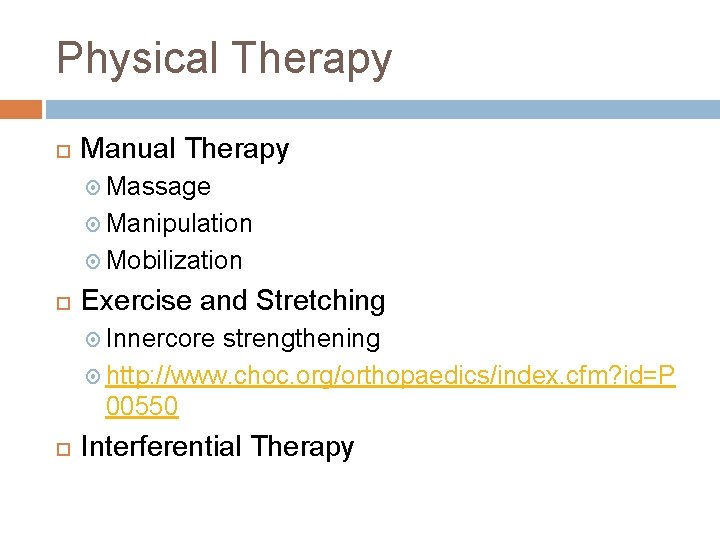
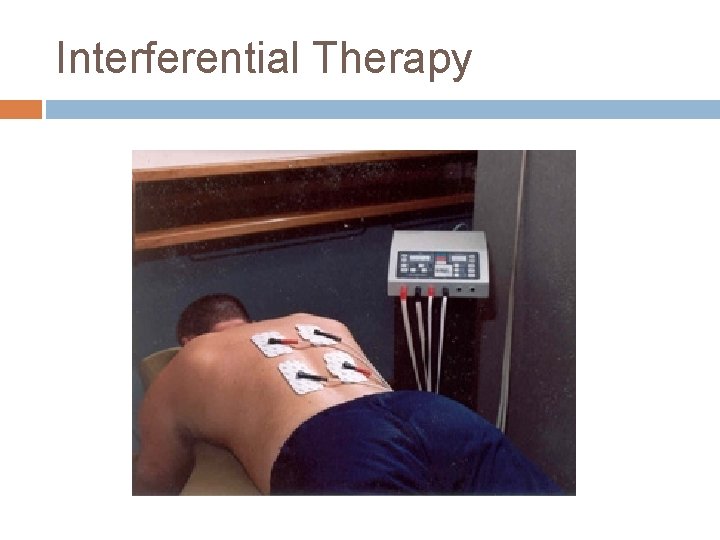
Physical Therapy Manual Therapy Massage Manipulation Mobilization Exercise and Stretching Innercore strengthening http: //www. choc. org/orthopaedics/index. cfm? id=P 00550 Interferential Therapy
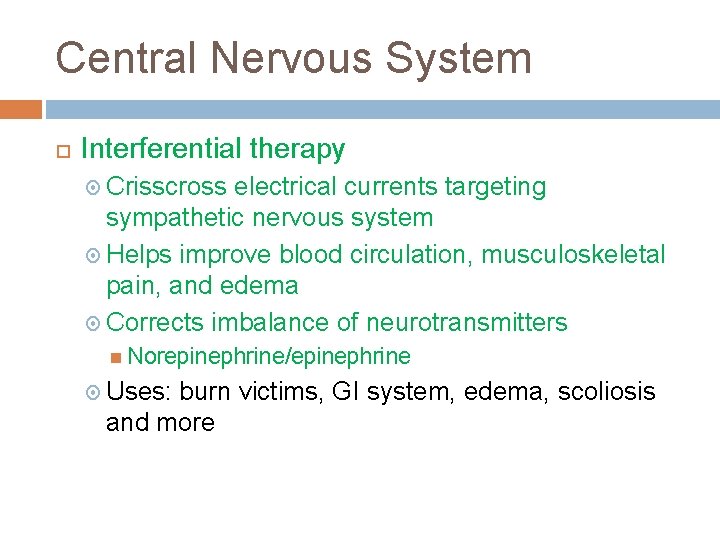
Central Nervous System Interferential therapy Crisscross electrical currents targeting sympathetic nervous system Helps improve blood circulation, musculoskeletal pain, and edema Corrects imbalance of neurotransmitters Norepinephrine/epinephrine Uses: burn victims, GI system, edema, scoliosis and more
Interferential Therapy
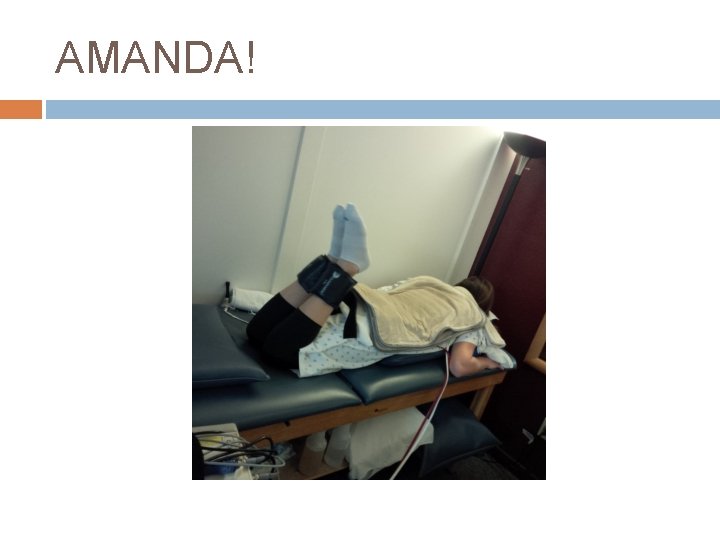
AMANDA!
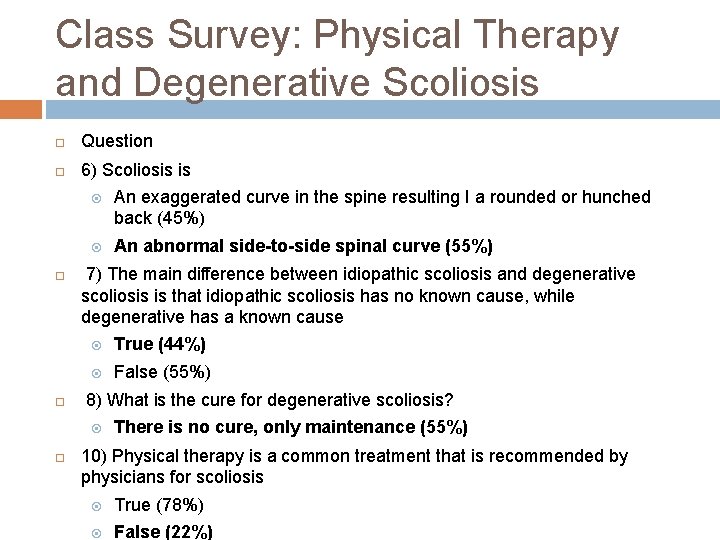
Class Survey: Physical Therapy and Degenerative Scoliosis Question 6) Scoliosis is An exaggerated curve in the spine resulting I a rounded or hunched back (45%) An abnormal side-to-side spinal curve (55%) 7) The main difference between idiopathic scoliosis and degenerative scoliosis is that idiopathic scoliosis has no known cause, while degenerative has a known cause True (44%) False (55%) 8) What is the cure for degenerative scoliosis? There is no cure, only maintenance (55%) 10) Physical therapy is a common treatment that is recommended by physicians for scoliosis True (78%) False (22%)
Conclusion Highly recommended! Additional Research Needed: Nutrition + Scoliosis Degenerative + Physical Therapy
Learn By Doing If it looks good, try it Learn By Being Is the ability to take the knowledge you learn and turn it into wisdom
References 1. Active self-correction and task-oriented exercises reduce spinal deformity and improve quality of life in subjects with mild adolescent idiopathic scoliosis. Results of a randomised controlled trial. (n. d. ). Retrieved May 17, 2014, from file: ///C: /Users/Amanda/Downloads/exercises reduce deformity (1). pdf 2. Treatment of pain and of the nervous system. (1999, November 30). Retrieved from http: //www. google. com/patents/US 5995873 3. Association between regulating synaptic membrane exocytosis 2 gene polymorphisms and degenerative lumbar scoliosis. (n. d. ). Retrieved May 17, 2014, from file: ///C: /Users/Amanda/Downloads/Article 3. pdf 4. Electrical Stimulation for the Treatment of Pain and Muscle Rehabilitation. (n. d. ). Retrieved May 17, 2014, from https: //www. unitedhealthcareonline. com/ccmcontent/Provider. II/UHC/en. US/Assets/Provider. Static. Files. Pdf/Tools and Resources/Policies and Protocols/Medical Policies/Electrical_Stim_Tx_Pain_Muscle_Rehab. pdf