
Degassing thermal treatment M Taborelli S Calatroni C
Degassing thermal treatment M. Taborelli, S. Calatroni, C. Pasquino TE-VSC Master thesis work of C. Pasquino Vacuum, Surfaces & Coatings Group Technology Department 29 September 2020 M. Taborelli 1
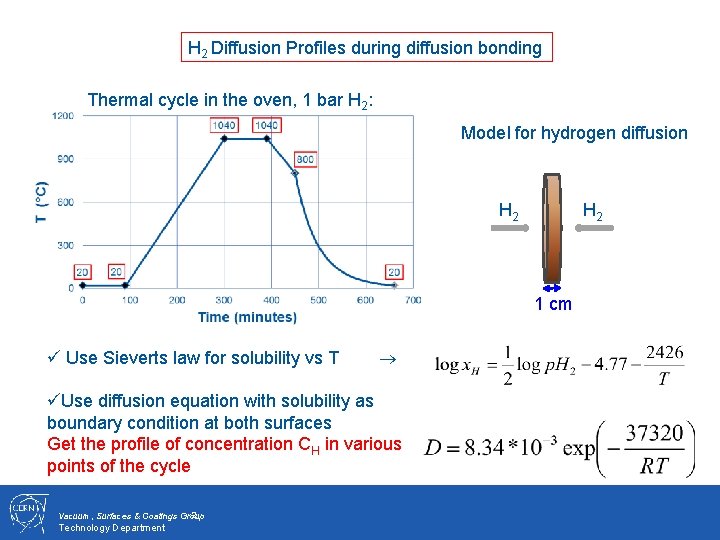
H 2 Diffusion Profiles during diffusion bonding Thermal cycle in the oven, 1 bar H 2: Model for hydrogen diffusion H 2 1 cm ü Use Sieverts law for solubility vs T üUse diffusion equation with solubility as boundary condition at both surfaces Get the profile of concentration CH in various points of the cycle 2 Vacuum, Surfaces & Coatings Group Technology Department
![H 2 Diffusion profiles during bonding thermal cycle C[w%] H profile at 1313 K,](http://slidetodoc.com/presentation_image/a3adc63b0ef22f5ee598751c8e6e0a93/image-3.jpg "H 2 Diffusion profiles during bonding thermal cycle C[w%] H profile at 1313 K,")
H 2 Diffusion profiles during bonding thermal cycle C[w%] H profile at 1313 K, 1 bar, 1 h 30 C[w%] X [cm] The profile is flat! (1. 19 e-4 with a deviation of 1 e-12) Perfect equilibrium with the external pressure Cooling to 800 C in 1 h. The profile is still flat! (1. 17 e-4 with a deviation of 4 e-8) Again perfect equilibrium with the external pressure X [cm] 3 Vacuum, Surfaces & Coatings Group Technology Department
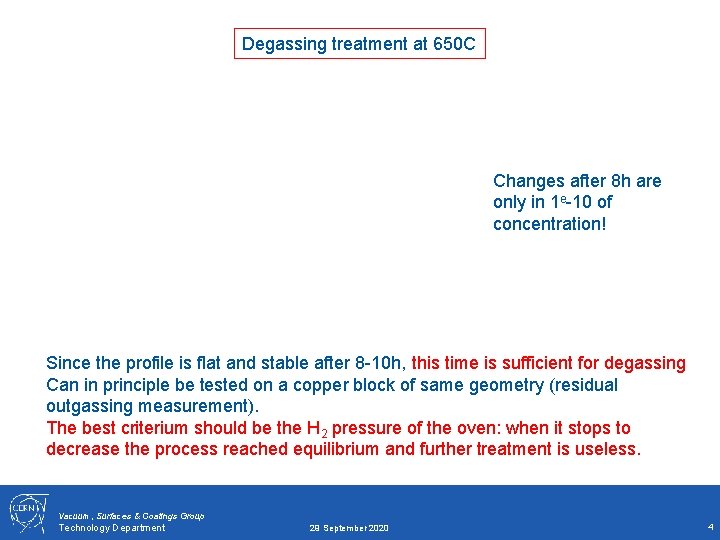
Degassing treatment at 650 C Changes after 8 h are only in 1 e-10 of concentration! Since the profile is flat and stable after 8 -10 h, this time is sufficient for degassing Can in principle be tested on a copper block of same geometry (residual outgassing measurement). The best criterium should be the H 2 pressure of the oven: when it stops to decrease the process reached equilibrium and further treatment is useless. Vacuum, Surfaces & Coatings Group Technology Department 29 September 2020 4
- Slides: 4