
DEFLECTING CAVITY OPTIONS FOR RF BEAM SPREADER IN
DEFLECTING CAVITY OPTIONS FOR RF BEAM SPREADER IN LCLS II Suba De Silva Jean Delayen, Rocio Olave, Todd Satogata, Geoff Krafft Center for Accelerator Science Department of Physics, Old Dominion University December 4 th, 2013 Page 1
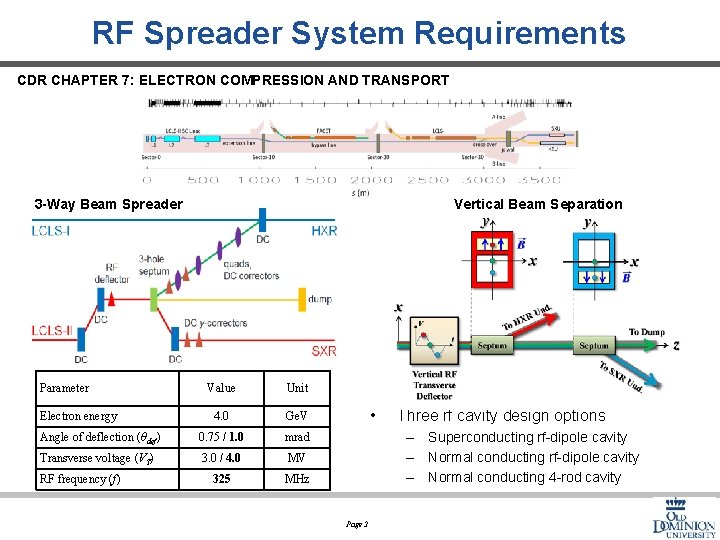
RF Spreader System Requirements CDR CHAPTER 7: ELECTRON COMPRESSION AND TRANSPORT 3 -Way Beam Spreader Parameter Vertical Beam Separation Value Unit 4. 0 Ge. V Angle of deflection (θdef) 0. 75 / 1. 0 mrad Transverse voltage (VT) 3. 0 / 4. 0 MV 325 MHz Electron energy RF frequency (f) • Three rf cavity design options – Superconducting rf-dipole cavity – Normal conducting 4 -rod cavity Page 2
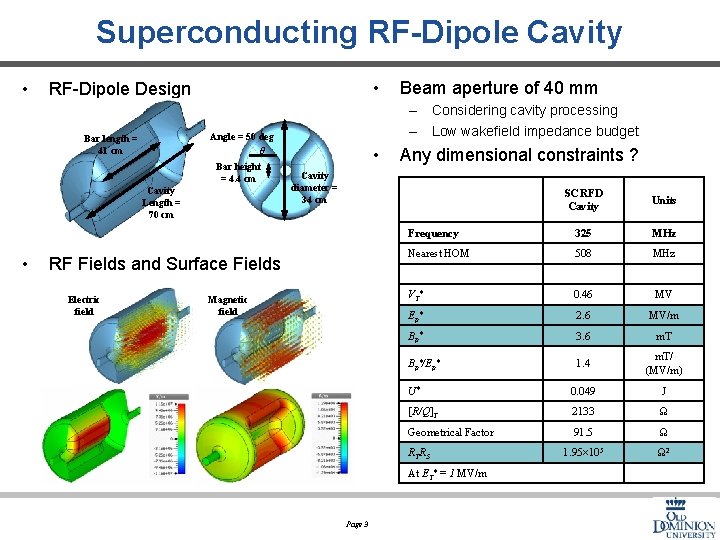
Superconducting RF-Dipole Cavity • • RF-Dipole Design Bar height = 4. 4 cm Cavity Length = 70 cm • – Considering cavity processing – Low wakefield impedance budget Angle = 50 deg θ Bar length = 41 cm • Any dimensional constraints ? Cavity diameter = 34 cm RF Fields and Surface Fields Electric field Beam aperture of 40 mm Magnetic field SC RFD Cavity Units Frequency 325 MHz Nearest HOM 508 MHz VT* 0. 46 MV Ep* 2. 6 MV/m Bp* 3. 6 m. T Bp*/Ep* 1. 4 m. T/ (MV/m) U* 0. 049 J [R/Q]T 2133 Ω Geometrical Factor 91. 5 Ω 1. 95× 105 Ω 2 RTRS At ET* = 1 MV/m Page 3
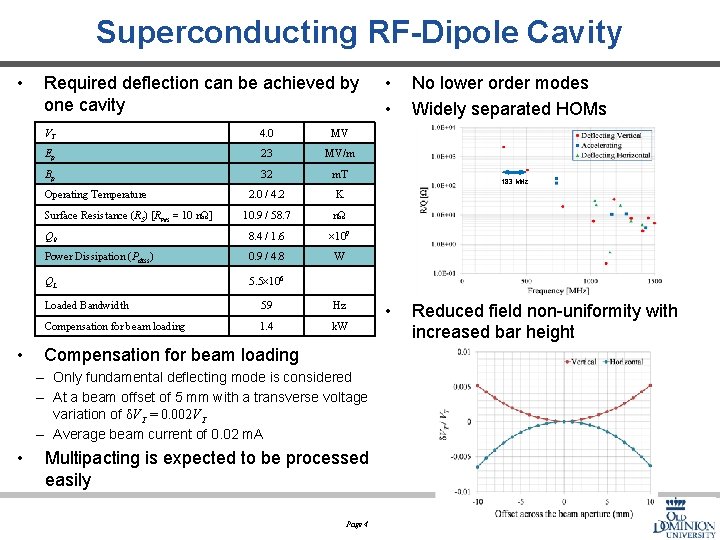
Superconducting RF-Dipole Cavity • Required deflection can be achieved by one cavity VT 4. 0 MV Ep 23 MV/m Bp 32 m. T 2. 0 / 4. 2 K 10. 9 / 58. 7 nΩ Q 0 8. 4 / 1. 6 × 10⁹ Power Dissipation (Pdiss) 0. 9 / 4. 8 W QL 5. 5× 10⁶ Operating Temperature Surface Resistance (RS) [Rres = 10 nΩ] • Loaded Bandwidth 59 Hz Compensation for beam loading 1. 4 k. W Compensation for beam loading – Only fundamental deflecting mode is considered – At a beam offset of 5 mm with a transverse voltage variation of δVT = 0. 002 VT – Average beam current of 0. 02 m. A • Multipacting is expected to be processed easily Page 4 • • No lower order modes Widely separated HOMs 183 MHz • Reduced field non-uniformity with increased bar height
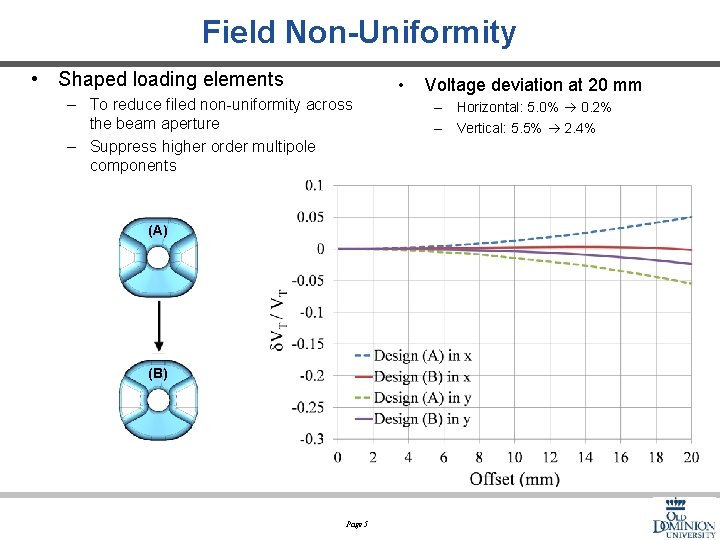
Field Non-Uniformity • Shaped loading elements – To reduce filed non-uniformity across the beam aperture – Suppress higher order multipole components (A) (B) Page 5 • Voltage deviation at 20 mm – Horizontal: 5. 0% 0. 2% – Vertical: 5. 5% 2. 4%
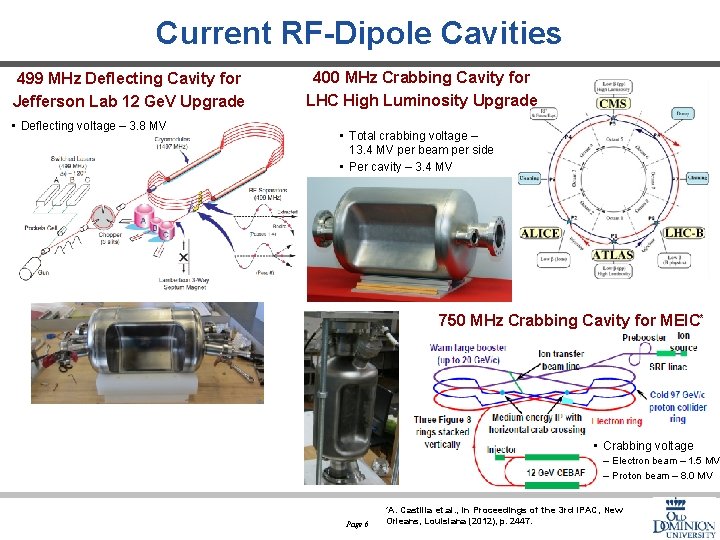
Current RF-Dipole Cavities 499 MHz Deflecting Cavity for Jefferson Lab 12 Ge. V Upgrade • Deflecting voltage – 3. 8 MV 400 MHz Crabbing Cavity for LHC High Luminosity Upgrade • Total crabbing voltage – 13. 4 MV per beam per side • Per cavity – 3. 4 MV 750 MHz Crabbing Cavity for MEIC* • Crabbing voltage – Electron beam – 1. 5 MV – Proton beam – 8. 0 MV *A. Page 6 Castilla et. al. , in Proceedings of the 3 rd IPAC, New Orleans, Louisiana (2012), p. 2447.
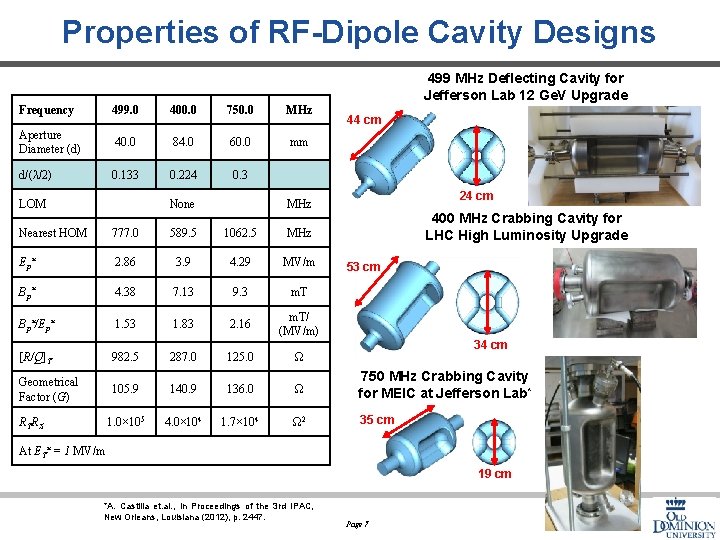
Properties of RF-Dipole Cavity Designs 499 MHz Deflecting Cavity for Jefferson Lab 12 Ge. V Upgrade Frequency 499. 0 400. 0 750. 0 MHz Aperture Diameter (d) 40. 0 84. 0 60. 0 mm d/(λ/2) 0. 133 0. 224 0. 3 LOM None 44 cm 24 cm MHz 400 MHz Crabbing Cavity for LHC High Luminosity Upgrade Nearest HOM 777. 0 589. 5 1062. 5 MHz E p* 2. 86 3. 9 4. 29 MV/m B p* 4. 38 7. 13 9. 3 m. T Bp*/Ep* 1. 53 1. 83 2. 16 m. T/ (MV/m) [R/Q]T 982. 5 287. 0 125. 0 Ω Geometrical Factor (G) 105. 9 140. 9 136. 0 Ω 750 MHz Crabbing Cavity for MEIC at Jefferson Lab* 1. 0× 105 4. 0× 104 1. 7× 10⁴ Ω 2 35 cm RTRS 53 cm 34 cm At ET* = 1 MV/m 19 cm *A. Castilla et. al. , in Proceedings of the 3 rd IPAC, New Orleans, Louisiana (2012), p. 2447. Page 7
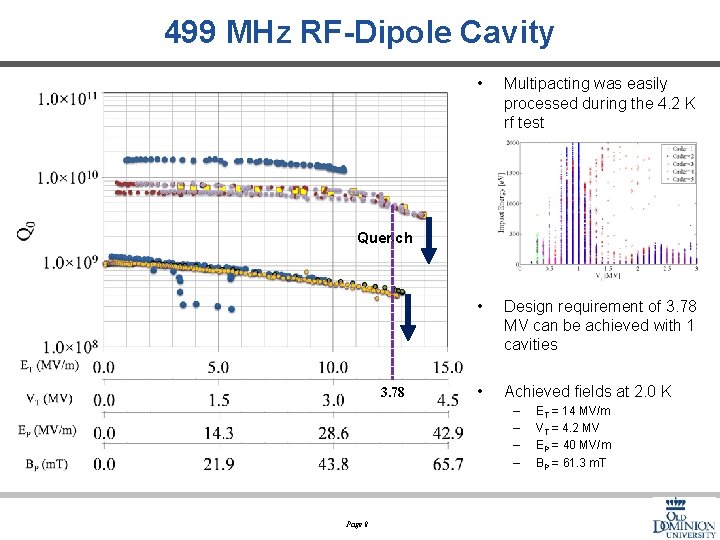
499 MHz RF-Dipole Cavity • Multipacting was easily processed during the 4. 2 K rf test • Design requirement of 3. 78 MV can be achieved with 1 cavities • Achieved fields at 2. 0 K Quench 3. 78 – – Page 8 ET = 14 MV/m VT = 4. 2 MV EP = 40 MV/m BP = 61. 3 m. T
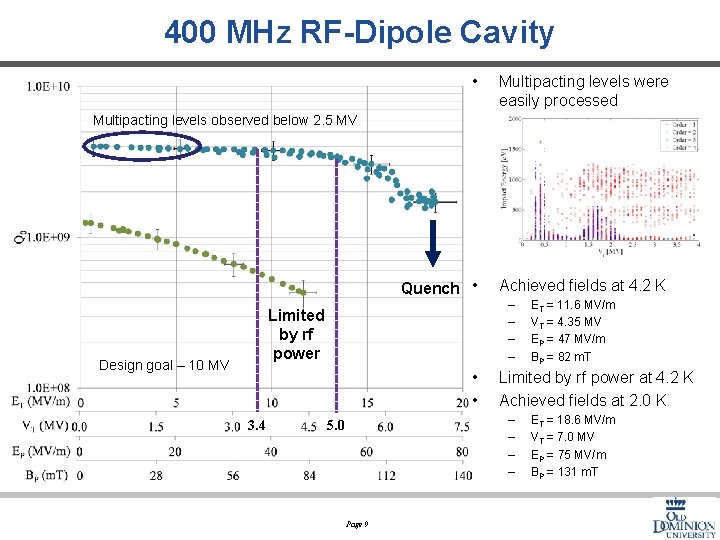
400 MHz RF-Dipole Cavity • Multipacting levels were easily processed Quench • Achieved fields at 4. 2 K Multipacting levels observed below 2. 5 MV – – Limited by rf power Design goal – 10 MV • • 3. 4 Limited by rf power at 4. 2 K Achieved fields at 2. 0 K – – 5. 0 Page 9 ET = 11. 6 MV/m VT = 4. 35 MV EP = 47 MV/m BP = 82 m. T ET = 18. 6 MV/m VT = 7. 0 MV EP = 75 MV/m BP = 131 m. T
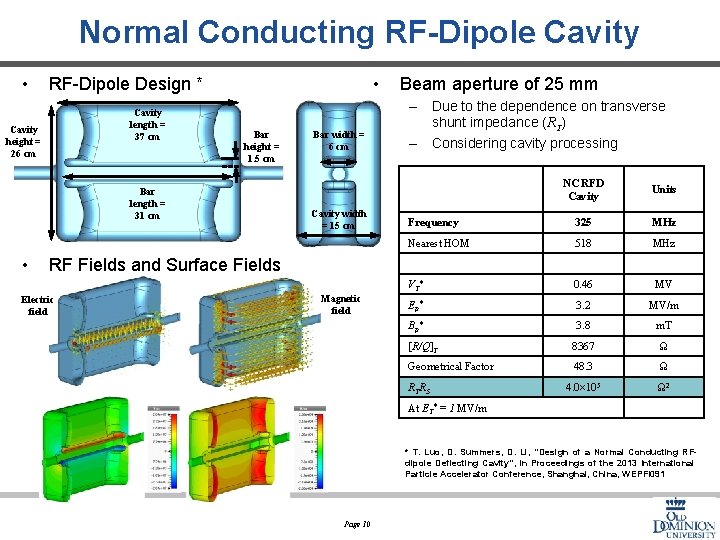
Normal Conducting RF-Dipole Cavity • • RF-Dipole Design * Cavity length = 37 cm Cavity height = 26 cm Bar height = 1. 5 cm Bar length = 31 cm • Bar width = 6 cm Cavity width = 15 cm Beam aperture of 25 mm – Due to the dependence on transverse shunt impedance (RT) – Considering cavity processing NC RFD Cavity Units Frequency 325 MHz Nearest HOM 518 MHz VT* 0. 46 MV Ep* 3. 2 MV/m Bp* 3. 8 m. T [R/Q]T 8367 Ω Geometrical Factor 48. 3 Ω 4. 0× 105 Ω 2 RF Fields and Surface Fields Electric field Magnetic field RTRS At ET* = 1 MV/m * T. Luo, D. Summers, D. Li, “Design of a Normal Conducting RFdipole Deflecting Cavity”, in Proceedings of the 2013 International Particle Accelerator Conference, Shanghai, China, WEPFI 091 Page 10
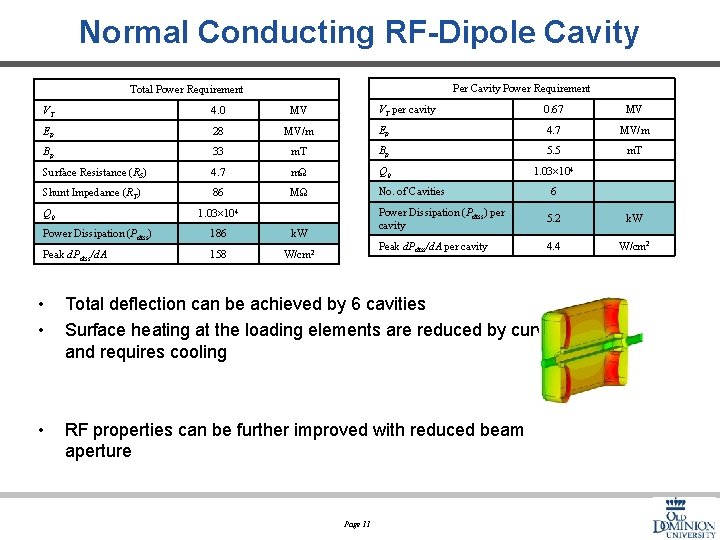
Normal Conducting RF-Dipole Cavity Per Cavity Power Requirement Total Power Requirement VT per cavity 0. 67 MV MV/m Ep 4. 7 MV/m 33 m. T Bp 5. 5 m. T Surface Resistance (RS) 4. 7 mΩ Q 0 1. 03× 104 Shunt Impedance (RT) 86 MΩ No. of Cavities VT 4. 0 MV Ep 28 Bp Q 0 1. 03× 104 Power Dissipation (Pdiss) 186 k. W Peak d. Pdiss/d. A 158 W/cm 2 6 Power Dissipation (Pdiss) per cavity 5. 2 k. W Peak d. Pdiss/d. A per cavity 4. 4 W/cm 2 • • Total deflection can be achieved by 6 cavities Surface heating at the loading elements are reduced by curving and requires cooling • RF properties can be further improved with reduced beam aperture Page 11
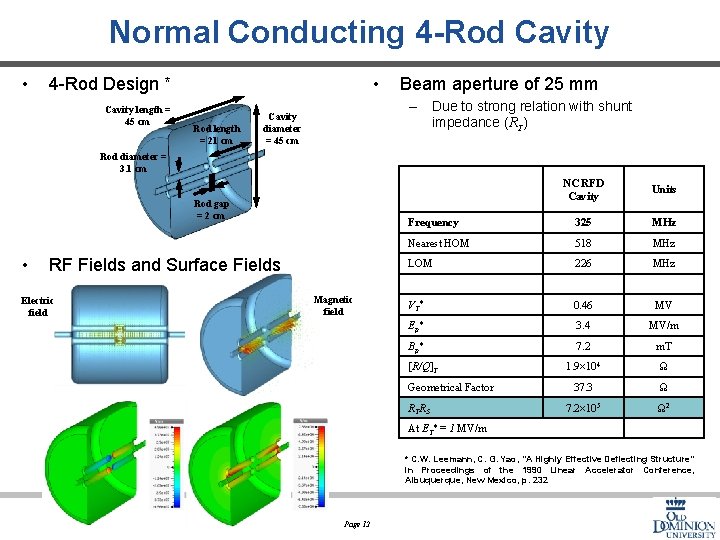
Normal Conducting 4 -Rod Cavity • • 4 -Rod Design * Cavity length = 45 cm Rod length = 21 cm Beam aperture of 25 mm – Due to strong relation with shunt impedance (RT) Cavity diameter = 45 cm Rod diameter = 3. 1 cm Rod gap = 2 cm • RF Fields and Surface Fields Electric field Magnetic field NC RFD Cavity Units Frequency 325 MHz Nearest HOM 518 MHz LOM 226 MHz VT* 0. 46 MV Ep* 3. 4 MV/m Bp* 7. 2 m. T 1. 9× 10⁴ Ω 37. 3 Ω 7. 2× 10⁵ Ω 2 [R/Q]T Geometrical Factor RTRS At ET* = 1 MV/m * C. W. Leemann, C. G. Yao, “A Highly Effective Deflecting Structure” in Proceedings of the 1990 Linear Accelerator Conference, Albuquerque, New Mexico, p. 232 Page 12
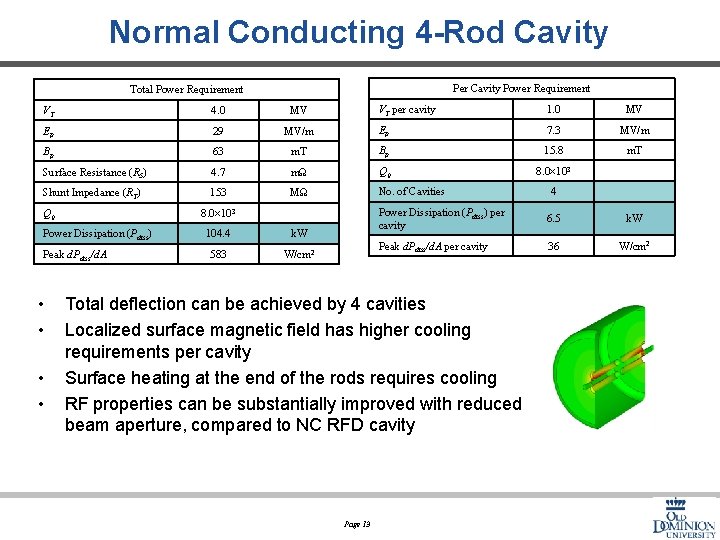
Normal Conducting 4 -Rod Cavity Per Cavity Power Requirement Total Power Requirement VT per cavity 1. 0 MV MV/m Ep 7. 3 MV/m 63 m. T Bp 15. 8 m. T Surface Resistance (RS) 4. 7 mΩ Q 0 8. 0× 103 Shunt Impedance (RT) 153 MΩ No. of Cavities VT 4. 0 MV Ep 29 Bp Q 0 8. 0× 103 Power Dissipation (Pdiss) Peak d. Pdiss/d. A • • 104. 4 k. W 583 W/cm 2 Power Dissipation (Pdiss) per cavity 6. 5 k. W Peak d. Pdiss/d. A per cavity 36 W/cm 2 Total deflection can be achieved by 4 cavities Localized surface magnetic field has higher cooling requirements per cavity Surface heating at the end of the rods requires cooling RF properties can be substantially improved with reduced beam aperture, compared to NC RFD cavity Page 13 4
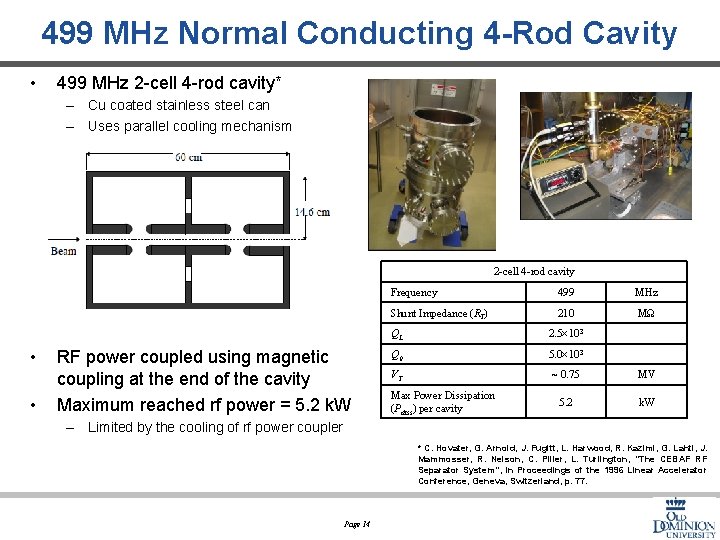
499 MHz Normal Conducting 4 -Rod Cavity • 499 MHz 2 -cell 4 -rod cavity* – Cu coated stainless steel can – Uses parallel cooling mechanism 2 -cell 4 -rod cavity • • RF power coupled using magnetic coupling at the end of the cavity Maximum reached rf power = 5. 2 k. W Frequency 499 MHz Shunt Impedance (RT) 210 MΩ QL 2. 5× 10³ Q 0 5. 0× 103 VT ~ 0. 75 MV 5. 2 k. W Max Power Dissipation (Pdiss) per cavity – Limited by the cooling of rf power coupler * C. Hovater, G. Arnold, J. Fugitt, L. Harwood, R. Kazimi, G. Lahti, J. Mammosser, R. Nelson, C. Piller, L. Turlington, “The CEBAF RF Separator System”, in Proceedings of the 1996 Linear Accelerator Conference, Geneva, Switzerland, p. 77. Page 14
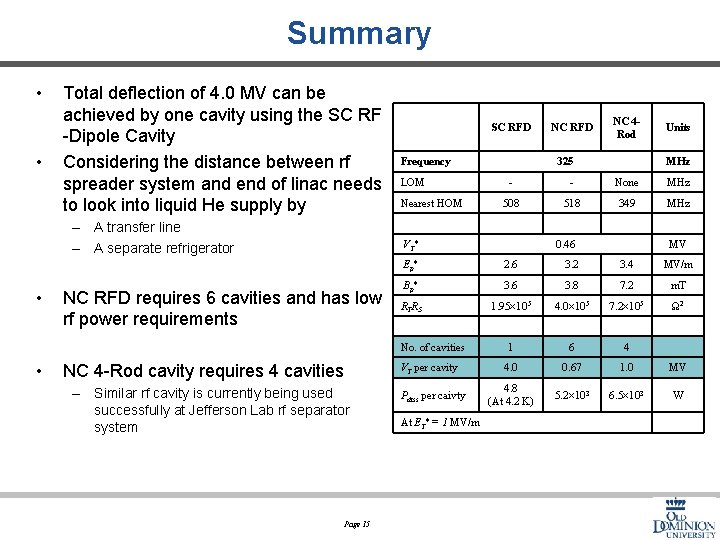
Summary • • Total deflection of 4. 0 MV can be achieved by one cavity using the SC RF -Dipole Cavity Considering the distance between rf spreader system and end of linac needs to look into liquid He supply by – A transfer line – A separate refrigerator • SC RFD Frequency LOM Nearest HOM NC 4 -Rod cavity requires 4 cavities Page 15 MHz - - None MHz 508 518 349 MHz 0. 46 MV 2. 6 3. 2 3. 4 MV/m Bp* 3. 6 3. 8 7. 2 m. T RTRS 1. 95× 105 4. 0× 105 7. 2× 10⁵ Ω 2 1 6 4 4. 0 0. 67 1. 0 MV 4. 8 (At 4. 2 K) 5. 2× 10³ 6. 5× 10³ W VT per cavity – Similar rf cavity is currently being used successfully at Jefferson Lab rf separator system Units Ep* No. of cavities • NC 4 Rod 325 VT* NC RFD requires 6 cavities and has low rf power requirements NC RFD Pdiss per caivty At ET* = 1 MV/m
- Slides: 15