
Definitive VAT system for intraUnion trade of goods

- Slides: 19
Definitive VAT system for intra-Union trade of goods COM(2018)329 of 25 May 2018 European Commission TAXUD 11 September 2018
Why is time for a definitive VAT system? Ø The current system for B 2 B trade in force since 1993 is transitional in nature (Article 402 of the VAT Directive) Ø It is fragmented, complex, burdensome for businesses and hampers intra-Union trade Ø VAT fraud responsible for EUR 50 billion revenue loss a year in the EU; EUR 160 billion the size of the VAT GAP Ø The creation of a simple, modern and fraud-proof VAT system is a fiscal priority (Annual Growth Survey 2017)
technical and political choices Ø 2011 Communication on the Future of VAT: change from taxation at origin to taxation at destination Ø Taxation in the MS of origin politically unachievable conclusions, May 2012) Ø 2016 VAT Action Plan "Time to decide": the best option is charging VAT on cross-border supplies of goods and services Ø The Council and the European Parliament endorsed a definitive system based on taxation at destination (Ecofin conclusions May 2016; November 2016) Ø 2017 Communication "Time to act" sets out the legislative approach (Ecofin
Two-step approach 1° legislative step: q October 2017 proposal: notion of CTP + cornerstones of the definitive system for intra-Union B 2 B trade of goods (Article 402 of the VAT Directive) q May 2018 proposal: detailed technical provisions for the operation of the definitive system (envisaged entry into force 1 July 2022) 2° legislative step : q Definitive system extended to services (after implementation and monitoring of 1° step)
Benefits Ø Cross-border VAT fraud reduced by 83% with saving of EUR 41 billion a year (4, 5% of the EU VAT revenue) Ø VAT Compliance costs reduction for businesses of EUR 1 billion Ø Less derogations, more uniformity: intra-EU supplies and domestic supplies treated the same way
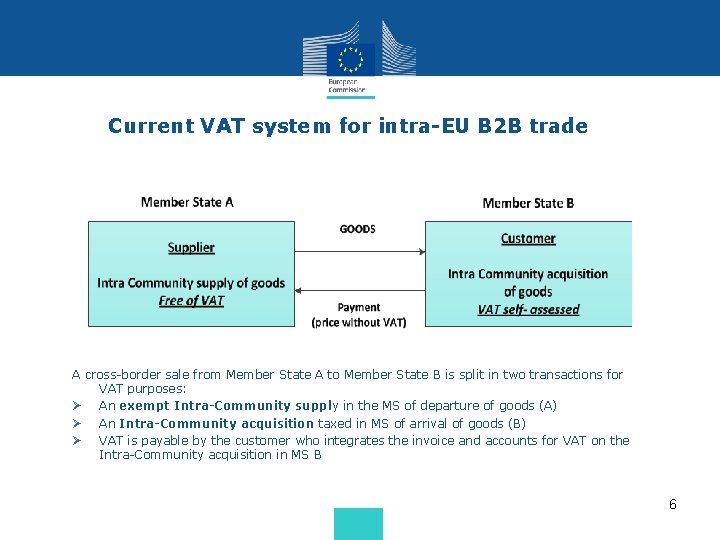
Current VAT system for intra-EU B 2 B trade A cross-border sale from Member State A to Member State B is split in two transactions for VAT purposes: Ø An exempt Intra-Community supply in the MS of departure of goods (A) Ø An Intra-Community acquisition taxed in MS of arrival of goods (B) Ø VAT is payable by the customer who integrates the invoice and accounts for VAT on the Intra-Community acquisition in MS B 6
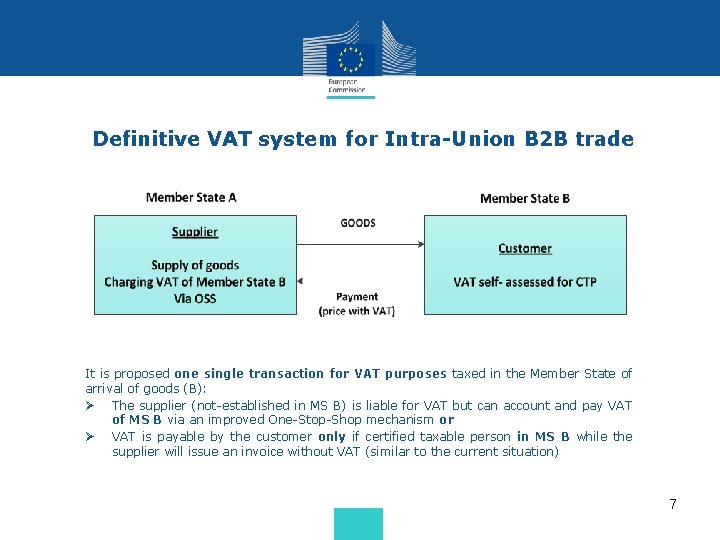
Definitive VAT system for Intra-Union B 2 B trade It is proposed one single transaction for VAT purposes taxed in the Member State of arrival of goods (B): Ø The supplier (not-established in MS B) is liable for VAT but can account and pay VAT of MS B via an improved One-Stop-Shop mechanism or Ø VAT is payable by the customer only if certified taxable person in MS B while the supplier will issue an invoice without VAT (similar to the current situation) 7
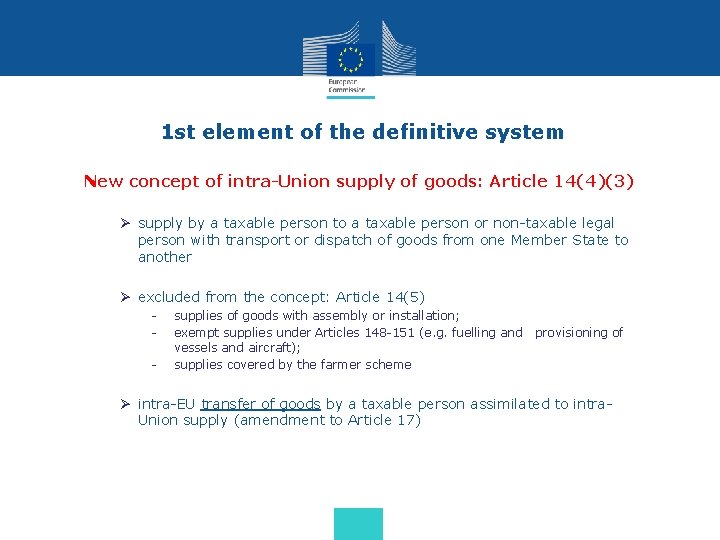
1 st element of the definitive system New concept of intra-Union supply of goods: Article 14(4)(3) Ø supply by a taxable person to a taxable person or non-taxable legal person with transport or dispatch of goods from one Member State to another Ø excluded from the concept: Article 14(5) - supplies of goods with assembly or installation; exempt supplies under Articles 148 -151 (e. g. fuelling and vessels and aircraft); supplies covered by the farmer scheme provisioning of Ø intra-EU transfer of goods by a taxable person assimilated to intra. Union supply (amendment to Article 17)
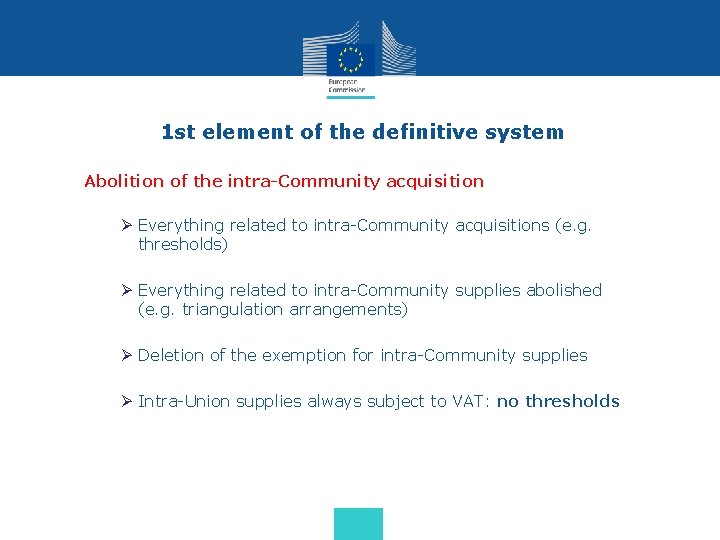
1 st element of the definitive system Abolition of the intra-Community acquisition Ø Everything related to intra-Community acquisitions (e. g. thresholds) Ø Everything related to intra-Community supplies abolished (e. g. triangulation arrangements) Ø Deletion of the exemption for intra-Community supplies Ø Intra-Union supplies always subject to VAT: no thresholds
2 st element of the definitive system New place of supply rule: Article 35 a Ø Intra-Union supplies are taxed where the transport ends (taxation at destination) Ø Except supplies made under the margin scheme which will be taxed where the transport begins under Article 32 (Art. 35 c) Ø New means of transport remain taxable in the MS of arrival also when the customer is a non-taxable person (Art. 35 b) Ø other rules on the place of supply of goods remain unchanged (e. g. supply with and without transport; supply with assembly or installation; gas and electricity)
3 rd element of the definitive system Single chargeability rule for intra-Union supplies: Article 67 Ø VAT is chargeable on the issue of the invoice or on the expiry of the fifteenth day of the month following that in which the taxable event occurs Ø Same rule applies to the supply of new means of transport when customer is a non-taxable person
Who pays VAT? VAT on Intra-Union supplies will be payable Ø by the supplier, as for any taxable supply of goods and services under the general rule of Article 193 of the VAT Directive or Ø by the acquirer only if "certified taxable person" (CTP) and when the supplier is not established in the MS of taxation under the new Article 194 a
CTP in the definitive VAT system v for making the EU VAT system more fraud proof, only reliable traders will account for VAT as recipient of intra-Union supplies of goods (reverse charge) v Notion defined in the 2017 proposal (new Article 13 a): criteria, exclusions and procedure harmonised at EU level v Certification granted by the tax authority of the MS where the applicant is established and recognised in all MSs v CTP status will be verified on-line through the VAT information electronic exchange system (VIES)
Other reverse charge provisions In the definitive system the reverse charge will remain applicable as "anti-fraud" measure only for services § Art. 200 - New means of transport where the supplier is a taxable person (cross-border supply) status quo maintained § Art. 199 – optional and permanent RC for goods and services not touched by the proposal § Art. 199 a – optional and temporary RC for goods and services until December 2028 but limited to services from July 2022 § Art. 199 b - Quick reaction mechanism to combat fraud limited to services
New One-Stop-Shop (OSS) scheme § to build on the current MOSS for EU traders in place from 2015 for TBE services which will be extended to all B 2 C supplies of good and services from 2021 (E-commerce package, December 2017) § available from July 2022 for traders established in the EU or with an appointed representative established in the EU § to pay, declare and deduct VAT on B 2 B supplies of goods and services when the supplier is liable to pay VAT but is not established in the MS of taxation § It will also cover purchases of goods by certified traders (liable for VAT) who are not-established in the MS of taxation § Submission of quarterly OSS VAT return or monthly if the Union annual turnover is above EUR 2, 5 billion
VAT obligations for intra-Union supplies ü One single VAT registration within the EU (in principle) ü Mandatory invoicing for intra-Union supplies (according to rules of the Supplier's MS) ü Recapitulative statements maintained only for services (reporting obligation removed for goods) ü Two VAT returns (in principle): 1. Current VAT return for domestic supplies 2. OSS VAT return for intra-Union supplies if the person liable for VAT is not established in the MS of taxation
Data in the OSS VAT return § VAT number in the MS of identification for OSS scheme (the same allocated in the internal system) § § For each MS of taxation in which VAT is chargeable o Total value of goods and services supplied exclusive of VAT o The total amount per rate of the chargeable VAT o The total amount of chargeable VAT on supplies of goods and services o The amount of VAT for which deduction is made o Amendments related to previous tax periods o Net amount of VAT to be paid or credited For each MS other than MS of identification o The total value of supplies of goods for each MS where the goods are transported from + VAT number o The total value of supplies of services for each MS where there is an establishment from which the services are supplied + VAT number
VAT deduction in the OSS scheme q Traders will pay the net amounts of VAT due in each Member State of taxation to a designated banking account (Art. 369 i) q In case of several establishments in the Union, the deductible proportion of VAT is determined by each MS of establishment for all the transactions carried out from that establishment (Art. 369 ag) q The input VAT can be claimed back via the refund procedure for "nonestablished traders" in the MS concerned, if there are not supplies covered by the OSS scheme for which VAT is chargeable in that MS (Art. 369 j) q VAT credit in a given tax period is carried forward to the following period or can be refunded by the MS concerned (Art. 369 ia)
What else does not change? ü almost everything related to importation of goods ü almost everything related to supply of services ü exemptions on exports, exemptions related to international transport (Art. 148 -150 of the VAT Directive), exemption related to international trade (Art. 154 – 163) ü customs procedures No 42 and 63 with adaptations (e. g. the importation of goods followed by an intra-Union supply of goods will remain exempt) ü reverse charge for cross-border supplies and investment gold (Art. 196 and Art. 198)